
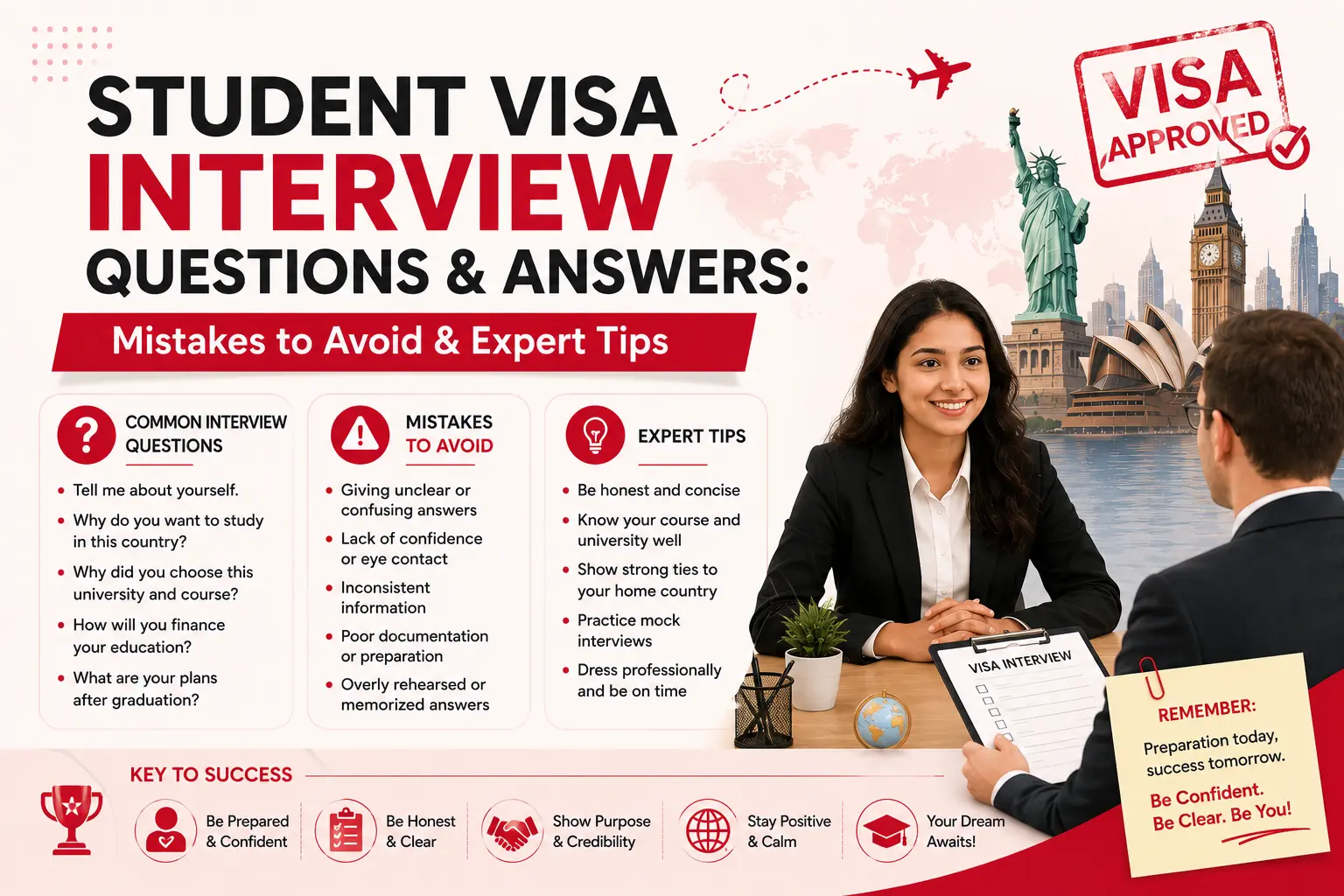
Applying for a student visa is one of the most crucial steps in your study abroad journey. While academic documents, test scores, and university offer letters play an important role, the student
interview often becomes the final deciding factor in visa approval. Many capable and deserving students face rejection not because they lack qualifications, but because they are unprepared to answer interview questions confidently and clearly. Learn: Step by Step Guide for Student Visa Process
A student visa interview is designed to assess your intentions, credibility, financial readiness, academic background, and future plans. Visa officers aim to ensure that you are a genuine student with a clear study purpose and the ability to comply with visa regulations. Understanding what interviewers look for—and how to respond effectively—can significantly improve your chances of success. This detailed guide covers commonly asked student visa interview questions, sample answers, preparation tips, common mistakes to avoid, and country-specific insights, helping you walk into your visa interview well-prepared and confident.
What is a student visa interview?
A student visa interview is a formal meeting between a visa officer and a student applying to study abroad. Its purpose is to assess whether the applicant is a genuine student with clear academic goals, sufficient financial resources, and an intention to follow the host country’s visa rules. During the interview, the officer asks questions about the student’s chosen course, university, academic background, funding sources, and plans after graduation. The interview helps authorities ensure that the student is travelling primarily for education and not for immigration purposes. A successful student visa interview depends on honest answers, clear study plans, and confidence. The interview is usually short (2–10 minutes) but highly impactful.
Why do student visa interviews matter?
Student visa interviews play a crucial role in deciding whether an applicant will be allowed to study abroad. They help visa officers evaluate the student beyond documents and test scores. Below are the key reasons why student visa interviews matter.
- To verify genuine student intent- Visa interviews help authorities confirm that the applicant’s primary purpose is education. Officers assess whether the student has a clear study plan and genuine academic motivation.
- To assess academic preparedness, through interview questions, visa officers evaluate how well the student understands their chosen course, university, and academic pathway.
- To check financial stability- The interview ensures that students have sufficient funds to cover tuition fees and living expenses without violating visa conditions.
- To evaluate plans, Visa officers look for realistic post-study plans and strong ties to the home country to reduce immigration risk.
- To ensure visa rule compliance, Interviews help confirm that students understand and are willing to follow the host country’s visa regulations throughout their stay.
What are the general tips students should follow before attending a student visa interview?
Preparing well for a student visa interview can significantly increase your chances of approval. The following tips help students present themselves confidently and professionally before the visa officer.
- Understand your course and university- Be well-informed about your chosen course, university ranking, curriculum, and why it fits your academic and career goals.
- Organize all required documents- Carry all original documents such as offer letters, financial proofs, academic certificates, and test scores in a neat and orderly manner.
- Prepare clear and honest answers- Avoid memorized responses. Practice answering common questions honestly and confidently, keeping your explanations direct.
- Dress formally and professionally- First impressions matter. Wear neat, formal attire to show seriousness and respect for the interview process.
- Be confident and calm- Stay composed, maintain eye contact, and speak clearly. Confidence reflects preparedness and genuine intent.
- Be clear about financial planning- Understand your funding sources thoroughly and be ready to explain who is sponsoring you and how expenses will be covered.
- Know your plans- Have a clear idea about your career plans after graduation, emphasizing how you intend to use your education responsibly.
- Follow visa rules and Guidelines- Understand the visa conditions, including work limits and stay duration, and show willingness to comply with them.
- Practice mock interviews- Participating in mock visa interviews helps reduce nervousness and improves your ability to answer questions naturally.
- Stay honest at all times- Never provide false information or exaggerated claims, as honesty is critical for building trust with the visa officer.
Common Student Visa Interview Questions and Sample Answers
1. Why do you want to study abroad?
What the officer checks:
Your motivation and awareness of global education.
Sample Answer:
“I want to study abroad because it offers global exposure, advanced teaching methodologies, and practical learning opportunities that are limited in my home country. Studying abroad will help me gain international perspectives, industry-relevant skills, and cultural understanding that will strengthen my career.”
2. Why did you choose this country?
What the officer checks:
Whether your choice is well-researched.
Sample Answer:
“I chose this country because it has a strong education system, globally recognized universities, and high academic standards. The country is known for its focus on research, innovation, and industry collaboration, which aligns with my academic and career goals.”
3. Why did you choose this university?
What the officer checks:
Your knowledge of the institution.
Sample Answer:
“I chose this university because of its strong academic reputation, experienced faculty, modern infrastructure, and industry-oriented curriculum. The university’s ranking, alumni success, and partnerships with companies make it an ideal place for my studies.”
4. Why did you choose this course?
What the officer checks:
Course relevance to your academic background and career plan.
Sample Answer:
“I chose this course because it aligns perfectly with my previous studies and long-term career goals. The curriculum focuses on both theoretical knowledge and practical skills, which will prepare me for real-world challenges in my field.”
5. How is this course related to your previous education?
What the officer checks:
Academic consistency.
Sample Answer:
“My previous education laid the foundation for this course. I studied core subjects that are directly related to this program, and this course will help me deepen my understanding and specialize further in the field.”
6. Why not study the same course in your home country?
What the officer checks:
Justification for studying abroad.
Sample Answer:
“Although similar courses are available in my home country, this course abroad offers better infrastructure, updated curriculum, international exposure, and strong industry integration, which are crucial for my career growth.”
7. What are your academic qualifications?
What the officer checks:
Your academic preparedness.
Sample Answer:
“I have completed my [degree/diploma] from [institution] with [percentage/GPA]. My academic performance reflects my interest and dedication toward my chosen field of study.”
8. What were your scores in English proficiency tests?
What the officer checks:
Language ability.
Sample Answer:
“I have taken the IELTS exam and scored an overall band of 7.0, meeting the university and visa requirements. This demonstrates my ability to study in an English-speaking academic environment.”
9. How will you fund your education?
What the officer checks:
Financial stability.
Sample Answer:
“My education will be funded through a combination of personal savings, family support, and an education loan. I have sufficient funds to cover tuition fees and living expenses for the entire duration of my course.”
10. Who is sponsoring your education?
What the officer checks:
Sponsor credibility.
Sample Answer:
“My parents are my primary sponsors. They have stable income sources and sufficient savings to support my education and living expenses abroad.”
11. What is your sponsor’s occupation and income?
What the officer checks:
Financial authenticity.
Sample Answer:
“My father is a [profession] with an annual income of [amount], and my mother is a [profession]. Their income and savings are well-documented and sufficient to support my studies.”
12. Have you taken an education loan?
What the officer checks:
Financial planning.
Sample Answer:
“Yes, I have taken an education loan from a recognized bank, which covers a part of my tuition fees. This shows my structured financial planning for overseas education.”
13. Where will you stay during your studies?
What the officer checks:
Accommodation planning.
Sample Answer:
“I will stay in university-provided accommodation during my first year. It is safe, affordable, and close to campus, making it convenient for academic life.”
14. Do you have relatives or friends in this country?
What the officer checks:
Immigration intent.
Sample Answer:
“I do not have close relatives living there. I am travelling solely for educational purposes and will follow all visa regulations.”
(If yes, answer honestly but clarify independence.)
15. What are your plans after graduation?
What the officer checks:
Return intent.
Sample Answer:
“After completing my studies, I plan to return to my home country and apply my international education and skills to grow professionally. The knowledge gained abroad will give me an advantage in the local job market.”
16. Do you plan to work while studying?
What the officer checks:
Compliance with visa rules.
Sample Answer:
“Yes, I may take up part-time work within the limits allowed by my student visa. My primary focus, however, will always be my studies.”
Learn: Post Study Work Visa
17. What if you don’t get a job after graduation?
What the officer checks:
Realistic planning.
Sample Answer:
“My main objective is education. Regardless of job opportunities, I am committed to completing my studies and returning to my home country to build my career.”
18. Why should we grant you a student visa?
What the officer checks:
Overall credibility.
Sample Answer:
“I am a genuine student with a clear academic plan, sufficient financial resources, and strong intent to follow visa rules. This education is essential for my career growth, and I am fully committed to complying with all regulations.”
Country-Specific Student Visa Interview Focus
USA (F-1 Visa)
- Strong focus on non-immigrant intent.
- Questions about SEVIS, funding, and return plans.
Learn: F1 Student Visa | H1B Visa | Difference Between F1 Visa and M1 Visa
UK
- Emphasis on course knowledge and university choice.
- A credibility interview may be recorded.
Learn: Apply for UK visa
Canada
- Focus on the study plan and finances.
- Genuine student requirement
Australia
- GS (Genuine Student) assessment.
- Career outcomes and course relevance.
Germany & Europe
- Academic background and language proficiency.
- Financial proof through a blocked account.
What are the common mistakes students should avoid in student visa interviews?
Students often face visa rejection not due to lack of eligibility, but because of avoidable mistakes during the interview. Understanding these common errors can help you approach the student visa interview more confidently and professionally.
Common Mistakes Students Should Avoid in Student Visa Interviews
- Giving memorized or rehearsed answers- Visa officers can easily identify scripted responses. Overly rehearsed answers sound unnatural and raise doubts about genuineness.
- Showing immigrant intent- Expressing plans to settle permanently abroad or focusing too much on post-study jobs can lead to rejection, as student visas are temporary.
- Poor knowledge of course or university- Not knowing basic details about your course, university, or curriculum reflects weak preparation and a lack of seriousness.
- Inconsistent or contradictory answers- Any mismatch between your interview answers and submitted documents can create suspicion and negatively impact your application.
- Unclear financial explanation-Failing to clearly explain funding sources, sponsor details, or financial documents is a significant reason for visa refusals.
- Nervous or overconfident behaviour- Extreme nervousness or overconfidence can both create a negative impression. Maintain calm, polite, and professional behaviour.
- Overexplaining or giving irrelevant details- Long, unnecessary explanations can confuse the officer. Keep answers concise and relevant.
- Carrying incomplete or disorganized documents- Missing or poorly arranged documents show a lack of preparation and professionalism.
- Arguing with the visa officer- Disagreeing or arguing, even politely, can harm your chances. Always remain respectful and composed.
- Providing false or exaggerated Information- Misrepresentation of facts, fake documents, or exaggeration can lead to immediate rejection and future visa bans.
How to prepare for a student visa interview?
- Research Your Course and University Thoroughly- Understand the course structure, subjects, duration, and why you chose that specific university.
- Know Your Study Plan Clearly- Be ready to explain how the course fits your academic background and future career goals.
- Prepare Financial Details in Advance- Clearly understand your funding sources, sponsor information, tuition fees, and living expenses.
- Organize All Required Documents- Arrange academic records, offer letters, financial proofs, test scores, and passports neatly.
- Practice Common Interview Questions- Rehearse answers to frequently asked visa questions, but avoid memorizing responses.
- Attend Mock Visa Interviews- Mock interviews help reduce nervousness and improve confidence and clarity.
- Improve Communication Skills- Practice speaking clearly and confidently in English to express your answers effectively.
- Understand Visa Rules and Conditions- Know the work limits, duration of stay, and responsibilities associated with your student visa.
- Plan Your Accommodation and Travel- Be aware of where you will stay and how you plan to manage your daily life abroad.
- Stay Calm and Positive on Interview Day- Dress formally, remain polite, maintain eye contact, and answer honestly and confidently.
Final Thoughts
The student visa interview is a decisive step in turning your study abroad dream into reality. While documents and academic records are essential, your ability to clearly explain your study plans, financial readiness, and future goals often determines the outcome. By understanding common student visa interview questions and preparing honest, well-structured answers, you can approach the interview with confidence and clarity. Remember, visa officers look for genuine students with clear intentions, realistic plans, and strong ties to their home country. Staying calm, confident, and truthful during the interview can significantly improve your chances of approval. With proper preparation and the right mindset, the student visa interview becomes an opportunity to showcase your commitment to international education rather than a hurdle to fear.
FAQs on Student Visa Interview Questions and Answers-
Q.1 What is the purpose of a student visa interview?
Ans- The interview checks whether you are a genuine student with clear study plans, financial stability, and intent to follow visa rules.
Q.2 How long does a student visa interview usually last?
Ans- Most student visa interviews last between 2 to 10 minutes, depending on the country and visa officer.
Q.3 What documents should you carry for the visa interview?
Ans- You should carry your offer letter, financial proofs, academic certificates, passport, test scores, and visa application documents.
Q.4 Do you need perfect English to pass the visa interview?
Ans- No, you only need clear and understandable English to communicate your study plans confidently.
Q.5 Can memorized answers affect your visa interview?
Ans- Yes, visa officers prefer natural and honest responses rather than memorized or rehearsed answers.
Q.6 How should you answer questions about funding your education?
Ans- Clearly explain your sponsor, income sources, savings, or education loan with supporting documents.
Q.7 Is it okay to mention part-time work during the interview?
Ans- Yes, but clearly state that your primary focus is studying and that you will follow visa work limits.
Q.8 What should you say about plans after graduation?
Ans- Emphasize completing your studies and returning to your home country to use your skills professionally.
Q.9 Can a strong academic profile guarantee visa approval?
Ans- No, visa approval depends on interview performance, financial credibility, and genuine student intent.
Q.10 How can you improve your chances of clearing the visa interview?
Ans- Prepare thoroughly, understand your course and university, be honest, and answer confidently and concisely.
Leave a Comment
Your email address will not be published.