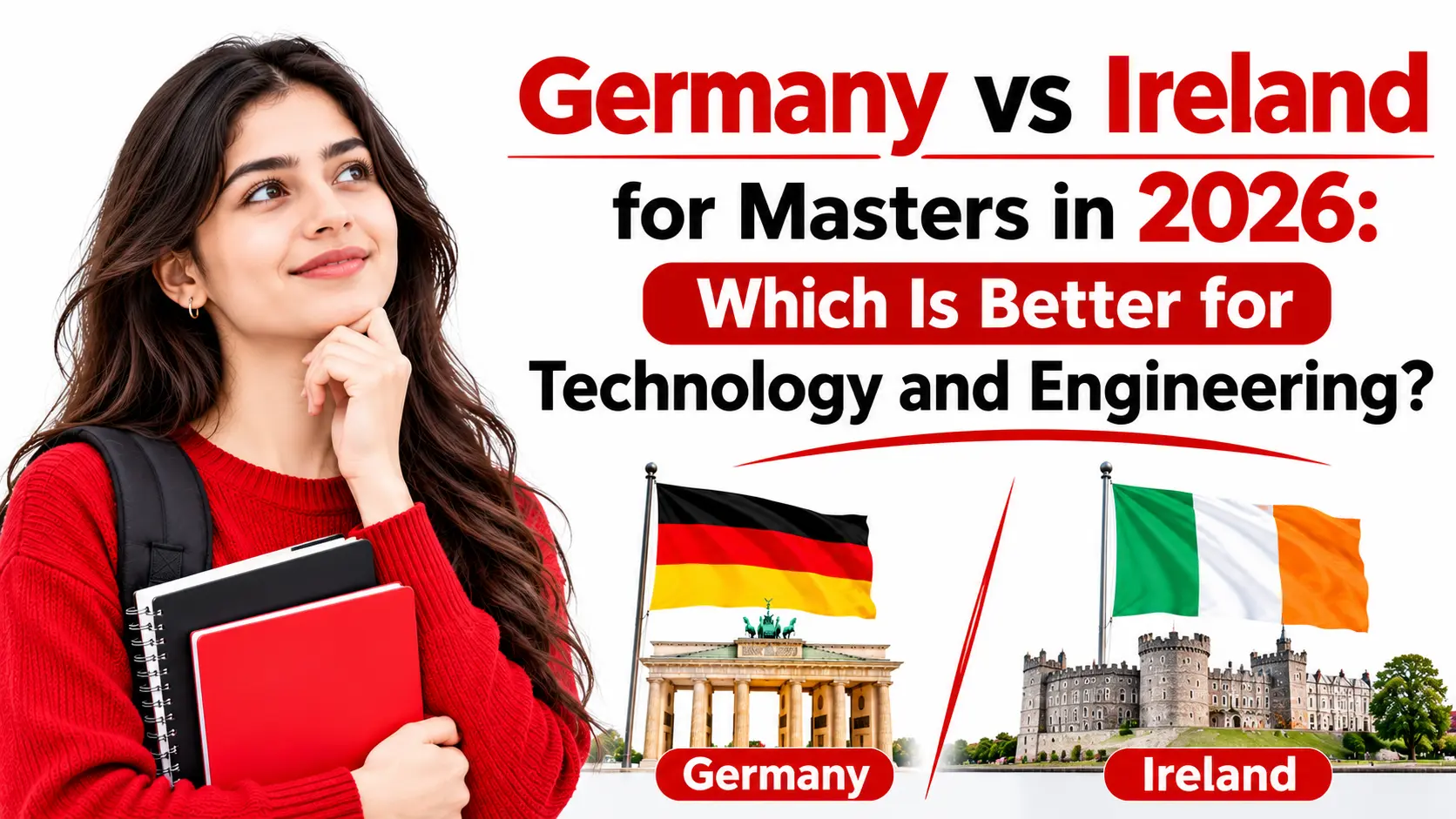
Choosing the correct country to further your higher education is an important decision for students looking to study in Europe. Germany and Ireland are two popular spots for students wishing to study technology and engineering. Both countries provide excellent education, modern facilities and great career opportunities. Germany is well known for having affordable education, top class engineering universities and a strong industrial economy.
On the other hand, Ireland is known for having a rapidly developing technology industry, English speaking and global companies. However there are differences between the two countries in terms of tuition fees, cost of living, employment, visa requirements, language and future career opportunities. Students should therefore carefully consider the differences between the two countries when deciding where to study their 2026 Masters degree. This article will outline the main differences between Germany and Ireland highlighting the key points around education, scholarships, student life, employment and opportunities after studying so you can make an informed decision.
Why are Germany and Ireland popular tech study destinations?
- Technology industry: Both Germany and Ireland have rapidly growing technology sectors with global companies, startups, and research centers. Students get access to modern technology and innovation-driven environments.
- Universities: Germany and Ireland offer highly ranked universities known for engineering, computer science, artificial intelligence, data science, and information technology programs.
- Career opportunities: International students can find internships, part-time jobs, and full-time career opportunities after graduation in both countries.
- Global companies: Ireland hosts the European headquarters of many international technology companies, while Germany is home to major engineering and industrial giants.
- Research: Universities in both countries focus strongly on research, practical learning, and industry collaboration, which helps students gain real-world skills.
- Affordable education: Germany is famous for low or no tuition fees at many public universities, while Ireland offers scholarships and a strong return on investment through career opportunities.
- Work opportunities: Both countries provide post-study work permits that allow students to stay and search for jobs after completing their degrees.
- Student environment: Students from different countries study in Germany and Ireland, creating diverse and multicultural campuses.
- Infrastructure: Modern laboratories, research facilities, smart classrooms, and strong internet connectivity improve the learning experience for students.
- European access: Studying in Germany or Ireland gives students access to travel, networking, and career opportunities across Europe.
Education system in Germany
Germany is famous for its strong public university system. Many German universities rank among the best in Europe. The country especially performs well in engineering, technology, and research-based education. One of the biggest advantages of studying in Germany is the low tuition fees. Many public universities charge little or no tuition fees for international students. Students mainly pay semester fees, which are usually affordable. Students can also compare some of the top universities in Germany to explore institutions offering strong academic and research opportunities in technology and engineering.
German universities focus heavily on practical education. Students often work on real-world projects, research tasks, and internships. This helps them develop industry skills before graduation. Germany also offers many English-taught master's programs, especially in technical fields. Therefore, students who do not speak German can still study comfortably. Students exploring alternative English-language admission requirements can also read our guide to study in Europe without IELTS to understand which universities may accept alternatives to IELTS.
However, students should understand that daily life in Germany may still require some German language skills. Learning basic German can make communication easier and improve job opportunities after graduation. German universities also encourage independent learning. Professors expect students to manage their schedules, complete research work independently, and participate actively in projects.
Education system in Ireland
Ireland has quickly become one of Europe's leading destinations for international education. Irish universities offer modern teaching methods, industry-focused courses, and strong connections with technology companies. One major advantage of Ireland is that English is the main language. This makes communication easier for international students. Students can study, work, and socialize without learning another language. Students interested in pursuing postgraduate education in Ireland can also explore our guide to study in Ireland for details about universities, courses, admission requirements and available study options. Students who are comparing English-language admission requirements can also read our guide to study in Europe without IELTS, which explains where alternative English-proficiency options may be accepted.
Irish universities focus strongly on innovation and industry collaboration. Many master's programs include internships, company projects, and practical assignments. Students often interact directly with professionals from global technology companies. Ireland also has a shorter master's degree duration compared to some countries. Many master's programs finish within one year.
This helps students save time and enter the job market faster. However, tuition fees in Ireland are generally higher than in Germany. Students should carefully plan their finances before choosing Ireland. Despite higher costs, many students still choose Ireland because of its strong technology industry and post-study work opportunities.
Tuition fees comparison between Germany and Ireland
Germany is often considered one of the most affordable study destinations in Europe. Public universities usually charge very low tuition fees or no tuition fees at all. Students mainly pay administrative or semester charges. This makes Germany attractive for students with limited budgets. Private universities in Germany may charge higher fees, but they are still often lower than tuition fees in countries like the United States or the United Kingdom.
Ireland, in comparison, has higher tuition fees. Master's programs in technology-related fields can be expensive, depending on the university and course. However, many students view this as an investment because Ireland offers strong career opportunities after graduation. Students should not focus only on tuition fees. They should also compare living costs, scholarships, and future earning potential. Indian students comparing international education budgets can also explore our guide to cheapest countries to study abroad for Indian students to compare affordable destinations and education expenses.
Cost of living
| Living Expense Factor | Germany | Ireland |
|---|---|---|
| Overall Living Cost | Generally more affordable for students | Usually more expensive, especially in major cities |
| Accommodation | Student housing and shared apartments are comparatively cheaper | Rent is high, especially in Dublin and other big cities |
| Food Expenses | Grocery and daily food costs are moderate | Food and dining costs are slightly higher |
| Transportation | Public transport is affordable and student-friendly | Transportation costs can be higher in urban areas |
| Health Insurance | Mandatory but reasonably priced for students | Health insurance may cost more for international students |
| Utility Bills | Electricity, internet, and heating costs are manageable | Utility expenses can be expensive in some cities |
| Student Discounts | Many discounts available for transport, museums, and activities | Student discounts are also available in many places |
| Part-Time Work Support | Lower living costs reduce financial pressure | Higher living costs increase dependence on part-time jobs |
| Best Cities for Budget Students | Leipzig, Dresden, and Aachen are considered affordable | Smaller Irish cities are cheaper than Dublin |
| Financial Planning | Suitable for students with limited budgets | Requires stronger financial planning and budgeting |
Scholarships and financial support
| Scholarship & Financial Support Factor | Germany | Ireland |
|---|---|---|
| Scholarship Availability | Many scholarships are offered by government and universities | Scholarships are available through universities and government programs |
| Government Scholarships | DAAD scholarships are popular for international students | Government of Ireland scholarships support international students |
| University Financial Aid | Many public universities provide financial assistance | Universities offer merit-based and course-specific scholarships |
| Tuition Fee Support | Scholarships may fully or partially cover tuition fees | Scholarships often reduce tuition costs for students |
| Living Expense Support | Some scholarships also help with accommodation and daily expenses | Certain scholarships provide living allowances |
| Merit-Based Scholarships | Academic performance is important for selection | Strong academic records improve scholarship chances |
| Research Funding | Research students can receive grants and project funding | Research and technology students may receive funding opportunities |
Students looking for additional financial support can explore different study abroad scholarships to understand the funding opportunities available for international education.
What about the technology industry and career opportunities in Germany and Ireland?
Germany: technology industry and career opportunities
- Germany has one of the strongest and largest technology industries in Europe.
- The country is highly advanced in fields like Artificial Intelligence (AI), cloud computing, cybersecurity, automotive technology, and software engineering.
- Cities such as Berlin, Munich, and Frankfurt are major technology hubs with many startups and international companies.
- Germany has a high demand for skilled IT professionals, software developers, data scientists, and engineers.
- Public universities in Germany offer affordable education, which makes it a popular destination for international students.
- The country provides excellent work-life balance, job security, and strong long-term career growth opportunities.
- Learning the German language can increase job opportunities and help in career advancement.
- Germany also offers good opportunities for permanent residency and long-term settlement after studies or employment.
- The country is especially suitable for students who want affordable education and stable career opportunities in the technology sector.
Ireland: technology industry and career opportunities
- Ireland is one of Europe's leading international technology hubs and attracts many global tech companies.
- Several multinational companies have their European headquarters in Dublin, making Ireland a strong destination for tech careers.
- The country is highly developed in areas such as cloud computing, fintech, Artificial Intelligence (AI), data analytics, and software services.
- Ireland offers excellent career opportunities for software engineers, cloud professionals, business analysts, and AI specialists.
- Since English is the main language, international students can easily adjust to the education system and workplace environment.
- Ireland provides strong exposure to multinational corporate culture and global work experience.
- The salaries in the technology sector are attractive, especially in international companies.
- Cities like Dublin and Cork are major centers for technology and innovation.
- However, the cost of living and accommodation in Ireland is very high, especially in Dublin.
- Ireland is a good choice for students who prefer an English-speaking environment and want careers in multinational technology companies.
Work opportunities during studies in Germany vs Ireland
| No. | Factor | Germany | Ireland |
|---|---|---|---|
| 1 | Part-Time Work Permission | International students can work up to 140 full days or 280 half days per year. | International students can work 20 hours per week during studies and 40 hours during holidays. |
| 2 | Common Student Jobs | Students commonly work in restaurants, supermarkets, warehouses, delivery services, and university campuses. | Students commonly work in cafes, hotels, retail stores, restaurants, customer service, and warehouses. |
| 3 | Opportunities in Tech Field | Germany offers strong internship and part-time opportunities in engineering, IT, and manufacturing sectors. | Ireland provides good opportunities in IT, business, finance, and multinational companies. |
| 4 | Average Hourly Wage | Students usually earn between €12 and €20 per hour depending on skills and location. | Students generally earn between €12 and €18 per hour. |
| 5 | Major Cities for Jobs | Berlin, Munich, and Hamburg offer strong student job opportunities. | Dublin and Cork provide the highest number of student jobs. |
| 6 | Language Requirement | Learning the German language improves the chances of getting better part-time jobs. | English-speaking environment makes communication easier for international students. |
| 7 | Internship Opportunities | Universities and industries provide excellent internships and research opportunities. | Students can access internships and graduate trainee roles in multinational companies. |
What are the differences between post-study work opportunities in Germany and Ireland?
Students comparing post-study employment options across destinations can also explore our guide to post-study work visa options in different countries.
Germany: post-study work opportunities
- Post-study work visa: Germany allows international students to stay for up to 18 months after graduation to search for a job related to their field of study.
- Job opportunities: Germany offers strong career opportunities in engineering, IT, automotive, manufacturing, research, and healthcare sectors. Skilled professionals such as software developers, engineers, and data analysts are in high demand.
- Language requirement: Many international companies offer English-speaking jobs, especially in the technology sector. However, learning German improves job prospects and long-term career growth.
- Salary and career growth: Germany provides competitive salaries and stable career opportunities for skilled graduates.
- Permanent residency opportunities: Germany offers good pathways for permanent residency and long-term settlement after gaining work experience.
- Major employment cities: Cities like Berlin, Munich, and Frankfurt are major hubs for international job opportunities.
Ireland: post-study work opportunities
- Post-study work visa: Ireland allows eligible international students to stay and work for up to 2 years after graduation under the Third Level Graduate Scheme. For more details about eligibility, stay-back duration and employment options, students can refer to our guide to the Ireland post-study work visa.
- Job opportunities: Ireland offers strong opportunities in IT, finance, fintech, pharmaceuticals, cloud computing, and multinational companies. Many global companies hire international graduates in technical and business-related roles.
- Language advantage: English is the primary language in Ireland, which makes communication and workplace integration easier for international students.
- Salary and corporate exposure: Ireland offers attractive salaries, especially in multinational technology companies.
- Residency opportunities: Ireland also provides pathways for long-term residency, although the process can be more competitive compared to Germany.
- Major employment cities: Dublin and Cork are the main centers for graduate employment and multinational companies.
How do language, student life, culture, weather, and lifestyle differ for international students in Germany and Ireland?
Language and communication
Ireland has a clear advantage for students who prefer English-speaking environments. Students can communicate comfortably from the first day. This helps students adjust quickly to academics, part-time jobs, and social life.
Moreover, Germany offers many English-taught master's programs, but daily life may still involve German communication. Learning German is not always mandatory, but it can improve job opportunities and social integration. Although students are willing to learn a new language, they may enjoy Germany more because it adds an extra skill to their profile.
Student life and culture
Germany offers rich history, beautiful architecture, music festivals, museums, and cultural events. Students can travel easily across Europe because of Germany's central location. German cities also provide excellent public transportation and modern infrastructure.
Ireland is famous for its friendly people, lively social culture, music traditions, and welcoming atmosphere. Irish cities often feel smaller and more personal compared to large German cities. Students in Ireland may find it easier to build social connections because of the English-speaking environment.
Weather and lifestyle
Germany experiences cold winters and pleasant summers. Some regions receive snowfall during the winter months. Ireland generally has mild weather throughout the year, although rainfall is common.
Students who prefer cooler temperatures may enjoy Germany, while those who prefer moderate weather may feel more comfortable in Ireland.
Lifestyle preferences also matter. Germany often feels more structured and organized, while Ireland may feel more relaxed and social.
What are the differences between visa processes and immigration policies in Germany and Ireland for international students?
- Germany requires students to show proof of funds through a blocked account, while Ireland mainly asks for bank statements and tuition fee proof. Students planning to study in either country can refer to our student visa application process guide to understand the general steps involved in preparing and submitting their visa applications.
- Germany's student visa process can take longer because of detailed documentation and residence permit procedures, whereas Ireland's process is generally simpler and faster.
- Germany allows international graduates to stay for up to 18 months after studies to search for jobs, while Ireland offers up to 2 years under the Third Level Graduate Scheme.
- Both Germany and Ireland allow international students to work part-time during their studies under specific regulations.
- Germany provides stronger pathways for permanent residency and long-term settlement opportunities for skilled professionals.
- Ireland is more suitable for students who prefer an English-speaking environment and easier communication in daily life.
- Germany is considered better for affordable education and technical career opportunities, especially in engineering and IT sectors.
- Ireland offers better exposure to multinational companies and a global corporate work culture.
Conclusion
The decision to study a Master's in Germany or Ireland in 2026 will depend on your personal, long term goals, budget, lifestyle and career aspirations. If you are searching for a long term solution, good research opportunities, strong engineering and technology industries and affordable tuition fees then Germany will be a great choice. If you are willing to learn German and experience Europe's industrial and innovative economy then Germany will be a great choice.
Alternatively if you want to study in an English speaking country, have exposure to multinational corporations and want to quickly adapt to living as an international student then Ireland would be a great choice. Ireland has a strong presence of global tech companies and therefore would be a great choice if you want to work within the IT, fintech, cloud computing or business sectors. Both countries provide quality education and good work prospects after studying. Choosing which country to study in will depend on if you want to save money and have a stable environment or want exposure to global corporations and an English speaking country.
FAQs on Germany vs. Ireland
Q.1. Which country is more affordable for international students, Germany or Ireland?
Ans: Germany is generally more affordable because public universities charge very low or no tuition fees.
Q.2. Which country offers better technology career opportunities?
Ans: Both countries offer strong tech opportunities, but Germany is stronger in engineering and manufacturing, while Ireland is known for multinational tech companies.
Q.3. Is the German language mandatory to study in Germany?
Ans: No, many universities offer English-taught master's programs, but learning German improves job opportunities.
Q.4. Which country has a better post-study work visa?
Ans: Ireland offers up to 2 years of post-study work opportunities, while Germany provides up to 18 months.
Q.5. Which country is better for permanent residency opportunities?
Ans: Germany is often considered better for long-term settlement and permanent residency pathways.
Q.6. Is Ireland better for English-speaking students?
Ans: Yes, Ireland is fully English-speaking, making communication and social integration easier.
Q.7. Which country has lower living costs?
Ans: Germany generally has lower living and accommodation costs compared to Ireland.
Q.8. Which country is best for engineering students?
Ans: Germany is highly preferred for engineering, automotive technology, and industrial innovation.
Q.9. Can international students work part-time during studies in both countries?
Ans: Yes, both Germany and Ireland allow international students to work part-time while studying.
Q.10. Which country offers better student life and cultural experience?
Ans: Both countries provide excellent student experiences, but Germany offers rich historical and cultural diversity, while Ireland is known for its friendly and social atmosphere.