
Ireland has become one of the most attractive study-and-work destinations for international students in recent years. Its universities rank highly, the tech and life sciences sectors are booming, and the country’s immigration settings have long included a pragmatic post-study pathway that lets graduates search for work and transition into the Irish labour market. This long-form guide unpacks the current stay-back rules (the Third-Level Graduate Program / Stamp 1G), explains what changed recently or remains the same heading into 2026, walks you through the practical steps to convert post-study permission into long-term employment in Ireland, and outlines sectors, career strategies, and pitfalls to avoid. Wherever possible, I will point you to the official guidance so you can verify the details for your own case.
Headlines on Ireland 2026 Stay-Back Visa Update
- Non-EEA students who graduate from recognized Irish higher education institutions may be eligible to remain in Ireland after finishing their studies under the Third-Level Graduate Program (Stamp 1G) to look for employment.
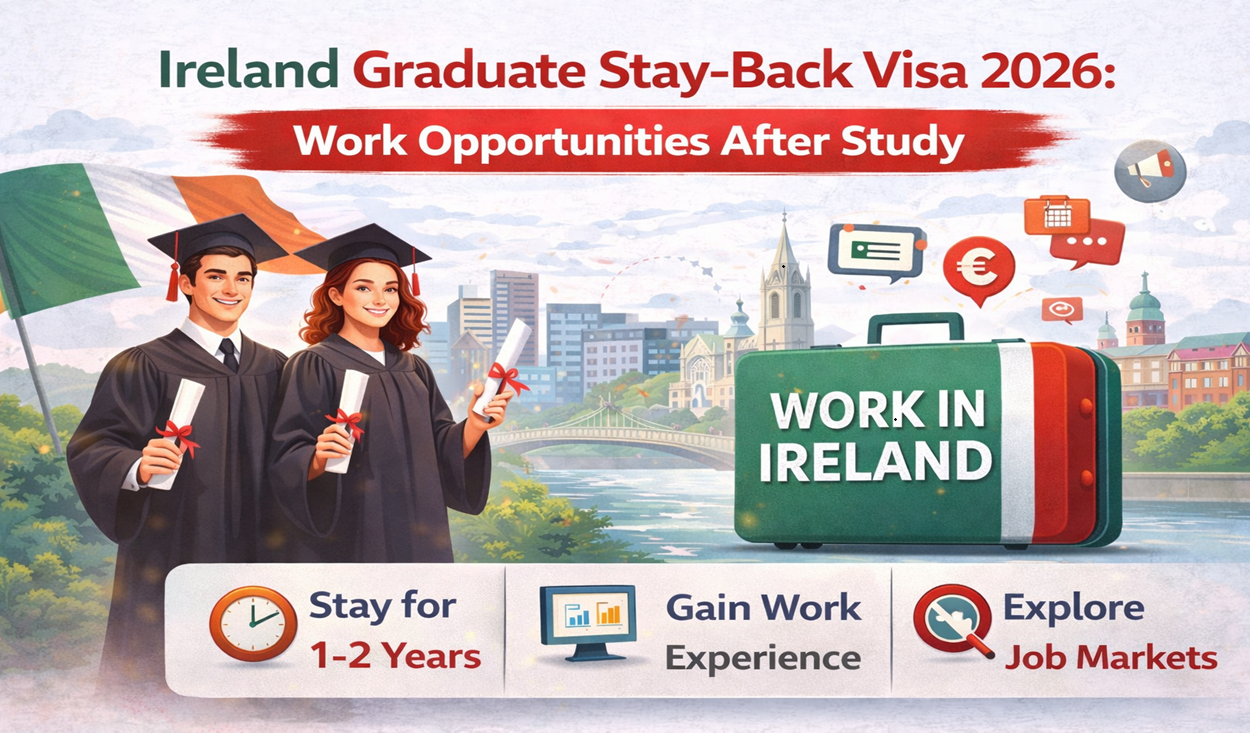
- Typical duration: up to 12 months for most bachelor’s (Level 8) graduates; up to 24 months for many master's and higher-level (Level 9/10) graduates. Exact entitlement depends on the award level and the program.
- To change from student status to Stamp 1G, you must hold a current Stamp 2 permission and register the change with the immigration service within the specified window (commonly within six months of receiving official confirmation of your award). There are other eligibility conditions (e.g., a limit on total student years in the State).
- Stamp 1G holders may work up to 40 hours per week and are free to pursue most types of employment while searching for an employer or applying for an employment permit. This makes Stamp 1G a flexible bridge to employment permits (e.g., Critical Skills or General Employment Permits) and longer-term residence options.
What is the Third-Level Graduate Program (Stamp 1G)?
It is Ireland’s formal “stay-back” permission for non-EEA/EEA-excluded graduates. Suppose you complete an eligible full-time program at a recognized Irish awarding body and meet the other conditions. In that case, you can apply to change your immigration permission from Stamp 2 (student) to Stamp 1G. That Stamp gives you time, typically one year or two years, depending on your qualification, to find work and apply for an employment permit or other immigration permission. The Stamp is intended as a time-limited job-seekers’ permission rather than an automatic route to permanent residence. Still, it’s widely used as a stepping stone into Ireland’s labour market.
Which changes have been made in the 2026 Stay-Back Visa in Ireland?
While the core structure remains unchanged, the following details are worth attention:
1. More precise wording around Level 9/10 duration and renewal
The official ISD page emphasizes that for Level 9 or above awards, you receive 12 months initially. Then you can renew for another 12 months, “where the graduate satisfies the immigration authorities that he or she has taken appropriate steps to access suitable graduate-level employment”.
· If you’re a postgraduate, you’ll want to plan for that renewal phase, not just assume automatic 24 months.
2. Still the same upper limit on total time as student + post-study permission
For example, the student's time on Stamp 2 + time on Stamp 1G counts towards the total allowed time. Especially for Level 8 graduates: past examples mention the 7-year student + post-study limit.
· Make sure your cumulative time as a student in Ireland is tracked.
3. Emphasis on “recognized programs” and the Interim List of Eligible Programs (ILEP)
The older policy document (2017 revision) specifies that the award must be from a program listed on the ILEP.
· This means twin-check: (a) your institution is recognized, (b) the specific program is eligible.
4. Policy document last updated March 28, 2024
The official ISD page shows a “last updated” date of March 28 2024. → While this isn’t a “2026 change” per se, it shows the latest official policy text is already in place, so the 2026 rules likely follow that version unless a future amendment is published.
5. University prospectuses reflect the 1-year/2-year stay-back structure.
For example, Trinity College Dublin’s 2026 international prospectus states, “Eligible postgraduate students can stay for up to two years” under the Third Level Graduate Scheme.
· This offers assurance that the current policy is being applied and communicated to prospective students.
What is not clearly changed but worth monitoring?
- There is no recent official announcement (as of current public sources) that the duration for Level 8 graduates has been increased beyond 12 months; similarly, the eligibility conditions (six-month window, valid Stamp 2, etc.) remain unchanged in the official policy.
- No significant policy document shows that the stay-back extends beyond 24 months for postgraduate levels as standard (some commentary suggests a 24-month “licence” already). One source (SelectIreland) mentions “The new permission will double the ‘stay back option’ for international students at Level 9 and above” (i.e., quoting earlier change), but this appears already reflected in the existing policy.
- There’s no published significant change to permit types, work-hours allowance (40 hours/week), or the requirement to move into an employment permit for a longer stay after Stamp 1G.
- There’s no publicly flagged change that the stay-back scheme will apply differently by subject area, or that new quotas/caps have been introduced for 2026 (as per available sources).
Explore More About Visa Update |
What has remained the same?
- Graduates with an award at Level 8 (Honours Bachelor) of the National Framework of Qualifications (NFQ) receive up to 12 months of Stamp 1G permission to remain in Ireland after graduation.
- Graduates at Level 9 (Master’s) or Level 10 (PhD) may receive up to 24 months (initial 12 months + renewal for a further 12) Stamp 1G permission.
- The application must be made within six months of receiving your award notification from the institution.
- You must hold a valid Stamp 2 (student permission) at the time of applying, and the award must be from a “recognized Irish awarding body” and an eligible program.
Who qualifies for the eligibility checklist?
To qualify for Stamp 1G under the Third-Level Graduate Program, you generally must meet all of the following:
- Be a non-EEA national (students from the EEA/EU behave differently).
- Hold a current Stamp 2 (student) immigration permission and an up-to-date registration card.
- Have completed an eligible full-time award from a recognized Irish awarding body (your college will issue the confirmation you'll need). Different institutions publish how they support students to apply.
- Apply within six months of receiving official notification of your award (the “six-month window” is a recurrent requirement in official guidance).
- Have not already exceeded the seven-year maximum as a non-EEA student in Ireland (there are limits on the total length of time one can remain as a student).
How long can you stay?
- Level 8 (Bachelor’s)- typically 12 months of Stamp 1G.
- Level 9 (Taught Master’s) and Level 10 (PhD)- typically up to 24 months (often issued as an initial 12 months with a possible further 12 months subject to conditions).
Universities sometimes give precise wording for particular programs, and EU/Irish recognised frameworks (QQI/HEA levels) determine the award level. Always check your award level and the official wording in your award letter because the duration entitlement follows that level designation.
What you can and cannot do on Stamp 1G?
- Work: You can work up to 40 hours per week (effectively full-time) and are not restricted to specific job types or salary bands while holding Stamp 1G. That freedom makes it an excellent period to try different roles or short-term contracts.
- Apply for employment permits: During Stamp 1G, you may apply for an employment permit, such as the Critical Skills Employment Permit (for high-value roles and a strong route to longer permission) or the General Employment Permit (for other qualifying jobs). Once an employment permit is issued, you can change your immigration status accordingly.
- Not an automatic path to residency: Stamp 1G itself is temporary and does not automatically lead to permanent residency or citizenship, which requires further steps (usually time spent under employment permits and meeting residence requirements).
Steps to apply (practical timeline)
- Confirm your award and collect documentation. When your institution confirms you’ve satisfied requirements (final transcript, award letter), request an official immigration-style letter confirming the award date and eligibility.
- Check your Stamp 2 status and registration card. You must be legally registered for Study in Ireland as a student at the time you apply. If you have an expired registration, contact ISD immediately.
- Apply within six months of award notification. Turn up to your local immigration/registration centre (ISD) with the required documents — the university often provides guidance and templates.
- Receive Stamp 1G. In most cases, you’ll be issued a Stamp 1G permission for the period you’re eligible (12 or 24 months as appropriate).
- Job hunt + employer permit application. While on Stamp 1G, you search for work and, once you have an employer, you or your employer applies for an employment permit that fits the post. If granted, you register the change of permission.
What are the employment routes after getting a job?
Two common employment permit routes graduates use after Stamp 1G:
· Critical Skills Employment Permit- Targeted at high-skilled occupations (ICT, engineering, medical, and specific finance roles) and often allows fast-track progress toward long-term residency. It typically requires a specified minimum annual salary and that the role be on the Critical Skills Occupations List. Graduates in STEM and related fields often pursue this route.
· General Employment Permit- For roles not eligible for Critical Skills but that still meet criteria (labour market needs, minimum salary thresholds, employer obligations). The General Permit is more flexible in job types, but may be slower for residency progression.
Many graduates secure an initial job via Stamp 1G (contract or temporary) and then transition to a Critical Skills permit if the job qualifies. Employers often have HR teams that can advise; for small employers, you may need to guide them through the permit process.
Which are the top sectors hiring international graduates in Ireland in 2026?
Ireland’s economy continues to be led by a combination of multinational investment and a vibrant indigenous sector. Sectors that consistently hire international graduates include:
- Information and Communications Technology (ICT)- Dublin, Cork, Galway and Limerick host many global tech hubs and start-ups. Roles range from software engineers to data scientists and product managers.
- Pharmaceuticals and Life Sciences- Ireland is a European hub for biopharma manufacturing and R&D with major employers and a strong supply chain.
- Financial Services and Fintech- Dublin’s finance cluster offers roles in banking technology, payments, compliance and analytics.
- Engineering and Renewable Energy- As Ireland invests in green energy, demand for engineers and specialists grows.
- Healthcare and Medical Devices- Clinical trials, device manufacturing and healthcare analytics are active areas.
- Professional Services and Consulting- Management consulting, tax and advisory services recruit graduates with strong analytical skills.
Graduates with practical experience, internships, or targeted placements during study have an edge in the Irish job market. Universities and career services in Ireland often maintain employer links and job fairs specifically for international students.
Finances, accommodation and practical life during stay-back-
The Stay-Back Visa (Stamp 1G) allows international graduates to remain in Ireland after completing their studies to seek employment and gain professional experience. During this phase, managing finances, finding suitable accommodation, and adapting to independent living are crucial.
- Financial Planning- Living expenses in Ireland typically range from €1,200 to €1,800 per month, depending on the city. Dublin is the most expensive, while Cork, Limerick, and Galway offer more affordable living. A general monthly budget includes- Rent, food, general utilities, transport, and other expenses. Graduates on Stamp 1G can work full-time (40 hours/week), which helps cover living expenses once employed. Initially, personal savings are essential for job search months. Opening an Irish bank account and obtaining a PPS Number are essential for salary and tax purposes.
- Accommodation Options- Housing can be competitive, especially in Dublin. Common choices include shared apartments or houses that are found on Daft.ie, Rent.ie, or MyHome.ie. Choosing to live in smaller cities like Galway or Waterford can reduce costs and provide access to emerging job markets in tech, healthcare, and engineering.
- Practical Aspects of Daily Life- Graduates must maintain private health insurance, typically costing €50–€80 monthly. Public transport is reliable, with Leap Cards offering discounted fares for buses, trains, and trams. Mobile and internet plans average €20–€30 per month. Networking through career fairs, LinkedIn, and alumni events can significantly improve job prospects.
- Work-Life Balance and Future Planning- Irish workplaces value collaboration and punctuality, while weekends offer time for recreation, travel, and exploring Ireland’s cultural heritage. The stay-back period is also a pathway to Critical Skills or General Employment Permits, enabling long-term career growth and potential residency.
International graduates and pathways to long-term residence-
Stamp 1G itself is temporary, but it’s a critical first step. Typical progression is:
- Stamp 1G (job-seekers permission) → secure employment
- Apply for an employment permit (e.g., Critical Skills) while or after working on Stamp 1 G.
- Register the new permission with ISD and continue employment under the permit.
- After meeting residency/permit duration requirements (varies by permit type), apply for longer-term permissions (e.g., Stamp 1A, long-term residency or naturalization processes) as eligible.
The Critical Skills Employment Permit, in particular, is known as a valid route because it can make the pathway to long-term residency quicker for high-skilled workers. Always plan your route early and track requirements carefully (time on permit, continuous residence, tax history).
What are the common pitfalls during the stay-back period, and how can they be avoided?
- Delaying the Visa Application- Many graduates postpone their visa application or submit incomplete documents, risking rejection. Apply as soon as your degree results are officially confirmed and ensure your passport, IRP card, and proof of award are valid. Early booking with the Irish Naturalization and Immigration Service (INIS) is essential to avoid delays.
- Poor Financial Planning- Underestimating Ireland’s living costs is a common issue. Monthly expenses range from €1,200 to €1,800, depending on location. Graduates should have savings to cover at least three months of living costs while job hunting and manage expenses through budgeting tools and responsible spending.
- Late Job Search- Waiting until after graduation to start applying for jobs reduces available time under the visa. Begin your job hunt in your final semester, update your LinkedIn profile, and attend university career fairs to build employer connections early.
- Weak Networking Efforts- Relying solely on online job applications limits opportunities. Ireland’s professional culture values connections, so attending alumni events, job fairs, and industry meetups can significantly increase your employment prospects.
- Unplanned Accommodation Choices- Rushing into expensive or short-term housing often causes financial strain. Research verified listings on Daft.ie or Rent.ie, avoid scams, and consider regional cities like Galway or Limerick for affordable, long-term stays.
- Missing Work Permit Transition Deadlines- Failure to apply for a Critical Skills or General Employment Permit before the Stamp 1G expires can affect legal status. Track your visa timeline and initiate the transition soon after receiving a job offer.
- Overlooking Skill Development and Wellbeing- Graduates often stop upskilling after completing their degree, reducing competitiveness. Pursue online certifications and maintain a healthy work-life balance through social or community activities.
- Lack of Long-Term Career Planning-Treating the stay-back period as temporary is a lost opportunity. Focus on roles listed under Ireland’s Critical Skills Occupation List to secure long-term employment and potential residency.
Closing thoughts
Ireland’s Third-Level Graduate Program remains one of the most pragmatic stay-back policies in Europe: it gives international graduates real time to convert academic achievements into career steps inside a market that values tech, science and professional skills. In 2026, the core rules remain familiar — award-level based durations, the need to hold Stamp 2 and apply within a set window, and the strong incentives to transition into employment permits for longer-term settlement — but the landscape continues to favour graduates who prepare early, target high-demand sectors, and build local work experience during or immediately after study. If you plan well and use university services, Stamp 1G can be the launchpad for a successful Irish career. For legal confirmation of any individual step, always check the official ISD pages and your university guidance.
FAQs on Stay-Back Visa Update
Q1. What is Ireland’s Stay-Back Visa for international students?
Ans- It’s officially called the Third-Level Graduate Program (Stamp 1G), allowing non-EEA graduates to stay in Ireland after completing studies to find work.
Q2. How long can you stay in Ireland after graduation under this visa?
Ans- Bachelor’s (Level 8) graduates can stay up to 12 months, while Master’s or PhD (Level 9/10) graduates can stay up to 24 months.
Q3. Who is eligible for the Stay-Back Visa in 2026?
Ans- Non-EEA students who completed a full-time degree from a recognized Irish institution and currently hold a valid Stamp 2 permission.
Q4. Can you work full-time on Stamp 1G?
Ans- Yes, you can work up to 40 hours per week while on Stamp 1G status.
Q5. Can you extend your Stay-Back Visa after it expires?
Ans- Generally, no. The permission is granted only once per award level. You must switch to an employment permit if you wish to stay longer.
Q6. What kind of jobs can you take while on Stamp 1G?
Ans- You can take up any type of employment there are no restrictions on job sector or salary while on Stamp 1G.
Q7. Can you apply for permanent residency after the Stay-Back Visa?
Ans- Not directly. You must first move to an employment permit (like a Critical Skills or General Employment Permit) and then meet residency requirements.
Q8. When should you apply for Stamp 1G?
Ans- You must apply within six months of receiving official confirmation of your award from your university.
Q9. Which sectors offer the best opportunities for graduates in 2026?
Ans- Top hiring sectors include IT, pharmaceuticals, finance, engineering, and healthcare.
Q10. Can you travel outside Ireland while on Stamp 1G?
Ans- Yes, you can travel, but ensure your immigration card and re-entry documents are valid before leaving Ireland.
Q11. Can you get Stamp 1G more than once?
Ans- Rules limit repeat access consult ISD guidance, especially if you progress to a higher award level (e.g., bachelor → master). Check official pages for the exact conditions.
Q12. Will Stamp 1G make me eligible for residency?
Ans-Not directly. Stamp 1G is temporary and intended to facilitate work search; residency requires additional qualifying permissions (such as employment permits) and a minimum residence period.


Leave a Comment
Your email address will not be published.