Loading blog article…
Hi! Connect with us 👋
Let's talk about your study plans.
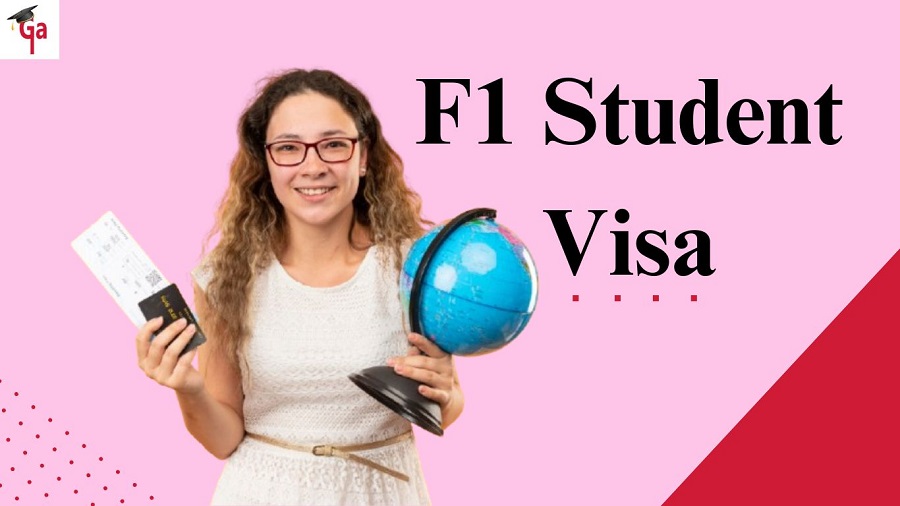
There are currently over a million international students studying in the United States. Additionally, students who wish to study in the United States should familiarize themselves with the F-1 student visa application process. Applying for a US student visa can take some time.
There are generally multiple steps involved in applying for a US F1 student visa. The procedures vary by location; therefore, it is important to check the instructions on the official site of the US embassy or consulate where you intend to apply. Learn about the F-1 student visa application process if you want to study in the United States. Thus, keep reading the next detail.
International students can enter the United States and attend schools approved by the Student and Exchange Visitor Program (SEVP) with the F-1 student visa. It is a non-immigrant visa. Suppose you are enrolled full-time in a language education program or at a recognized university or college, theological school, conservatory, research high school, elementary school, or other educational organization. In that case, you are eligible for admission into the United States with the F-1 Visa.
If you intend to apply for an F-1 student visa, there are a number of regulations to be aware of. These conditions must be fulfilled for your application to be approved:
· Institution certification- Your intended educational institution must have SEVP Immigration & Customs Enforcement's approval.
· Enrolment requirements- During the duration of your educational term, you ought to be registered at the university full-time.
· English language proficiency- You must either be registered in classes that will assist you in becoming more proficient in the language or comply with the institution's necessary level of English proficiency rating.
· Adequate funding: You must demonstrate that you have enough money on hand to cover the costs of living and educational costs while in the United States.
· Passport validity: Your passport must remain valid for travel to the United States for a minimum of six months from the date of the end of the program.
· Resident status in your home country: After earning your college degree, you must have a place to call home.
Once you are accepted to a US university with SEVP certification, the F-1 student visa application procedure begins. The US government uses SEVP approval as evidence that your university is recognized and has the resources necessary to offer you a college degree.
Your university will provide your I-20 paperwork upon acceptance. This form records your study schedule and offers verified details about your visit. This data is entered into the Student and Exchange Visitor Information System (SEVIS) at the time of issuance of your I-20-
You will have to pay about $535 for your F-1 student visa, which covers the expenses of the visa directly, as well as SEVIS registration and maintenance charges.
Remember to keep the receipt for the I-901 SEVIS charge. It is required for the interview for your visa.
Your visa application is your DS-160. To obtain an F-1 visa, all potential students from abroad must finish a DS-160.
Once your DS-160 has been properly submitted, a printed verification with a barcode will be sent to you. Keep this form handy; you will need it for interviewing for your visa.
Make an appointment for your visa interview at the US embassy or consulate that is closest to you. Remember to schedule your visits as early as possible because wait times might take months and vary by nation.
Ask your enrolment advisor for advice on student visa interviews or how to arrange a practice interview if you plan to register at a US university. You will feel more at ease with the procedure if you prepare for your visa interview.
In the interview stage of the F-1 visa application procedure, the US embassy or consulate verifies that you are a genuine, serious student travelling to study. You must also demonstrate at your visa interview that you possess the money to pay for your education in the US and that you want to return home once your studies are done. Unless there are any exceptional circumstances, you must attend your visa interview in person.
Following a successful visa interview, you will receive your F-1 visa and obtain F-1 status. Moreover, you are now permitted to study in the United States.
Finish the DS-160: Complete the online application for a visa and print the page of confirmation.
Make an appointment for an interview: Schedule a visit to one of the American embassies or consulates abroad.
Get the paperwork ready: Collect the original paperwork needed for the first application for an F-1 visa, such as
The application cost must be paid Before your interview. Pay the money and retain the receipt.
Go to the interview- Bring the necessary paperwork to the interview.
Although it's normally preferable to apply in your home country, you can renew your F-1 visa at any US Embassy or Consular office. Information unique to a particular place can be found on the website of the US Embassy or Consulate. However, when renewing your F-1 visa, bear the following points in mind-
It is necessary to demonstrate transitory intent, financial stability, and acceptance into a SEVP-approved institution to convert a B1 or B2 tourist visa to an F1 student visa. The actions you must take are as follows:
To qualify for an F-1 visa, you also need to
The following information relates to overseas students' F1 visa slots-
Questions concerning your study schedule: These will resemble the ones you may encounter in interviews and your essays for college applications. They are simply curious about your decision to continue your studies instead of entering the workforce. Your decision to study in the US as opposed to your native nation or another location piques your curiosity as well.
Questions regarding your choice of university: The interviewer is interested in your intended university, just as they are in your study intentions. These enquiries are intended to reveal more about your credentials as a learner and potential career. Universities of higher quality will be valued more highly than lesser-known ones.
Concerns regarding your academic aptitude: It should come as no surprise that during your interview, you will have to demonstrate your ability to find success in a US university. Your chances of succeeding in your program can be assessed based on your test results, prior GPA, and prior study abroad experience.
Concerns regarding your financial situation: The most crucial step in getting your F1 visa is this. If you are unable to prove that you will be able to pay for your studies, you will not be granted an F1 student visa, regardless of your academic credentials. Compared to other nations, the US has substantially higher educational costs. Investigating and having a sound financial strategy is crucial. Tuition costs should be one of many things covered by this plan. Housing, food, transportation, health insurance, and all other pertinent costs should be taken into account.
Questions concerning your intentions after graduation: In theory, only students who want to return home after graduation are eligible for the F1 student visa. Through programs like OPT and H1B, it is feasible to remain in the United States after graduation. However, it will be necessary to demonstrate that you have connections and commitments, such as relatives, belongings, or an offer of employment, that will require you to return home.
|
Do's |
Don’ts |
|
A smile brings confidence. There is no reason to look serious. Going to the USA for your Studies was your dream, and you are closer to it. There, you got a reason to smile. |
Your primary intent to travel to the USA is to study; there is no reason to be nervous about it. Thousands of students from all around the world do that. While little nervousness is natural, sweating or hyperventilating is not a good sign. If you tend to get too fidgety, try breathing exercises before you start your interview to calm your nerves. |
|
Being able to communicate in English is one of the primary requirements for pursuing education in the USA. You have to be able to speak English. |
Visa Officers can understand Indian accents, so do not try to throw off an American accent. Be clear, crisp, and without forced accents as much as possible. |
|
Not being able to make eye contact is considered a sign of dishonesty. Practice at home and look at the interviewer when answering the questions. |
Looking in the eye and constantly staring without blinking are two different things. Continuous staring can make the interviewer uncomfortable – remember to blink while talking. |
|
Always make sure the file you carry is complete with all the necessary documents, and it is catalogued properly so that in case you are asked to present a document, you have it ready. |
The visa officer, in all probability, would not ask for any documents. Please do not offer to show it to them (until and unless they specifically ask to see something). |
|
You should be able to convince the visa officer that you will return to your home country after completing your studies since you have strong ties. |
Do not emphasize staying back for a long period after the course completion. Also, do not extend any thoughts on getting a full-time job in the US and staying there permanently. |
The F1 student visa is an exclusive desire visa, which means that you commit to studying in the US and then going back to your home country after you are done. Accordingly, you cannot enter the US on an F1 visa to obtain lawful permanent residency, and it is not a direct route to a green card. After receiving an F1 visa, there are a few routes you can take to obtain a green card.
F-1 students are permitted to work on campus up to 20 hours per week during the academic year and up to 40 hours during the off-campus period. However, off-campus employment is prohibited for F-1 students during their first year of study. After that, if they are approved and fulfil specific eligibility standards, they can work off-campus.
After your program is over, you have sixty days to depart the country using your F1 visa. If you want to stay in the United States, you will have to apply to modify your visa status, switch to a different school to obtain a new I-20 form, or rejoin an advanced course.
Author
Content Writer & International Education Specialist
Sakshi Taneja is a content writer specializing in international education, study abroad opportunities, university admissions, student visas, scholarships, and career guidance. She creates accurate, research-driven, and student-focused content to help aspiring international students make informed decisions about their global education journey.
No comments yet
Comments are temporarily closed.
Please provide your contact information
Free Counselling

10/26/2026

9/21/2026
2/26/2026
11/3/2025
11/3/2025
Want some help figuring out what kind of prep service is right for you?
Help and Support