Abroad Insights: News and Tips for Students


Germany is one of the most preferred study destinations amongst the international students due to its excellent higher education and research programs and courses. The universities in Germany offer a multitude of courses, including engineering, computer science, business, natural sciences, medicine, etc. The country hosts a number of high-ranking universities with excellent academic and research records.
Among the best universities for international students and seeking to study in Germany, your choice of the right university varies according to the course, admission requirements, language requirements, location, tuition fees, future employment and career prospects among other reasons.
Students planning to study in Germany can compare universities based on their academic interests, admission requirements and future career plans. In this article, we are going to look at the Top 10 Universities in Germany.
The important universities in Germany listed below are recognised as leading institutions and are considered popular amongst the international student market:
University | QS Global 2027 | Times Higher Education |
|---|---|---|
Technical University of Munich (TUM) | 25 | 27 |
Ludwig-Maximilians-Universität München (LMU Munich) | 61 | 34 |
Heidelberg University | 86 | 49 |
Freie Universität Berlin | 98 | 113 |
RWTH Aachen University | 104 | 92 |
Karlsruhe Institute of Technology (KIT) | 110 | 166 |
Humboldt-Universität zu Berlin | 140 | 89 |
Technische Universität Berlin (TU Berlin) | 158 | 160 |
TU Dresden | 185 | 174 |
University of Bonn | 209 | 92 |
Note: The order of ranking for this list of top universities in Germany may differ from the ranking organisation to organisation and year to year. We are not treating this order as a permanent list of the top university in Germany.
The Technical University of Munich (TUM) is one of Germany's well-known universities, particularly for students interested in technology, engineering, natural sciences, life sciences, medicine, management, and related fields. Its academic portfolio includes Bachelor's and Master's programmes across several disciplines.
For international applicants, the Technical University of Munich has established information and application procedures. In the application process, it may be necessary to provide certain documents, such as academic qualifications and language certificates.
Popular Study Areas:
Engineering
Computer Science
Natural Sciences
Life Sciences
Medicine
Management
Economics
Why choose TUM?
Acquiring knowledge in one of the TUM’s programs is a great opportunity for individuals who are interested in technology, research, engineering, and innovative approaches. Students who are looking forward to studying in an international academic environment can choose from a wide range of study programs taught in English.
Ludwig-Maximilian University Munich, LMU Munich provides comprehensive education and excellent facilities. Here are the details about the programs offered, popular fields of study, and other important details for prospective students.
Overviews of more than 300 study programs are available, including an increasing number of master’s programs offered in English. This may be an attractive option for international students who are interested in pursuing postgraduate studies in Germany.
Popular Study Areas:
Economics
Business Administration and Social Sciences
Computer Science
Natural Sciences and Mathematics
Medicine
Humanities
Data Science and related fields
Why choose LMU Munich?
Students exploring the opportunities for a comprehensive education at a world-class university, may be interested in the variety of undergraduate and postgraduate programs offered by LMU. It is important to note that application requirements can vary depending on the degree program, so international students are advised to review requirements carefully.
Heidelberg University is one of Germany’s oldest and most renowned research universities that provide excellent study conditions in a high-academic environment. The institution covers a wide range of study fields, including natural sciences, medicine, humanities, social sciences, and many others. It attracts students from all around the world due to its comprehensive approach and the opportunity to gain in-depth knowledge in a chosen sphere of science.
Heidelberg University can be a great choice for those who are interested in both academic and scientific fields of study. Not only that, but the institution offers a wide range of postgraduate and undergraduate programs. Additionally, there are many interdisciplinary research areas that may be worth considering.
Popular Study Areas:
Natural Sciences
Medicine
Computer Science
Social Sciences
Humanities
Life Sciences
Why to choose Heidelberg University?
International applicants Heidelberg welcomes international applicants who wish to combine an international experience with an academic course. The requirements for international applicants are different for each course, please check the individual programme requirements.
Freie Universität Berlin is a large research university in Berlin offering a wide range of study fields. It stands for excellence in the fields such as social sciences, humanities, natural sciences, earth sciences, and life sciences.
Students have the advantage of being located in Berlin, which is one of Germany’s cultural and academic centres. Students are able to choose from a variety of Bachelor’s and Master’s study courses in accordance with their qualifications and interests.
Popular Course Areas:
Social Sciences
Humanities
Natural Sciences
Earth Sciences
Life Sciences
Political and Social Studies
Choosing Freie Universität Berlin
Freie Universität Berlin can be a good choice for those who are interested in a comprehensive study with a focus on research in various fields. The university is also a great choice for those who want to be immersed in an international and diverse environment.
RWTH stands out for its focus on engineering, technology and scientific programmes, with RWTH currently offering courses in mechanical engineering, electrical engineering, computer science, civil engineering as well as natural sciences.
Students looking for technical university education can examine separate RWTH Aachen University undergraduate and graduate programmes. The university has connections to science and industry for students hoping to forge a career in these fields.
Popular Study Areas:
Mechanical Engineering
Electrical Engineering
Computer Science
Civil Engineering
Materials Science
Natural Sciences
Why choose RWTH Aachen University?
RWTH Aachen could be suitable for students wanting to undertake studies related to engineering, technology and research. The courses on offer enable students to acquire advanced knowledge of technical and scientific disciplines.
Karlsruhe Institute of Technology (KIT) is a research-oriented university that focuses on engineering, natural sciences, computer science, and technology. The university offers an education process that combines teaching and research activities in related scientific fields.
The range of bachelor’s and master’s degree programs at KIT can be an excellent choice for international students who are interested in technical and scientific studies.
Popular Study Areas:
Computer Science
Mechanical Engineering
Electrical Engineering
Chemical Engineering
Natural Sciences
Information Technology
Why choose KIT?
Students may consider Karlsruhe Institute of Technology as a great opportunity to get professional education in the fields of technology, engineering, and natural sciences on a scientific level. Nevertheless, it is essential to learn more about the admission process and course structure prior to applying.
Humboldt-Universität zu Berlin is a renowned establishment of higher education in the capital of Germany. The university offers a wide range of study courses in Humanities, Social Sciences, Natural Sciences, Economics, and other subjects.
The academic setting at Humboldt-Universität zu Berlin will be of interest to those who want to gain interdisciplinary knowledge and engage in scientific research. Humboldt University welcomes international students who wish to enter one of the Bachelor’s or Master’s degree programs offered.
Popular Study Areas:
Economics
Social Sciences
Natural Sciences
Humanities
Computer Science
Life Sciences
Why choose Humboldt University?
Students may be interested in the wide range of academic courses and the opportunity to conduct research in various fields of science. Besides, Humboldt-Universität is located in the heart of Berlin, which is a great place to experience a truly European experience.
The Technische Universität Berlin is a technological university offering programs in the field of engineering, computer sciences, architecture, planning, natural sciences, and many more. The university is located in Berlin and is known for its research-oriented approach.
Technical education programs can be found among the offered Bachelor's and Master's programs. TU Berlin may suit those students who plan to have their career in engineering and scientific fields.
Popular Study Areas:
Computer Science
Mechanical Engineering
Electrical Engineering
Architecture
Civil Engineering
Environmental Engineering
Why Choose TU Berlin?
This university can be appropriate for students who are interested in technology and research. Besides, the university's location can be an advantage for such students.
Technische Universität Dresden (TU Dresden) is a large research university providing programmes in various fields such as engineering, natural sciences, computer sciences, medicine, etc. The institution is renowned for its research activities and technical studies.
Prospective international students may look for bachelor’s and master’s degrees programmes in different fields of study. The institution provides various programme options in the field of engineering and technology depending on the academic needs of students.
Popular Study Areas:
Engineering
Computer Science
Electrical Engineering
Mechanical Engineering
Natural Sciences
Medicine
Why to Choose TU Dresden?
The institution is a good choice for students looking for research and technical education. The institution provides opportunities to study different engineering and scientific fields in a research environment.
The University of Bonn provides education in the sphere of mathematics, natural sciences, economics, agriculture, medicine, humanities, and social sciences.
The university offers a wide range of study courses for international students at undergraduate and postgraduate levels.
The University of Bonn has a great variety of academic disciplines, which cover different spheres of science.
Popular fields of study at the University of Bonn include:
Mathematics
Computer Science
Natural Sciences
Economics
Agriculture
Medicine
Humanities
Why choose the University of Bonn?
The University of Bonn is a great choice for those who want to get an education in humanities, mathematics, computer science, natural sciences, economics, agriculture, and medicine. Students at an undergraduate or postgraduate level can choose from a wide range of study disciplines and directions.
When choosing a university to study in, factors to consider go beyond the institution's ratings. Apart from the school's overall score, international students should evaluate the course structure, language of instruction, entry requirements, location, and general expenses, including scholarships.
International students also need to be aware of financial considerations such as a Germany student visa blocked account when budgeting overall study costs.
Students should also learn if their desired program is taught in English or German and if they meet the standards. The process of application, required papers and deadlines may vary for every course and university.
The students seeking a funding opportunity can also explore the options offered by DAAD Scholarship in Germany and confirm its eligibility criteria before considering it for the application.
By researching the mentioned points prior to applying, students who wish to study in Germany will find the described process much easier.
Popular Fields of Study in Germany
Germany provides the best study courses in various popular fields of study. Choosing the type of program will depend on the student’s background, interests, and future professional goals.
The most popular fields of study in Germany are:
Engineering
Computer Science
Business and Management
Data Science
Natural Sciences
Medicine
Agriculture
Economics
Social Sciences
When looking for the most suitable educational institution to enter, students should compare the curriculums of the programs they are interested in and not rely on the overall ranking of the universities.
The Top 10 Universities in Germany listed above all have a different strength of subjects, research areas, locations and number of courses. There are technology universities like TUM, RWTH Aachen, KIT and TU Berlin and research universities of general focus like LMU Munich, Heidelberg or University of Bonn.
Before sending in your application, it is recommended to compare your course, requirements, language criteria, costs, location and future plans and it is worthwhile to research to find out the right German university for you.
Ans- Technical University Munich (TUM), LMU Munich, Heidelberg University, RWTH Aachen, KIT, TU Berlin and other reputed German universities attract most international students.
Ans- Germany is a great choice for high-quality education, research and offers a wide variety of study courses.
Q3. What are the Best public universities in Germany?
Ans- Top public universities in Germany include TUM, LMU Munich, Heidelberg University, RWTH Aachen, KIT and Humboldt University.
Ans- Yes, Indian students have an option to study in Germany, however, they need to fulfill the eligibility criteria of the desired course.
Ans- One can pursue all kinds of courses in Germany, such as Engineering, Computer Science, Business Administration, Medical, Natural Sciences, Agriculture and many more.
Ans- Yes, majority of courses in Germany, at Masters level, are taught in English.
Ans- Requirements range via programme however can also encompass educational qualifications, language certificate and other required documents.
Ans- Costs range by means of university, programme and area, in conjunction with residing charges along with accommodation and transportation.
Ans- Yes, worldwide college students can find numerous scholarship and investment opportunities depending on their eligibility.
Ans- Compare the direction, admission necessities, language, area, fees and profession possibilities before selecting a university.

A key ability in both the personal and professional spheres is effective communication. Being able to express yourself effectively and sympathetically can significantly impact how your relationships turn out, whether you're talking to loved ones, clients, or coworkers. Becoming a great communicator takes effort, self-awareness, and a dedication to improvement. This is a thorough tutorial on improving communication and impacting every discussion.
It is crucial to comprehend what communication is before delving into the strategies. Conversation is an ongoing endeavour that includes listening, interpreting, and effectively responding. It includes written, spoken, and non-verbal components, all affecting how the information you provide is understood.
· Effective communication increases connections with other people and cultivates trust.
· Employers value people who can collaborate and communicate well.
· Finding an agreement and addressing misconceptions are made easier with straightforward discussion. In social and professional contexts, effective communication makes you feel more confident.
Talking is only one aspect of communication; listening is just as essential. Focusing intently, comprehending what is being said, and reacting to it are all components of active listening.
Advice for active listening-
The ability to identify and control your own emotions as well as comprehend and affect those of others is known as emotional intelligence (EI). One characteristic of excellent communicators is high EI.
Strategies to improve emotional intelligence-
Both what you say and how you say it matter just as much. Speech that is confident, succinct, and clear can enthral your listeners.
Techniques for clear and straightforward verbal communication-
Develop your nonverbal communication skills-
Your gestures, facial expressions, and body language frequently convey more information than your words. Understanding your body language guarantees that your message is consistent with your intention.
Important nonverbal communication tips for success-
Written communication is essential in both personal and professional relationships in the digital age. Clarity and tone are crucial in any type of communication, including emails, reports, and social media posts.
Tips to Improve Written Communication-
Growth requires constructive criticism. Excellent communicators ask for and give others feedback to develop their abilities.
The best ways to provide and get feedback-
Each audience is unique. Understanding and connection are improved when you adapt your communication style to your audience's tastes, expertise, and cultural background.
Effective adaptation techniques-
Public speaking is one of the most daunting communication skills, yet becoming proficient can increase your effectiveness and self-assurance.
Advice for public speaking-
A key component of excellent communication is being open to various points of view. It promotes understanding and respect for one another.
Strategies for developing an open mind-
· Steer clear of assumptions and hasty judgments.
· Seek out different points of view and perspectives.
· Be prepared to modify your position in the face of strong evidence.
· Promote conversation rather than monologue.
In the current digital age, technology offers a variety of methods to improve communication, such as collaboration platforms and video conferencing.
Ways to improve communication through using technology-
Communication barriers can cause misconceptions and impede the flow of ideas. One must be attentive, flexible, and conscious to overcome these obstacles. The following valuable techniques will help you overcome typical communication obstacles-
Being an excellent communicator is a process rather than a final goal. It calls for self-awareness, constant effort, and a readiness to learn new skills from every encounter. You may acquire the abilities to build relationships, inspire trust, and accomplish your goals personally and professionally by practising the techniques described in this guide.
Keep in mind that the best communicators are not only skilled speakers but also sympathetic listeners, considerate responders, and lifelong learners

For non-native English speakers, the TOEFL Speaking segment can be particularly difficult. Test-takers must demonstrate excellent pronunciation, grammar, and vocabulary, and respond to a variety of prompts in a clear, fluid, and cohesive manner. Effective TOEFL Speaking preparation entails employing strategic practice methods and developing essential abilities.
Everything you need to know will be covered in this book, including the format of the TOEFL Speaking portion, critical abilities, efficient study techniques, and professional advice to improve your score.
The TOEFL Speaking section assesses your ability to communicate effectively in English in academic and social settings. It consists of four tasks, categorized as Independent Speaking (Task 1) and Integrated Speaking (Tasks 2-4).
You will respond to a question in this task by drawing on your thoughts and experiences. It will be expected of you to state your position and give evidence to support it clearly.
Steps-
This assignment will have you read a passage about a campus-related topic and then hear a discussion about the same subject. The main ideas from the discussion should be summed up and connected to the reading.
Steps-
Similar to Task 2, this task includes academic material. You will hear a portion of a lecture on the same topic and read a brief academic excerpt. You must provide an overview of the ideas presented in both sources.
Steps-
Task 4 only involves hearing and summarizing data. After listening to an academic lecture, you will summarize the key points made.
Steps-
Task Type | Description | Preparation Time | Response Time |
Task 1: Independent Speaking | Express an opinion on a familiar topic | 15 sec | 45 sec |
Task 2: Integrated (Reading + Listening + Speaking) | Summarize and explain a campus-related situation | 30 sec | 60 sec |
Task 3: Integrated (Reading + Listening + Speaking) | Summarize and explain an academic concept | 30 sec | 60 sec |
Task 4: Integrated (Listening + Speaking) | Summarize and explain a lecture | 20 sec | 60 sec |
The TOEFL Speaking section lasts 16–17 minutes in total, and answers are graded according to their vocabulary, grammar, pronunciation, fluency, and subject accuracy. learn: TOEFL Listening section
The following practical study advice will help you get the most out of your TOEFL Speaking score-
To improve pronunciation and fluency, use the shadowing technique, which entails listening to a native speaker and instantly repeating what they say using the same intonation, rhythm, and pronunciation.
How should you practice?
Regular communication is essential for progress. Develop the practice of responding to one TOEFL Speaking question each day.
Methods for practicing
Templates enable you to provide well-organized responses and swiftly organize them.
Independent speaking task-1 template
For integrated speaking assignments, you must provide a summary of a lecture or a reading chapter. Summarization is a skill that can be developed via practice.
How should you practice?
Your capacity to swiftly remember and organize essential information will increase as a result.
To become accustomed to the format and time constraints of the TOEFL, practice under actual test settings is crucial.
Practice tips-
Finding areas for growth can be aided by receiving input from language partners, tutors, or teachers.
Practice tips-
· Participate in peer reviews by joining online TOEFL Speaking groups.
Join Gateway Abroad's Expert TOEFL Coaching: Enroll in TOEFL Course Now Check Your: TOEFL Exam Eligibility, Exam Date, Fee, and Application Form |
The Speaking component of the TOEFL is difficult since it assesses organization, coherence, pronunciation, and fluency under time constraints. Common errors made by test-takers can result in lower marks. The most common mistakes and methods to prevent them are as follows-
Some pupils talk too quickly, which makes their meaning obscure. Some people talk too slowly and run out of time before finishing their answers.
How can you prevent it?
Inaccurate intonation and pronunciation
Speech sounds weird when words are mispronounced or when the voice is monotone.
Incorrect syllable stress.
How can you avoid it?
Listen to news, audiobooks, and podcasts with native speakers.
You sound uncertain and less fluent if you use too many fillers.
How can one avoid it?
A low score results from straying from the subject or omitting important details.
Ways to prevent-
The listener becomes confused when you speak haphazardly without a defined structure.
How can you avoid it?
If you talk too slowly or focus on one thing for too long, there won't be time for a conclusion.
How can one avoid it?
Some test-takers make their answers sound robotic by memorizing them. The examiner can detect an odd or off-topic reaction.
How can you avoid it?
Responses that use simple or repetitive language come across as simplistic.
For instance, always using the word "good" rather than "beneficial," "effective," or "advantageous."
How can one avoid it?
Improper verb tenses, subject-verb agreement, and sentence construction diminish clarity.
How can you avoid it?
Speaking quietly or pausing excessively out of nervousness reduces fluency.
Ways to Prevent-
The TOEFL Speaking section requires a combination of fluency, pronunciation, vocabulary, grammar, and time management skills. By using structured practice techniques, speaking templates, and regular feedback, you can significantly improve your performance.
Ans- The TOEFL Speaking section has four tasks: one independent task and three integrated tasks. You have 17 minutes to complete this section.
Ans- To score well, focus on fluency, pronunciation, coherence, grammar, and vocabulary. Structuring your responses logically and speaking confidently is essential.
Ans- Practice speaking daily on various topics. Use shadowing techniques, record yourself, and avoid long pauses or fillers.
Ans- A good TOEFL Speaking score falls within the range of 20 to 25. However, what constitutes a good score may vary depending on the requirements of the institution or program you are applying to.
Ans- Mispronouncing vowels, stressing the wrong syllable, and speaking too fast or too softly. Practice with YouGlish, Forvo, or ELSA Speaks to refine pronunciation.
Ans- Practice with a timer. Aim to finish with 1-2 seconds left to avoid being cut off. Stick to 30-35 seconds for main points and leave 5 seconds for a conclusion.
Ans- No. Memorized responses sound unnatural and may not fit the question. Instead, learn response patterns and practice speaking on different topics.
Ans- Build a word bank with topic-related words and synonyms. Use idiomatic expressions carefully, but do not force them.
Ans- Practice under real test conditions and focus on communication, not perfection. Take deep breaths, speak at a steady pace, and believe in your practice.
Ans- Yes, you can repeat the TOEFL exam, including the Speaking portion, if you're unhappy with your results. Be sure to review the TOEFL norms and procedures, though, as there are limitations on the number of times you can retake the exam.

Studying abroad is a dream for many students. It provides unmatched educational opportunities, chances for international networking, and a competitive advantage in the labor market. However, one of the most significant hurdles is funding. The sum of tuition, housing, transportation, daily expenses, and other related costs might add up rapidly. Fortunately, an educational loan can bridge the financial gap and help students pursue their aspirations without burdening their families. Everything you require to know about student loans for studying abroad is covered in this extensive blog, including various kinds of loans and eligibility requirements, along with top lenders and ways to repay.
An education loan enables students to finance their studies without compromising on quality or settling for less. Key benefits include:
When it comes to student loans for overseas study, there are two main categories:
Although they differ between banks and nations, the admission standards generally consist of-
Overseas education loans typically cover the following costs-
The following set of paperwork is needed to apply for an educational loan:
Explore More: How To Maximize Your Study Abroad Loan
The following are a few of the most well-known banks and NBFCs that provide loans for study abroad-
Interest rates vary by lender and depend on the type of loan, repayment plan, and applicant profile. Here's a broad concept:
Some banks offer interest rate concessions (0.5%) to female students.
This is the break given during the course duration and an additional 6–12 months after course completion. No repayment is needed during this period, though some banks charge simple interest.
Early repayment or foreclosure is allowed in most cases, often with no penalty.
The loan approval and disbursement process for studying abroad typically follows these key steps:
1. Research and Compare Lenders
2. Check Eligibility
3. Submit Loan Application
4. Document Submission
5. Loan Processing and Verification
6. Sanction Letter Issued
7. Loan Agreement and Collateral Submission
8. Disbursement of Funds
9. Begin Repayment After Moratorium
If you are looking for other ways to finance your education abroad:
An education loan for studying abroad can turn your dreams into reality—without overwhelming financial stress. By understanding the different loan types, eligibility criteria, documentation, and repayment terms, students and parents can make well-informed decisions.
It’s essential to start early, compare multiple lenders, and apply with complete and accurate documentation to avoid delays. When planned wisely, an educational loan becomes an investment in a successful future.
Ans- Most banks issue a pre-admission sanction letter based on conditional offer letters.
Ans- Yes, if the diploma is from a recognized institution and the course duration is eligible.
Ans- Yes, most banks still require a co-applicant to assess repayment capability.
Ans- Yes, under Section 80E of the IT Act in India, interest is tax-deductible for 8 years.
Ans- Most education loans cover tuition fees, accommodation, travel, books, insurance, and living expenses.
Ans- The answer is contingent upon the lender and the total amount of the loan. For loans over ₹7.5 lakhs, public banks might demand collateral, but some private lenders and NBFCs provide non-collateral loans.
Ans- The repayment typically begins following the end of the course and, subject to the lender, a 6- to 12-month moratorium period.
Ans- Some lenders provide provisional loan sanction letters before admission, which can help with visa applications.
Ans- Typically, parents, siblings, or legal guardians with a stable income and good credit history can act as co-applicants.
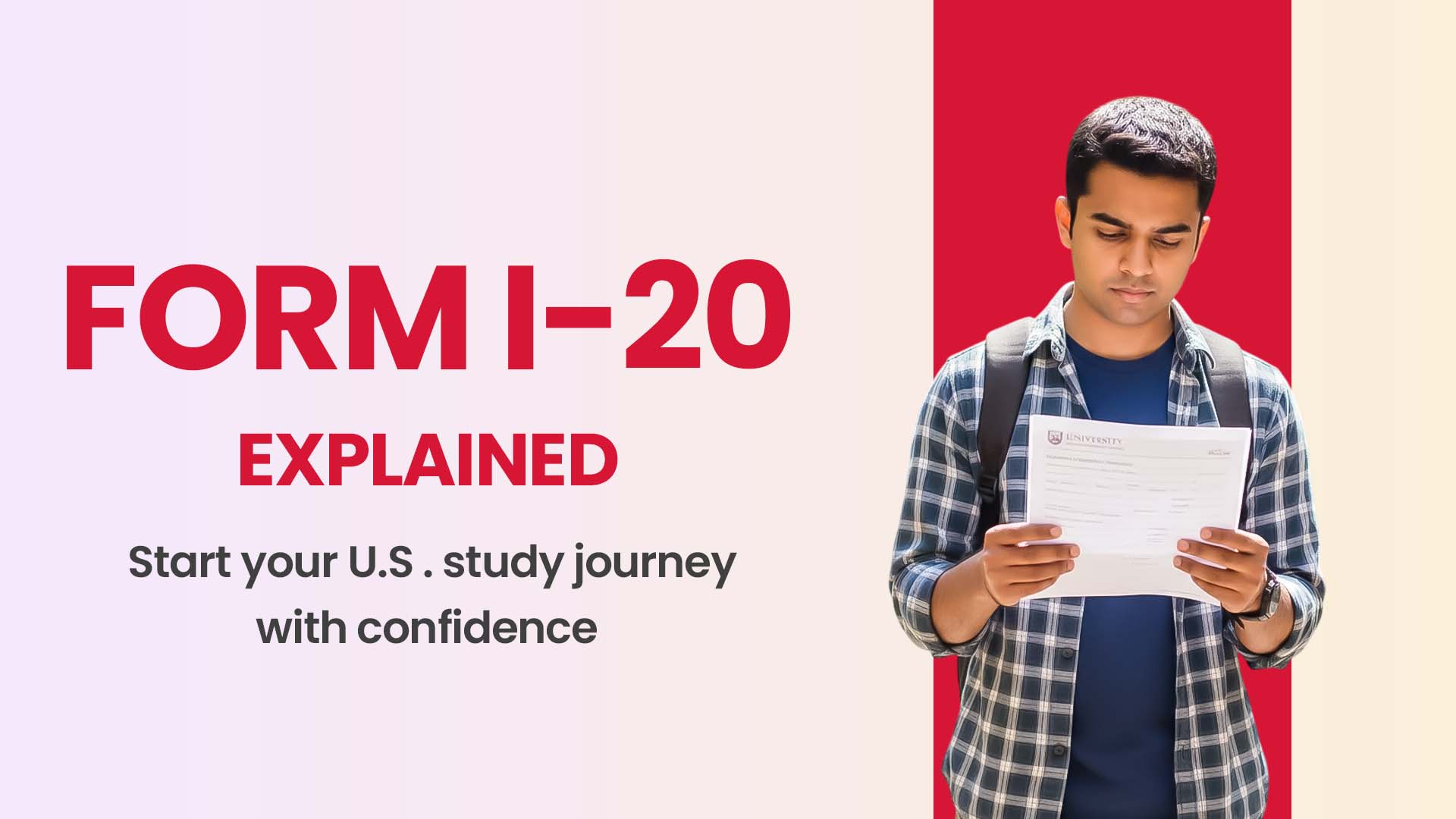
Studying in the United States is a dream for many international students, and securing admission to a U.S. institution is the first step toward fulfilling that dream. One of the most critical documents in this journey is Form I-20, issued by U.S. institutions to students accepted into their programs. This blog provides an in-depth guide to Form I-20, covering its purpose, application process, key sections, and important guidelines.
Form I-20, officially known as the Certificate of Eligibility for Nonimmigrant Student Status, is a document issued by the Student and Exchange Visitor Program (SEVP)-certified U.S. institutions to international students admitted to their academic programs. This document is essential for obtaining an F-1 (academic student visa) or M-1 (vocational student visa) and plays a significant role throughout a student’s stay in the U.S.
You must fulfill the following prerequisites to receive the I-20 visa application form-
You must complete the following two procedures after receiving your I-20 form-
Form I-20 serves several key purposes:
Any international student seeking to study in the U.S. under an F-1 or M-1 visa must obtain Form I-20 from their educational institution. This includes:
To receive a Form I-20, students must first secure admission to a SEVP-certified U.S. educational institution. The school must confirm the student’s acceptance and financial ability to pay for their studies.
After acceptance, students typically need to provide:
Once the required documents are verified, the school issues Form I-20, which contains the SEVIS (Student and Exchange Visitor Information System) number and other details.
Students must pay the SEVIS I-901 fee at www.fmjfee.com before submitting a visa application. The receipt is required for the visa application.
With Form I-20, students can proceed with the F-1 or M-1 visa application by scheduling a visa interview at the nearest U.S. Embassy/Consulate.
The major you have selected and the level of study you are pursuing under graduation or postgraduation—determine the completion date on your Form I-20. In addition, the university has estimated how long it might take you to complete all of the prerequisites for your degree. An extension can be sought from the university's foreign office at least one month before the completion deadline, just in case you cannot complete your program by the specified date. Furthermore, the length may differ according to the degree of study-
To remain in compliance with U.S. immigration laws, students must:
If Form I-20 is lost, damaged, or expired, students should immediately contact their school’s DSO to request a new copy.
Common Mistakes to Avoid
The following situations may result in students receiving a new Form I-20 from their DSO after receiving the original Form I-20 for program acceptance-
Final Thoughts-
Form I-20 is a crucial document for international students planning to study in the U.S. Understanding its purpose, application process, and maintenance requirements ensures a smooth transition into academic life in the U.S. Students must carefully review and comply with all the regulations related to their Form I-20 to avoid legal complications during their studies.
Ans- Form I-20 is an official document issued by SEVP-certified U.S. institutions to international students, allowing them to apply for an F-1 or M-1 student visa and study in the U.S.
Ans- Any international student seeking to study in the U.S. under an F-1 (academic) or M-1 (vocational) visa must have a valid Form I-20 issued by their school.
Ans-You must first gain admission to a SEVP-certified U.S. school, provide financial proof, and meet all admission requirements. The school will then issue Form I-20.
Ans- No. Form I-20 is required to apply for a student visa, but it is not a visa. You must present it when applying for an F-1 or M-1 visa at a U.S. embassy or consulate.
Ans- You must pay the SEVIS I-901 fee, apply for a student visa, schedule a visa interview, and bring Form I-20 to the U.S.
Ans- Yes, but you need a valid travel signature from your Designated School Official (DSO) before leaving. The signature should be renewed every six months for re-entry.
Ans- You cannot stay in the U.S. or travel without a valid I-20.
Ans: Form I-20 allows students to apply for Curricular Practical Training (CPT) and Optional Practical Training (OPT), but separate approval is required before commencing work.
Ans- If your program extends beyond the I-20 expiration date, you must request an extension from your DSO before it expires to maintain your legal status.
Ans—If you change your major, school, or funding source, you must get a new Form I-20 from your DSO reflecting these changes.
It can be stressful for foreign learners to apply for a master's program. Are you sure you applied for the correct visa? Which linguistic test must you complete? When is the best time to book your flights? There are many things that you have to consider.
You could choose to enlist the assistance of a study abroad consultant, Gateway Abroad Jaipur, who will assist you with the documentation and registration.
To give you peace of mind that the Master's program is complete, here is an overview of all the things you must achieve from the start until you're ready to take flight.
You must first finish your bachelor's degree in order to apply for a master's degree overseas. For admission to the majority of master's programs, you must have a specific grade on your bachelor's program of study.
You have to take an English Proficiency Test to prove your linguistic knowledge. At this point, you should also prepare all of your prior records, as you will require them for the application. However, to ensure you are getting everything crucial, it is essential to follow your application process strictly.
The first step is to determine precisely how you intend to spend the next twelve months to two years of your life. However, you most likely already know what you are looking to pursue at this point. The majority of people will find this to be comparable to or equivalent to their bachelor's degree.
Examining universities with a reputation for distinction in your subject is a brilliant idea. Searching for funding to study abroad is also an essential thing to know. Moreover, the language of instruction, the degree's international validity, and your future employment prospects are other crucial considerations.
As directed by the institution you attend, the next stage is completing an international language competence exam. This material is included in the prerequisites for the course you choose.
You will probably need to pass either the IELTS or TOEFL because most universities now offer English-language courses.
Additionally, some institutions accept other English language assessments, such as the Duolingo or PTE Academic tests. In addition to the program you choose, you might also be required to take extra qualifying tests, such as the GRE or GMAT.
All of your original paperwork, such as your prior diplomas and the outcomes of your classwork and language assessments, should now be with you. Letters of recommendation or references, a statement of purpose, or a personal statement may still be required to finish your application.
References, which can come from current employers or former instructors, serve as a means of confirming your qualifications and moral fiber. Remember to allow them adequate time to respond.
A personal statement is a brief essay that enables you to discuss yourself, your motivations for applying to the course, and your belief that you are a qualified applicant.
In addition to your application, you might be looking for and qualifying for postgraduate international scholarships. The institution's portal is the ideal starting point for your research. The majority of institutions provide overseas students with substantial scholarships.
To find out about any further government grants, bursaries, or scholarships that might be relevant to you, you can then visit the official pages of the respective governments in the country.
Examining portals that provide a thorough list of funding for study abroad available in every nation, provided by various private or public companies, may also be a wise choice. A brilliant place to start your scholarship search is with well-known international scholarships such as the Fulbright, Chevening, and GREAT grants.
Applying for a student visa should be your first course of action after verification from your educational institution. In most cases, if you are an international student who needs a visa to visit a particular nation, you must provide the following papers, although the requirements vary depending on your nationality and the country you intend to travel to.
When applying for a student visa, several nations additionally require you to submit a medical certificate and proof of health insurance. The nation's official site has a list of all the things you have to upload.
Verify the tuition costs, whether you are interested in applying for a competitive scholarship program overseas, and whether you want to take out a foreign education loan to cover your expenses before deciding to study abroad.
After confirming your decision, you should make sure that the cost of paying for your education out of pocket or by taking out a student loan will be compensated for by increasing your earning capacity in the future.
Choosing accommodation well in advance will help you avoid worrying about where you'll stay for your first couple of nights in a foreign place, whether you choose private or university-provided housing. Furthermore, when you apply for a student visa, some nations additionally require proof of residency.
Although many nations require it in the visa application process, having foreign medical coverage is always a brilliant idea. When you have health insurance, you can be sure that you will be safe in the event of an accident or unanticipated disease without having to pay a considerable amount of money.
During the application process, overseas colleges require the following documents from you:
Copies of your previous academic credentials: When applying for a master's degree at a foreign university, you have to include verified copies of your English-language test graduation credentials.
Some schools will also demand a high school graduation certificate, even though the majority of master's applications only need an undergraduate degree. Universities require these records as evidence that you have completed and attended prior educational cycles to admit you to a postgraduate degree.
The documents of your academic work provide the institution with comprehensive information about your undergraduate coursework, including modules and lessons taken with grades. The transcripts in question must be official copies, not pictures or written pages, as required by institutions.
Transcripts from academic institutions are crucial because they show which courses you have taken. This information helps colleges determine whether you have the training and experience needed for the Master's program you are applying for.
You are likely going to study in English or another widely used foreign language when pursuing a degree overseas. Because of this, institutions require you to be sure that you are capable of using a foreign language at the level of academia and that it won't be an obstacle to your educational experience.
For those who are learning English, IELTS, PTE Academic, TOEFL, C1 Advanced, and other formal language certifications are usually required by Master's programs. They are genuinely expecting you to have a specific score when they demand it. The higher your score, the more specific they are in believing that you are proficient in English.
Many learners need direction when they are required to submit a motivation letter or statement of purpose with their application. Although they seem very comparable, a statement of purpose and a motivation letter are not the same thing.
Nonetheless, both documents should focus on your educational experiences and the reasons you are applying for a certain degree. They should also generally be well-written, concise, and organized.
Universities anticipate that in a motivation letter, you will emphasize in greater detail your career ambitions and the background related to the course of study. Additionally, they may ask you to specify the course or area of specialization you wish to pursue for your master's.
In your statement of purpose, colleges expect you to discuss your background, hobbies, and career aspirations, as well as what has shaped and motivated your educational and career path so far. Put differently, it's a far more intimate document that allows you to make your application stand out.
Your academic resume serves as your business card. However, you should absolutely discuss your professions and extracurricular interests; schools will only show a little interest in hearing about them in great detail.
They want to evaluate how your background aligns with or demonstrates your interest in the course of study you wish to pursue. Because of this, you should concentrate on adding published scholarly papers, work in academic groups, pertinent think-tanks, etc., to your resume.
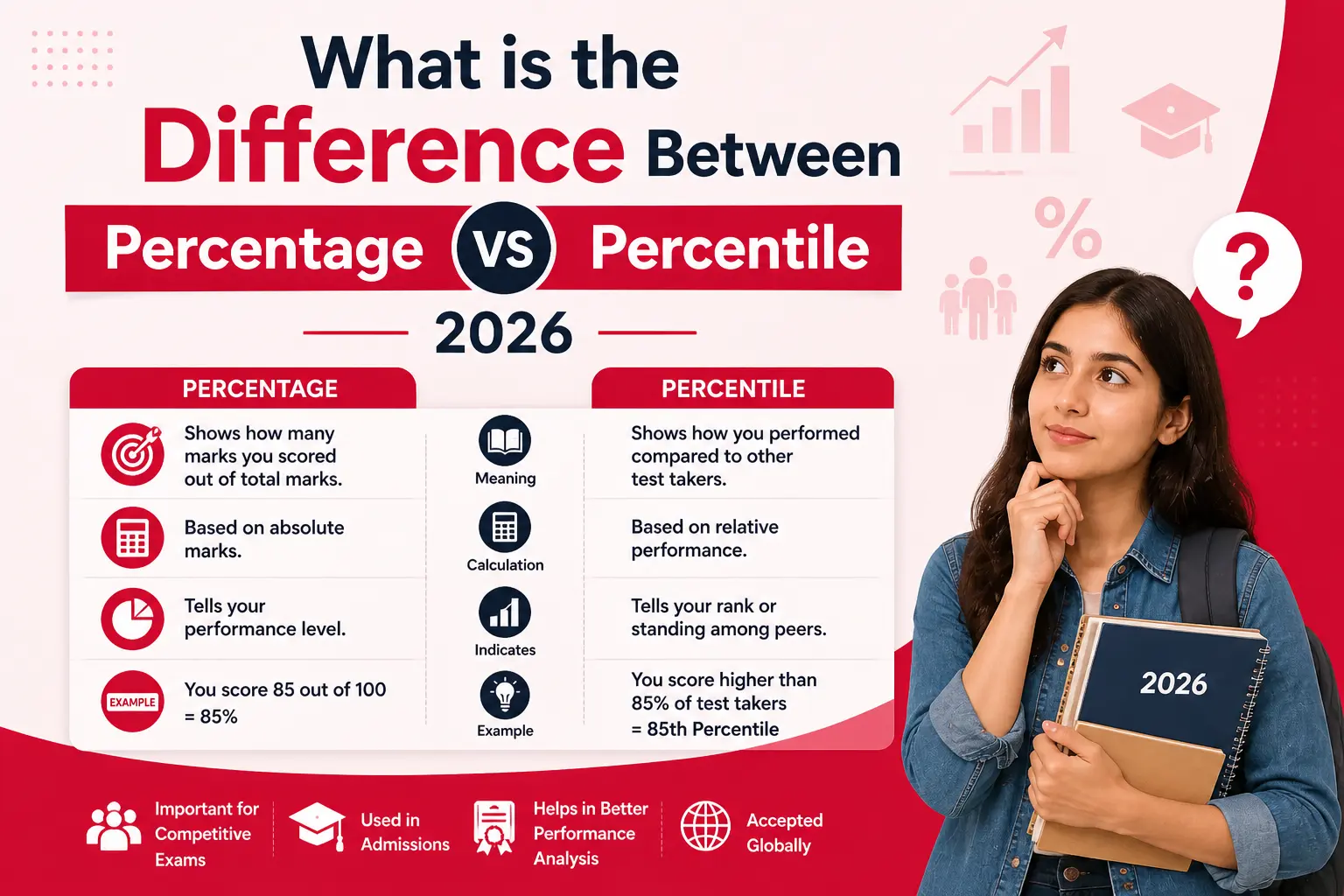
In the world of numbers and statistics, especially in academic performance and competitive examinations, the terms percentage and percentile are frequently used. While they sound somewhat similar and are often confused, they refer to entirely different concepts. Both serve important purposes in evaluation systems, statistical interpretation, and comparative analysis.
This guide aims to provide a detailed understanding of what percentages and percentiles are, how they differ, and when each is used. We will explore definitions, examples, key differences, usage in various fields, common misconceptions, and frequently asked questions.
Definition:
A percentage is a mathematical expression that represents a number as a fraction of 100. It shows how much of something exists relative to the whole.
Formula-
|
Percentage |
(Obtained Value) |
×100 |
|
(Total Value) |
Example-
If a student scores 45 out of 50 marks in a subject-
|
Percentage |
45 |
×100 |
|
50 |
Percentages are useful for giving an absolute measure of achievement or value, and they allow for easy comparison across different contexts by normalizing data to a scale of 100. Percentages are widely used in everyday life, academics, finance, business, and data analysis. Below are the major uses of percentages-
1. Academic evaluation-
2. Financial calculations-
3. Business and economics-
4. Data interpretation-
5. Daily life-
6. Exams and competitive tests-
7. Investments-
A percentile is a measure used in statistics to indicate the relative standing or rank of a value in a dataset. It tells us what percentage of observations fall below a particular value.
Example:
If your exam score is in the 85th percentile, it means you scored higher than 85% of the test-takers. It does not mean you scored 85%.
Common Percentiles:
Percentiles are primarily used to evaluate a person’s relative performance in comparison to a group. Percentiles are widely used in education, statistics, healthcare, business, and performance evaluation to understand how a specific value or individual compares to a larger group. Unlike percentages, which show an absolute value out of 100, percentiles measure relative ranking. Here are the key uses of percentiles-
1. Competitive exams and standardized tests-
2. Educational assessment-
3. Growth and health assessment-
4. Human resources and employee appraisal-
5. Statistical analysis and research-
6. Finance and economics-
7. Risk assessment and quality control-
Definition-
Nature-
Purpose-
4. Calculation-
|
Percentage |
(Obtained Value) |
×100 |
|
(Total Value) |
5. Range-
6. Score dependency-
7. Usage-
8. Interpretation-
9. Example-
Result type-
Application context-
Evaluation type-
|
Feature |
Percentage |
Percentile |
|
Definition |
A value out of 100 representing part of a whole. |
A measure indicating the value below which a given percentage of observations fall. |
|
Nature |
Absolute |
Relative |
|
Represents |
How much is achieved |
How well one performed compared to others |
|
Use Case |
Marks, growth rates, financial data |
Competitive exams, statistical ranking |
|
Range |
0% to 100% |
1st to 99th percentile (usually) |
|
Meaning of 90 |
90% = 90 out of 100 |
90th percentile = better than 90% of people |
|
Interpretation |
Direct and quantifiable |
Comparative and positional |
|
Dependency |
Independent of others’ scores |
Dependent on others’ scores or values |
Example 1: Exam Score
Here, the percentage tells us what the student scored, while the percentile tells us how they ranked.
Example 2: Competitive Exam (e.g., NEET, JEE, GMAT)
Suppose 2 lakh candidates appear for an exam.
Here, the percentile is more important than percentage, especially when cutoffs are based on relative performance.
Example 3: Child Growth Chart
Academic and Competitive Exams:
For example:
Statistics and Research:
Medical Field:
Business and Finance:
“Percentile and percentage are interchangeable.”
Not true. A student scoring 95% may not be in the 95th percentile if many others also scored higher.
“A percentile is just a percentage score.”
No. Percentile is a rank, not a score.
“If I’m in the 100th percentile, I scored 100%.”
Not necessarily. Being in the 100th percentile means you are the top scorer, regardless of the actual score.
7. Visual Representation
Imagine a class of 100 students:
8. When to Use Percentage vs Percentile
|
Situation |
Use Percentage |
Use Percentile |
|
Board Exams |
✔️ |
❌ |
|
Competitive Exams |
✔️ + Percentile (for ranking) |
✔️ |
|
Health Reports |
❌ |
✔️ |
|
Business Growth |
✔️ |
❌ |
|
Statistical Ranking |
❌ |
✔️ |
9. Pros and Cons
Percentage
Pros:
Cons:
Percentile
Pros:
Cons:
10. Tips to Remember the Difference
Use this simple memory trick:
Understanding the difference between percentage and percentile is essential for interpreting performance in academics, exams, research, and professional evaluations. While percentage provides a direct measure of achievement, percentile gives context to that achievement by comparing it to the performance of others.
In a highly competitive world, relative performance often matters more than just raw scores. Hence, percentile rankings are increasingly used in selection processes. However, both concepts are valuable in their own right and must be used wisely depending on the situation.
By grasping the distinctions between these two terms, students, professionals, researchers, and analysts can better interpret data, make informed decisions, and communicate results more accurately.
|
Explore More: |
Q1: Can I score 99 percentile with 70% marks?
Yes, if most other candidates score less than 70%, your percentile could be 99.
Q2: Is 100 percentile possible?
Technically, no. 99.9 is the highest, representing the top performer. The 100th percentile would mean you scored better than yourself, which isn’t statistically valid.
Q3: Is percentile used in all exams?
No. It is mainly used in competitive and standardized tests where relative ranking matters.
Q4: Which is more important—percentage or percentile?
Depends on context. For jobs and university admissions, percentile is crucial in competitive exams; percentage is used in regular academic evaluation.
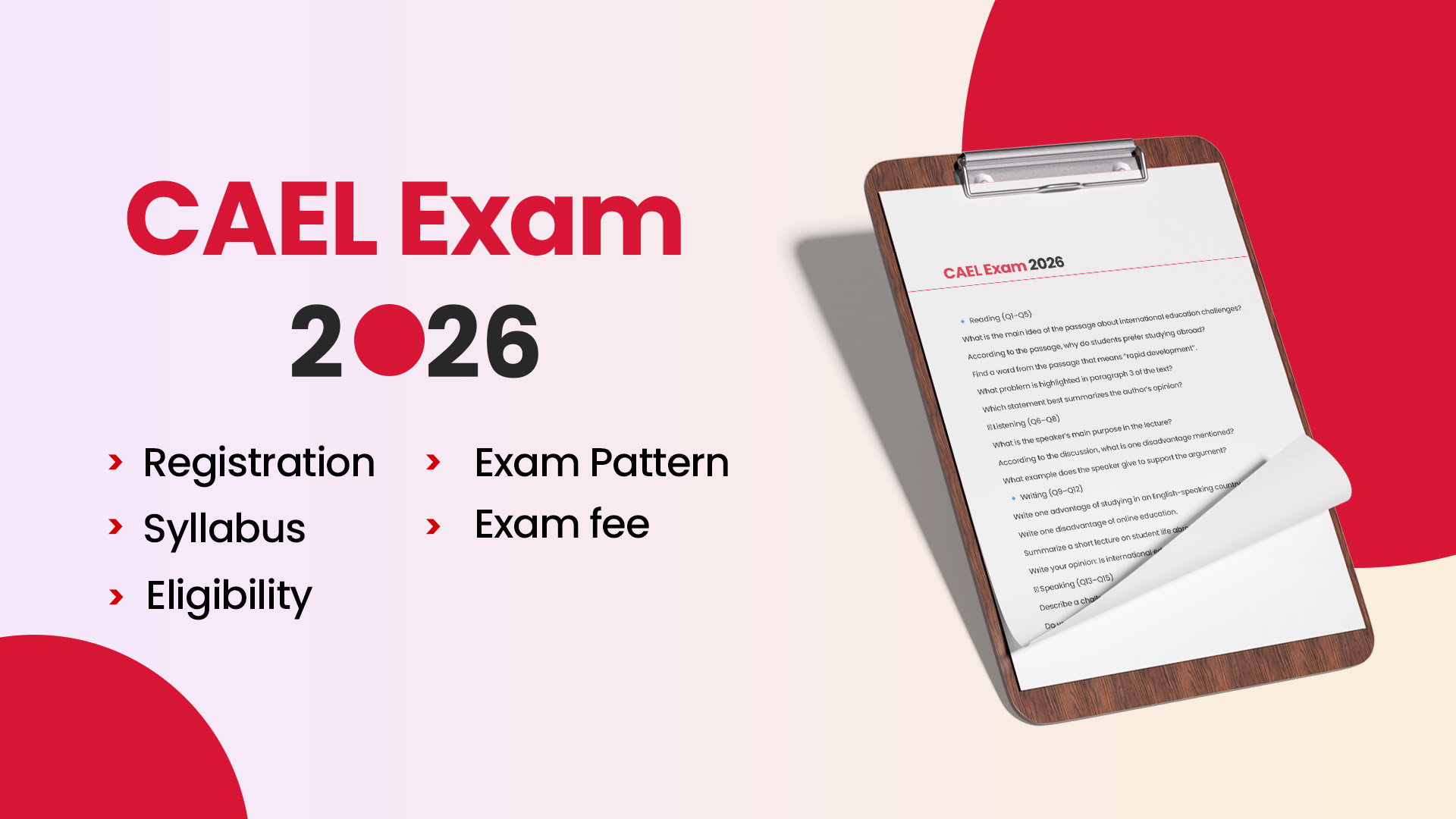
The Canadian Academic English Language (CAEL) Test is a standardized assessment designed to measure the English language proficiency of individuals seeking to study or work in English-speaking environments, primarily in Canada. This thorough information gives detailed perspectives on the CAEL test, including elements such as registration, exam structure, curriculum, costs, qualification criteria, and examination dates.
The CAEL exam assesses a student's English language proficiency before they enroll in a post-secondary educational institution in Canada. The test is an acronym for the Canadian Academic English Language (CAEL). It is among the best ways to assess if a student is proficient in English, which is necessary for success in the classroom.
The CAEL exam assesses a candidate's proficiency in English in academic settings. Through integrated exercises that mimic real-life situations found in academic contexts, it evaluates all four language skills: speaking, reading, writing, and listening. Many Canadian educational institutions acknowledge the test as a valid indicator of English language competency. The CAEL exam realistically depicts the English language used in Canadian academic settings.
|
Exam Name |
CAEL |
|
CAEL Full form |
Canadian Academic English Language |
|
Most popular for |
Studying in Canada |
|
Conducted by |
Paragon Testing Enterprises |
|
Mode of Exam |
Computer-Based Test |
|
Test Type |
CAEL Online CAEL At Test Centre |
|
Duration |
3.5 Hours |
|
Result |
8 Working Days |
The following are the main categories of CAEL tests-
The CAEL test has several benefits and justifications. Among them are-
· Fully computer-delivered: The CAEL exam can be taken entirely online at home or in person at one of the more than 40 testing locations located throughout the world.
· Test duration: The entire test takes roughly three and a half hours. Speaking, Reading, Writing, and Listening are the four areas on which the final test report assigns scores.
· Proficiency in all four sections of the CAEL tests integrated: Candidates must finish a variety of assignments. In several of these exercises, the person taking the test will need to apply their skills to respond to questions depending on their written and spoken responses to what they have come across.
· Unscored items in every test: Every test includes tasks and unscored items that are utilized to create new tests. The structure of these unscored questions is the same as that of the scored items, and they might be included in any assessment. The difference between unscored and scored questions is going to be indistinguishable to the exam taker.
There are multiple processes involved in registering for the CAEL exam to make sure applicants are ready and fulfill all prerequisites.
Make an account: To get started, register on the official CAEL website. All exam-related activities, including registering, obtaining learning resources, and viewing test results, will be accessed through this account.
Choose your test format: There are two formats for the CAEL exam-
Select the option that best fits your needs and schedule.
Choose the test day and place: Decide on a convenient test date and location. Many places throughout the world, including several centers in India, offer the CAEL exam. Although test dates are offered all year round, it is best to sign up as soon as possible to guarantee your desired time window.
Make the test fee payment: Each site has a different test fee. In India, test-takers must pay about INR 12,500 as of 2026. Some online payment options are available, such as net banking and credit/debit cards.
Confirmation: You will receive a confirmation email with information on your test day, time, and location once you have finished registering and paying. Make sure that everything is accurate and notify the exam center if mistakes appear.
For efficient preparation, it is essential to comprehend the format of the CAEL exam. The exam is designed to evaluate integrated language proficiency using exercises that closely resemble academic assignments.
The following elements make up the CAEL test-
|
Skills |
Duration |
|
Speaking |
7-10 Minutes |
|
Integrated Listening
|
25-35 Minutes |
|
Integrated Reading |
35-50 Minutes |
|
Academic Unit A |
60-70 Minutes |
|
Academic Unit B |
40-45 Minutes |
The Integrated Skills Approach
Candidates must use a variety of language abilities in a single activity as part of the CAEL test's integrated skills approach. To make sure candidates can successfully synthesize material, a prompt for writing that requests an overview or analysis may be given after a reading passage.
The 2026 CAEL test syllabus is meant to take into account the linguistic requirements of a classroom setting. Every division concentrates on particular abilities and kinds of tasks.
Standard test charge- As of 2026, the cost in India is roughly INR 12,500.
Supplementary services-
Since fees are subject to change, it is best to check the authorized CAEL webpage for the most up-to-date details.
Those who want to prove their English language skills, especially for academic purposes in Canada, can take the CAEL exam. The CAEL exam does not have an established age limit. Candidates under the age of eighteen, however, might require parental approval. No particular academic background is necessary to take the test. Nevertheless, applicants should verify the language requirements of the university or company they are applying to. The exam center may require a valid passport or government-issued ID for registration and the test day, depending on the exam center.
Candidates must bring the same ID they used to register. Candidates can take the CAEL exam as many times as they wish. However, each time, applicants need to register and pay the exam fee. However, applicants should confirm that they can meet the language competence standards of the organizations or institutions they plan to attend.
There are dates available for CAEL tests all year long. A test sitting's registration period ends either one business day before the test or when the sitting meets its maximum number of participants. Dates, hours, and places of the tests are subject to vary, and candidates will receive an email if their registration updates. To get the most up-to-date information on exam dates and availability, visit the official CAEL website often.
It takes a lot of preparation to score highly on the CAEL exam. The following tactics will help you succeed-
Professionals and students who want to work or study in Canada take the CAEL test to assess their English ability. The test accurately assesses language proficiency in everyday situations because of its integrated skills approach. There are several exam dates available to candidates throughout the year, and the registration process is simple. Comprehending the exam format, curriculum, costs, and prerequisites is crucial for effective preparation. Candidates can raise their grades by performing frequently and through official educational resources.
Ans- Anyone can take the CAEL test, but it is primarily for students applying to Canadian institutions. There are no strict age or educational requirements.
Ans- You can register online through the official CAEL website, select a test date and location, and pay the exam fee.
Ans- The test consists of four sections: Speaking, Reading, Listening, and Writing, with integrated tasks that reflect real academic scenarios.
Ans- The CAEL test assesses English proficiency using academic reading passages, lectures, discussions, and writing tasks that require critical thinking.
Ans- The test fee varies by location. In India, it is approximately INR 12,500 as of 2026. Additional fees may apply for rescheduling or cancellations.
Ans- CAEL test dates are available throughout the year at multiple locations worldwide. Candidates can check the official website for the latest test dates.
Ans- Yes, there is no limit on the number of times you can take the CAEL test. You must register and pay the fee for each attempt.
Ans- Test results are typically available within 8 business days after the test date. Candidates can access their scores online.
Ans- A valid passport or government-issued ID is necessary for both registration and test day verification.
Ans- Candidates can use official CAEL practice materials, sample tests, and online courses available on the CAEL website to improve their performance.

An essential step for prospective medical professionals looking to get admission to prestigious medical schools across the globe is the Medical College Admission Test, or MCAT. The 2026 MCAT exam will include a thorough assessment of a candidate's knowledge, critical thinking, and problem-solving ability. The MCAT exam, a comprehensive standardized test, is an essential component of the medical school enrollment process and a key predictor of an applicant's likelihood of success in the challenging and demanding field of medicine.
The 2026 MCAT exam will test numerous areas, including biology, chemistry, physics, psychology, sociology, and research methodologies. It assesses people's comprehension of scientific ideas and their ability to connect these concepts to actual medical circumstances.
A computer-based exam called the Medical College Admission Test (MCAT) assesses applicants in four areas. Students who wish to pursue medical studies in the US, Australia, Canada, and other US territories must take the Medical College Admission Test, or MCAT exam 2026.
It addresses biology, chemistry, physics, psychology, and sociology. The test is a crucial component of the medical school application process. It assists in assessing whether students possess the abilities and information required to excel in medical school.
Prospective test-takers should carefully check the eligibility requirements established by the exam organizers prior to taking the MCAT exam. Students who want to work in allopathic, osteopathic, podiatric, or veterinary medicine can take the MCAT. Applicants must fulfill the following eligibility standards-
Candidates wishing to register for MCAT must produce valid ID proof and an AAMC ID to demonstrate their candidature. The list of the required documents is available on the official AAMC website. Students are advised to check the AAMC website regularly to get the latest updates regarding the documentation. We have included the list of ID proofs that are acceptable by the authority during MCAT registration-
The four main test components included in the MCAT syllabus are-
To answer the questions, you must combine your knowledge of biological and biochemical concepts with your aptitude for scientific inquiry and reasoning in the fields of biology and biochemistry. This section looks at processes that are specific to living things, like-
It also evaluates how well an organism's organ systems and cells work together and independently. It asks you to talk about what happens inside the living structure at different levels of biological organization.
By combining your understanding of basic concepts in physics and chemistry with your scientific investigation and reasoning, you are expected to address the difficulties associated with the chemical and physical underpinnings of biological systems. This section assesses your comprehension of –
It also assesses your comprehension of the fundamental physical and chemical concepts that underlie the mechanics of human organs and your capacity to apply these ideas to life systems.
To address problems, you will need to integrate your fundamental ideas with scientific research and reasoning, focusing, in part, on the psychological, social, and biological foundations of behavior.
The critical analysis and reasoning section of the MCAT exam will resemble many of the verbal tests that have been used to evaluate our reasoning abilities during our schooling.
While the MCAT takes six hours and fifteen minutes, the entire sitting time, including breaks, is seven hours and thirty minutes. All four of the MCAT exam's components total between 472 and 528 marks.
The MCAT is divided into four sections, each designed to assess different competencies:
Sections | No. of MCQ's | Duration in Minutes |
Biological and Biochemical Foundations of Living Systems. | 59 | 95 |
Chemical and Physical Foundations of Biological Systems. | 59 | 95 |
Psychological, Social, and Biological Foundations of Behaviour. | 59 | 95 |
Critical Analysis and Reasoning Skills. | 53 | 90 |
To register for the MCAT exam, take the actions listed as follows-
The MCAT is administered multiple times throughout the year. For 2026, the exam dates are as follows:
Please be aware that these dates could change at any time. To ensure you have the most recent information, you must consult the AAMC's official MCAT calendar.
Under normal circumstances, the cost of the MCAT exam in India is around INR 27,885. Depending on how many days remain before the test date at the time of late MCAT registration, late registration fees range from 4,152 INR to 16,610 INR.
Together with the initial enrolment price, participants examining beyond the US, Canada, or US Territories will be assessed an international fee of USD 120. If registration is canceled, global payments are not recoverable.
AAMC can reschedule or cancel the MCAT test dates. The Association of American Medical Colleges, or AAMC, has a web page where students can ask for exam cancellations and rescheduling.
The timing of the original test date determines the MCAT cancellation and rescheduling fees. The Eastern Time Zone determines the cancellation limitations. However, after ten days before the test date, pupils are unable to change the date.
The MCAT exam in 2026 is a crucial milestone for those who want to become doctors. It evaluates critical thinking and analytical abilities, as well as a wide range of knowledge in disciplines, including biology, chemistry, physics, psychology, and sociology. Due to its demanding format and high stakes, the MCAT requires intense study and preparation.
Performing well on the test dramatically increases one's chances of being admitted to prestigious medical programs and starting a rewarding career in medicine. By showcasing their understanding of scientific concepts and their capacity for applying them to actual medical situations, people can start a life-changing path to significantly improve the lives of others.
Ans- The MCAT is typically offered from January through September. Exact dates and registration deadlines can be found on the official AAMC website.
Ans- The exam lasts 7 hours and 30 minutes, including breaks. It consists of four sections, each lasting around 90–95 minutes.
Ans-
Ans- Each section is scored from 118 to 132, with a total score range of 472 to 528. The median score is around 500.
Ans-
Ans- Most students study for 3 to 6 months, dedicating 300–500 hours to preparation.
Ans—No significant changes have been announced as of now. Always check the AAMC website for updates.
Ans- The standard registration fee is around $330, with additional costs for late registration, rescheduling, or international testing.
Ans- MCAT scores are typically valid for 2 to 3 years, depending on medical school policies.
Ans- The AAMC offers free and low-cost materials, including full-length practice exams, question banks, and study guides

The future of tomorrow lies with today's youngsters. Students or kids must design their study schedules based on their wise decisions if they want to influence the future. If one thing defines our internet generation, it is our audacious approach to life's decisions. In 2026, studying overseas will be more thrilling than before. There are several possibilities, whether you seek more established study locations or recent developments.
The global education scene has changed tremendously in recent years, and the trends for studying abroad in 2026 hold even more intriguing prospects. The future of international education is being shaped by several essential aspects as students and institutions adjust to changing demands. Here, we examine the most popular Study abroad trends for 2026, covering topics like visa regulations, study locations, educational styles, and study abroad applicants' goals.
New options for Study abroad destinations
Students who want to study abroad have a wide range of options, which can be thrilling and offer a range of experiences. Demand is rising for destinations such as study in Germany and study in Ireland, along with more conventional destinations like the Study in USA, Study in UK, and Study in Australia. The inexpensive cost of living, student-friendly visa laws, and high quality of education are the reasons for these new preferences.
It is enhanced by the availability of post-graduation work visa opportunities in top countries and the generally low cost of living. This has inspired students to broaden their perspectives and make decisions based on their long-term professional goals related to their study locations.
Study abroad applicants increasingly choose Hybrid Learning Models, which combine online and in-person instruction. These approaches enable students to begin online education before switching to on-campus instruction. This method provides flexibility, lowers upfront expenses, and considers students who could have difficulties obtaining a study visa.
For example, universities in the US, UK, and Australia are expanding their hybrid learning initiatives, giving students access to top-notch education regardless of where they live. This trend will particularly benefit those pursuing higher education while juggling employment or personal obligations.
Universities emphasize practical skills that meet industry expectations, as skills-based education is widespread. Students getting ready for the global labor market are especially interested in courses in technology, artificial intelligence, sustainability, and healthcare.
Universities and businesses collaborate to encourage this trend by giving students practical experience through workshops, internships, and real-world initiatives. This gives prospective students who want to study abroad access to state-of-the-art materials and chances to network to improve their employability.
Sustainability is evolving into a crucial component of international education and is no longer merely a trendy term. Numerous academic institutions are integrating environmentally friendly procedures into their campus operations and programs. Additionally, ethical education—emphasizing environmental care and social responsibility—is becoming more popular.
Courses that tackle global issues like social justice, energy conservation, and climate change are gaining popularity among students. This pattern indicates a shift in objectives, with education acting as a vehicle for constructive global influence.
One of the biggest concerns of students who want to study abroad is financial accessibility. Governments and academic institutions are responding to this by increasing the number of study abroad scholarships and grants available. These consist of region-specific, need-based, and merit-based scholarships intended to draw in a wide range of international applicants.
For example, students get significant financial assistance through the DAAD Scholarships, Chevening Scholarships, and the Fulbright Nehru fellowship Program. New funding programs are also being introduced to encourage inclusion in foreign education and assist underrepresented groups. Minority and economically disadvantaged individuals and those with exceptional aptitude in the arts, STEM course, and technology would be the target audience for the new scholarships.
Emerging nations like Germany, the Netherlands, and Study in Singapore are drawing interest, even if well-known travel destinations like the US, Canada, the UK, and Australia are still popular. These locations provide excellent post-graduation employment prospects, reasonably priced tuition, and high-quality education.
For instance, Germany's strong engineering programs and tuition-free educational system are top attractions for international students. Similarly, people looking for a smooth transition from school to work choose Study in Canada because of its welcoming immigration laws and work visa options.
Study abroad preparation relies heavily on English proficiency tests like the Duolingo English Test, TOEFL, and IELTS. Nonetheless, the structure and availability of these tests are changing. Students are finding it easier to complete language requirements because of online testing choices and quicker result delivery.
Furthermore, some universities are implementing their language tests or exempting students from English-speaking nations or those who have already studied in English from taking the English competency exam.
learn more: Top Non English Speaking countries for Study Abroad
Regarding Study abroad trends for 2026, the student experience is at the forefront. Universities spend money on career counseling services, cultural integration initiatives, and mental health support. These programs aim to establish a comprehensive setting that supports professional, intellectual, and personal development.
Additionally, technology contributes to improving students' educational experience. Personalized learning platforms, AI-powered academic advisement, and virtual campus tours assist students in making wise choices and maintaining their interest throughout their educational careers.
This teaching approach is becoming increasingly popular. Universities provide more individualized learning opportunities, enabling students to tailor their Study plans to their interests and needs. Student-centric learning approaches strongly emphasize adaptability, personalization, and engagement. Universities are implementing strategies that let students customize their education to fit their interests and professional aspirations. For instance, students can investigate various subject areas thanks to interdisciplinary curricula and modular course designs.
This trend, in line with the increasing need for individualized instruction, guarantees that students get the most out of their foreign education investment. Personalized learning allows prospective students to create a curriculum that fits their interests and professional objectives. Because of this change, students have more control throughout their academic lives.
Geopolitical issues heavily influence study-abroad patterns. Immigration, international relations, and visa policies significantly influence student mobility. Changes in visa regulations, for instance, in popular countries like the US and the UK, can attract or discourage international students. Studying international agreements and alliances significantly shapes prospects.
Cross-border educational partnerships and dual-degree programs are gaining popularity, providing students with distinctive educational opportunities. Geopolitical stability and advantageous legislation will draw more students to particular areas in 2026. Governments are also attempting to improve relations with other countries through collaborations and educational exchanges.
Opportunities for employment after graduation are a key factor for students hoping to study abroad. International student enrolment is expected to rise in nations that provide easier routes to permanent residence and employment. For example, after finishing their studies, students can obtain helpful work experience through Australia's Temporary Graduate Visa and Canada's Post-Graduation Work Permit (PGWP). These chances are alluring because they facilitate students' seamless transition from school to the working world.
Country | Post-graduation work visa duration | Qualifications required |
United States | 12-36 months (OPT) | Degree from a U.S. institution |
United Kingdom | 2 years (Graduate Route) | Degree from a UK university |
Canada | 1-3 years (Post-Graduation Work Permit) | Full-time program completion in Canada |
Australia | 2-4 years (Temporary Graduate Visa) | 2+ years of study in Australia |
Germany | 18 months (Job Seeker Visa) | Degree from a German institution |
As the variety of courses increases, students are choosing degrees in cutting-edge disciplines like data science, environmental studies, and digital marketing. Although traditional professions like business administration, engineering, and medicine are still in demand, specializations are becoming increasingly common.
This change reflects the dynamic global labor market, with new sectors and positions appearing regularly. Universities are adapting their curricula and launching new programs to satisfy modern expectations.
Technology is changing students' preparation for studying abroad. Technology advancements are making the process easier, from AI-powered apps for university selection and application monitoring to virtual chats with education consultants. Platforms that help students prepare for English proficiency tests and apply for visas also enable them to confidently handle the challenges of studying overseas.
An increase in dual degree and interdisciplinary programs is anticipated in 2026. These programs integrate domains like technology and business or healthcare and sustainability, enabling students to gain a variety of skill sets that will help them meet the demands of changing industries and compete in the global labor market.
The future of studying abroad appears brighter than ever as governments and universities work together to improve the student experience and address challenges. Students can accomplish their academic and professional goals by keeping up with these trends and utilizing available resources while positively impacting a more sustainable and interconnected world. The Study abroad landscape 2026 is defined by innovation, inclusivity, and adaptability. Hybrid learning models, skills-based education, and sustainable practices are redefining how students approach international education. Top destinations continue to change, providing new opportunities and pathways for aspirants.
Ans—Many new trends influence Indian students' academic paths as they prepare to study overseas in 2026–2026. Global universities are changing to meet students' demands, from skills-based education and hybrid learning models to more mental health support and sustainable education options.
Ans- Administration of Business.
Computer science and engineering.
Healthcare Management.
Statistics and mathematics.
Tourism and hospitality.
Foreign languages.
Nursing.
Both machine learning and artificial intelligence.
Ans- For international universities, autumn intake describes the courses that begin in September and go through December of a given academic year. For practically all universities, it serves as the central intake. Nearly every course is offered in the autumn.
Ans- Studying abroad significantly impacts professional advancement and improves academic credentials in today's globalized market. Students are better prepared with the necessary skills for long-term professional success as international experiences gain value.
Ans- Stepping outside your comfort zone, adjusting to new circumstances, and honing your problem-solving abilities are all necessary for navigating daily life in a foreign nation. You will develop perseverance and trust as you overcome obstacles, which will help you in many facets of life.
Ans- USA. The United States has been the most popular Study abroad location globally for many years. Students hungry for academic success come from all over the world to attend the nation's esteemed universities, which top international university rankings.
Ans- The most popular choice for international students is the autumn intake, which starts in late August or early September.
Ans- Many students now believe that studying abroad, where they may take advantage of more significant resources, possibilities for research, and global experiences, is a more appealing choice for investing in their future due to growing tuition rates.
Ans- Many students are currently receiving education loans from numerous institutions. Numerous financing programs that cover living expenses and tuition are available from banks and NBFCs.
Ans- The United States, the United Kingdom, Canada, and Australia are among the countries that grant students post-study employment visas. Students can thus develop their professional careers and gain valuable work experience after completing their Study abroad program.
Studying abroad is a dream come true for many students around the world. From world-class education to international exposure and networking opportunities, the benefits are immense. However, one of the primary barriers that can stand between students and their academic goals abroad is language proficiency—especially English. Whether you are aiming for the US, UK, Canada, Australia, or any other English-speaking country, a solid command of English grammar is critical not just for admission tests like IELTS, TOEFL, or PTE but also for academic success and daily communication abroad.
In this blog, we will explore the essential grammar rules and concepts that every study abroad aspirant should master. From sentence structures to verb tenses and connectors, this guide will provide the foundation you need to communicate accurately and confidently in both written and spoken English.
English grammar is the skeleton of the language. It gives structure to your thoughts and ensures clarity in communication. For study abroad aspirants, grammar proficiency is essential for the following reasons:
Here are the most essential English grammar concepts every study abroad aspirant should master:
Understanding the parts of speech is fundamental. For several students around the world, studying abroad is their ideal opportunity.
Eight primary parts of speech form the foundation of English grammar:
Understanding how each of these functions is the first step toward constructing correct sentences.
Correct sentence structure ensures your ideas are clear. English sentences are typically structured as follows:
Understanding how to structure these sentences will significantly improve both your writing and speaking scores.
When perfecting your sentence structures, make sure you also review the foundational rules for English degrees of comparison to describe qualities accurately
Tenses indicate the time of an action. A firm grasp of the 12 major English tenses is vital. Here’s a quick breakdown:
Learn Full Details: What is Present Tense
Learn Full Details: What is Past Tense
Learn Full Details: What is Future Tense
Each tense has its specific function in academic and casual contexts. For example, past perfect is frequently used in formal writing to indicate completed actions in the Past before another event.
According to this principle of subject-verb agreement, a plural subject needs a plural verb, and an individual subject needs a singular verb.
Watch out for tricky cases like:
Mistakes in subject-verb agreement are common and can lower your credibility in written and spoken English.
Nouns are defined by articles, which are brief but effective words. Knowing when to use them is crucial:
Omitting or misusing articles can confuse readers and affect your clarity.
Learn Full Details: What are articles in English Grammar
Prepositions are small words that link nouns and pronouns to other words:
Common preposition combinations include:
Misuse of prepositions can lead to awkward or incorrect expressions.
Learn: What are Prepositions, Meaning, Type, and Example
To indicate opportunity, need, or skills, modal verbs such as can, could, may, might, must, shall, should, will, and would are used.
• "You must send in an application by June."
Modal verbs are essential for expressing polite requests, suggestions, and formal tones in academic and professional settings.
Learn: What is a Modal Verb and an Example
Conditional sentences talk about possibilities or hypothetical situations. There are four main types:
Understanding conditionals is critical for writing essays and explaining causes and effects.
Active: "The professor teaches the course."
Passive: "The course is taught by the professor."
Passive voice is useful in academic writing when the actor is unknown or unimportant. However, overuse can make writing dull, so use it strategically.
Learn: What is Active and Passive Voice
Mastering English grammar isn’t about memorizing endless rules—it’s about understanding how the language works and applying it effectively. For study abroad aspirants, strong grammar isn’t just a test requirement but a life skill that will support every academic, social, and professional endeavor overseas.
By focusing on the grammar essentials outlined above and integrating consistent practice into your daily routine, you’ll build the confidence and clarity you need to thrive in an English-speaking environment.
Ans- Good grammar ensures clear communication, helps in passing language proficiency tests like IELTS or TOEFL, and is essential for academic writing and daily interactions abroad.
Ans- Focus on tenses, sentence structure, subject-verb agreement, articles, prepositions, modal verbs, and conditionals.
Ans- One of the most common mistakes is subject-verb agreement, especially with complex sentences or collective nouns.
Ans- Practice regularly using grammar apps, read English articles, write daily, and get feedback from teachers or language partners.
Ans- Yes, passive voice is acceptable and often preferred in academic writing when the doer of the action is less important.
Ans- Absolutely. Articles help define whether a noun is specific or general, which is crucial for clarity and correctness.
Ans- Grammar affects fluency and accuracy in speaking. Errors can confuse listeners and lower your band score in speaking tests.
Ans- Some useful resources include Grammarly, Cambridge Grammar books, BBC Learning English, and Purdue OWL.
Ans- You don’t need to be perfect, but you should demonstrate a solid grasp of grammar rules and avoid frequent errors.
Ans- Yes, exposure to native English through movies or podcasts improves your understanding of grammar in real contexts.

English is one of the most widely spoken languages in the world, and improving your spoken English can open doors to countless opportunities. Practicing with friends is one of the most effective and enjoyable ways to enhance your skills. In this blog, we’ll explore creative, fun, and simple daily exercises you can do with your friends to boost your spoken English skills.
Practicing spoken English with friends offers numerous advantages that make learning both effective and enjoyable. Here’s why:
Every day, set aside 15 to 30 minutes to speak with your friend exclusively in English. Commit to speaking exclusively English throughout this period.
It is an effective technique to rehearse talks in real life. Choose situations where you might utilize English, such as placing an order at a restaurant.
How to do it?
They keep you interested and make studying enjoyable. To increase your understanding of words and proficiency, try these games-
Twenty inquiries
· To figure out what a thing, person, or location is, a single individual thinks of it, and the other person asks up to 20 yes/no questions.
Association of Words
· Say words associated with the previous one in turn. As an illustration, "Sun" → "Light" → "Warmth" → "Beach."
Taboo
· Don't use any particular "taboo" words while describing a word. If the word is "Apple," for instance, stay away from terms like "fruit" or "red."
English-language films, TV series, and YouTube videos are excellent resources for learning pronunciation, phrases, and genuine expressions. Talk about what you saw to make it interactive.
Practice tips-
Storytelling enhances coherence, vocabulary, and fluency. Take turns telling English-language stories.
Story ideas-
Use flashcards to increase your vocabulary. On one side, write a new term, and on the other, its definition, pronunciation, or application.
How to work out together?
Debating is a great opportunity to hone your speaking abilities and practice quick thinking. Select straightforward, humorous subjects like-
How to lead a discussion?
Create word searches, riddles, or crossword puzzles for one another. Learning new terms and their definitions can be enjoyable in this way.
For instance-
One of the most effective tools for improving yourself is to record your interactions. It enables you to
How to complete it?
These are a great way to get better at diction and pronunciation. Here are a few examples-
instances such as-
How should you practice?
A variety of language-learning applications are available to make English practice enjoyable and engaging.
How can buddies utilize applications together?
Keep a collective journal in which you record new terms, expressions, and phrases.
How to apply it?
Choose arbitrary images from books, periodicals, or the internet to describe. Each person takes turns using English to describe the setting, the individuals involved, and the activities.
The reason it works-
Talk with your friends about the postings made by English-language accounts you follow on social media.
Concepts-
Making mistakes is a normal aspect of learning. As a group, discuss and gain knowledge from them.
How to handle errors?
Conclusion
Spoken English practice with friends may be fun and productive if done creatively and consistently. You will strengthen your relationship with your friends as well as your ability to communicate by implementing these enjoyable and easy everyday activities.
Ans- Begin by setting a regular time to practice and agree to speak only in English during that session. Start with simple topics and gradually increase the complexity as you grow more confident.
Ans-You can practice tongue twisters, do shadowing exercises by mimicking native speakers, or sing English songs together during a karaoke session.
Ans- Create a judgment-free zone with your friends. Remember, everyone is learning, and making mistakes is part of the process. Start with casual conversations to build confidence.
Ans-Try games like 20 Questions, Word Association, Taboo, or even creating riddles and puzzles for each other. These activities make learning interactive and fun.
Ans- Absolutely! Watching English media improves your listening skills, vocabulary, and understanding of natural expressions. Discussing what you watch with friends enhances the learning experience.