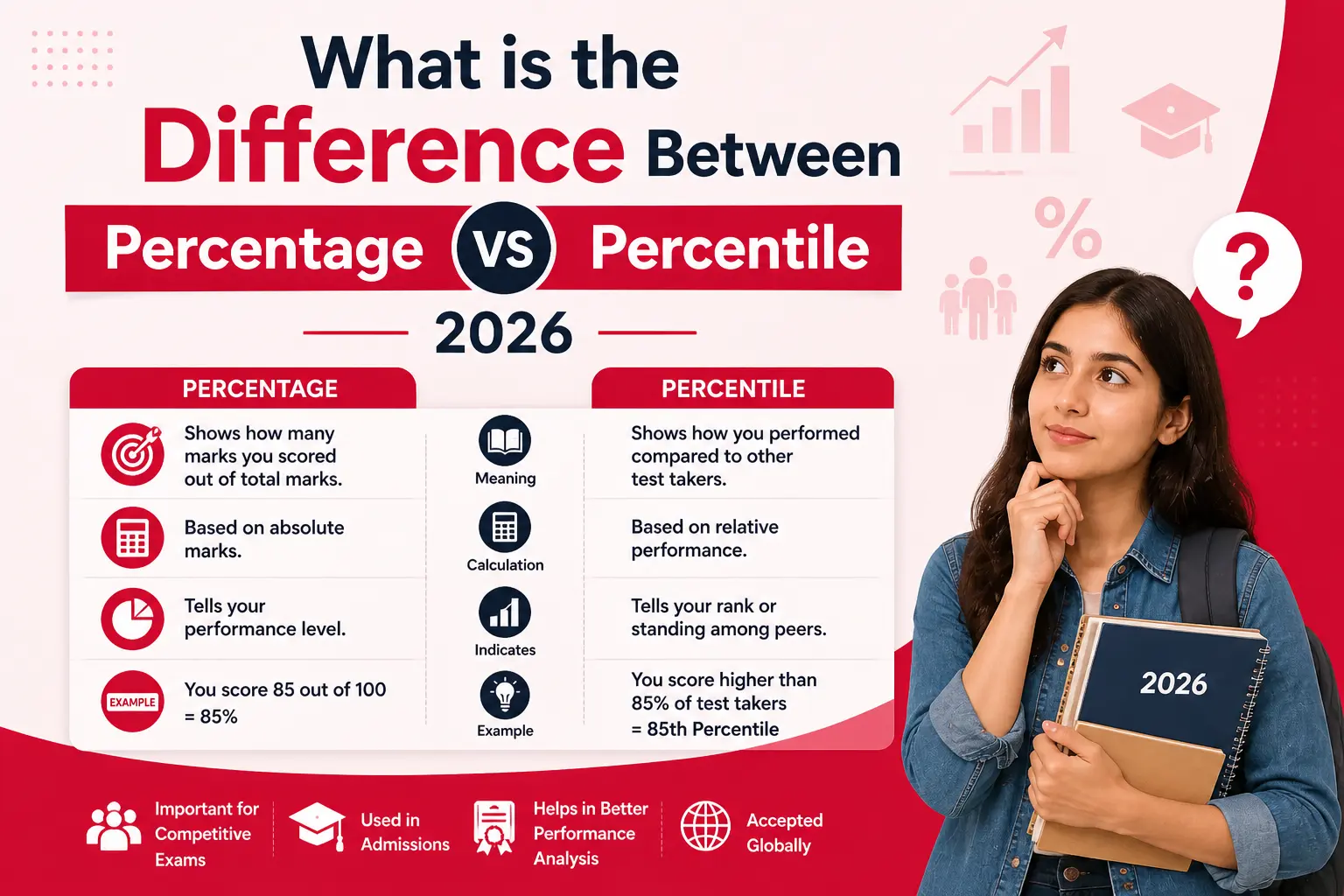
In the world of numbers and statistics, especially in academic performance and competitive examinations, the terms percentage and percentile are frequently used. While they sound somewhat similar and are often confused, they refer to entirely different concepts. Both serve important purposes in evaluation systems, statistical interpretation, and comparative analysis.
This guide aims to provide a detailed understanding of what percentages and percentiles are, how they differ, and when each is used. We will explore definitions, examples, key differences, usage in various fields, common misconceptions, and frequently asked questions.
Definition:
A percentage is a mathematical expression that represents a number as a fraction of 100. It shows how much of something exists relative to the whole.
Formula-
|
Percentage |
(Obtained Value) |
×100 |
|
(Total Value) |
Example-
If a student scores 45 out of 50 marks in a subject-
|
Percentage |
45 |
×100 |
|
50 |
Percentages are useful for giving an absolute measure of achievement or value, and they allow for easy comparison across different contexts by normalizing data to a scale of 100. Percentages are widely used in everyday life, academics, finance, business, and data analysis. Below are the major uses of percentages-
1. Academic evaluation-
2. Financial calculations-
3. Business and economics-
4. Data interpretation-
5. Daily life-
6. Exams and competitive tests-
7. Investments-
A percentile is a measure used in statistics to indicate the relative standing or rank of a value in a dataset. It tells us what percentage of observations fall below a particular value.
Example:
If your exam score is in the 85th percentile, it means you scored higher than 85% of the test-takers. It does not mean you scored 85%.
Common Percentiles:
Percentiles are primarily used to evaluate a person’s relative performance in comparison to a group. Percentiles are widely used in education, statistics, healthcare, business, and performance evaluation to understand how a specific value or individual compares to a larger group. Unlike percentages, which show an absolute value out of 100, percentiles measure relative ranking. Here are the key uses of percentiles-
1. Competitive exams and standardized tests-
2. Educational assessment-
3. Growth and health assessment-
4. Human resources and employee appraisal-
5. Statistical analysis and research-
6. Finance and economics-
7. Risk assessment and quality control-
Definition-
Nature-
Purpose-
4. Calculation-
|
Percentage |
(Obtained Value) |
×100 |
|
(Total Value) |
5. Range-
6. Score dependency-
7. Usage-
8. Interpretation-
9. Example-
Result type-
Application context-
Evaluation type-
|
Feature |
Percentage |
Percentile |
|
Definition |
A value out of 100 representing part of a whole. |
A measure indicating the value below which a given percentage of observations fall. |
|
Nature |
Absolute |
Relative |
|
Represents |
How much is achieved |
How well one performed compared to others |
|
Use Case |
Marks, growth rates, financial data |
Competitive exams, statistical ranking |
|
Range |
0% to 100% |
1st to 99th percentile (usually) |
|
Meaning of 90 |
90% = 90 out of 100 |
90th percentile = better than 90% of people |
|
Interpretation |
Direct and quantifiable |
Comparative and positional |
|
Dependency |
Independent of others’ scores |
Dependent on others’ scores or values |
Example 1: Exam Score
Here, the percentage tells us what the student scored, while the percentile tells us how they ranked.
Example 2: Competitive Exam (e.g., NEET, JEE, GMAT)
Suppose 2 lakh candidates appear for an exam.
Here, the percentile is more important than percentage, especially when cutoffs are based on relative performance.
Example 3: Child Growth Chart
Academic and Competitive Exams:
For example:
Statistics and Research:
Medical Field:
Business and Finance:
“Percentile and percentage are interchangeable.”
Not true. A student scoring 95% may not be in the 95th percentile if many others also scored higher.
“A percentile is just a percentage score.”
No. Percentile is a rank, not a score.
“If I’m in the 100th percentile, I scored 100%.”
Not necessarily. Being in the 100th percentile means you are the top scorer, regardless of the actual score.
7. Visual Representation
Imagine a class of 100 students:
8. When to Use Percentage vs Percentile
|
Situation |
Use Percentage |
Use Percentile |
|
Board Exams |
✔️ |
❌ |
|
Competitive Exams |
✔️ + Percentile (for ranking) |
✔️ |
|
Health Reports |
❌ |
✔️ |
|
Business Growth |
✔️ |
❌ |
|
Statistical Ranking |
❌ |
✔️ |
9. Pros and Cons
Percentage
Pros:
Cons:
Percentile
Pros:
Cons:
10. Tips to Remember the Difference
Use this simple memory trick:
Understanding the difference between percentage and percentile is essential for interpreting performance in academics, exams, research, and professional evaluations. While percentage provides a direct measure of achievement, percentile gives context to that achievement by comparing it to the performance of others.
In a highly competitive world, relative performance often matters more than just raw scores. Hence, percentile rankings are increasingly used in selection processes. However, both concepts are valuable in their own right and must be used wisely depending on the situation.
By grasping the distinctions between these two terms, students, professionals, researchers, and analysts can better interpret data, make informed decisions, and communicate results more accurately.
|
Explore More: |
Q1: Can I score 99 percentile with 70% marks?
Yes, if most other candidates score less than 70%, your percentile could be 99.
Q2: Is 100 percentile possible?
Technically, no. 99.9 is the highest, representing the top performer. The 100th percentile would mean you scored better than yourself, which isn’t statistically valid.
Q3: Is percentile used in all exams?
No. It is mainly used in competitive and standardized tests where relative ranking matters.
Q4: Which is more important—percentage or percentile?
Depends on context. For jobs and university admissions, percentile is crucial in competitive exams; percentage is used in regular academic evaluation.
Author
Content Writer & International Education Specialist
Sakshi Taneja is a content writer specializing in international education, study abroad opportunities, university admissions, student visas, scholarships, and career guidance. She creates accurate, research-driven, and student-focused content to help aspiring international students make informed decisions about their global education journey.
No comments yet
Be the first to share your thoughts!
Please provide your contact information
Free Counselling

9/21/2026

2/26/2026

11/3/2025

11/3/2025

10/27/2025
Want some help figuring out what kind of prep service is right for you?
Help and Support

Leave a Comment
Your email address will not be published.