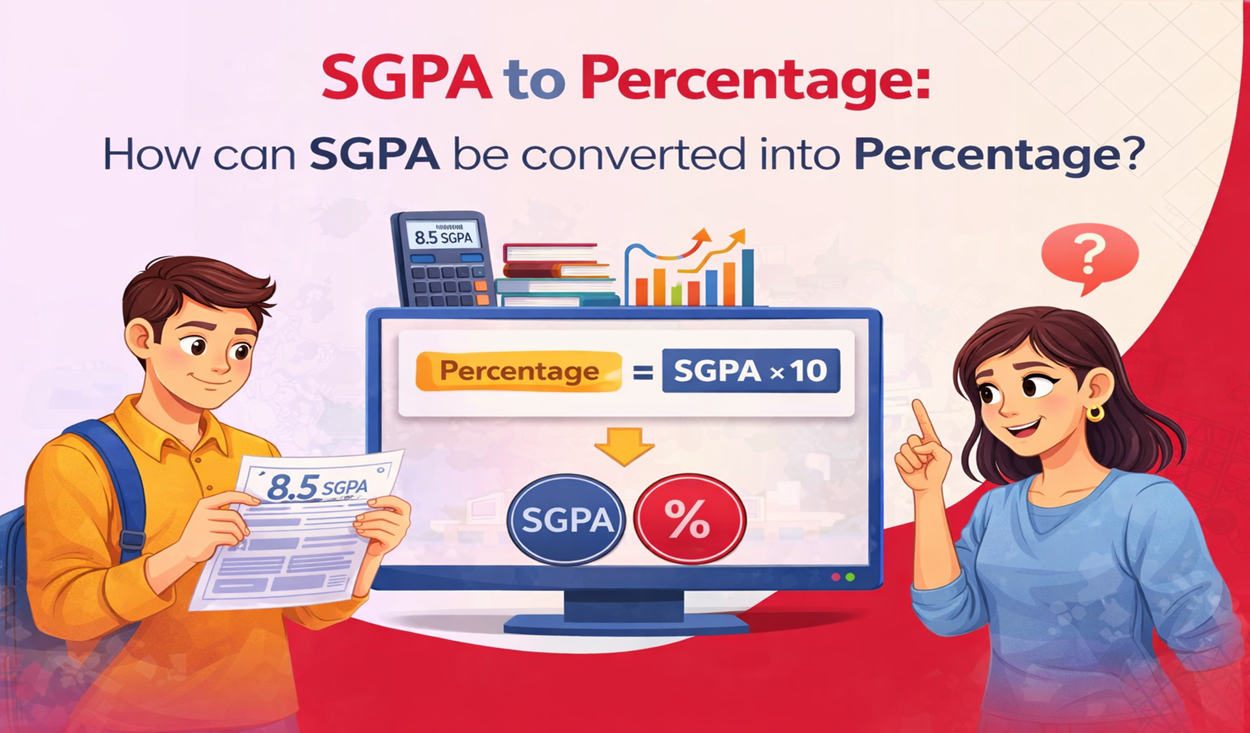
Regarding academic assessments, a student's success for a given semester is primarily measured by their SGPA (Semester Grade Point Average). However, many colleges and businesses need the GPA's percentage equivalent for additional evaluations. To understand your academic success in more relatable terms, you must convert your SGPA into a percentage. This article will cover what SGPA is, why it matters, and how to convert it to a percentage correctly.
A semester's weighted average of grade points earned in every course is known as the semester grade point average, or SGPA. Universities that implement the Credit-Based Grading System (CBGS) extensively use it. To get the SGPA, the grade points obtained are multiplied by the number of credits allotted to each course.
SGPA is computed similarly to GPA; however, it solely considers the courses taken during that semester.
Formula-
|
SGPA= |
∑(Credit Hours × Grade Points) |
|
∑(Credit Hours) |
Example-
|
Subject |
Credit Hours |
Grade |
Grade Points |
|
English |
3 |
A |
4.0 |
|
Biology |
4 |
B+ |
3.5 |
|
History |
2 |
B |
3.0 |
Total Grade Points = (3x4) + (4x3.5) + (2x3) = 12 + 14 + 6 = 32
Total Credit Hours = 3 + 4 + 2 = 9
SGPA=32/9=3.56
Converting SGPA into percentages is essential because it helps translate your academic performance into a universally recognized format. Many universities and organizations globally prefer percentage-based grading systems, making comparing students' performance across different educational systems easier. Here are some key reasons why this conversion is necessary:
The formula to convert SGPA into a percentage may vary from one university to another. However, the most commonly used formula is-
If your SGPA is 8.2, the percentage would be calculated as follows:
|
SGPA |
Percentage |
|
6.0 |
52.5% |
|
7.0 |
62.5% |
|
8.0 |
72.5% |
|
9.0 |
82.5% |
|
10.0 |
92.5% |
Conclusion-
Knowing how to convert SGPA into a percentage for various academic and professional applications is essential. Since different universities may have different conversion formulas, it is best to check with your institution. Using the right formula, you can accurately represent your academic performance in percentage terms for scholarships, jobs, or further education.
|
Explore More: |
Ans- SGPA stands for Semester Grade Point Average, representing the average grade points obtained in one semester.
Ans- Many universities, employers, and scholarship programs require percentage marks to better understand and compare academic performance.
Ans- Percentage = (SGPA × 10) - 7.5 is the most common formula.
Ans- No, different universities may have different conversion formulas. Always check the official guidelines.
Ans- You can manually convert SGPA into percentages using the appropriate formula.
Ans- Many universities provide online calculators on their official websites.
Ans- SGPA is widely used in India and a few other countries and follows the credit-based grading system.
Ans- SGPA contributes to the overall CGPA, representing cumulative performance across semesters.
Ans- Visit your university's official website or contact the examination department.
Ans- Some universities accept SGPA, but most prefer percentage marks for evaluation.
Author
Content Writer & International Education Specialist
Sakshi Taneja is a content writer specializing in international education, study abroad opportunities, university admissions, student visas, scholarships, and career guidance. She creates accurate, research-driven, and student-focused content to help aspiring international students make informed decisions about their global education journey.
No comments yet
Be the first to share your thoughts!
Please provide your contact information
Free Counselling

9/21/2026

2/26/2026

11/3/2025

11/3/2025

10/27/2025
Want some help figuring out what kind of prep service is right for you?
Help and Support

Leave a Comment
Your email address will not be published.