
Study Abroad Blogs
Abroad Insights: News and Tips for Students

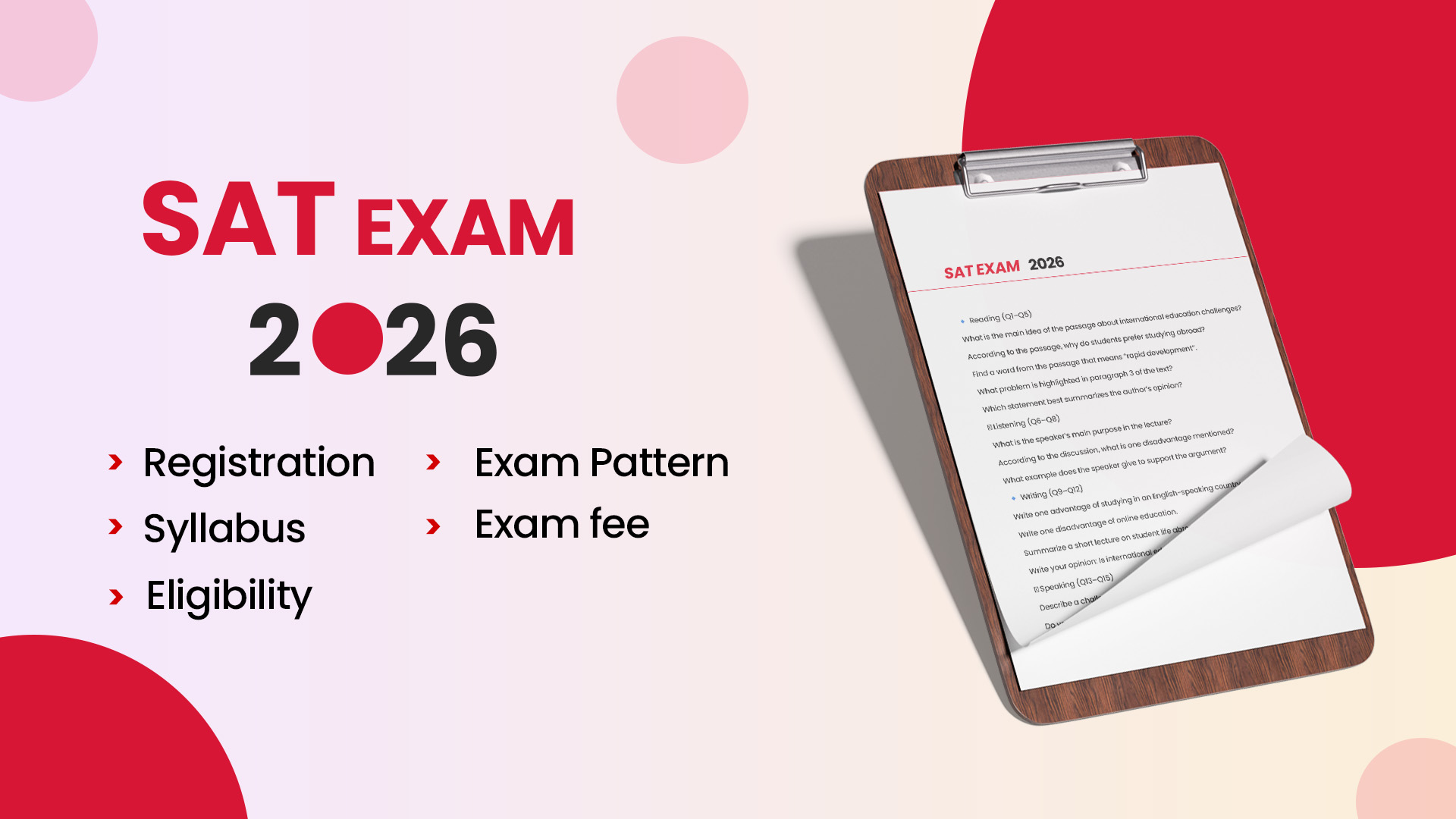
SAT Exam 2026: Registration, Exam form, Date, Syllabus, Pattern, Fee
The College Board administers a standardized test called the SAT (Scholastic Assessment Test). In the United States as well as other nations, including Canada, the United Kingdom, and India, it is generally acceptable for undergraduate entrance. The goal of the SAT exam 2026 digital format shift is to increase exam efficiency and accessibility. With easy-to-read tables, this guide offers comprehensive information on SAT registration, syllabus, exam pattern, preparation, and fees.
What is the SAT Exam in India?
Students in grades 11 and 12 frequently take the SAT (Scholastic Assessment Test), a standardized entrance exam, to gauge their potential for admission to international colleges. For undergraduate admission, Indian students wishing to study in Germany, Canada, the United States, the United Kingdom, Italy, and other countries must submit their SAT results. It offers a consistent assessment of their ability to learn and prepare for university-level coursework.
There are two parts to the test: math, reading, and writing. The maximum SAT score is 1600, with each segment receiving a score out of 800. To guarantee their desired test day and venue, students should register as soon as possible.
SAT 2026 Exam Highlights
|
Exam Name |
SAT (Digital) |
|
SAT full form |
Scholastic Assessment Test |
|
Official Website |
https://www.collegeboard.org/ |
|
SAT Exam Duration |
2 hours 14 minutes |
|
Most popular for |
Undergraduate courses in the US, Canada, UK, Italy, etc. |
|
SAT India Country Code |
260 |
|
Conducted by |
College Board |
|
Mode of Exam |
Online |
|
SAT Fee for Indian Students |
$68 + $43 +$19.98 = $130.98 which is ₹11,124 (approx.) |
|
Score Range |
on a 1600 scale point |
|
Exam centers in India |
All major Indian cities |
Key Updates in Digital SAT 2026
- Adaptive format: Difficulty of the second module depends on performance in the first.
- Shorter test: Reduced from 3+ hours to ~2h 14m.
- Faster results: Scores delivered within days.
- No penalty for guessing: Encourages attempting all questions.
What is the full form of the SAT exam?
Scholastic Assessment Test is the full name of the SAT. The Scholastic Aptitude Test was the original name of the SAT exam. The College Board creates and administers the SAT exam for foreign candidates hoping to enroll in a variety of bachelor's programs at foreign universities. The seven months of the year—March, May, June, August, October, November, and December—are when the digitalized SAT exam is administered. Even though submitting test results is optional, applicants still take the SAT to demonstrate their aptitude when applying to colleges. According to their results on the Scholastic Assessment Test, this, in turn, aids applicants in receiving a scholarship.
SAT Exam Eligibility 2026
The SAT 2026 exam's qualifying requirements were not specified by the College Board, which administers the examination. Students who intend to enroll in undergraduate programs at a foreign university can typically take the SAT to fulfill the prerequisites for admission. You should be aware, nevertheless, that not all international universities require the SAT. To demonstrate their educational skills, some students may take the SAT exam in 2026 as an additional supplement.
You can review the general SAT eligibility criteria listed below before registering for the exam.
- Age limit- Although there are no age restrictions, the majority of students who take the SAT are between the ages of 17 and 19 and do so during their junior or senior year of secondary school.
- Education Level- Students are usually able to enroll for the SAT if they are enrolled in or have finished secondary school. Students in grades 11 and 12 frequently take the test.
- Registration- To take the SAT, you must first sign up by making a profile on the College Board website and then finish the application process, which includes choosing a test day and venue.
- Payment- Unless you are eligible for a fee waiver, which is granted to qualified low-income students, you must pay the registration fee. Only Indian applicants to Indian universities are covered by this. International students are exempt from this clause.
- Identification- To enter the examination facility on test day, a legitimate photo ID is needed.
SAT Registration for 2026
Are you unsure about how to apply for the SAT in India? Students must sign up in order to take the SAT exam. Students can use the internet to register for the SAT. Candidates using the online approach must first register for an account on the official SAT website and then generate a login ID. See the following for information on SAT registration requirements and registration procedures-
SAT enrolment
- Applicants need to click on the Registration tab after visiting the College Board website.
- A new tab will open with a fresh SAT registration window.
- After selecting "Create Account," the registration form will show up.
- Enter all necessary information, including personal, parental, and general facts.
Select the chosen SAT Test center
- Applicants need to select the date and the chosen SAT center.
- Prior to choosing their desired time and location, applicants must review the SAT 2026 schedule.
Fill out the SAT registration form
- After selecting the exam location and date, applicants need to complete the SAT registration form.
- Candidates must be aware that if any information is entered incorrectly, the registration form may be denied.
Pay the SAT registration fee
- The candidate must finish the SAT fee payment after finishing the previously mentioned stages.
- Applicants must keep in mind to only use the approved payment methods.
- During active transactions, applicants ought to avoid closing the browser tab, disrupting the network, or causing any other disruptions.
SAT India Exam Pattern for 2026
On its official website, the College Board, which administers the SAT, posts the exam pattern. Reading and Writing (RW) and Mathematics are the two areas that make up the SAT exam. The reading and writing portion will consist of 54 questions, while the mathematics portion will consist of 44 questions. Two hours and fourteen minutes will be the time given to attempt both portions of the SAT 2026 exam (India). Applicants will have different amounts of time to complete each component. Candidates are not allowed to move between parts for a specified amount of time. Every question on the SAT 2026 test will be in the form of multiple-choice questions.
|
SAT Exam Sections |
Time Allocated |
Number of Questions |
|
Reading and Writing (RW) |
64 minutes: divided into two 32-minute modules |
54 questions |
|
Math |
70 minutes: divided into two 35-minute modules |
44 questions |
|
Total |
134 minutes: 2 hours 14 minutes |
98 questions |
SAT Exam Syllabus 2026
1. Reading and Writing Test
- Format: Short reading passages (25-150 words), one question each.
- Domains:
- Craft and Structure: Word usage in context, text structure, purpose, relationship between texts.
- Information and Ideas: Main idea of the text, use of evidence, inferences, information integration from texts or graphics.
- Conventions of Standard English: Punctuation, grammar, sentence structure.
- Expression of Ideas: Synthesis skills, transitions, clear expression.
- Areas to be tested include: Literature, history/social studies, humanities, science.
- Number of Questions: ~54 questions in two adaptive sections.
2. Mathematics Section
- Format: Calculator allowed throughout (Desmos calculator on screen).
- Domains:
- Algebra: Linear equations, inequalities, systems of equations.
- Advanced Math: Functions, quadratic equations, polynomials.
- Data Analysis and Problem Solving: Ratios, percentages, probability, statistics.
- Geometry and Trigonometry: Perimeter, area, volume, angles, trigonometric ratios.
- Number of Questions: ~44 questions in two adaptive sections.
The SAT Exam Fees
All candidates must pay the same SAT exam cost. However, overseas students taking the test outside of the United States must pay additional regional fees. In India, the 2026 SAT fee is Rs 11,232. The tax includes this charge. The cost of the SAT exam is the same in every city and place in India. Examine the following table for additional SAT-related fees-
|
Fee Type |
Amount (USD) |
Approximate Amount (INR) |
|
SAT Exam Fee |
$68 |
₹5,775 |
|
Non-U.S. Regional Fee |
$43 |
₹3,652 |
|
Sales Tax |
$19.98 |
₹1,697 |
|
Total SAT Fee |
$130.98 |
₹11,232 |
Fees for SAT cancellations and late Registration-
Since it is costly to cancel your SAT registration, students are always encouraged to choose a different day rather than canceling the test completely. SAT registration costs are non-refundable beyond five days before test day; therefore, candidates should be aware of this.
|
Fee Type |
Amount (USD) |
Approximate Amount (INR) |
|
Test Centre Change |
$29 |
₹2,463 |
|
Test Cancellation |
$29 |
₹2,463 |
|
Late Cancellation |
$39 |
₹3,312 |
|
Late Registration |
$34 |
₹2,887 |
SAT Exam Dates 2026-
The SAT is administered by the College Board seven times a year, in March, May, June, August, October, November, and December. The dates for the SAT 2026 exam have now been revealed. Everyone taking the SAT in India or any other foreign nation uses the same dates. Applicants must register if they wish to take the SAT exam. The SAT exam date in India for 2026 must be known to candidates. It is recommended that applicants register for the SAT exam before the application time limit in order to prevent stress at the last minute.
|
Test Date |
Registration Deadline |
Late Registration Deadline |
|
August 22, 2026 |
August 7, 2026 |
August 11, 2026 |
|
September 12, 2026 |
August 28, 2026 |
September 1, 2026 |
|
October 3, 2026 |
September 18, 2026 |
September 22, 2026 |
|
November 7, 2026 |
October 23, 2026 |
October 27, 2026 |
|
December 5, 2026 |
November 20, 2026 |
November 24, 2026 |
|
March 6, 2027 |
February 19, 2027 |
February 23, 2027 |
|
May 1, 2027 |
April 16, 2027 |
April 20, 2027 |
|
June 5, 2027 |
May 21, 2027 |
May 25, 2027 |
SAT Score 2026
The two components of the SAT include mathematics, writing, and reading. A maximum score of 1600 is possible for these two sections, which are evaluated on a 200–800 point scale. On a range of 20 to 80, other sub-scores are recorded. The results of a test show how an applicant compares to another applicant who took the test.
Around the world, the SAT is still a crucial part of college admissions. The test is more efficient with its updated digital format, giving pupils a better experience. The secret to success is time management, comprehension of the exam format, and adequate preparation.
Master the SAT with Real Practice TestsAdaptive, timed, and exam‑style questions to help you score higher.
|
SAT vs ACT
Standardized assessments for college admissions include the SAT and ACT. Despite their similarities, their scoring, content focus, and organization are different. Researching both tests can help you decide which one best suits your skills and college application standards. Check: ACT vs SAT Exam
|
Criteria |
SAT |
ACT |
|
Duration |
2 hours 14 minutes (digital) |
2 hours 55 minutes |
|
Scoring |
400–1600 |
1–36 |
|
Sections |
Reading, Writing, Mathematics |
English, Math, Reading, Science |
|
Calculator |
Allowed throughout math |
Allowed in specific sections |
|
Test Format |
Computer-based |
Computer-based and paper-based |
FAQs
Q.1 Is 1200 a respectable score on the SAT?
Ans- Indeed, 1200 is a good grade that should allow you to enroll in the majority of colleges.
Q.2 Which SAT score is the highest?
Ans- 1600 is the highest possible SAT score. Four hundred is the lowest possible SAT score.
Q.3 Does the SAT have an age limit?
Ans- The age restriction for SAT attempts is not given. However, most SAT applicants are in the 17–19 age range.
Q.4 Do scores on the SAT expire?
Ans- In theory, SAT scores are perpetual. Some colleges do, however, have a time limit of five years between taking the test and applying.
Q.5 Is a passport required for the SAT?
Ans- Applicants should make sure that they possess an active passport on the day of the test.
Q.6. Is the SAT mandatory for all universities?
Ans: No. Most of the universities in the USA require SAT scores, but there are some that are test-optional. It is always recommended to look into the admission policy of the university.
Q.7. What are the requirements for taking the SAT?
Ans: There are no requirements. Usually SAT is taken by high school students to get admission in undergraduate courses abroad.
Q.8. How do I prepare for SAT?
Ans: SAT can be prepared by taking practice mock tests for SAT, focusing on adaptive modules and developing math, grammar, and comprehension skills.
Q.9. What is the difference between SAT and ACT?
Ans: Both SAT and ACT are college admission tests in the USA but SAT is an adaptive test, whereas ACT contains a science section, and both differ in their scoring system.
Q.10. Does Gateway Abroad Education offer support for SAT preparation?
Yes. Gateway Abroad Education offers counseling and test preparation services to those students who wish to study abroad, along with visa assistance and preparation for the SAT, GRE, IELTS, etc.
What is the excellent score for the SAT?
The institutions you are applying to will ultimately determine what constitutes a respectable SAT score. A high SAT score, on the other hand, may help you stand out to college admissions officers and improve your chances of receiving a scholarship. Moreover, to determine what a good SAT score is and set realistic goals for your exam, read about the current SAT scores and the SAT scoring method. Students who want structured preparation can also explore SAT Coaching in Jaipur to strengthen their exam strategy and work towards their target score.
To achieve a good SAT score, you can join the SAT Preparation test at Gateway Abroad Education, which is a study abroad consultant. Generally speaking, your chances of being accepted into a prestigious institution increase with your SAT score. Continue reading our blog for more information.
What is SAT?
The majority of colleges and institutions use the SAT as an entrance exam to decide who gets admitted. The College Board developed and administers the multiple-choice questions and computerized SAT exams. However, the Scholastic Assessment Test (SAT) is designed to assess high school students' eligibility for college and give universities a single, comparable statistic to compare all candidates. The SAT is a standardized test used by many colleges as part of their admissions process. If you are new to the exam, read our guide to the SAT exam format and requirements to understand its structure and what to expect before test day.
Section | Number of Questions | Minutes Given |
Reading and Writing (Module 1) | 27 | 32 |
Reading and Writing (Module 2) | 27 | 32 |
Math (Module 1) | 22 | 35 |
Math (Module 20 | 22 | 35 |
Total | 98 | 2 hours, 14 minutes |
The SAT includes a Math section that tests students' mathematical reasoning and problem-solving skills. To prepare more effectively, explore our guide to the SAT Math section, including the topics and question types you may encounter.
What is the SAT score?
The institutions you are applying to will ultimately determine what constitutes a respectable SAT score. A high SAT score, on the other hand, may help you stand out to college admissions officers and improve your chances of receiving an international student scholarship. However, your target score should depend on your preferred universities, so it is important to understand what is considered a SAT good score before planning your preparation.
On the other hand, an excellent SAT score is somewhere around 1200 overall. Although there are differing opinions, the most crucial factor is that a high SAT score opens the door to admission to the college of your choice. As a result, students must be wholly committed to studying before the test. An outline of what constitutes a high SAT score is mentioned here-
Percentile | Math Score | Evidence-Based Reading Writing Score | Total SAT score |
50 (Median) | 520 | 530 | 1040-1050 |
75 (Good) | 600 | 610 | 1200-1210 |
85 | 660 | 650 | 1290 |
95 | 740-750 | 710 | 1430-1440 |
99+ | - | 780-800 | 1560-1600 |
On the colleges you want to attend, a higher score typically improves your chances, especially if you want to attend in prestigious university. It is advisable to traverse the terrain of average scores for the institutions of your choice to map out your path successfully.
SAT Percentiles for Scores-
The percentiles are always brought up when discussing a high SAT score. Moreover, a comparative study, which displays how one candidate performed in relation to another, is represented by the percentiles derived from SAT scores. Therefore, applicants must also take percentile scores into account after receiving their SAT results in order to determine whether or not they are on par. To see how SAT scores relate to percentile scores, view the table below:
SAT Exam Scores | Percentile Score |
1570-1600 | 99+ |
1530-1560 | 99 |
1430-1440 | 95 |
1350-1360 | 90 |
1290 | 85 |
1240 | 80 |
1200 | 75 (good) |
1030 | 50 (median) |
What about the average SAT score?
The mean score on the SAT was 1028 for high school graduates in 2023. However, the college you choose to attend and how your score stacks up against the competition will determine how high your SAT score should be. Along with understanding score requirements, students should also strengthen their grammar and editing skills for the Reading and Writing section. Our guide to SAT punctuation rules can help you review punctuation concepts that may be tested in context.
Your SAT score can elevate your application from mediocre to outstanding, even though many American schools and universities no longer require candidates to submit standardized test results for admission. The College Board reports that in 2023, the average SAT scores were:
Total score: | 1028 |
Math: | 508 |
Reading and Writing | 520 |
How much does a good SAT score mean for college admissions?
Several tiered universities accept different sets of scores:
For Ivy League universities, a SAT score of 1400 or more is regarded as good.
- Anywhere between 1200 and 1400 can be regarded as suitable for a mid-level university.
- A score between 1000 and 1200 can also be helpful for people who wish to enroll at a community college.
- A high SAT score does not ensure admission to a reputable institution or university, as the institution's Board has made clear. Your entire application should align with all institutional standards, including your GPA, entrance essays, and general profile. Before deciding which standardized test to take, students can compare the SAT vs. ACT to understand the differences in test structure, question styles and preparation requirements. This comparison can help you choose the exam that best suits your strengths and college application plans.
To prepare for the SAT, visit Gateway Abroad Education.
It is entirely up to you whether or not your SAT results are the icing on the cake. The only objective of Gateway Abroad Education is to assist you in obtaining the desired score. With SAT coaching from study abroad professionals, you can get highly targeted study resources that are particularly matched to your needs.
FAQs
Q.1 What are the sections on SAT?
Ans-Math and Evidence-Based Reading and Writing are the two SAT sections.
Q.2 What is the SAT's duration?
The SAT lasts for two hours and fourteen minutes.
Q.3 How does one score on the SAT?
Ans- The SAT scores range from 200 to 800 points for each section. The sum of your section scores determines your overall SAT score. 1600 is the maximum SAT score that can be achieved.
Q.4 Which SAT score is the highest?
Ans- When writing for SAT exams, a score of 1600 is ideal.
Q.5 Do you need to retake the 1200 SAT?
Ans- Although 1200 is a fantastic SAT score, it might be wiser to retake the exam if you think you can do better.
Everything you should know about SAT Punctuation: Tips for Commas, Colons, and Dashes
Your entire SAT score depends heavily on the SAT Writing Section, where punctuation is a significant area of emphasis. Commas, semicolons, colons, and dashes are all necessary for a composition that is clear and effective, but many students need help understanding how to use them.
Gaining proficiency in punctuation can significantly improve your score on the SAT's Written and Linguistic section. The fundamental SAT punctuation guidelines will be covered in this essay, along with helpful hints and techniques to help you become an expert. Students who want structured guidance and targeted practice can explore SAT Coaching in Jaipur to strengthen their grammar, punctuation, and overall exam readiness.
The importance of punctuation in the SAT Writing Section:
The key component that maintains paragraph coherence elucidates significance and divides thoughts to guarantee concise and efficient composition is punctuation. In order to assess your proficiency with punctuation in constructing sentences, the SATs assess the way you use punctuation.
The meaning of a phrase can be changed by improper punctuation, which could lead to misunderstandings. You may significantly improve your grade on the SAT Written and Linguistic portion by knowing how to utilize punctuation, semicolons, colons, and dashes correctly. For this reason, learning the SAT punctuation principles is essential to getting a good score. For a broader understanding of the test structure and preparation requirements, read our guide to the SAT exam along with these punctuation strategies and SAT success tips.
Since punctuation accuracy can contribute to your Reading and Writing performance, it is also useful to understand what makes a good SAT score and how your target score aligns with your college goals.
There is a need for the applicants to know the most frequently examined punctuation characters to do well on the SAT Writing part. These consist of:
- Semicolons (): There is no need to use conjunctions to use these punctuation marks. Semicolons are used to connect mutually distinct sentences. In a complicated list, when commas are previously deployed, they can additionally be employed to distinguish elements.
- Commas (,): These punctuation marks are used to set off opening factors. It joins distinct sentences using conjunctions to connect sentences. The sentences divide unimportant material and differentiate between objects mentioned in a list.
- Dashes (—): To emphasize a point or draw attention to a subject that is not needed, dashes can be used instead of colons, brackets, or commas. They are also helpful for giving your writing style some variation, although they are less professional.
- Colons: These punctuation marks are the beginning of a list. The colons show a list of clarifications or extensions of the phrase that comes before it. The reader is informed that something significant is about to happen by these vital signs of punctuation.
What are the SAT Punctuation rules?
By using proper punctuation on the SAT, you can get the opportunity to get a high score. There are specific rules and regulations for using these punctuation marks, which applicants have to follow. Let’s read the below detail:
Rules for using Comma-
- Taking items out of a list: If there is a list of items, events, or actions, then you can use commas to distinguish them. But remember, don’t use commas after conjunction words; they will be only used before conjunction words.
For example, I purchased cucumber, tomato, and carrot.
I went walking, running, and climbing.
- Restrictive and Nonrestrictive Clauses: To understand the use of commas, restrictive and nonrestrictive clauses need to be understood. It is impossible to delete a restricted sentence from a paragraph without definitely changing the statement's overall purpose.
Example: The students studied in the library for hours on end.
Commas can only be used to separate sections in this phrase by modifying the meaning of it. A section of text is non-restrictive and ought to be enclosed by commas if it is not necessary for the paragraph's content or logic. Clauses that are essential to the paragraph sense shouldn't be surrounded by punctuation.
Example: Miss Rachna, who lives in the next bungalow, claims to be Riya.
The sentence's logic and meaning are not significantly affected by the term "who lives next bungalow." Commas correctly surround it.
To link two separate sentences: Before a conjunction like and, but, or, not, for, so, or still, place a comma. A comma can be used to join two separate clauses before a conjunction word.
Example: He studied hard, and he passed the exam.
Presenting modifiers and dependent sentences
If a sentence starts with a dependent clause, a comma will be placed after it. Here, we are sharing an example that will help you understand the dependent sentence.
Example: Because Richa did not study punctuation, her score was weaker than she had hoped.
On the other hand, when a sentence begins with a modifier, a comma also has to follow it.
Example: Regardless of her skills, the coach would not allow Tara to play during the game.
To get command over this modifier and dependent clause, you have to practice more. Moreover, correcting incorrect punctuation is required if you notice that it comes after a dependent clause or modifier.
Terminating introductory elements: Follow opening clauses, phrases, or words with a comma.
Example: After the match, we all went out for lunch."
- Commas should not separate adjectives and nouns. This is an inappropriate arrangement. Your understanding of this punctuation norm will be assessed on the SAT by employing headings as adjectives.
For example, I ran into John, my flatmate, on my way to class.
- Non-Essential Information: Eliminating these sentences would not alter the clause's sense. Additionally, commas must be used to separate each of these words.
Example with unnecessary terms: My grandmother's favorite recipe has been passed down through generations of families.
This example illustrates that it lacks the verb "my grandmother's favorite," which is not very helpful information.
After removing unnecessary terms,
Example: The family has been using this recipe for many generations.
So, we can see that after eliminating "my grandmother's favorite," the content's meaning remains unchanged. Make sure that these expressions are enclosed in commas, and practice identifying an appositive.
Rules for Colons on SAT-
Presenting a list or clarification: Colons are used to connect separate sentences. To ensure correct functioning, ensure that the colon comes after an entire sentence. You must correct the punctuation if a pause will not be used instead of the colon. Colons are often employed before lists or explanations on the SAT exam.
Examples-
She has three objectives: to travel, get employment, and graduate.
The well-known dessert recipe required a few simple components: sugar, wheat flour, milk, egg yolks, and powdered sugar.
Aunt Julie enjoys travelling, and her favourite places to visit are: historic sites and sunny beaches.
Emphasis: Colon is also used to highlight a point.
Example:
Only one subject is left: preparation.
Rules for Semicolons on SAT-
Semicolons Between Complete Thoughts: Semicolons are used to separate two entire ideas. A semicolon is misused, and the phrase's punctuation needs to be corrected if it is to be substituted with another period.
Example of improper semicolon usage:
Since Beyonce is my preferred singer, I genuinely want to attend her concert.
This semicolon separates an entire idea from an unfinished concept. The statement must be rewritten to distinguish between two coherent ideas.
Example of proper semicolon usage:
My favorite singer is Beyonce, and I would really like to see her perform live.
Complex Lists: components in an order that possess commas should be separated with semicolons.
Example: John Doe, the CEO, joined the meeting; Jane Smith, the CFO; and Mary Johnson, the COO."
Rules for Dashes on SAT-
Dashes are an excellent way to identify a non-essential phrase. Similar to a colon, dashes can also come before an order or a clarification. It is improper to put dashes and commas simultaneously to indicate unnecessary sentences.
Example: The following sentence needs to be corrected.
The neighbor’s dog—a yellow lab—is always running away.
However, the below example shows how dashes should be used appropriately to illustrate meaningful sentences:
The neighbor’s dog—a yellow lab—is always running away.
An example of the dash using a list: For the well-known dessert recipe, a few simple components were needed: flour, sugar, eggs, milk, and baking powder.
- Adding Emphasis: To highlight an instance or indicate a halt, use a dash. Example: "There was just one activity she could do—run."
Here are a few of the practice questions for SAT punctuation:
1. According to Naomi Nakayama of the University of Edinburgh, seeds from a dying dandelion seem to float in the air while ______ because their porous plumes increase drag. This keeps the seeds in the air long enough for the wind to spread them throughout the surrounding area.
Which option completes the paragraph and makes it adhere to Standard English conventions?
- falling, B. falling; C. falling; D. falling
Explanation-
Take note that the punctuation mark type is the only change in the options. That indicates that punctuation is the main topic of this question.
Let's examine the preceding and following words:
A lengthy and intricate noun phrase ("the reason... while falling") appears before the blank.
A verb ("is") comes after the blank.
Colonies and semicolons both need to come after an independent clause. We can rule out options B and C because neither side of the blank is an independent clause.
We also don't want a comma here because we know that it shouldn't be used between a subject and a verb. We can rule out option A. Option D, which truly refrains from using punctuation, is the only one that does not make any mistakes. The answer is choice D.
While punctuation is important for Reading and Writing, students should also prepare for the SAT Math section to build a balanced overall score.
The SAT Preparation course offered by Gateway Abroad Education allows you to practice these punctuation norms. It is a consulting firm for international education that provides practice tests, thorough explanations of the questions, and performance monitoring tools to help you get ready for the significant examination. These sites might also help you learn more about your areas of weakness. If you are still deciding which standardized test best suits your college plans, compare the SAT vs. ACT to understand their differences and choose the exam that aligns with your strengths.
FAQs on SAT Punctuation
Q.1: When should I use commas or dashes in SAT?
Ans: In addition to introducing an index or clarification, they can be used to indicate the end of an unnecessary sentence or term. Dashes and commas cannot be combined when they serve a purpose with unnecessary verbs or sentences.
Q.2: What function does the colon serve on the SAT?
Ans-Colon establishes a link between an autonomous sentence or a whole idea and any subsequent pertinent details.
Q.3: Why would someone utilize a colon technique?
Whenever we change a part of a separate phrase or entire sentence, the colon always appears before it. They are connected by a colon, which indicates that the second section functions as a discussion of the previous section.
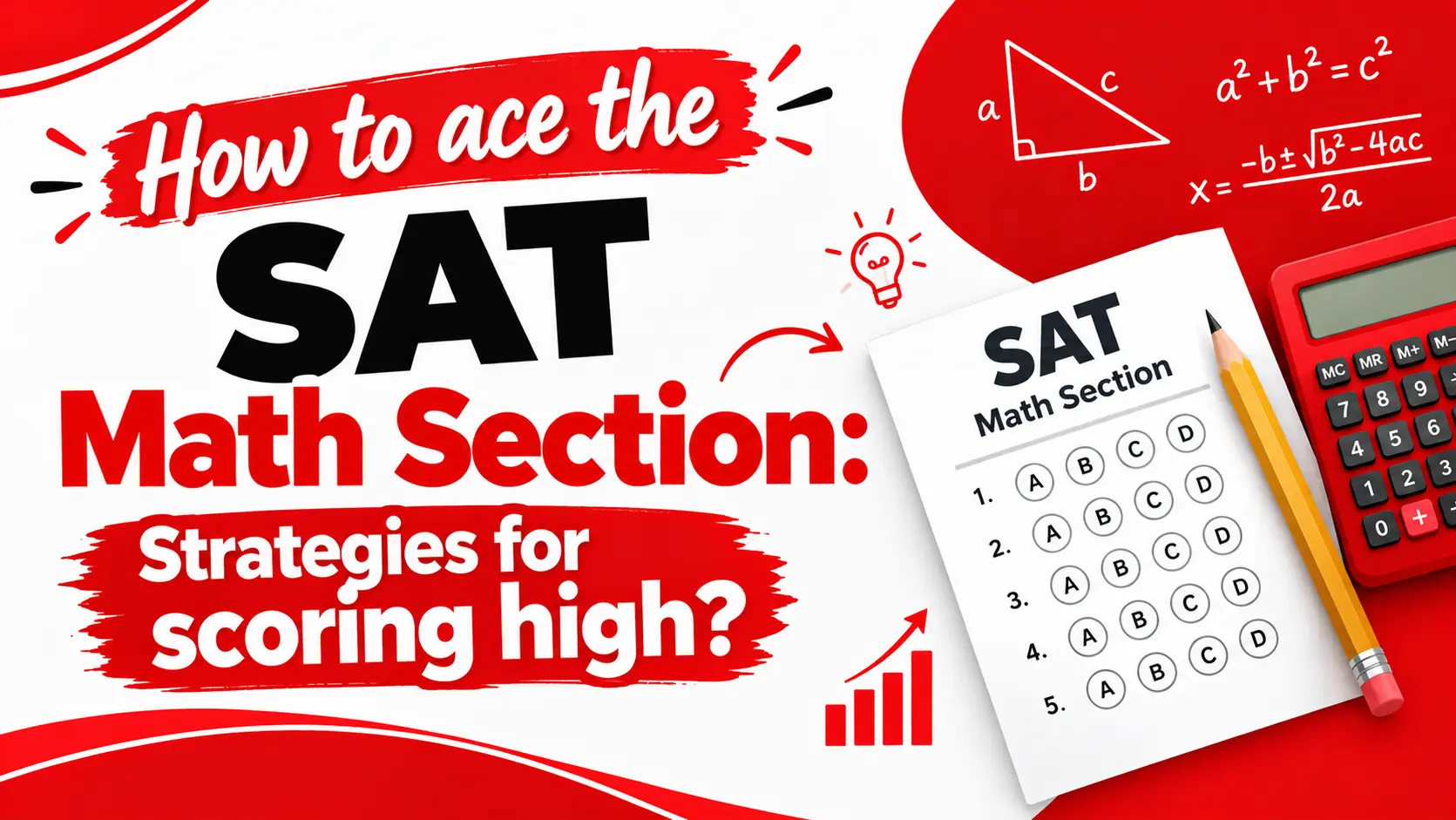
How to ace the SAT Math Section: Strategies for scoring high?
The SAT Math section is one of the most critical parts of the SAT, making up half of your total score. A strong performance in this section can significantly boost your chances of admission to top universities. To help you achieve a high score, this guide will break down the structure of the SAT Math section, key strategies, common pitfalls, and tips for maximizing your performance. Students who need structured guidance and practice can explore our SAT Coaching in Jaipur to strengthen their mathematical concepts and prepare for the exam more effectively.
How to understand the SAT Math Section?
Before diving into strategies, it's essential to understand what the SAT Math section tests. Before starting your preparation, review the SAT exam pattern and structure to understand the test format, section timings, and how the digital exam works. The SAT Math section consists of two parts:
No-Calculator Section (25 minutes, 20 questions)
· 15 multiple-choice questions
· 5 grid-in (student-produced response) questions
Calculator-Allowed Section (55 minutes, 38 questions)
· 30 multiple-choice questions
· 8 grid-in questions
Topics covered in the SAT Math Section
The SAT Math section is divided into four main content areas-
1. Heart of Algebra (~33%)
- Linear equations and inequalities
- Systems of equations
- Graphing linear equations
- Interpreting slope and intercepts
2. Problem Solving & Data Analysis (~29%)
- Ratios, rates, and proportions
- Percentages and unit conversions
- Probability and statistics
- Data interpretation (tables, charts, graphs)
3. Passport to Advanced Math (~28%)
- Quadratic equations and functions
- Exponents and radicals
- Polynomial operations
- Exponential growth and decay
4. Additional Topics (~10%)
- Geometry (circles, triangles, volume)
- Trigonometry (sine, cosine, tangent)
- Complex numbers
Which are the top strategies for scoring high on the SAT math section?
1. Master the fundamentals:
The SAT Math section tests basic mathematical concepts in complex ways. Ensure you have a strong foundation in:
- Algebra (solving equations, manipulating expressions)
- Arithmetic (percentages, ratios, proportions)
- Geometry (area, volume, angles, coordinate geometry)
- Data interpretation (charts, graphs, mean, median, mode)
Use high-quality prep books like The College Board's Official SAT Study Guide or The Princeton Review SAT Prep to reinforce these fundamentals.
2. Know the formulas and know when to use them:
The SAT provides a formula sheet, but relying on it can waste valuable time. Memorize key formulas, including:
- Slope formula: m=y2−y1x2−x1m = \frac{y_2 - y_1}{x_2 - x_1}m=x2−x1y2−y1
- Quadratic formula: x=−b±b2−4ac2ax = \frac{-b \pm \sqrt{b^2 - 4ac}}{2a}x=2a−b±b2−4ac
- Pythagorean theorem: a2+b2=c2a^2 + b^2 = c^2a2+b2=c2
- Area and volume formulas for circles, triangles, and rectangles
Understanding when and how to apply these formulas is just as important as memorizing them.
3. Practice mental math and estimation:
For the no-calculator section, mental math skills can be a game-changer. Practice:
- Multiplication and division shortcuts
- Quick approximations (e.g., estimating square roots)
- Simplifying fractions and percentages
Being comfortable with these techniques will help you solve problems faster and with greater accuracy.
4. Use strategic guessing and elimination:
You do not lose points for wrong answers on the SAT, so always answer every question. If you are unsure of an answer, use these strategies:
- Eliminate obviously incorrect choices
- Plug in answer choices to see what works
- Look for patterns in numbers or equations
If you are completely stuck, make an educated guess rather than skipping the question.
5. Master word problems and translating equations:
Many SAT Math questions are word problems that require you to translate English into mathematical equations. To improve:
- Identify key terms and variables
- Convert words into algebraic expressions
- Break the problem into smaller steps
For example, if a problem states, "Twice a number increased by five is 17," you should quickly recognize that it translates to 2x+5=172x + 5 = 172x+5=17.
6. Use plugging in and back solving:
If an algebraic equation seems difficult to solve, try plugging in numbers or answer choices:
- Plugging in values: Assign simple numbers to variables and test the equation.
- Back solving: Start with answer choices and plug them into the equation to see which one works.
These techniques can help you solve problems faster, especially on multiple-choice questions.
7. Familiarize yourself with graphs and functions:
Graphing equations is a common SAT topic. Make sure you:
- Understand how changes in an equation affect a graph
- Recognize linear vs. quadratic equations
- Know how to interpret function notation, such as f(x)f(x)f(x)
Being able to analyze graphs quickly can save time on test day.
8. Manage your time wisely:
The SAT Math section is time-pressured, so develop a pacing strategy:
- Spend no more than 1 minute per question on the first pass.
- If a problem is too difficult, skip it and come back later.
- Leave at least 5 minutes at the end to review flagged questions.
Practicing under timed conditions is essential for improving speed and accuracy.
9. Avoid common mistakes:
Many students lose points due to careless errors. Watch out for:
- Misreading the question (e.g., answering for x when asked for 2x)
- Forgetting negative signs or decimal placements
- Not simplifying final answers when required
Double-check your work to minimize these errors.
10. Take official practice tests:
The best way to prepare for the SAT Math section is to take full-length, timed practice tests. This helps you:
- Familiarize yourself with the test format
- Improve endurance for long testing periods
- Identify your weak areas and adjust your study plan
Use official SAT practice tests from the College Board for the most realistic experience.
Some additional tips for a high SAT Math Score?
Use online resources:
Many free online resources can supplement your study plan:
- Khan Academy (Official SAT Practice)
- College Board’s Blue Book (Official SAT Guide)
- YouTube Tutorials (SAT Math walkthroughs)
Join a study group:
Working with peers can help you learn new problem-solving techniques and stay motivated.
Simulate Real Test Conditions:
When taking practice tests:
- Use a real SAT-approved calculator (TI-84, Casio fx-9750GII)
- Take the test in a quiet, timed environment
- Use a bubble sheet to simulate the real test experience
Develop a Test-Day Strategy:
- Sleep well before the exam
- Eat a healthy breakfast to stay energized
- Bring all necessary materials (approved calculator, pencils, ID, admission ticket)
Stay Calm and Confident:
Confidence is key to performing well. If you encounter a tough problem, take a deep breath and move on. Many students do better by staying composed under pressure.
Conclusion-
Acing the SAT Math section requires a combination of strong foundational skills, strategic test-taking, and regular practice. By mastering algebra, problem-solving techniques, and time management, you can significantly improve your SAT Math score. With the right approach and consistent effort, you can achieve a high score and strengthen your college applications. If you are comparing standardized tests before choosing your preparation plan, read our guide to SAT vs. ACT to understand their differences in format, subjects, and scoring.
As you prepare, it is also useful to understand what is a good SAT score and set a realistic target based on the universities you plan to apply to.
10 Short FAQs on SAT Math Section
Q1. What are the key topics covered in the SAT Math section?
Ans- The SAT Math section focuses on:
- Heart of Algebra (linear equations, inequalities)
- Problem Solving & Data Analysis (ratios, percentages, statistics)
- Passport to Advanced Math (quadratics, exponents, polynomials)
- Additional Topics (geometry, trigonometry, complex numbers)
Q2. How can I improve my SAT Math score quickly?
Ans-
- Focus on high-yield topics like algebra and problem-solving.
- Practice mental math for speed in the no-calculator section.
- Take timed practice tests to improve pacing.
Q3. What is the best way to approach word problems?
Ans-
- Identify key terms and translate them into equations.
- Define variables and break problems into smaller steps.
- Check for logical answers before solving.
Q4. How can I manage my time effectively during the SAT Math section?
Ans-
- Spend 1 minute per question on the first pass.
- Skip difficult questions and return later if time allows.
- Leave 5 minutes at the end to review flagged questions.
Q5. Should I guess on SAT Math if I don’t know the answer?
Ans- Yes, there is no penalty for wrong answers, so always make an educated guess after eliminating incorrect choices.
Q6. What calculator should I use for the SAT Math section?
Ans- The best options include:
- TI-84 Plus CE (graphing calculator)
- Casio fx-9750GII (affordable and SAT-approved)
Q7. What are some common SAT Math mistakes to avoid?
Ans-
- Misreading the question (e.g., solving for x instead of 2x)
- Forgetting negative signs or decimal placements
- Not simplifying answers when required
Q8. How important are formulas, and should I memorize them?
Ans- Yes, the SAT provides a formula sheet, but memorizing key formulas like quadratic formulas, slope formulas, and Pythagorean theorem saves time.
Q9. What’s the best way to practice for SAT Math?
Ans-
- Take official SAT practice tests from the College Board.
- Review mistakes carefully and track progress.
Q10. How can I stay calm and confident on test day?
Ans-
Take proper sleep before to exam.
Eat a healthy breakfast to stay focused.
Skip tough questions and return later to manage stress

SAT vs ACT: Exam Guide for Study Abroad
You can be asked to take the SAT or ACT exam when you apply to schools and institutions in the United States. When it comes to standardized entrance tests, a lot of universities have changed to being test-optional over the past few years. According to the college to which you are applying, these tests might only be required as an elective for overseas applicants. The results of ACT vs SAT are used by universities who request them with your application for higher education as a means of assessing your abilities and preparedness for college.
If you are confused about which exam will be helpful to you, Gateway Abroad Education is here to help you. It is a study abroad consultant that offers applicants study abroad services. This study abroad consultant guides applicants about overseas university courses and offers SAT and ACT exam training classes. Students preparing for the SAT can explore our SAT Coaching in Jaipur for structured guidance, practice questions, and exam-focused preparation. Standardized tests are unlikely to have a negative effect on the admissions process and can be helpful when submitting to universities that have no requirements for test scores. In this blog, we will thoroughly study the SAT vs. ACT. So, let's continue to read the blog.
Overview of SAT and ACT
The SAT exam, also known as the Scholastic Aptitude Test, is a standardized assessment that gauges students' proficiency in reading, writing, and math. The two central portions of the exam are the reading, writing, and mathematics sections, and it lasts for two hours and fourteen minutes. A specific number of questions are tested in each of the two modules that make up each section. Additionally, universities in the United States, the United Kingdom, Canada, and Australia accept the SAT exam. Moreover, the SAT and ACT are Standardized tests in US colleges. Before choosing your test preparation strategy, read our guide to the SAT exam format and structure to understand its sections, duration, and scoring system.
The American College Testing, or ACT for short, is a standardized exam that is taken by applicants to universities in both the US and Canada. The exam assesses a student's proficiency in four subjects: science, math, reading, and English. A standardized test known as the American College Testing, or ACT, is taken by prospective undergraduates who are applying to study abroad. Additionally, there is an optional writing component that assesses a student's proficiency in writing. The ACT exam consists of around 215 questions divided into various sections and lasts for two hours and fifty-five minutes.
Feature | ACT | SAT |
Number of Questions | 217 | 98 |
Length of Assessment | 2 hours 55 minutes | 2 hours 14 minutes |
Scoring Scale | 1–36 | 400–1600 |
Test Dates | Seven times each year | Seven times in a year |
Pacing | Less time per question | More time per question |
Calculator Use | The Calculator be used on all math questions | The Calculator be used for all math questions |
Required Sections | English, Math, Reading, Science | Reading, Writing and Math |
Cost | $68 (no writing) $93 (with writing) | $68 |
Optional Section | Writing (essay) | None |
What are the key differences between the SAT and ACT?
In order to be admitted, many colleges and universities need students to submit their results from nationally recognized standardized tests, such as the SAT or the ACT. Additionally, providing test results might improve your application and help you qualify for merit scholarships, even if an increasing number of schools are making tests optional.
The topics covered, format, and grading systems vary from test to test. Nonetheless, both are employed to assess pupils' competence, understanding, and abilities in fundamental subjects, including math, reading, and writing. This section examines the essential elements of each standardized test and the difference between the SAT and ACT.
Structure:
The ACT is roughly 40 minutes lengthier and has more questions than the SAT, which has 98 questions and is often a shorter test, lasting 2 hours and 14 minutes.
- ACT: There is an additional essay portion in addition to the four required sections of English, math, reading, and science. Because the ACT is a linear test, your performance in one area has no bearing on the questions in subsequent parts. The ACT requires rapid comprehension of data, particularly in literacy and science.
Test Subject | Number of Questions | Minutes |
Reading | 40 | 35 |
English | 75 | 45 |
Science | 40 | 35 |
Writing (Optional) | 1 Essay | 40 |
Mathematics | 60 | 60 |
- SAT- The reading & writing and Math components make up the two parts of the SAT. The adjusted difficulty of the SAT is different from that of the ACT. Each segment is divided into two distinct modules, the complexity of which is determined by your performance on the first module.
Test Subject | Number of Questions | Minutes |
Math – Module 1 | 22 | 35 |
Math – Module 2 | 22 | 35 |
Reading and Writing – Module 1 | 27 | 32 |
Reading and Writing – Module 2 | 27 | 32 |
Scoring
In contrast to the ACT, which ranges from 1 to 36, the SAT gives you an overall score between 400 and 1600. Know about Act vs. Sat score comparison-
SAT Composite Score | ACT Composite Score |
1600 | 36 |
1560–1590 | 35 |
1520–1550 | 34 |
1490–1510 | 33 |
1450–1480 | 32 |
1420–1440 | 31 |
1390–1410 | 30 |
1350–1380 | 29 |
1310–1340 | 28 |
1280–1300 | 27 |
1240–1270 | 26 |
1200–1230 | 25 |
1160–1190 | 24 |
1130–1150 | 23 |
1100–1120 | 22 |
1060–1090 | 21 |
1020–1050 | 20 |
980–1010 | 19 |
940–970 | 18 |
900–930 | 17 |
860–890 | 16 |
810–850 | 15 |
760–800 | 14 |
720–750 | 13 |
630–710 | 12 |
560–620 | 11 |
SAT ACT science section differences-
While the SAT includes questions in its reading portion that evaluate your science ability, the ACT has a separate science section.
- ACT: The science portion of the ACT assesses your speedy data interpretation, comprehension of experimental design, and ability to identify opposing scientific positions. There won't be a lot of chemical or biology knowledge you need to remember by heart.
- SAT: However, without explicitly evaluating you on science, the science-like analysis will be woven throughout other SAT sections. Research reports and graphs from a variety of disciplines may be included in passages.
Act math vs. Sat math Section-
The SAT and ACT math problems assess high school-level arithmetic abilities. However, the subjects and queries differ.
- ACT: The math problems on the ACT are more varied. It covers a greater variety of areas in which questions may arise and offers a greater variety of question kinds. Additionally, the ACT stresses visual problem-solving and includes more mathematics and trigonometry questions.
- SAT: Compared to the ACT, the SAT places a lot more emphasis on algebraic questions. Moreover, higher-level concepts like complex functions and imaginary numbers that are not included in the ACT are tested on the SAT. To understand the concepts tested and prepare more effectively, explore our detailed guide to the SAT Math section.
SAT ACT English reading and sections:
The ACT offers English as a section and Reading as a distinct component, but the SAT offers Reading and Writing in a single section.
- ACT: The ACT contains sections that are one page long. There are a few sections, but they are lengthier. While responding to questions, you can concentrate on the entire passage and comprehend it thoroughly. Even though the passages are a bit longer, the English part has more straightforward grammatical questions, and the ACT's level of reading may be lower than the SAT.
- SAT: In contrast, the SAT encourages you to shift your attention to other themes as you go along because its passages are shorter and more varied. However, the SAT reading level may be more challenging than the ACT's, and some of its passages may also be poetic. Moreover, the reading portion of the SAT may also have more complex and accurate grammatical problems. If you want to strengthen your grammar and editing skills for the SAT Reading and Writing section, review these essential SAT punctuation rules before your exam.
Section on Essays (ACT Only)
An advantage that the SAT no longer provides is the additional essay on the ACT. A high essay score can improve your application for many reasons, even if universities do not need it.
- Beyond Test Results: If you are a great writer but your standardized test results don't adequately demonstrate it, the essay provides a distinct venue for showcasing your persuasive and critical thinking abilities.
- Holistic Application: Admissions officers prefer to see how you use evidence, organize your arguments, and explain complex concepts, all of which are critical for success in college.
- Scholarship Factor: Certain scholarships emphasize writing skills, and the essay is an excellent opportunity to demonstrate them.
Similarities between SAT and ACT
The majority of colleges consider the SAT and ACT to be equivalent. Before worrying about their differences, it's crucial to keep this in mind. These tests share the following characteristics:
- Assessment of college readiness: Both give universities a uniform view of your academic abilities and understanding, particularly in the areas of reading, writing, and math.
- When to take the test: It's important to note that the target test-takers are usually high school juniors and seniors. Registration for both exams opens about a month before each exam day.
- No wrong answer penalty: If you guess incorrectly, you won't lose any further points. This implies that both can benefit from educated assumptions.
- Super-scoring: The super-scoring feature of the SAT and ACT lets universities examine your top section results from a variety of test dates. Understanding the scoring systems is also important when setting your target, so read our guide on what is a good SAT score and how your score can support your college application.
Pros and cons of ACT vs SAT
The Act vs. SAT comparison chart below will explain the positive and negative points of the ACT and SAT.
Pros of the ACT | Pros of the SAT |
Accepted by many US colleges and universities. | Accepted by many US colleges and universities. |
Compared to SAT test questions, ACT questions are thought to be clearer and more succinct. | It can be applied to assess a candidate's eligibility for a particular scholarship. |
Every ACT section has an equal weight. | Being more well-liked in the past could increase your chances of getting in. |
Only accurate responses are used to calculate scores; guessing is not penalized. | It gives preference to pupils who are more proficient in math. |
Which scores to submit to colleges is up to you. Students who are better writers might be given preference. | It is a test that can be learnt, so you may boost your performance. |
Cons of the ACT | Cons of the SAT |
Not a single indicator of success or ability to succeed in college. | The SAT by itself is not a reliable indicator of success or preparedness for college. |
For kids who are more proficient in math, this might not be the greatest exam option. | It’s easy to give SAT test results too much weight. |
Compared to the SAT, it has many more problems to answer in shorter amounts of time. | Section scores are determined in a separate way. |
There is a specific science test portion that may need further study and preparation. | For strong writers, this might not be the greatest exam option. |
SAT vs ACT fees 2026
Exam fees also differ and have gone up over the past 12 months. The SAT now costs $60 instead of $52. The ACT exam now costs $68 (up from $63 the previous year) and $93 (up from $88 the last year) if the optional writing component is taken. Moreover, in Indian rupees, the fees are depicted below in table-
Examination Fee | SAT Registration Fee | ACT Registration Fee |
INR 10,991 | INR 15,603.51 (without writing) INR 17,695.14 (with writing) |
How do you register for SAT vs. ACT?
Candidates will need to take separate steps to register for one of the specified standardized tests for undergraduate enrolment. The steps to apply for the SAT and ACT exams are as follows:
Steps to register for the ACT Exam
To register for the ACT exam, follow these steps:
- Sign in by going to the official ACT website.
- Enter the necessary information and finish all the processes.
- After selecting your ACT location and date, finish the registration process.
- Pay the applicable fee and upload it to finish the registration process.
Steps to register for the SAT Exam
Check out the procedures below to register for the SAT exam:
- Candidates must sign in by going to the College Board website.
- Start the SAT registration process and start entering all of the information one by one.
- The process of selecting an SAT date and getting to the exam center will involve a few stages.
- After choosing the test location and date, candidates will be directed to the website, where they may pay the price.
- The SAT registration process is finished after the cost is paid.
Which is more accessible, the SAT or the ACT?
Tragically, since it relies on the individual educational abilities of every learner, there cannot be a one-size-fits-all response to whether the test is more accessible or better.
However, this implies that students with a strong background in science and math should consider taking the ACT exam, while kids who excel in reading, math, and English might try their hand at the SAT exam. What is easier and more comfortable for the candidates to provide is entirely up to them.
How do you decide between the SAT and the ACT?
Taking several practice exams is the most excellent method to decide between the SAT and ACT. To obtain a true sense of how the test is administered, we highly advise taking it in real-world testing environments. When choosing a choice, take into account the following factors-
- Recognize your shortcomings: Be brutally truthful. Does a manuscript with a lot of vocabulary make you stumble? Do you struggle with introductory algebra without a calculator? That's where you begin.
- The results of the practice exams show that the students should take all the SAT and ACT practice exams where they struggled the most matters, even if the difference in their scores is slight.
- It's not just about the subject: On one test, did you feel hurried all the time, but oddly, you had plenty of time on the other? Your testing style can be inferred from that pacing.
FAQs-
Q.1 Who sits for the ACT exam?
Ans- High school students who intend to enroll in US colleges usually take the ACT exam.
Q.2 How can you sign up to take the ACT?
Ans- The registered ACT portal is where you can sign up for the ACT exam digitally.
Q.3 Will the SAT be more complex than the ACT?
Ans- The ACT is not more complex than the SAT. The themes covered and the format of the two tests differ slightly. These variances impact Each test-taker differently, making one exam more difficult than another. You can find out which kind would be most appropriate for you by taking lengthy practice exams in each type.
Q.4 Which test is preferred by colleges, the SAT or the ACT?
Ans- In general, colleges and institutions prefer neither the SAT nor the ACT. Both standardized entry examinations are generally accepted at schools throughout the United States unless a school specifically specifies otherwise.
Q.5 Which test, the SAT or the ACT, is more widely taken?
Ans—In the past, the SAT proved more popular on the East and West coasts of the US, but the ACT has been more popular in the Midwest and South. Nonetheless, schools and universities across the United States accept both tests.
Q.6 Is it possible for me to take the SAT and ACT?
Ans-Yes, students are free to take both tests if they so want. To increase the probability of getting admitted to a specific college or university. Moreover, few students can attempt both tests to determine which one they fare better on.