
Study Abroad Blogs
Abroad Insights: News and Tips for Students

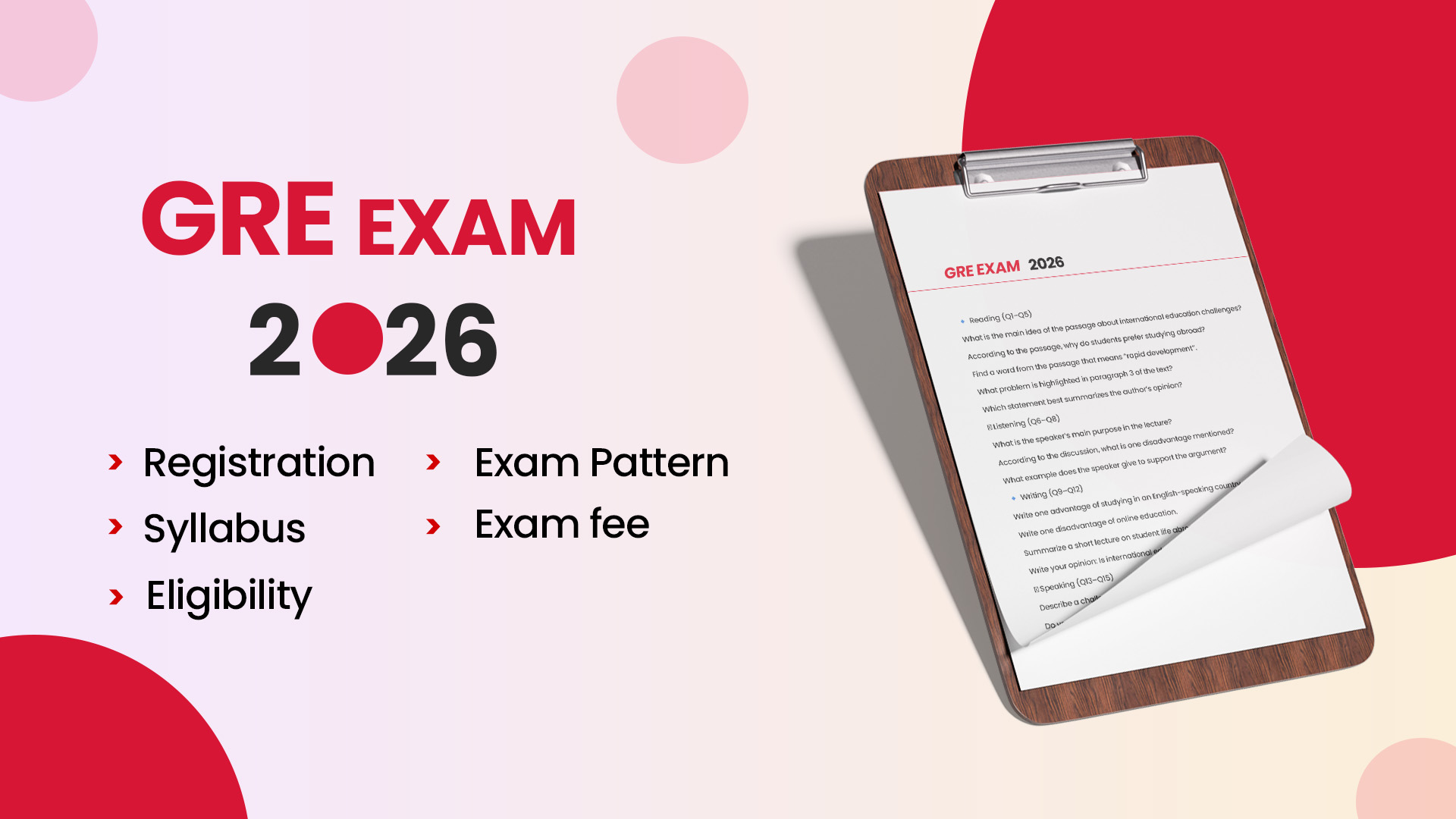
GRE Exam 2026: Registration, Qualification, Exam Fee, Exam Pattern, Date, Exam Center
A globally recognized standard test for applicants wishing to finish their post-graduation studies overseas (MS or MBA) is the Graduate Record Examination (GRE). The GRE is administered by the Educational Testing Service (ETS). The purpose of this computer-based, multiple-choice test is to assess a candidate's analytical writing, problem-solving, and critical thinking abilities.
Basic math, data analysis, and college-level vocabulary are all assessed on the GRE. The General Test and the Subject Test are the two forms in which ETS administers the GRE. Do you intend to sit for the GRE this year? It's critical to understand your alternatives for GRE testing locations. The ETS administers the Graduate Record Examination at various testing locations across the globe. There are 47 cities in India alone where you can take the GRE. Because of its worldwide reach, GRE testing centers are easily accessible to students worldwide. The article examines the GRE Exam, fee, exam pattern, exam date, and center in 2026. Students who need structured preparation can explore our GRE coaching classes in Jaipur for guidance on the exam pattern, practice questions, and test preparation.
What is the GRE?
GRE stands for Graduate Record Examination in its entirety. ETS administers this widely recognized standardized test. To make sure PG candidates who intend to study abroad are prepared, the GRE Exam assesses analytical writing, numeric aptitude, and verbal thinking abilities. As the exam has no age restriction, anyone can stroll into any of the 47 test locations in India to take the GRE. Within ten to fifteen days following the test, the GRE score is produced. This score is good for the following five years. Even if the GRE is not the most difficult test in the entire globe, you must continue to put in the necessary work to prepare for it.
What about GRE highlights for 2026?
Students with high GRE scores are likely to have an average GPA of 4.0. The GRE is a highly competitive standardized test that is taken annually by over 70,000 Indian students. This section shares the latest key points related to the GRE test 2026. Candidates can also review what constitutes a good GRE score and how Verbal Reasoning, Quantitative Reasoning, and Analytical Writing scores are evaluated.
Exam Name | GRE |
GRE full form | Graduate Record Examinations |
Most popular for | MS courses in the USA |
Also accepted for | MBA courses outside India |
Conducted by | ETS (Educational Testing Service) |
Mode of Exam | Computer-based test |
GRE Exam Fees | GRE General Test: ₹22,550 INR GRE Subject Test: ₹14,500 INR |
GRE Validity | 5 Years |
What are the types of GREs?
The GRE General Test and the GRE Subject Test are the two primary forms of the exam. Based on the needs of the courses you are enrolling in; each has a certain function. We have provided the GRE test pattern for each through the following section.
1. General GRE Exam
Your broad academic skills, such as analytical writing, quantitative thinking, and verbal reasoning, are assessed by the GRE broad Test. It is the most commonly used exam in the world for graduate school admission.
2. The GRE Subject Exam
With its subject-specific focus, the GRE Subject Test offers a more thorough evaluation of knowledge in disciplines, including the subjects of chemistry, mathematics, physics, and psychology. These exams are perfect for enrolling in graduate programs that demand specialized knowledge in a certain field.
GRE pattern 2026-
Analytical Writing, Verbal Reasoning, and Quantitative Reasoning are the three components that make up the GRE pattern. Candidates comparing graduate admission tests should also understand the GRE vs GMAT Analytical Writing section, particularly the skills assessed by each exam.
GRE Sections | Number of Questions | Allotted Time |
GRE Analytical Writing (One section) | One “Analyze an Issue” task | 30 minutes |
GRE Verbal Reasoning (Two sections) | Section 1: 12 questions | Section 1: 18 minutes |
GRE Quantitative Reasoning (Two sections) | Section 1: 12 questions | Section 1: 21 minutes |
What about the GRE Syllabus 2026?
There are three sections in the GRE General Test syllabus-
- Quantitative Reasoning on the GRE
- Verbal Reasoning on the GRE
- Analytical Writing on the GRE
Quantitative Reasoning on the GRE-
A component of the GRE General Test, GRE Quantitative Reasoning, or GRE Quant, evaluates your foundational mathematical knowledge as well as your capacity for quantitative analysis and problem-solving. Some problems using quantitative thinking are grounded in mathematical contexts, while others are based on real-world situations.
These subjects are lifted from basic figures or algebra classes in high school, which are typically no more advanced than a second algebra course. According to the ETS, the GRE quantitative reasoning curriculum calls for you to
- Recognize, evaluate, and understand the fundamental quantitative data.
- Use mathematical models to solve difficulties.
- Use fundamental abilities and simple mathematical ideas.
GRE Verbal Reasoning-
This verbal portion evaluates your capacity to examine written content and the connections between various sentence elements, such as words, phrases, and concepts. Candidates must pass the Sentence Equivalency (SE), Reading Comprehension (RC), and Text Completion (TC) tests. You must master verb tenses, subject-verb agreement, idioms, modifiers, and parallelism in order to answer these kinds of questions. According to the GRE verbal reasoning syllabus and the ETS, you must-
- Analyze and draw conclusions from discussions; make sense of incomplete information; ascertain the author's viewpoints and/or presumptions; comprehend the author's aim as well as several levels of meaning, such as literal and figurative.
- Select important features; Determine and differentiate between big and minor points; Summarize the content and comprehend its structure.
- Understand the connections between phrases and concepts; comprehend the significance of specific words, phrases, and full texts.
GRE Analytical Writing-
One section of the GRE General Test that evaluates your analytical writing and critical thinking abilities is the Analytical Writing Assessment (AWA), often known as GRE Analytical Writing. Analyze an Issue and Analyze an Argument are the two independently timed assignments that candidates must try in the Analytical Writing course. The GRE analytical writing course, according to the ETS, mandates that you-
- Explain and bolster complicated concepts.
- Build arguments.
- Maintain a focused and well-organized conversation.
GRE test eligibility requirements-
You must fulfill the following requirements in order to register for the GRE-
- It is necessary to have an undergraduate degree in any accepted discipline.
- On the day of the test, a legitimate photo ID from the government must be shown.
- Your passport is the only acceptable form.
- The ETS has not set an age restriction.
How can you apply online for the GRE?
These easy steps will help you register for the GRE Exam-
- Register for an account on the official GRE website, ETS.
- Based on the prerequisites of the schools you're applying to and your academic objectives, select between the GRE General Test and the GRE Subject Test.
- Choose the General Test if you're going with that option.
- The GRE at Home option allows you to take the test from the convenience of your home, or you can take it at a designated GRE Test Centre.
- To verify your email address, wait for a verification email in your inbox and follow the directions.
- Verify your current time zone or, if required, choose an alternative.
- Select your desired date from the calendar after choosing a two-month range to see available dates.
- After deciding on a date, pick a time that works for your test and click "Register for this test.
- Lastly, pay the money to complete the enrolment procedure.
GRE Exam centers & dates for 2026-
In India, GREs are administered in 24 States and Union Territories. We have included the centers in the chart below for your convenience.
Exam Centres | |||
Gujarat | Chandigarh | Kerala | Rajasthan |
Uttar Pradesh | Delhi | West Bengal | Punjab |
Assam | Uttarakhand | Punjab | Jharkhand |
Karnataka | Goa | Maharashtra | Bihar |
Madhya Pradesh | Haryana | Telangana | Chhattisgarh |
Tamil Nadu | Jammu and Kashmir | Jharkhand | Andhra Pradesh |
There are several test venues, so for the sake of simplicity, we have indicated the tentative exam dates for several of the most well-liked ones below.
Months | Delhi | Chennai | Mumbai |
January 2027 | 2, 6, 7, 8, 9, 14, 15, 16, 17, 20, 21, 22, 23, 24, 28, 29, 30, 31 | 2, 6, 7, 8, 9, 13, 17, 20, 21, 22, 23, 28, 29, 30 | 2, 6, 7, 8, 9, 13, 14, 15, 16, 17, 20, 21, 22, 23, 28, 29, 30, 31 |
February 2027 | 3, 4, 5, 6, 7, 10, 11, 12, 13, 17, 18, 19, 20, 24, 25, 26, 27, 28 | 3, 4, 5, 6, 7, 10, 11, 12, 13, 17, 18, 19, 20, 24, 25, 26, 27 | 3, 4, 5, 6, 7, 10, 11, 12, 13, 17, 18, 19, 20, 24, 25, 26, 27, 28 |
March 2027 | 3, 4, 6, 7, 10, 11, 13, 17, 18, 20, 21, 24, 25, 26, 27, 30 | 3, 4, 6, 10, 11, 13, 17, 18, 20, 21, 24, 25, 27, 31 | 3, 4, 6, 7, 10, 11, 13, 17, 18, 20, 21, 24, 25, 26, 27, 30 |
April 2027 | 1, 2, 7, 8, 9, 10, 11, 14, 15, 16, 17, 19, 21, 22, 23, 24, 27, 28, 29, 30 | 1, 2, 7, 8, 9, 10, 11, 15, 16, 17, 21, 22, 23, 24, 28, 29, 30 | 1, 2, 7, 8, 9, 10, 11, 14, 15, 16, 17, 19, 21, 22, 23, 24, 27, 28, 29, 30 |
What are GRE Exam Fees 2026?
In India, the cost of the GRE General Test is ₹22,550 INR. In the same way, the cost of the GRE Subject Test is Rs. 14,500 in Indian Rupees. There is an extra ₹5,000 cost for candidates who wish to modify the test location or reschedule.
India's GRE special handling fees-
For certain revisions or requests, there are additional special handling fees on top of the regular application fees.
- The cost of rescheduling, switching exam locations, altering your subject test, and restoring your score is ₹5,000.
- Payment bounce and additional score report fees total ₹2,900.
- Finally, there is a ₹5,900 fee for score review.
What is the range of scores on the GRE?
The following elements, together with their respective GRE Score Ranges, are included in the GRE Score Report, according to the official website.
- 130–170-Verbal Reasoning
- 130–170: Quantitative Reasoning
- 0–6- Analytical Writing
Current GRE Exam 2026 Updates-
For the benefit of applicants preparing to take the GRE, this section discusses the most recent changes to the test in 2026.
- GRE reduced to less than Two Hours: ETS declared that the GRE General Test will be completed in less than two hours, halving the current test duration. Because of this, the GRE General Test is the most efficient and quick test for admission to law, business, and graduate schools. It also lessens test-takers' weariness. Test takers and institutions can rely on the same valid and reliable scores from this condensed version of the GRE.
- GRE costs updated: Both the General Test and the Subject Test now have updated GRE costs. Students currently have to pay ₹22,550 INR for the GRE General Test and ₹14,500 INR for the GRE Subject Test.
- New GRE center in Kashmir: Hashtag Educational Services at Regal Chowk, Srinagar, is the location of ETS's first GRE center in Kashmir. A specific testing facility has been established in Kashmir for the first time by a major evaluation body.
- Only passport is accepted- The only documents that ETS accepts are Indian passports; Aadhaar cards are no longer allowed.
GRE Exam, fee, exam pattern, exam date, center-FAQs-
Q.1. Does the GRE test have validity?
Ans- You have plenty of time to apply to graduate schools because the GRE results are valid for five years from the exam date.
Q.2 What time of day is best to take the GRE?
Ans- Three to six months prior to your application deadline is typically the ideal time to take the GRE. This gives plenty of time for getting ready and for any retakes that might be necessary.
Q.3 What constitutes a high GRE score?
Ans- Generally speaking, a decent GRE score is 158 or higher for verbal, 159 or higher for quantitative, and 4.5 or higher for analytical writing. You are in the 75th percentile or higher if your total score is 318 or higher.
Q.4 Is the GMAT more difficult than the GRE?
Ans- The perceived difficulty varies from person to person since the GRE and GMAT tests cater to various skill sets. While the GMAT might call for more robust logical and critical reasoning abilities, the GRE is typically thought to be more flexible. Students considering an MBA can also review the GMAT exam pattern, syllabus, fees and registration process before deciding which test suits their target programmes.
Q.5 How much time is required to prepare for the GRE?
Ans- You should devote roughly ten to fifteen hours a week for two to three months of concentrated study time. However, depending on your desired score and starting skill level, the precise duration may change.
Q.6 Do scholarships for the GRE exist?
Ans- Scholarships are not available from the ETS, which administers the GRE. However, GRE results may be required to demonstrate academic achievement for students seeking any study abroad scholarships. You can differentiate yourself from the competition by achieving a high GRE score. Students planning to study overseas can explore available study abroad scholarships to understand funding opportunities for postgraduate programmes.
Q.7 When should I take the GRE?
Ans- Depending on when you apply to universities, you can take the test. You have adequate time to get results and make any necessary re-attempts if you start three months prior to the time limit for university applications.
Q.8 Where will the GRE 2026 be held in India?
Ans- The GRE is administered in ETS-approved testing locations, which are spread throughout 47 major Indian cities. You can find the closest GRE location and take the test there.

What is the excellent score for the GRE?
A question that plagues every student taking the GRE is: How significant is the GRE score? What constitutes a high score? Furthermore, how does it affect admission? Although no one GRE score can be considered good, there are a few prevalent considerations. The specificity of the course you are applying to should be considered while determining your target score.
If you are not well aware of this, you can get help from study abroad consultants at Gateway Abroad Education. It offers GRE coaching in Jaipur to applicants who want to study overseas. In this article, we'll go over what you ought to learn about the GRE scoring method to assist you in choosing the right goal score for yourself.
What is GRE?
The Graduate Record Examination (GRE) is a standardized test commonly used for admission to graduate and business schools. Before preparing for the test, students should understand the GRE exam pattern, registration process, eligibility, and fees to plan their preparation effectively.
ETS administers the GRE to help graduate, business, and other professional institutions assess applicants' Verbal Reasoning, Quantitative Reasoning, and Analytical Writing skills.
Section | Questions | Time |
Analytical writing | 1 analyze and issue task | 30-minutes |
Verbal Reasoning | Section 1- 12 questions Section-2 15 questions | Section 1- 18 minutes Section 2 23 minutes |
Quantitative Reasoning | Section 1- 12 questions Section-2 15 questions | Section 1- 21 minutes Section 2 26 minutes |
What is a good GRE score?
The range of GRE scores is 260–340. The combined scores of the Verbal Reasoning and Quantitative Reasoning parts of the GRE generate this range of scores. However, these parts are scored in one-point increments on a scale from 130 to 170—your score on The GRE Analytical Writing section evaluates your ability to analyse an issue, develop a clear argument, and communicate your ideas effectively.
Section | GRE Score Range | Increment |
|---|---|---|
GRE Verbal Reasoning | 130-170 | 1 point |
GRE Quantitative Reasoning | 130-170 | 1 point |
GRE Analytical Writing | 0-6 | 0.5 points |
A strong GRE score, however, is defined as 158+ on Verbal Reasoning, 159+ on Quantitative Reasoning, and 4.5+ on Analytical Writing. You are usually in the 75th percentile or above with this range.
But this is only a general rule. A higher Quantitative Reasoning score than Verbal Reasoning is probably required if you are applying to a math-heavy degree like engineering. However, a higher Verbal Reasoning score may be more significant for a program that prioritizes verbal and writing abilities.
Students looking to improve their Verbal Reasoning scores can practise GRE reading comprehension strategies to strengthen their ability to understand passages, identify key ideas, and interpret written information. Another useful way to prepare for the Verbal Reasoning section is to practise GRE text completion questions, which help students work on vocabulary, sentence structure, and context-based reasoning.
So, here we are sharing the difference between a good and a low GRE score through a comparison table-
GRE Scoring | Verbal Reasoning | Quantitative Reasoning | Analytical Writing |
Best GRE Score | 163-170 | 165-170 | 5.0-6.0 |
Competitive GRE Score | 158-162 | 159-164 | 4.5 |
Good GRE Score | 152-158 | 153-158 | 4.0 |
Below Average GRE Score | 151 or below | 152 or below | 3.5 or below |
What about the Average GRE score?
The GRE is divided into two sections: quantitative reasoning and verbal reasoning. The maximum potential score is 340, with each segment costing up to 170 points.
However, the average score for quantitative analysis was 158 in 2022–2023, whereas the average score for verbal reasoning was roughly 151.
Moreover, test scores for analytical writing in 2022–2023 averaged 3.4 out of 5. However, our overall score was not affected by the analytical writing component. The table below shows average GRE Scores by section from 2022 to 2023-
Section | Average |
|---|---|
Verbal Reasoning | 151.2 |
Quantitative Reasoning | 158.1 |
Analytical Writing | 3.4 |
GRE score percentile-
Each GRE result consists of two parts: a percentile rank and a scaled score that is 130–170. Compared to your scaled score, your percentile rank is more significant. You may see how your GRE scores stack up against other test takers by looking at your percentile rank. For instance, a scaled Verbal score of 150 on the GRE corresponds to around the 47th percentile, which means that you performed better than 47 percent of the candidates and poorer than the other 53 percent. These are the most recent GRE percentile rankings that ETS has made public.
Score | Analytical Writing Percentile |
|---|---|
6.0 | 99 |
5.5 | 98 |
5.0 | 91 |
4.5 | 81 |
4.0 | 56 |
3.5 | 38 |
3.0 | 17 |
2.5 | 7 |
2.0 | 2 |
1.5 | 1 |
1.0 | <1 |
Use Gateway Abroad Education to get ready for the GRE
It is entirely up to you whether your GRE scores are the cherry on top of a balancing-the-scales situation. The sole goal of Gateway Abroad Education is to help you achieve the score you want. You can obtain highly targeted study materials that are specifically tailored to your needs with this study abroad expert's GRE coaching.
FAQs
Q.1 Are the results of the GRE utilized for other purposes?
Ans- It is helpful to know when you still have time to prepare if your scores will be used to determine your course placement or scholarship consideration.
Q.2 How do you handle several GRE scores?
Ans- You may choose to retake the GRE. However, it would be helpful to understand the significance of that initial score. You can rest on test one if a school will use your most excellent GRE score, because you can retake it if necessary.
Q.3 What is a good GRE score for top universities?
Ans- A good GRE score depends upon the university, course and competition. It is important to check the cut-off scores and average marks of the desired university.
Q.4 Is 300 a good GRE score?
Ans- A GRE score of 300 maybe suitable for certain graduate programs. However, for more competitive universities or courses, higher scores may be required.
Q.5 What is a good GRE score for MS in the USA?
Ans- The ideal score depends upon the target university/course. For instance, engineering programs tend to emphasize more upon Quantitative Reasoning. Other disciplines may give importance to Verbal Reasoning and writing skills.
Q.6 How are GRE percentiles calculated?
Ans- Percentiles help determine how a test taker’s score compares to other examinees. Your percentile ranking depends upon your performance and relevant ETS comparisons.
Q.7 How long are GRE scores valid?
Ans- The scores for GRE General Test are valid for 5 years from the test date.
Q.8 Can I retake the GRE to improve my score?
Ans- Yes. There is an option for a retest. However, you can appear for the GRE General Test once every 21 days and up to 5 times within a 12-month period.
Q.9 Do universities consider GRE scores alone for admission?
Ans- Universities take into account several factors for admissions such as academic transcripts, SOP, recommendation letters, work experience, etc., along with the GRE scores. Hence, it is important to go through the eligibility criteria of the desired university.
Q.10 Can I choose which GRE scores to send to universities?
Ans- The test taker can choose which scores to report using ETS’s Score Select option; however, individual institutions may have different requirements.

Easy Tips and Tricks for GRE Text Completion
This GRE Text Completion of the GRE test measures your ability to use reasoning to understand and analyze material that has been presented to you. They accomplish this by leaving out essential words from brief passages, leaving you to fill in the blanks by using the passage's remaining content as a guide to produce a coherent and meaningful whole.
Gateway Abroad Education is the best platform for covering all aspects of the GRE, from knowing when to take the test to learning how to be well-prepared. Before starting your preparation, explore our GRE exam guide to understand the test and its different sections. With its extensive resources and professional advice, you'll be ready to tackle the GRE (Graduate Record Examination) with assurance.
A Summary of GRE Text Completion
The GRE Verbal Reasoning exam comprises several crucial sections, one of which is the Text Completion section. Text passages ranging from one to five phrases with one to three missing words comprise the GRE Text Completion questions. You are provided with a list of choices for every blank in this section. In order to finish the sentence systematically, you must select the appropriate words. To get credit for many blanks, you must accurately fill in every blank. It is your responsibility to choose the proper word from the list and provide context for the passage. The GRE Text Completion section analyses students' critical thinking and checks their knowledge of advanced vocabulary.
The GRE Verbal section has roughly six text-completion questions in each of its six sub-sections, for a total of about twelve questions. According to the official ETS website, the GRE cost in India for the general test is ₹ $22,550. While it costs $220 in other countries, the price in China is $231.30.
GRE Text completion format and its type of question:
Every GRE text completion question has the same format, with one phrase or paragraph and one, two, or three blanks. The next step is to choose the word or phrase that best completes each blank while maintaining the sentence's overall meaning.
The GRE test, which was created by the Educational Testing Service (ETS), is exclusive in the format of its text completion questions. This is due to a number of factors, the primary one being that the original sentence's number of blanks varies depending on the question. The second primary distinction is that in multiple-choice questions involving blank text filling, you must choose every correct response in order to get any credit for the question.
Variations in GRE Text Completion Questions:
Single Blank Questions-
Out of the three types of text completion questions, single-blank questions are the most straightforward and concise. You are only required to choose one correct response from a set of five options for single-blank questions.
· Sample Question for GRE Text Completion (Single Blank):
Hefele was definitely a sophisticated and worldly man; thus, it is hard to attribute his lack of success in the role on __________.
A. feebleness, B. stupidity, C. laziness; D. cupidity, E. incapacity
The correct response is (A).
Explanation-
This single-blank GRE text completion question serves as an illustration of how even something as simple and brief as a sentence can present significant challenges in problem-solving. This looks like it should be a reasonably straightforward challenge to handle at first glance. It's hard to argue that Hefele's lack of success is due to his lack of sophistication and worldliness, given his level of sophistication and experience. Therefore, all we have to do is select an answer option that effectively implies "not sophisticated and worldly." After that, we're done. This question serves as a great illustration of how crucial it is to have a solid vocabulary base with a wide range of words in order to complete GRE text completion questions correctly.
The biggest obstacle preventing many students from optimizing their GRE Verbal section score is a minimal vocabulary in English. To strengthen this skill, explore these practical strategies to improve your English vocabulary and understand unfamiliar words in context. To demonstrate how simple it is to answer this question if you just understand what each word actually means. To this point, POE (Process of Elimination) is the most effective technique to arrive at the correct answer, presuming that the individual has a firm grasp of all five terms in the answer alternatives. For instance, being unintelligent does not imply being cosmopolitan or intellectual. Answer option (B) can thus be categorically ruled out. The same is true for response options (C), (D), and (E). This leads us to response option (A) feebleness via POE. Applying the proper meaning of feebleness in this context, it is evident that someone who has never experienced life is not a clever or worldly person. As a result, response option (A) feebleness is obviously the correct response.
Double and Triple Blanks Questions-
Text completion problems with double and triple blanks are typically lengthier and more complicated—sometimes noticeably. These problem types' question stems can have more than one sentence; that is, they can be little paragraphs of text rather than simply short sentence. Finally, response options for these kinds of questions could not always consist of merely one word but rather a string of words, such as a short sentence.
· Sample Question on the GRE Text Completion (Double Blank)
The German scientific literature market in the nineteenth century was so strong that publishers were always concerned about (i)_______ of new titles. This fear resulted in even relatively unremarkable writers who wrote technical treatises for a living becoming (ii)_______.
Blank (i) | Blank (ii) |
A. prices | D. limited public relevance |
B. supplies | E. enviable scholarly credentials |
C. embargoes | F. strong bargaining positions |
The correct answers are (F) and (B).
Explanation-
This is a different kind of double-blank text completion problem, but it can be challenging. When students choose (A) pricing over (B) supplies, they typically select incorrectly on this issue. Why, then, would they act in this way? Keep in mind that GRE text completion questions assess more than just your command of English vocabulary. Also, they frequently determine phrase meaning. A student will need to dedicate a significant amount of effort to honing this talent if they hope to score highly on the verbal reasoning component of the GRE. Consistently understanding the correct "meaning" of a sentence is arguably more of a soft skill.
This problem's primary flaw is that students may have assumed something that needs to be supported by the evidence, most likely because they were answering the question from their perspective or real-world experience. For instance, you most likely picture reading books when you consider the topic of "books." As a result, (A) pricing seems to be appropriate in this situation. For the majority of frequent readers, a cheap book is preferable to one that costs more money. But this is where they attempt to trap you. In the sentence that relates to the first blank, who exactly is the subject? Upon closer inspection, the publishers are the ones at fault, not the customers. And what concerns would publishers of books have? Exorbitant book costs? Book publishers would prefer for book prices to be high since it would allow them to profit from the increased sales, particularly during this period of strong demand for scientific literature, as the question describes.
Then, at periods of extraordinarily high demand for their popular commodity, what would our nineteenth-century German book providers' main commercial concerns be? In other words, if 20,000 individuals are interested in purchasing a particular book but only 1,000 copies can be printed, they are losing out on a significant portion of their prospective sales.
As a result, although book buyers would primarily be concerned with book prices during periods of intense demand, book publishers would be far more concerned with their supply chain and satisfying the market for their product as a whole. As a result, (B) supplies rather than (A) prices are accurate. Regarding the second blank, if there is such a strong market demand for the books, then seller-side marketing plays a far more significant role, giving writers of books better-negotiating leverage than they would have in hard times. Strong bargaining positions (F) are, therefore, the appropriate response to the second blank.
Triple Blank Questions-
Sample Question on the GRE Text Completion (Triple Blank)
- It is frequently referred to as "willed forgetting" when unpleasant memories are suppressed. However, genuine forgetting differs from the occurrence of suppressed memory by (i)_______. Repressing unwanted memories requires work, but it is less effective (iii)_______ than actually forgetting them because forgotten experiences tend to resurface.
Blank (i) | Blank (ii) | Blank (iii) |
A. less controlled | D. eases | G. permanent |
B. different in its effect | E. conveys | H. arduous |
C. far more common | F. entails | I. immediate |
Correct Answer is (B), (F), and (G).
Explanation-
Of the three issues covered here, this final GRE text completion question is arguably the most difficult. That actually shouldn't be shocking, though, as three blank questions are typically more complicated, longer, and, regrettably, more difficult to predict than one or two blank questions. Fortunately, of the three primary text completion question types, they are also the rarest.
Repressing bad memories is not the same as genuinely forgetting them, as implied by the question's statement that "repressing unwanted memories is less _______ than TRULY forgetting them." To genuinely lose them would be irreversible. Repressing them would, therefore, have a shorter-lasting effect, so the correct response in this case is (G) permanent.
Now that we understand the third blank let's examine the second one. The strong negation words in the sentence "In spite of the effort that it _______" imply that the reverse must be true, even if it might initially seem like temporarily suppressing a memory should be easier to perform than really erasing a memory forever. Therefore, repressing a memory for a short while must need more work than actually forgetting it. This means that (F) entails the correct response in this case.
It should be far easier to fill in this last, longer blank now that the majority of the problem has been resolved, and we have a much better grasp of the sentence's overall meaning.
As we already know, it seems to be far easier to forget than to temporarily suppress a memory completely. For this reason, there is a critical distinction between these two memory-related phenomena. Therefore, the correct response in this case is (B) different in its effect.
In contrast to single-blank questions, double- and triple-blank questions require you to choose one correct response from a list of three options for each blank. Furthermore, partial answers receive no points, which renders these challenges much more complicated to figure out. For instance, a random guess on a double-blank question has only a one in nine chance of being correct, while a guess on a triple-blank question has a one in twenty-seven chance of being accurate.
Methods for handling GRE Text Completion Questions -
The two main types of GRE Verbal questions that assess your understanding of higher-level English vocabulary words are text completion and sentence equivalency questions. You can also strengthen your verbal reasoning skills by practising these GRE Reading Comprehension strategies, which focus on understanding passages, identifying key ideas, and interpreting context. Even though these two question types do not only assess this specific skill set, it is unquestionably essential to raising one's score on this exam segment.
Read the entire passage: Give the passage a thorough read before beginning to fill in the blanks. Gaining an understanding of the overarching concept, essential ideas, and cohesive flow will be beneficial. Making the correct word choice to capture the author's meaning entirely is much easier when you understand the paragraph in its entirety. For instance, you can choose idioms and phrases that express progress and creative thinking when the chapter discusses technological advancements.
Look for hints: The written word for the blank is often hinted at or suggested by the content. Pay attention to the way the paragraph flows, the way the phrases are put together, and the overall mood of the section. These invisible clues might reveal the author's tone, feelings, and line of reasoning. It's crucial to select words for the blanks that correspond with this change in perspective while transitioning from a critical to a positive one.
To guess before you peek: Before looking at the possible answers, try your hand at guessing a word that might fit in the blank. By taking the initiative, you may protect yourself from the impact of bad decisions and maintain a sharper concentration. If the paragraph is about environmental conservation, for instance, your decision-making process can be influenced by picturing a word like sustainability before evaluating the possibilities.
Verify each option: Make sure to carefully consider each of the available response options whenever you encounter a blank. Eliminate choices that don't align with the passage's general tone, meaning, or feel. Your choice of words should make perfect sense in the context of the sentence, improving its flow and logic. Additionally, keep in mind that if the section is all about cooperating and teamwork, search for phrases that illustrate cooperation, as they will be a perfect match for the subject.
Utilize those hints provided by the context: Context is a practical resource for identifying the ideal word to fill in the blank. Words preceding and following the blank should be closely examined because they contain essential hints. You can guarantee a perfect fit by exploring the connections between these terms and the possible contextual usage of word responses.
Grammar is essential: The word choice must make sense within the sentence's grammatical structure and fit the context. Learning GRE words will help you make grammatically correct sentences. They ought to fit in perfectly and not cause any discomfort.
One against several blanks: Answers to questions with one or more blanks should be handled differently than those with more than one. When dealing with single-blank questions, concentrate on the central concept and hold it like a pro. When faced with many blanks, determine the relationship between the blanks. A reasonable and meaningful sentence should be formed by the words selected for each blank.
Remove when unsure: In situations when doubt arises, apply the process of elimination. Answer options that clearly do not fit the tone, topic, or meaning of the paragraph should be avoided. You can reduce the number of options available to you and raise the probability of choosing the correct response by methodically breaking the sentences.
Steer clear of drama: Be cautious when responding with extremely dramatic or extravagant responses. An appropriate response would not exaggerate and would instead fit the tone and content of the piece. Choosing a word that has been evaluated and fits the mood and significance of the piece is usually the best option.
Keep an eye on the time:
- Avoid concentrating on a single question for too long.
- If you find yourself stuck, get over it and try again later.
- If possible, proceed to the following query and come back to it later.
Managing your time well will guarantee that you get the most out of the Text Completion portion.
Use genuine GRE practice tools: Practice with genuine GRE materials, such as official practice exams and sample questions, to enhance your text completion abilities. You can take the Gateway Abroad Jaipur GRE practice test series, which will guide you properly on how to score 160+ in the GRE verbal section. For structured practice across Verbal Reasoning and the other GRE sections, explore our GRE preparation course, which includes practice materials, mock tests, and preparation guidance.
Examine your responses: When you finally submit your test, go over your responses. In order to make sure your chosen words or phrases make sense and are grammatically correct, double-check them. Ascertain that the options you choose align with the sentence's content and style. You can increase your correctness and identify any thoughtless errors by going over your responses again.
Gateway Abroad Jaipur Tricks for GRE Text Completion Questions
Although it can occasionally seem impossible to prepare for the Text Completion problems on the GRE Verbal section, there are three main areas where regular work will lead to increases in your performance.
- Increase your vocabulary in advanced English.
- Become more adept at determining the original sentence's genuine meaning.
- Discover the most typical strategies used by the GRE to deceive and trap you, and keep an eye out for these traps on all of your upcoming practice questions.
GRE Text Completion practice questions-
1. Gustave Flaubert was so ........... with belly dancing during his 1850 Middle East vacation that he wrote a letter to his mother claiming that the dancers alone were worth the trip.
(A) overpowered by (B) mesmerized (C) shocked by (D) pleaded with by (E) agitated by
Answer: (B) mesmerized
Explanation- The dancers alone made his trip worthwhile is a hint. Moreover, they impressed Flaubert. The only word that adequately expresses this sensation is enamored by. The word "overwhelmed" suggests that Flaubert was given more than he could manage. Conversely, taken aback by only implies that our traveler was taken aback by the dancers; we cannot be certain that his surprise was pleasant. Beseeched by, on the other hand, does not convey Flaubert's feelings; if the performances had scared him, he would not have thought the experience was worthwhile.
2. Legislators are manipulating the demography of each district so that those in power can easily win ……. elections, and as a result, the borders of congressional districts are being drawn in a way that increasingly favors incumbents. Of course, it's always possible that a challenge from within the party will arise for the incumbent. That being said, after the primary, the general election is (ii).
Blank (i) | Blank (ii) |
|---|---|
(A) an ineluctable | (B) seldom nugatory |
(C) an invidious | (D) remarkably contentious |
(E) a plangent | (F) merely denouement |
Answer: (A) an ineluctable and (F) merely denouement
Explanation- If district boundaries are drawn to safeguard incumbents or those currently holding office, then success for those incumbents ought to be all but certain. These terms are equivalent to inevitable. Both "invidious" and "plangent," which imply "causing envy" and "full of lamentation," lack the same level of evidence as the credited answer. A few transitional words precede the second blank. The first, of course, suggests a shift in direction even though it seems like the paragraph is still going in the same way: The author acknowledges that incumbents encounter difficulties from time to time. The second, however, likewise veers off course, bringing the text back to its original position and asserting that elections are effectively decided upon in advance.
That is the meaning of simple denouement. Seldom nugatory is incorrect because it implies that the general election is not very important, which is contrary to what the paragraph suggests; similarly, amazingly controversial is erroneous because it means that the general election is highly disputed.
3. Unlike the expatriates of yester years, who gave nothing back to their native lands, those today are making _____________ investments.
a. More or less the same
b. Much smaller
c. Truly commendable
d. Mandatory
e. Obligatory
Ans is c: Truly commendable.
Explanation- The first word of this one blank text completion question gives us a hint. The word "Unlike," which we know denotes a contrast, appears at the beginning of the statement. For instance, "B is low compared to A, which is high."
This statement draws a parallel between expatriates from the past and present. The expatriates of the past made no contributions to their home countries. Conversely, what are modern expatriates expected to accomplish? It is required of them to give back to their home countries and be kind. Therefore, comparing their contributions will show that expatriates today are far more giving and make more noteworthy investments.
As you practise these techniques, understanding what constitutes a good GRE score can help you set a realistic target for your preparation.
FAQs-
Q.1 What type of questions are text completion on the GRE?
Ans- Questions in the verbal reasoning section of the GRE are of the type known as GRE text completion questions. Examinees must choose the appropriate words or phrases from the list of response options to finish a statement that has one or more blank spaces in a grammatically accurate and logically coherent manner.
Q.2 Which abilities are assessed in text completion questions on the GRE?
Ans- GRE text completion questions, such as terminologies, phrase structure knowledge, evaluation of context, and analytical thinking, test a variety of abilities. In addition to having a solid understanding of English grammar and vocabulary, test takers must be able to understand the purpose of the sentences.
Q.3 How can you do better on text completion questions on the GRE?
Ans- Regular practice with natural GRE resources, such as authentic practice exams and question samples, will help you do better on GRE text completion questions. Learn the kinds of terms and expressions that frequently show up in text completion questions and cultivate comprehension techniques for reference and structuring sentences. In order to select wisely from the available answers, you also need to concentrate on improving your knowledge of words and rational thinking abilities.
Top Strategies for Improving Reading Comprehension for the GRE
One of the most important abilities for the verbal portion of the GRE is reading comprehension. It assesses your comprehension, analysis, and evaluation of complex texts on a range of subjects. You will read passages from a variety of genres, including literature, history, science, and social sciences, and you will respond to questions based on their structure, content, tone, and implications. You must use several strategies and techniques to increase your speed, accuracy, and confidence in order to pass the reading comprehension test. For a broader overview of the test, read our GRE exam guide before exploring these reading comprehension strategies.
Enhancing your GRE reading comprehension is a crucial ability that might have a big influence on your score. The GRE's Reading Comprehension section assesses your ability to comprehend complicated ideas, analyze written texts, and evaluate arguments.
This post will cover some of the top GRE reading comprehension strategies. You will have a better understanding of how to approach reading comprehension passages and questions on the GRE at the end of this article.
What about the GRE Reading Comprehension Format?
The purpose of the GRE Reading Comprehension portion is to assess your knowledge and comprehension skills of textual materials. It tests your ability to recognize key concepts, make deductions, and analyze reasoning made in passages. This section breaks down the structure and format in depth.
Number of questions: Usually, there are 10 to 15 questions total across 6 to 8 passages in the Reading Comprehension portion. These sections are positioned thoughtfully throughout the test and range in difficulty. As you move through the parts, the complexity tends to get more difficult.
Various types of passage –
The GRE Reading Comprehension portion contains readings from a variety of academic fields, such as
- Humanities (literature, philosophy, history).
- Social sciences (economics, sociology, psychology, etc.).
- Subjects pertaining to business, such as management and economics
The difficulty of each passage varies based on the topic matter and is intended to assess particular reading comprehension abilities.
Length of passages-
The average length of a passage is between 150 and 350 words. The general guideline is that the passages are not very long, though there may be some modest variations in length. However, they frequently call for close attention and critical reading because they can be complex and contain abstract notions.
What are the types of questions in GRE Reading Comprehension?
A range of reading and reasoning abilities are analyzed by the questions that follow each passage. These fall into a number of categories-
Primary purpose or main idea- You are asked to determine the passage's primary purpose or overarching message. They demand that you comprehend the author's motivation for writing.
- "What is the main idea of the passage?" is an example.
Details-based questions- These inquiries center on particular information or facts that are mentioned in the passage. They put your abilities to find and analyze information to the test.
- For example-What part does X play in the procedure outlined in the passage?
Inference questions- These questions demand you to derive logical findings relying on the facts in the passage. Although it might not be stated directly, the solution can be deduced from the context.
- As an illustration, what can be deduced about the author's perspective on X?
Contextual vocabulary questions- These test your capability to deduce a word or phrase's significance from the passage in which it appears. You can also practise related verbal reasoning skills through GRE Text Completion questions.
- For instance, the term "elevated" most closely signifies what it is meant to mean in the sentence.
The author's tone or attitude must determine the author's viewpoint, belief, or emotional position towards a given subject in order to answer these questions.
- Example-The tone of the passage can be best described as…
Structure or organization-These questions assess your comprehension of the writer's argument or debate style as well as the organization of the material.
- Example- What is the function of the second paragraph in the passage?
Logical connection or argumentation-These enquiries focus on the logic underlying the claims made in the text. Evaluating the evidence for or against ideas or claims may be necessary.
- Example- Which of the following best describes the reasoning in the second paragraph?
Answer choices-
There are five possible answers for every question in the GRE Reading Comprehension exam. The process of elimination is a crucial tactic because, even if there is only one right answer, the other options frequently seem reasonable. Misunderstandings or unrelated information can lead to wrong answers.
Which are the types of passages in GRE Reading Comprehension?
The GRE Reading Comprehension portion's passages can be separated into two main categories-
- Single-passage questions-These are common enquiries that come after a paragraph. You will read a passage and respond to all of the related questions.
- Double-passage or paired passages specific parts, you could be required to read two briefs, connected passages, after which you will be presented with questions that assess your capacity for textual contrasts and comparisons. You are assessed on your ability to combine data from two distinct sources.
How much time is required to solve reading comprehension in the GRE?
Time management is an essential skill because you will have about 35 minutes to complete the Reading Comprehension questions in the verbal reasoning section. Moreover, it is equivalent to 1.5 to 2 minutes per question. You must strike the right balance between your ability to work successfully according to the constraints of time and thorough comprehension and reading proficiency.
What are the general strategies for success?
To excel in the GRE Reading Comprehension section, you should:
- Skim the passage to gain an understanding of its structure and major idea, then attentively read for the specifics if you want to do well on the GRE Reading Comprehension part.
- As you read the passage, highlight important details such as the primary point, corroborating details, and transitions.
- To increase your reading speed without sacrificing understanding, practice with timed readings.
- Respond to inquiries using the text as a guide, not your ideas or past expertise.
- Examine incorrect responses to see why they were inaccurate, and use lessons learned to refine your strategy.
What are the components of a passage?
There are numerous ways to arrange the GRE passages. An issue is introduced in certain paragraphs, followed by an explanation of the author's solution. Certain passages pose a question and then provide an answer. A new idea is introduced, and an old one is criticized in certain places. Understanding and looking for these building elements in a text makes it easier to understand its structure and significance. Four potential building blocks can be found in most passages-
- The point- The most crucial thing the author is attempting to get over in the section is the purpose. It is your responsibility as a reader to identify this point. After your initial reading, you need to be able to recognize the primary idea the author is attempting to express.
- Background- What you need to know to grasp the idea is the background information. The writer occasionally uses twisted language that renders it hard to tell if a sentence serves as information or background knowledge. Therefore, whenever you come across new information, you should exercise caution.
- Support- The extra material provided by the writer in the way of instances or proof to bolster the main argument is known as support. Always pay attention to the many types of evidence and instances that the writer offers to verify your claims.
- Implications- The consequences of the primary point are known as implications. They are the outcomes—the result. In comparison with the other three components of a reading comprehension passage, the effects are very simple to comprehend.
How to understand passage structure?
- Determine the primary idea-The passage's main idea is its principal argument or theme. It frequently offers insight into the author's viewpoint and is typically featured in the opening or closing paragraph.
- Identify transitions and direction- Transition words and phrases such as however, in contrast, on the other hand, etc., are frequently used in GRE passages to indicate changes in the argument or the introduction of new ideas. These can assist you in following the passage's flow and comprehending the connections between its various portions.
- Recognize how paragraphs are organized- Usually, each paragraph has a distinct goal. Focus on the supporting facts that follow the topic sentence, which often introduces the paragraph's primary idea.
How to approach the questions?
- Read the question attentively- before reading the text in order to get the answer. This helps you concentrate on the pertinent parts of the passage and provides you with a clear idea of what you are looking for.
- Remove incorrect responses- GRE frequently contains responses that appear correct but are not. To eliminate responses that are blatantly incorrect or irrelevant to the passage, apply the process of elimination. Two options are frequently obviously wrong, which reduces the number of options available to you.
- Pay attention to the author's meaning- Refrain from responding with preconceived notions or opinions. Rather, concentrate on the author's intention. The right response will represent the concepts, tone, and viewpoint expressed in the passage, not your interpretation.
- Verify your response using the passage- After selecting your response, go back and review the pertinent section of the passage to make sure it aligns with the data.
What are the strategies to get better scores in GRE reading comprehension?
It takes a combination of time management, continuous practice, and successful tactics to raise your GRE Reading Comprehension score. Strong reading habits and quick question-answering techniques are essential because this portion assesses your capacity to evaluate and comprehend difficult texts from a range of areas. Understanding what contributes to a good GRE score can also help you set a realistic target for your preparation
Start with the topic and scope:
The topic should be clear in the first few sentences of the passage. Look for the noun that is the main focus of the phrase. Is the topic a historical figure, a scientific finding, a business plan, a social concept, etc.? Compared to the scope, the topic is less well-defined. What parts of the topic at hand attract the writer? Think of the topic as the top of the umbrella. The scope depicts the umbrella's parabolic and shows what would and fail to fit under it. If we are talking about "radiocarbons," for example, we can be talking about "theories about the execution of carbon dating.”
Develop active reading habits:
A key tactic for enhancing your GRE reading comprehension abilities is active reading. Rather than passively reading the text, this entails actively participating in it. Reading actively improves your ability to remember crucial information, comprehend difficult concepts, and decipher the intent of the writer.
Note the goal as soon as you finish reading:
Almost all of the GRE's passages come with a primary concept question that asks about the passage's main concepts. Write down your comprehension of the objective as an imperfect verb before moving on to the first question. However, these questions require you to understand the paragraph's overall goal. You will just become more perplexed by the response alternatives.
Improve vocabulary through context:
Students still need to comprehend difficult words and phrases that are commonly used in reading comprehension passages. Even if the GRE no longer explicitly measures vocabulary as it once did. Deducing word meanings from context is crucial. Building a stronger vocabulary can also help you understand unfamiliar words in academic passages. Explore these new English words with meanings to expand your vocabulary.
Inferences are based on implications:
As you read each paragraph, take notes on the author's stated statements as well as anything he suggests using specific words or phrases. Keep an eye out for any descriptive terms that allude to the author's point of view, and trust your instincts. A tunnel can be think as a vast expanse of water. There's always a lot more going on than meets the eye.
Identify the passage structure:
Gaining an understanding of a passage's structure is essential to increasing comprehension. The majority of GRE passages are well-structured, with the body providing supporting information and the introduction or conclusion presenting the primary idea or argument.
Apply the process of elimination:
You will frequently discover that one or more of your answer options look reasonable while responding to GRE reading comprehension questions. The process of elimination is essential for choosing the correct response. Occasionally, one or two responses will be obviously at odds with the passage or unrelated to the query. When two responses appear to be similar, consider which one best fits the passage's main theme or the author's intention. Frequently, one response is more specific or general than the other.
Practice with Timed Passages:
It is crucial to practice reading comprehension under timed conditions because the GRE is a time-pressured test. This will help you learn how to manage your time while still fully understanding the text efficiently. Structured GRE preparation can help you practise verbal reasoning questions, improve time management, and identify areas that need more work
Make notes or annotate:
Almost all of the GRE's passages come with a Main Idea question that asks about the main concepts of the passage. Because these questions need you to understand the paragraph's overall objective, make sure you put down your comprehension of the purpose as an infinitive verb before moving on to the first one. You will just become more perplexed by the response alternatives.
Examine the passage for any detail-related queries:
On your route map, note the exact paragraph that contains the details. Only return to the section AFTER using your notes from that paragraph as a forecast if the response alternatives are too few. First, use the information in your passage notes to generate a prediction. With it, you can get rid of the four terrible selections. If necessary, you should only reread a particular portion of the passage.
Conclusion-
One of the most difficult yet rewarding aspects of the GRE verbal section is reading comprehension. It asks you to use your reasoning and critical thinking abilities to a variety of texts and questions. You must practice frequently and develop some effective strategies and techniques that will help you read more quickly, comprehend better, and respond appropriately if you want to succeed in this section.
We have covered some of the best general reading comprehension exercises in this post, including scanning, summarizing, paraphrasing, annotating, and removing incorrect responses. We've also included some pointers and strategies for handling various question types, including primary idea, indirect, detail, purpose, and tone questions.
FAQs on GRE Reading Comprehension-
Q.1. What is the GRE Reading Comprehension section?
Ans- The GRE Reading Comprehension section assesses your ability to understand, analyze, and interpret written texts from a variety of fields, including social sciences, humanities, and natural sciences. You will answer questions about the main ideas, details, inferences, and tone of passages.
Q.2. How many questions are there in the GRE Reading Comprehension section?
Ans- Typically, the GRE Reading Comprehension section includes 6 to 8 passages with a total of 10 to 15 questions. The exact number of questions can vary depending on the test version.
Q.3. What types of passages can you expect in the GRE Reading Comprehension section?
Ans- Passages can come from a range of subjects, such as social sciences, humanities, natural sciences, and business-related topics. These passages vary in complexity and may contain both factual information and abstract concepts.
Q.4. How long are the reading passages?
Ans- Each passage in the GRE Reading Comprehension section typically ranges from 150 to 350 words. While the passages vary in length, they provide enough detail for you to understand the main idea and answer the questions accurately.
Q.5. What types of questions are asked in the Reading Comprehension section?
Ans- The questions can focus on main ideas, specific details, inferences, tone, vocabulary in context, and the structure of the passage. Some questions may also ask about the author’s purpose or the function of certain sentences.
Q.6. How should you approach reading the passage?
Ans- Start by skimming the passage for its main points and structure. Focus on understanding the main idea and the author’s argument. Afterward, read carefully to gather supporting details, and take brief notes if needed.
Q.7. How can I improve my performance on the GRE Reading Comprehension?
Ans- To improve your score, practice active reading, build your vocabulary, familiarize yourself with different question types, and review your practice test results. Time management and effective reading strategies are key to performing well.
Q.8. How much time do you have for the Reading Comprehension section?
Ans- You will have about 35 minutes to complete the Reading Comprehension portion of the GRE, which includes reading the passages and answering the questions. This equates to approximately 1.5 to 2 minutes per question.
Q.9. What is the best strategy for answering GRE Reading Comprehension questions?
Ans- Focus on reading the passage carefully, identify the main idea and use the process of elimination to narrow down answer choices. Refer back to the passage when in doubt, and be aware of the specific details the question is asking about.
Q.10. How can you practice for the GRE Reading Comprehension section?
Ans- Regular practice with GRE-style reading passages is essential. Use official GRE materials, prep books, and online resources. Practice under timed conditions to build speed and accuracy, and review your mistakes to improve your understanding of the material.
How to Prepare for the GRE Analytical Writing Section?
The GRE Analytical Writing portion is sometimes regarded as difficult, but it is something you can overcome if you prepare and have the correct attitude. You must efficiently and concisely express challenging thoughts in order to pass this part, which assesses your written communication and critical thinking abilities. We will look at ways to succeed in the analytical portion of the GRE in this guide.
What is the GRE Analytical Writing Section?
The first portion of the Graduate Record Examination (GRE) is the Analytical Writing exam, which evaluates your capacity for critical thought and clear written English communication. It assesses your ability to clearly communicate difficult concepts, create strong arguments, and evaluate a problem or argument in a time-sensitive setting. This part prepares you for the test by demonstrating your writing and analytical abilities, which are essential for success in business or graduate school.
Structure of the Analytical Writing Section-
There are two tasks in this section-
- Examine a problem: You are shown a statement about a widely relevant subject. It is your responsibility to assess the matter, adopt a stance, and bolster your viewpoint with persuasive arguments and examples.
- Examine an argument: You are presented with a brief argument that has a claim backed up by logic and proof. You must point out the argument's logical errors, make suggestions for enhancements, and not necessarily agree or disagree with the assertion.
This portion takes 60 minutes in total, with 30 minutes allowed for each job. The GRE application, which offers standard document editing functions like cut, copy, paste, and undo, requires you to input your answers in a text box.
Why is the analytical writing section important?
- The analytical writing portion is significant because it evaluates critical thinking, argument construction, and communication clarity—skills necessary for success in both the classroom and the workplace. It assesses a person's capacity for in-depth thought analysis, logical argument construction, and clear communication, going beyond rote memorization.
- Test-takers are challenged in this portion of the test to think analytically about a variety of subjects, arrange their ideas logically, and write well-structured essays.
- The capacity to analyze data and present ideas convincingly is essential in both academic and professional contexts. The impact of one's efforts is frequently determined by the use of clear and rational communication, whether one is writing accounts, proposing proposals, or resolving issues.
- Through its emphasis on organization, logic, and precision, the analytical writing portion equips students with these demands of the actual world.
- Additionally, the purpose of this portion is to assess flexibility and intellectual discipline. Test-takers are required to react to new prompts in a set amount of time, demonstrating their capacity for quick thinking and well-reasoned responses under duress.
- These abilities are useful in settings where prompt decision-making and clear communication are critical. In the end, the analytical writing portion of many standardized examinations serves as a significant gauge of an individual's capacity to comprehend information, formulate strong arguments, and clearly communicate concepts.
Scoring and evaluation-
Every essay receives a score in half-point increments from 0 to 6. The combined value of the two essay scores determines the final Analytical Writing score. To provide a fair evaluation, essays are assessed by both an AI system and a qualified human rater. Essays with high scores usually have logical reasoning, appropriate grammar, pertinent examples, and a clear structure. Understanding the scoring criteria can help you set realistic preparation goals and explore what makes a good GRE score for your target graduate programs.
Which abilities are assessed in the part on analytical writing?
A variety of abilities that are essential for both academic and professional success are assessed on the GRE Analytical Writing part. It evaluates your critical thinking, complicated idea articulation, and clear and effective writing skills rather than your subject-matter expertise. A thorough explanation of the main abilities assessed in this area may be found below-
Critical thinking-The Analytical Writing portion relies heavily on your critical thinking skills. This entails dissecting concepts, claims, and arguments in order to arrive at logical and solid conclusions. The two tasks evaluate critical thinking in the following ways-
- You must analyze a general assertion or claim, choose a firm position, and support it with reasoned arguments and examples. Developing strong analytical skills can also help you understand complex passages, evaluate an author's reasoning, and improve performance in GRE Reading Comprehension.
- You must also analyze an argument, assess its logical coherence, and spot errors or erroneous presumptions.
- Success in both jobs hinges on your capacity to evaluate concepts impartially, identify subtleties, and refrain from oversimplifying.
Clarity of expression- Your capacity to communicate concepts succinctly and clearly is assessed in this area. Since strong communication is crucial for writing papers, ideas, and projects in higher education, admissions panels seek applicants with this ability.
- Use language that clearly expresses your thoughts.
- Making certain that every sentence advances the main point without leaving the reader perplexed.
- Explaining concepts in plain English as opposed to using extremely technical or complicated terminology.
Argumentation- One of the main components of the Analytical Writing part is the capacity to formulate and evaluate arguments. You have to show that you can-
- The "Analyze an Issue" task entails adopting a stance and constructing a compelling argument with pertinent examples and good logic.
- The "Analyze an Argument" job requires you to assess the logic of an argument, point out its flaws, and offer solutions.
You must provide reasons that are cohesive, logical, and nourished by evidence for both objectives.
Organization and structure- Coherent writing is more comprehensible and convincing. The following criteria are used to evaluate this skill: • Strong openings, well-developed body paragraphs, and succinct conclusions are characteristics of effective essays.
- An essay goes easily when concepts are connected between paragraphs seamlessly.
- All task components should be thoroughly covered in your response, leaving no questions unanswered.
Supporting evidence-To bolster their arguments, strong essays include precise, relevant examples as well as proof.
- Using historical events, current affairs, firsthand knowledge, or speculative possibilities to bolster your arguments is part of this competence.
- Examples should support your arguments rather than overpower them, even though they are crucial.
- Provide explanations for your instances that closely relate to your point of contention.
Language proficiency- Language proficiency: Your knowledge of the English language, especially in professional writing situations, is evaluated in the Analytical Writing portion. Using proper language and syntax to guarantee expertise and clarity is one of the most important components.
- Using a variety of relevant and exact language to express concepts effectively.
- To keep readers interested, steer clear of repetitious language and use a variety of phrase structures.
Alongside writing practice, students can strengthen their understanding of vocabulary in context by practising GRE Text Completion questions as part of their broader GRE preparation.
What is the format and time allocation for the analytical writing section for each task?
The first section of the GRE General Test, Analytical Writing, is intended to evaluate analytical writing and critical thinking abilities. There are two jobs in this part, each with a distinct format and time allotment:
Examine an issue task-
Format-In this assignment, you are given a claim or assertion about a widely relevant subject. It is your responsibility to Establish your stance on the matter.
- Provide persuasive arguments and pertinent examples to back up your viewpoint.
- Analyze the subject closely and, if appropriate, consider several points of view.
Time allocation-
- Allocate 30 minutes to finish this exercise, which entails reading and comprehending the challenge.
- Organizing and summarizing your answer.
- Composing and editing your essay.
Examine an Argument Task-
Format- This task involves presenting a concise argument or a collection of assertions and supporting data. You are not asked for your opinion, in contrast to the issue task. Rather, you must-
- Assess the logic of the argument.
- Determine any presumptions, shortcomings, or defects.
- Make recommendations on how to make the argument stronger or better.
Time Allocation-
- This activity, which requires 30 minutes, entails Carefully reading and evaluating the argument.
- Organizing your answer.
- The process of writing and editing your essay.
What are the key points to remember about the GRE analytical writing section?
- You have to efficiently manage the 30-minute allotment for each activity because they are both timed separately.
- The GRE software requires the essays to be typed into a text box that has standard word processing features (cut, paste, undo, etc.)
- Because the two duties are finished one after the other, there is no respite between them.
How much time does the component of analytical writing take overall?
- Students must complete this section in a total of sixty minutes. It indicates that each task will take half an hour.
- Practice writing timed essays, comprehending the prompts, and mastering the effective organization of convincing arguments are all part of qualifying for these assignments.
Time management strategies for Analytical Writing on the GRE-
Effective time management is one of the most difficult tasks in the GRE Analytical Writing Section. Here are some pointers-
- Write: Consistent writing practice will help you adjust to the 30-minute time limit.
- Create an outline before writing: Take the first few minutes to create an outline for your essay. This will provide a clear structure and assist you in organizing your ideas.
- Make time for review: Set aside a short period at the conclusion to check your essay for any grammatical mistakes or ambiguous sentences.
How to approach the "Analyze an Issue" task?
The "Analyze an Issue" task in the GRE Analytical Writing section requires you to present your perspective on a topic and support it with logical reasoning and relevant examples. Here's how to approach it effectively-
- Understand the prompt- Read the issue statement carefully and identify the key idea being discussed. Pay attention to the specific instructions, as they guide the type of response expected.
- Take a clear position- Decide your stance on the issue—whether you agree, disagree, or take a nuanced position. Having a clear perspective is crucial for crafting a cohesive argument.
- Plan your essay for 5 minutes, brainstorming and outlining your response. Identify 2–3 main points to support your stance and think of relevant examples from history, science, personal experience, or current events.
- Write a well-structured response.
- Introduction: State your position and briefly preview your main arguments.
- Body Paragraphs: Develop each argument in a separate paragraph, supported by examples and logical reasoning. Address counterarguments if applicable.
- Conclusion: Summarize your key points and reinforce your stance.
Stay focused and organized- Ensure your essay flows logically and directly addresses the prompt. Avoid going off-topic or being overly verbose.
Proofread- Reserve 2–3 minutes to check for grammar errors, awkward phrasing, or gaps in logic.
How to approach the "Analyze an Argument" Task?
The "Analyze an Argument" task in the GRE Analytical Writing section requires you to critique the logic of an argument presented in a short passage. Your goal is not to agree or disagree with the argument’s claim but to evaluate its reasoning and identify flaws. Here’s how to approach it effectively-
- Understand the argument- Carefully read the prompt to identify the main claim, supporting evidence, and underlying assumptions. Pay attention to the logical structure of the argument.
- Analyze assumptions and flaws- Determine any unstated assumptions, weak evidence, or logical fallacies. Common flaws include overgeneralizations, lack of evidence, reliance on questionable surveys, and causal oversimplifications.
- Plan your response- Spend 5 minutes outlining your essay. Identify 2–3 critical points to discuss, focusing on the argument’s weaknesses and suggesting ways to strengthen it.
- Write a structured response-
- Introduction: Summarize the argument and state that you will evaluate its reasoning.
- Body paragraphs: Discuss each flaw in detail, explaining how it undermines the argument. Where relevant, suggest how the argument could be improved.
- Conclusion: Summarize your critique and restate the need for additional evidence or adjustments.
- Stay objective- Focus on critiquing the argument’s logic rather than expressing your own opinion on the topic.
- Proofread- Use the last few minutes to check for clarity, grammar, and coherence.
What are common mistakes to avoid in the GRE analytical section?
Avoiding common mistakes in the GRE Analytical Writing section can significantly improve your score. Here are key pitfalls to watch out for
- Misunderstanding the prompt- Ensure you fully comprehend the task. For the "Analyze an Issue" task, focus on presenting and defending your perspective. For the "Analyze an Argument" task, critique the logic of the argument, not your opinion on the topic.
- Lack of organization- A poorly structured essay is hard to follow. Use a clear structure with an introduction, body paragraphs, and conclusion. Each paragraph should focus on a single idea.
- Weak examples- Vague or irrelevant examples weaken your arguments. Use specific, well-developed examples to support your points.
- Ignoring time management- Spending too much time planning or writing can leave no room for proofreading. Allocate time wisely: plan for 5 minutes, write for 20–22 minutes, and proofread in the final 3–5 minutes.
- Overlooking grammar and syntax- Frequent grammatical errors or awkward phrasing can distract from your message. Use concise, clear language.
- Repetition- Avoid restating the same points multiple times. Expand your argument with fresh ideas and evidence.
- Skipping the conclusion- Failing to conclude your essay leaves it incomplete and impacts coherence.
How to improve your GRE analytical writing skills?
- Write essays on various prompts to build familiarity and confidence.
- Study model essays to understand effective structures and techniques.
- Ensure clear organization—introduction, body paragraphs, and conclusion.
- Use specific, relevant examples to support your claims.
- Improve sentence structure and avoid grammatical errors.
- Allocate time for planning, writing, and proofreading.
- Get critiques from peers or tutors to identify areas for improvement.
Students who need structured preparation, practice resources, and guidance across different GRE sections can explore GRE coaching in Jaipur to review the available preparation options.
- Use varied and precise language to communicate ideas clearly.
Final Thoughts
Preparing for the GRE Analytical Writing section requires consistent effort and a strategic approach. By understanding the tasks, practicing regularly, and refining your writing skills, you can achieve a high score. Improving GRE Analytical Writing skills requires consistent practice and a strategic approach. Start by studying sample essays and understanding the scoring criteria. Practice writing responses to both "Analyze an Issue" and "Analyze an Argument" prompts under timed conditions.
Seek feedback from peers or tutors to identify weaknesses and refine your writing. Regularly analyze high-scoring essays to learn effective techniques and gradually build confidence and proficiency. Students who are also preparing for the GMAT can compare the analytical writing sections of the GRE and GMAT to understand the differences between the two exams.
FAQs on how to prepare for the GRE analytical writing section?
Q.1 What is the GRE Analytical Writing Section?
Ans- The GRE Analytical Writing section consists of two tasks: "Analyze an Issue" and "Analyze an Argument." It evaluates your ability to think critically, develop arguments, and communicate effectively through writing.
Q.2 How much time do I have for each task?
Ans- You have 30 minutes for each task, totaling 60 minutes for the entire Analytical Writing section.
Q.3 How do I improve my writing skills for the GRE?
Ans- Practice writing essays regularly, study high-scoring examples, focus on clear organization, and work on grammar and vocabulary.
Q.4 What is the best way to organize my essay?
Ans- Follow a clear structure: introduction, body paragraphs, and conclusion.
Q.5 How can you manage your time effectively?
Ans- Allocate 5 minutes for planning, 20-22 minutes for writing, and 3-5 minutes for proofreading.
Q.6 What should I do if I don’t know much about the topic?
Ans- Use general examples from history, current events, or personal experiences to support your argument, even if you lack specialized knowledge.
Q.7 How important is grammar and vocabulary?
Ans- Good grammar and varied vocabulary improve clarity and coherence, which are important for scoring well. Focus on writing clear, concise sentences.
Q.8 How do you approach the "Analyze an Issue" task?
Ans- Take a clear position on the issue, support your perspective with examples, and address potential counterarguments.
Q.9 What should you do for the "Analyze an Argument" task?
Ans- Critique the argument’s reasoning by identifying flaws, weaknesses, or unsupported assumptions. Do not present your opinion on the issue itself.
Q.10 How can you avoid common mistakes?
Ans- Stay focused on the prompt, organize your essay clearly, avoid vagueness, manage your time wisely, and proofread for errors before submitting.