
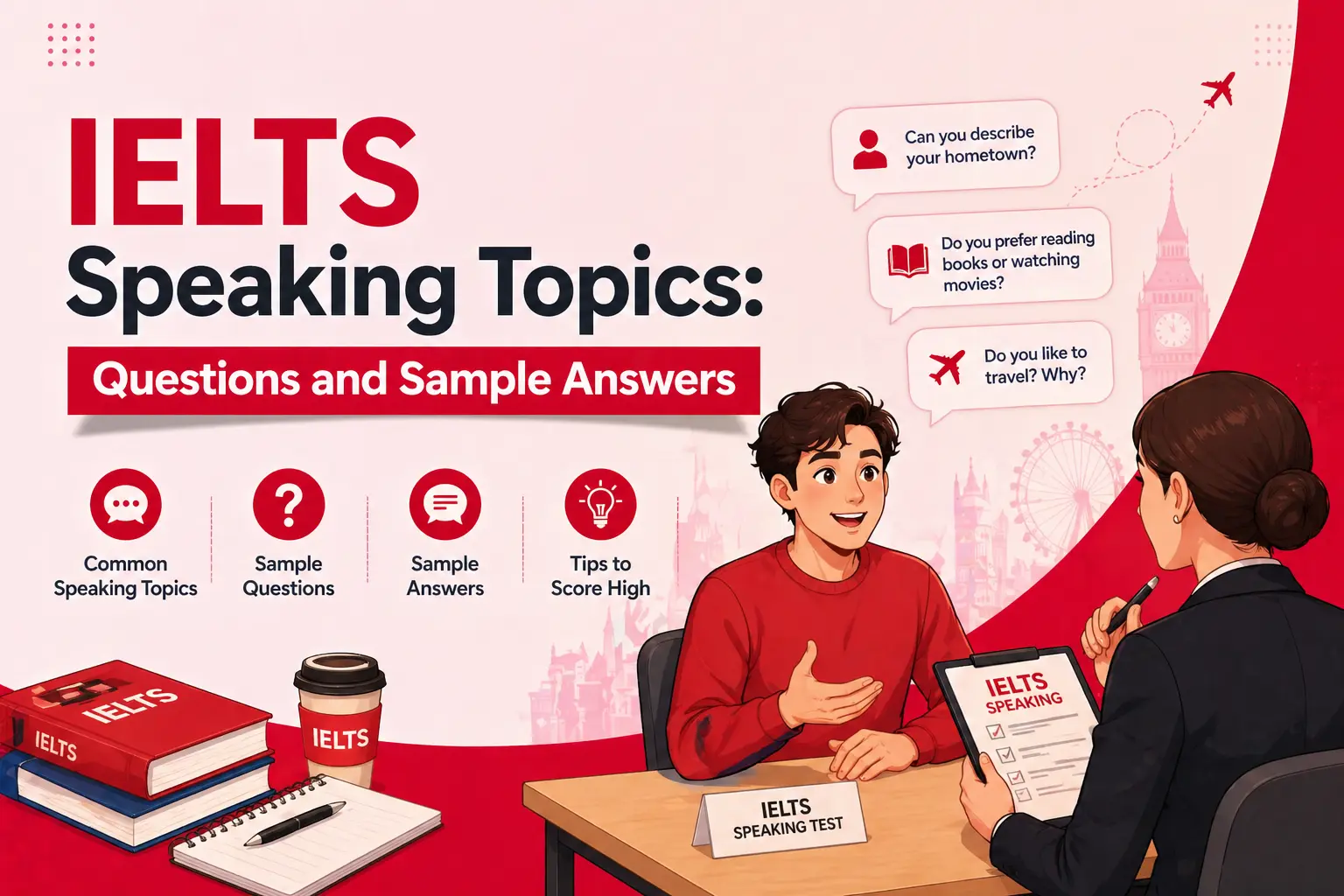
Introduction to IELTS Speaking Test
The IELTS Speaking Test is designed to assess a candidate’s spoken English skills in real-life situations. It evaluates four key criteria:
- Fluency and Coherence
- Lexical Resource (Vocabulary)
- Grammatical Range and Accuracy
- Pronunciation
The test lasts 11–14 minutes and is conducted as a face-to-face interview with a certified examiner. It is divided into three parts:
- Part 1: Introduction & Interview
- Part 2: Long Turn (Cue Card)
- Part 3: Discussion
This guide covers the most common IELTS Speaking topics, along with realistic questions and band-level sample answers.
PART 1: IELTS Speaking – Introduction & Interview
· Duration: 4–5 minutes
· Nature: Simple, familiar topics
· Focus: Fluency, confidence, basic grammar, vocabulary
Topic 1: Work or Studies
Question 1: Do you work or are you a student?
· Answer- I am currently a student. I am pursuing my bachelor’s degree in business administration. I chose this field because I am interested in management, leadership, and entrepreneurship.
Question 2: Why did you choose this field?
· Answer- I chose this field because it offers a wide range of career opportunities. Moreover, it helps develop practical skills like communication, problem-solving, and decision-making, which are essential in today’s competitive job market.
Question 3: What do you like most about your studies?
· Answer- What I like most is the practical approach. We often work on real-life case studies, which makes learning more engaging and helps us understand how businesses actually operate.
Topic 2: Hometown
Question 1: Where are you from?
· Answer- I am from Lucknow, a historic city in northern India, which is well known for its culture, architecture, and delicious cuisine.
Question 2: What do you like about your hometown?
· Answer- I love the peaceful environment and the rich cultural heritage. The city has a perfect blend of tradition and modernity, which makes it a pleasant place to live.
Question 3: Would you like to live there in the future?
· Answer- Yes, I would love to return someday. Although I may move abroad for better career opportunities, I would prefer to settle in my hometown later in life.
Topic 3: Daily Routine
Question 1: What do you usually do in the morning?
· Answer- I usually wake up early, go for a short walk, and then have breakfast. After that, I check my schedule and start preparing for my classes or work.
Question 2: Do you like your daily routine?
· Answer- Yes, I do. It keeps me organized and productive. Having a fixed routine helps me manage my time effectively.
Topic 4: Hobbies
Question 1: What are your hobbies?
· Answer- I enjoy reading books and listening to podcasts. In my free time, I also like cooking and experimenting with new recipes.
Question 2: Why do you enjoy this hobby?
· Answer- It helps me relax and reduces stress. Reading, especially, improves my vocabulary and general knowledge.
Topic 5: Technology
Question 1: How often do you use the internet?
· Answer- I use the internet daily, mainly for studies, communication, and entertainment.
Question 2: Has technology changed your life?
· Answer- Yes, definitely. Technology has made life more convenient. It allows me to access information instantly and stay connected with people across the world.
PART 2: IELTS Speaking – Cue Card (Long Turn)
Duration:
- 1 minute preparation
- 1–2 minutes speaking
You must speak continuously and cover all bullet points.
Cue Card 1: Describe a person who inspires you
You should say:
- Who the person is
- How you know them
- What qualities they have
- And explain why they inspire you
Sample Answer:
One person who truly inspires me is my father. He is a school teacher and has been working in the education field for more than 25 years. I know him not only as a parent but also as a role model.
He is extremely hardworking and disciplined. Despite many challenges, he always remained honest and dedicated to his profession. He believes in lifelong learning and constantly updates his knowledge.
What inspires me the most is his positive attitude and patience. He always encourages me to follow my dreams and never give up in difficult situations. His values and work ethic motivate me to become a better person.
Cue Card 2: Describe a memorable journey you took
You should say:
- Where you went
- Who did you go with
- What you did there
- And why it was memorable
Sample Answer:
I would like to talk about a trip to Manali that I took with my friends last year. It is a beautiful hill station located in Himachal Pradesh.
We went there during winter and enjoyed the snowfall for the first time. We visited famous tourist spots, tried local food, and did adventure activities like river rafting.
The journey was memorable because it allowed me to escape from my daily routine and spend quality time with my friends. The natural beauty and peaceful environment made it an unforgettable experience.
Cue Card 3: Describe a book you recently read
You should say:
- What the book was
- Who wrote it
- What it was about
- And why you liked it
Sample Answer:
The book I recently read is Atomic Habits by James Clear. It focuses on the power of small habits and how they can lead to remarkable changes over time.
The book explains how habits are formed and provides practical strategies to build good habits and break bad ones. I liked it because it is simple, motivating, and easy to apply in daily life. Learn more: IELTS Cue Card
PART 3: IELTS Speaking – Discussion
· Duration: 4–5 minutes
· Nature: Abstract and analytical
· Focus: Opinion, comparison, examples, justification
Topic: Role Models
Question 1: Why do people need role models?
· Answer- People need role models because they provide guidance and motivation. Role models inspire individuals to set goals and work hard to achieve success.
Question 2: Are celebrities good role models?
· Answer- Some celebrities can be good role models if they promote positive values. However, not all celebrities set a good example, so people should be selective.
Topic: Travel
Question 1: How has travelling changed in recent years?
· Answer- Travelling has become more convenient due to online booking and improved transportation. People can now plan trips easily using digital platforms.
Question 2: Should governments promote tourism?
· Answer- Yes, governments should promote tourism as it boosts the economy, creates jobs, and promotes cultural exchange.
Topic: Education
Question 1: Is online education as effective as traditional education?
· Answer- Online education is effective in terms of flexibility and accessibility. However, traditional education offers better interaction and practical exposure.
Question 2: How can education systems be improved?
· Answer- Education systems can be improved by focusing on practical learning, skill development, and using modern teaching methods.
Topic: Technology & Society
Question 1: Do you think people rely too much on technology?
· Answer- Yes, many people rely heavily on technology, which sometimes reduces face-to-face communication and physical activity.
Question 2: What are the disadvantages of technology for children?
· Answer- Excessive use of technology can affect children’s health, reduce creativity, and limit social interaction.
What are the helpful IELTS Speaking strategies?
- Speak clearly and naturally- Speak clearly and naturally so the examiner can easily understand you. Share your ideas confidently without forcing difficult words.
- Use complete sentences- Answer questions in full sentences instead of short replies. This helps you show your language ability more clearly.
- Practice speaking daily- Practice speaking English every day, even for a few minutes. Regular practice improves fluency and reduces nervousness.
- Stay calm while speaking- Stay relaxed during the test. If you need time to think, take a short pause instead of rushing your answer.
- Use correct and straightforward grammar- Focus on using simple and correct grammar. Clear sentences are better than long or confusing ones.
- Explain with reasons and examples- Support your answers with reasons or small examples. This makes your responses complete and more interesting.
- Maintain a steady speaking pace- Speak at a steady speed so your words sound clear. Avoid speaking too fast or too slowly.
- Use basic linking words- Use common words like because, so, and, and for example, to connect your ideas smoothly.
- Focus on clear pronunciation- Pronounce words clearly. Aim for easy understanding rather than copying any accent.
- Listen to the examiner carefully- Pay close attention to each question and answer it directly. This shows good listening skills.
- Expand your answers- Try to explain your ideas in detail, especially in Part 2 and Part 3 of the test.
- Avoid memorized responses- Speak in your own words. Natural answers sound more confident and genuine.
- Practice common topics- Prepare familiar topics like work, study, travel, hobbies, and daily life. This builds confidence.
- Use natural body language- Maintain eye contact and use simple gestures. This helps you appear confident and relaxed.
- Treat the test as a conversation- Think of the test as a friendly conversation rather than an exam. This mindset helps you speak more comfortably.
IELTS Speaking Band 7, 8 & 9 Model Answers
Each question below is answered at three band levels so you can see the difference in quality and complexity. Notice how vocabulary, structure, and depth increase as bands go up.
Topic: Work or Studies
Q: Do you work or study?
· Band 7 Answer- I’m currently studying business management at university. I chose this course because I want to pursue a career in marketing.
· Band 8 Answer- At the moment, I’m a third-year business management student. I opted for this field since I’m fascinated by how marketing strategies influence consumer behaviour.
· Band 9 Answer- I’m presently in my final year of a business management degree. I gravitated towards this discipline because it offers a comprehensive insight into organizational dynamics, and I believe it will equip me with the strategic thinking required for a successful marketing career.
Q: What aspects of your studies do you enjoy most?
· Band 7- I enjoy group projects because they allow me to work with classmates and learn from them.
· Band 8- I particularly appreciate group assignments as they foster collaboration and allow me to learn from diverse perspectives.
· Band 9- What I find most rewarding are the collaborative projects. They not only enhance my ability to work effectively within a team but also expose me to a multitude of viewpoints, which enriches my understanding of real-world business challenges.
Topic: Hometown
Q: Describe your hometown.
· Band 7- My hometown is Pune. It is a big city with many cafes and parks.
· Band 8- I come from Pune, a vibrant city in Maharashtra known for its educational institutions, historical sites, and thriving café culture.
· Band 9- I hail from Pune, a dynamic metropolis in western India. It’s renowned for its blend of modernity and tradition — from bustling educational hubs and tech parks to serene historical landmarks and lush green spaces.
Topic: Technology
Q: How has technology changed our lives?
· Band 7- Technology has made things easier. For example, we can communicate quickly with smartphones.
· Band 8- Technology has significantly simplified daily life. For instance, smartphones have transformed the way we communicate and access information.
· Band 9- Technology has fundamentally reshaped the fabric of our daily lives. With innovations like high-speed internet and smartphones, communication has become instantaneous, and information is accessible at our fingertips, which has irrevocably altered how we work, learn, and socialize.
Latest IELTS Speaking Topic Predictions (2026)-
The following are topics frequently appearing in recent tests, as well as strong predictions for upcoming exams:
Personal Life & Routine
- Daily routine
- A hobby you enjoy
- Your favourite time of day
- A life lesson you learned
People & Relationships
- Someone you admire
- A family member who influenced you
- A friend who helped you
- A teacher who inspired you
Places
- A memorable trip
- A place you want to visit
- A park you like
- Your favourite building
Learning & Education
- A subject you enjoy
- A skill you’re learning
- A teacher you admire
- Education vs online learning
Work & Career
- Your future job plans
- A company you admire
- Work you did recently
- A job you find interesting
Society & Culture
- A festival you celebrate
- Traditional food you like
- Customs in your culture
- Impact of globalization
Technology & Media
- A useful app
- The impact of social media
- Technology in education
- New gadgets you use
Environment & Nature
- A natural place you visited
- Environmental problems
- Sustainable practices
- Climate change awareness
Health, Sports & Lifestyle
- Healthy habits
- Importance of exercise
- A sport you like
- Importance of diet
These themes are based on global speaking trends and examiner patterns.
Topic-wise Vocabulary for IELTS Speaking-
Using strong vocabulary and collocations significantly boosts your Speaking Score.
Work & Studies
|
Word/Phrase |
Meaning |
Example |
|
career path |
professional growth over time |
“I want a flexible career path.” |
|
professional development |
improving skills |
“Online courses boost my development.” |
|
work ethic |
attitude towards work |
“A strong work ethic is crucial.” |
|
internship |
practical work experience |
“I did an internship last summer.” |
Hometown & Places
|
Word/Phrase |
Meaning |
Example |
|
tranquil |
peaceful |
“The countryside is tranquil.” |
|
vibrant |
full of energy |
“My city has a vibrant culture.” |
|
metropolis |
large city |
“Mumbai is a bustling metropolis.” |
|
local cuisine |
traditional food |
“I love exploring local cuisine.” |
Technology
|
Word/Phrase |
Meaning |
Example |
|
innovation |
new idea/tech |
“Innovation drives economic growth.” |
|
digital era |
modern tech period |
“We live in a digital era.” |
|
automation |
machines replacing tasks |
“Automation increases efficiency.” |
|
connectivity |
being linked |
“Internet connectivity is vital today.” |
Travel
|
Word/Phrase |
Meaning |
Example |
|
breathtaking |
extremely beautiful |
“The view was breathtaking.” |
|
cultural immersion |
experiencing culture deeply |
“I enjoyed cultural immersion in Japan.” |
|
itinerary |
travel plan |
“Our itinerary was well-organized.” |
|
off the beaten path |
unusual place |
“We explored places off the beaten path.” |
Education
|
Word/Phrase |
Meaning |
Example |
|
curriculum |
organized study plan |
“The curriculum is skill-oriented.” |
|
pedagogical |
teaching method |
“He uses an effective pedagogical style.” |
|
critical thinking |
analyzing logically |
“Education should build critical thinking.” |
|
lifelong learning |
continuous study |
“Lifelong learning is necessary today.” |
IELTS Speaking Mock Test Sets
Below are full mock test simulations (Parts 1, 2, 3) you can practice with timings.
MOCK TEST 1
Part 1
- What is your favourite season?
- Do you prefer mornings or evenings?
- How often do you use social media?
Cue Card
Describe an important goal you set for yourself.
You should say:
- What the goal was
- Why it was important
- How you achieved it
- And explain what you learned from it.
Part 3
- Why do people set goals?
- Is it important to set long-term goals?
- How can parents help children set goals?
MOCK TEST 2
Part 1
- Do you enjoy cooking?
- What kind of food do you like?
- Are you a good cook?
Cue Card
Describe a technology you find useful.
You should say:
- What the technology is
- How you use it
- What benefits does it have
- And explain why you find it useful.
Part 3
- Has technology made life easier?
- What are the negative aspects of technology?
- Will technology replace human jobs?
MOCK TEST 3
Part 1
- Do you enjoy watching movies?
- How often do you watch movies?
- Do you prefer watching at home or in the cinema?
Cue Card
Describe a trip you took with your family.
You should say:
- Where you went
- What you did
- How you felt
- And explain why the trip was memorable.
Part 3
- Why do people travel?
- How has travel changed in recent years?
- What are the advantages and disadvantages of tourism?
What are the expert tips to maximize your IELTS score?
- Speak with confidence- Speak confidently and believe in your ability. Confidence helps you sound fluent and leaves a positive impression on the examiner.
- Answer in complete sentences- Use full sentences instead of short replies. Complete answers help you show your grammar and speaking skills clearly.
- Focus on fluency, not perfection- Keep speaking even if you make small mistakes. Fluency matters more than being perfect.
- Use simple and clear language- Choose simple words that you can use correctly. Explicit language is better than difficult words being misused.
- Give reasons and examples- Support your answers with reasons or examples. This makes your responses meaningful and well-developed.
- Practice common topics- Practice topics like work, education, travel, technology, hobbies, and daily life. Familiar topics reduce stress during the test.
- Use linking words naturally- Use words like because, so, however, and for example to connect your ideas smoothly.
- Improve pronunciation- Pronounce words clearly and speak at a steady pace. Clear pronunciation helps the examiner understand you easily.
- Listen carefully to the examiner- Pay close attention to each question and respond directly. Good listening improves your answers.
- Avoid memorized answers- Speak naturally and in your own words. Memorized answers sound unnatural and may lower your score.
- Expand your answers- Add details to your responses, especially in Part 2 and Part 3. Short answers limit your score.
- Practice with mock tests- Take regular speaking mock tests. Mock practice helps you manage time and build confidence.
- Stay calm and relaxed- Stay calm during the test. A relaxed mind helps you think clearly and speak better.
- Correct yourself politely- If you make a mistake, correct it smoothly and continue speaking without panic.
- Treat the test as a conversation- Think of the IELTS Speaking test as a friendly discussion. This approach helps you speak more naturally and confidently.
|
Explore More |
Conclusion-
The IELTS Speaking test is not about using difficult or uncommon vocabulary; instead, it focuses on how clearly, confidently, and effectively you can communicate your ideas. Success in this section comes from regular practice, familiarity with common topics, and a clear understanding of question patterns across all three parts of the test. By consistently practicing topics such as work, education, technology, travel, hobbies, and society, candidates can build fluency and coherence in their responses. Structured answers with relevant examples, appropriate vocabulary, and natural grammar usage help create a strong impression on the examiner. With dedication, self-evaluation, and mock practice, achieving a high band score in IELTS Speaking is not only possible but highly achievable.
FAQs on IELTS Speaking Topics: Questions and Sample Answers -
Q1. How many parts are there in the IELTS Speaking test?
Ans- There are three parts: Part 1 (Introduction), Part 2 (Cue Card), and Part 3 (Discussion).
Q2. Is it necessary to use advanced vocabulary to score high?
Ans- No, clarity, fluency, and accuracy are more important than complex vocabulary.
Q3. Can you memorize answers for IELTS Speaking?
Ans- Memorized answers are discouraged and can reduce your score if detected.
Q4. How long is the IELTS Speaking test?
Ans- The test lasts between 11 and 14 minutes.
Q5. What types of topics are commonly asked?
Ans- Common topics include work, studies, hometown, hobbies, travel, technology, and society.
Q6. How can you improve your fluency?
Ans- Practice speaking daily, record yourself, and focus on speaking without long pauses.
Q7. Are answers the same for Academic and General IELTS?
Ans- Yes, the Speaking test is the same for both versions.
Q8. What should you do if you don’t understand a question?
Ans- You can politely ask the examiner to repeat or clarify the question.
Q9. How important is pronunciation in IELTS Speaking?
Ans- Pronunciation is one of the four key assessment criteria and is very important.
Q10. How many mock tests should you practice before the exam?
Ans- Practicing at least 10–15 complete mock tests is recommended for better confidence and performance.




Leave a Comment
Your email address will not be published.