
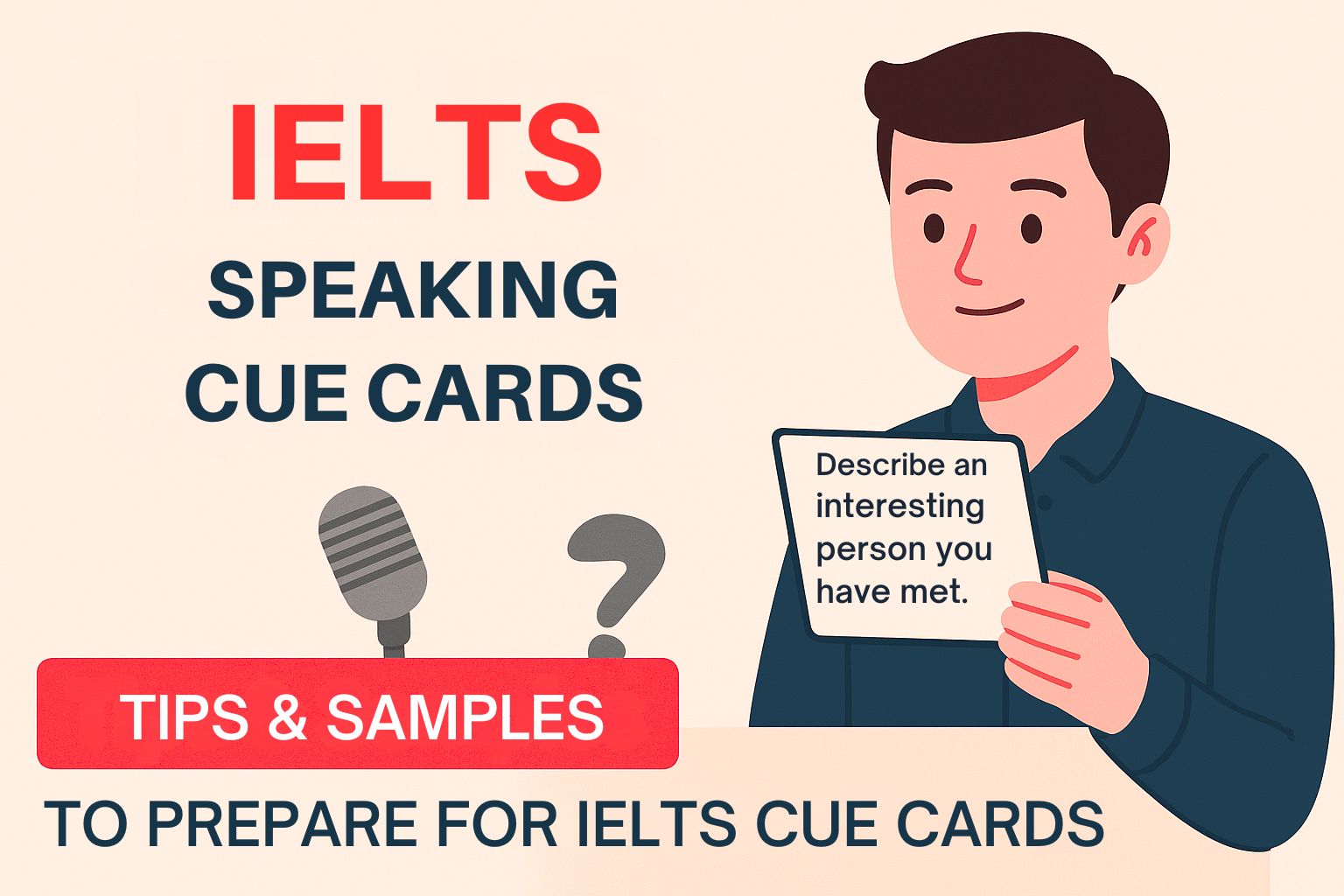
The International English Language Testing System (IELTS) is one of the most widely recognized English proficiency tests for non-native English speakers seeking to study, work, or settle abroad. The Cue Card segment is one of the most difficult and crucial components of the IELTS Speaking exam. This segment not only evaluates your fluency and coherence but also your ability to think and express ideas spontaneously. This blog explores everything about the IELTS Cue Cards exam pattern, frequently asked topics, sample questions and answers, and innovative preparation strategies to help you score high in the Speaking module.
Defining the IELTS Speaking Test Structure-
A trained examiner conducts an in-person interview for the IELTS Speaking Test. It is divided into three sections and lasts between 11 and 14 minutes.
- Part 1 – Introduction & Interview (4–5 minutes)- You respond to enquiries concerning subjects you are familiar with, such as studies, hobbies, family, and home.
- Part 2 – Long Turn (3–4 minutes)- This is the Cue Card round. You have one minute to get ready and are assigned a topic. After that, you have to talk for one or two minutes.
- Part 3 – Discussion (4–5 minutes)- It involves follow-up questions related to the cue card topic. This part evaluates your analytical and opinion-based speaking skills.
IELTS Cue Card Pattern (Part 2)-
The purpose of the Cue Card is to assess your capacity for lengthy speech on a particular subject. Here's what typically happens:
- You will be handed a cue card with a topic and four prompts or bullet points.
- You will also receive a piece of paper and a pencil to make notes.
- You have one to two minutes to talk after a minute of preparation.
- The examiner may ask 1–2 short questions once you finish.
Example of Format-
Describe a person you admire.
You should say:
- Who the person is
- How do you know the person
- What qualities do you admire
- And explain why you admire this person.
Read More: IELTS Exam Pattern and Syllabus
What are the popular IELTS Cue Card Topics of 2024–2025?
Cue card topics usually cover everyday situations. Common categories include:
1. People
- Describe a teacher who inspired you.
- Give an example of a family member you look up to.
- Describe a successful person you know.
2. Places
- Give an example of a location you'd like to see.
- Describe your favourite restaurant.
- Give an example of a city you've been to and enjoyed.
3. Objects
- Describe a gift you received.
- Describe an essential item you own.
- Describe a book you enjoyed reading.
4. Events
- Describe a recent celebration you attended.
- Describe a festival you enjoy.
- Describe a time you helped someone.
5. Experiences
- Describe a challenging situation you overcame.
- Describe a time you were very busy.
- Give an example of a proud accomplishment.
6. Technology & Media
- Describe your favourite app or website.
- Give an example of a technological device you frequently use.
Sample Cue Card Questions with Model Answers-
Cue Card 1- Describe a memorable journey you took.
You should say-
- Where you went
- How you travelled
- What you saw and did
- And explain why it was memorable.
Sample Answer-
One of the most memorable journeys I ever took was a road trip to Manali, a beautiful hill station in northern India. I went there with three of my college friends during the winter break.
We travelled by car, which made the journey even more fun and adventurous. Tall pine trees and snow-capped mountains surrounded the roads, and we often stopped to take pictures or enjoy roadside tea.
We visited Solang Valley, where we tried paragliding and skiing for the first time. The snow made everything look magical, and the cold air was refreshing. We also explored the local markets and tried delicious Himachali food.
What made this journey unforgettable was not just the destination but the bond we shared and the laughter we had. It was a much-needed escape from our busy routines.
Cue Card 2: Describe a book that had a significant impact on you.
You should say-
- What the book was
- How did you hear about it
- What the book is about
- And explain why it had a significant impact on you.
Sample Answer-
A book that had a significant impact on me is “Atomic Habits” by James Clear. I first heard about it from a friend who was trying to build a better morning routine.
The book is about how small daily habits can lead to remarkable long-term improvements in life. It explains the science behind habit formation and provides practical tips on how to break bad habits and form good ones.
What impressed me most was the idea of focusing on systems rather than goals. For example, instead of saying, “I want to lose weight,” you focus on building the habit of eating healthy and exercising daily.
This book changed how I approach my goals and daily routines. I’ve applied many of its principles, and they’ve helped me become more productive and focused.
Cue Card 3: Describe a time you helped someone-
You should say-
- When it was
- Who you helped
- How you helped them
- And explain how you felt about it.
Sample Answer-
A few months ago, I helped my cousin with his school project on climate change. He’s in 9th grade and was struggling to understand the topic and organize the content.
I sat with him over the weekend, explained the basic concepts, and helped him create a PowerPoint presentation. We also printed some charts and images to make it visually appealing.
He was pleased with the outcome and even got praised by his teacher. I felt really proud and satisfied knowing that I could support him.
Helping him reminded me of how important it is to give our time and knowledge to others, especially family. It was a small act, but it brought us closer.
Read More: IELTS exam 2025: Registration, Exam Fee, Exam Pattern, Exam Dates, Scores, and Tips
Which techniques should a candidate use to tackle IELTS Cue Cards effectively?
Understand the Cue Card Structure-
- Familiarize yourself with the format- Each cue card includes a central topic and 3–4 prompts to guide your response.
- Recognize the timing- You get 1 minute to prepare and must speak for 1–2 minutes.
Make Use of the Preparation Time-
- Note key points- Jot down short words or phrases, not complete sentences, to structure your answer.
- Plan the flow- Think of a brief introduction, main content, and conclusion.
- Visualize your answer- Mentally walk through what you will say; storytelling works well.
Use a Clear Structure-
- Start with a strong opening- Use phrases like “I’d like to talk about…” or “Let me describe…”.
- Follow the prompts- Address each bullet point in order for coherence.
- Wrap it up well- Conclude with a summary or your personal opinion to give your speech a rounded finish.
Speak Fluently and Coherently-
- Avoid long pauses- Practice keeping the conversation flowing, even if you use fillers like “Well,” or “Let me think.”
- Use linking words- Connect your ideas with phrases like first of all, in addition, for instance, as a result, and finally.
Expand Your Answer-
- Give details: Add descriptive information or examples to lengthen your response.
- Include personal stories: Use experiences to make your answer authentic and memorable.
- Answer the 'Why': Explain reasons behind your statements to show depth of thought.
Build a Strong Vocabulary-
- Learn topic-specific words- Memorize words and phrases related to common IELTS themes (e.g., travel, people, technology).
- Use synonyms- Avoid repeating the same word; use alternatives to demonstrate range.
- Practice collocations- Use natural word combinations like “make a decision” or “take part in.”
Improve pronunciation and intonation-
- Speak clearly- Focus on correct pronunciation, even if you speak slowly.
- Use intonation- Emphasize key points using voice modulation for better expression.
- Record yourself- Identify areas to improve by listening to your speech.
Practice with Real Cue Cards-
- Use past questions- Practice with real or frequently asked cue card topics.
- Use a timer- Time your 1-minute prep and 2-minute response to build confidence.
- Get feedback- Ask a teacher or peer to evaluate your response based on IELTS criteria.
Memorize Useful Phrases-
- For Introduction- “Today I want to share…”, “Let me tell you about…”
- For Giving Examples- “For instance…”, “One example that comes to mind is…”
- For Conclusion- “To sum up…”, “That’s why this moment is special to me…”
Stay Calm and Confident-
- Don’t panic if you forget- Take a breath, refer to your notes, or shift to another related idea.
- Smile and maintain eye contact- It helps in reducing nervousness and builds rapport with the examiner.
- Practice relaxation techniques- Deep breathing before speaking can help calm your nerves.
How are Cue Cards scored in IELTS?
Your response is evaluated based on four criteria-
|
Criterion |
What It Means |
|
Fluency & Coherence |
Ability to speak smoothly and organize ideas logically |
|
Lexical Resource |
Use of a wide range of vocabulary accurately |
|
Grammatical Range |
Use of various sentence structures with correct grammar |
|
Pronunciation |
Clarity, stress, rhythm, and correct intonation |
Each criterion contributes 25% to your total Speaking IELTS Band Score.
Cue Card preparation strategy according to week-
Here is a sample 4-week preparation plan for mastering IELTS cue cards-
Week 1: Foundation
- Understand the cue card structure.
- Start practising basic topics (e.g., describe a person/place).
Week 2: Vocabulary and Fluency
- Learn phrases and idioms for common topics.
- Record and review your answers.
In Week 3: Variety and Speed
- Cover advanced topics (e.g., tech, environment).
- Time yourself and reduce pauses.
Week 4: Mock Practice
- Simulate real test scenarios.
- Get feedback from a teacher or peer.
Top Phrases to Use in Cue Card Responses-
|
Situation |
Useful Phrases |
|
Starting |
“I'd like to talk about…”, “Let me describe…” |
|
Adding Details |
“In fact…”, “Moreover…”, “Additionally…” |
|
Giving Examples |
“For instance…”, “To give an example…” |
|
Expressing Feelings |
“I felt extremely…”, “It was truly amazing…” |
|
Concluding |
“To sum up…”, “Overall, it was a great experience.” |
Conclusion
The IELTS cue card section may seem daunting at first, but with consistent practice, you can turn it into a strength. Focus on structuring your speech, expanding your vocabulary, and using your 1-minute preparation time wisely. Remember, the goal isn’t perfection; it is communication. The more you practice with real topics and mock tests, the more confident and fluent you’ll become. Use the sample cue cards, tips, and weekly plan provided above to boost your IELTS Speaking score and move one step closer to your dreams.
FAQs on Common IELTS Cue Card
Q.1 What is the IELTS cue card?
Ans- It is Part 2 of the Speaking Test, where you speak on a topic for 1–2 minutes.
Q.2 Can you choose the cue card topic?
Ans- No, the topic is randomly given by the examiner.
Q.3 Can you ask for another topic?
Ans- No, you must speak on the assigned topic.
Q.4 Will you be penalized for pausing?
Ans- Occasional pauses are okay, but frequent, long pauses affect your score.
Q.5 Can you take notes during the 1-minute prep?
Ans- Yes, you’re encouraged to note down keywords.
Q.6 What if you speak for less than 1 minute?
You may get a lower score for fluency.
Q.7 Is it okay to make up a story?
Ans- Yes, the examiner evaluates your language, not the truth.
Q.8 Should you use complex vocabulary?
Ans- Use a range of vocabulary, but ensure it’s appropriate and accurate.
Q.9 Can you use personal examples?
Ans- Absolutely. They make your answers more natural and engaging.
Q.10 Is pronunciation more important than grammar?
Ans- Both are equally important; all four scoring areas matter.




Leave a Comment
Your email address will not be published.