
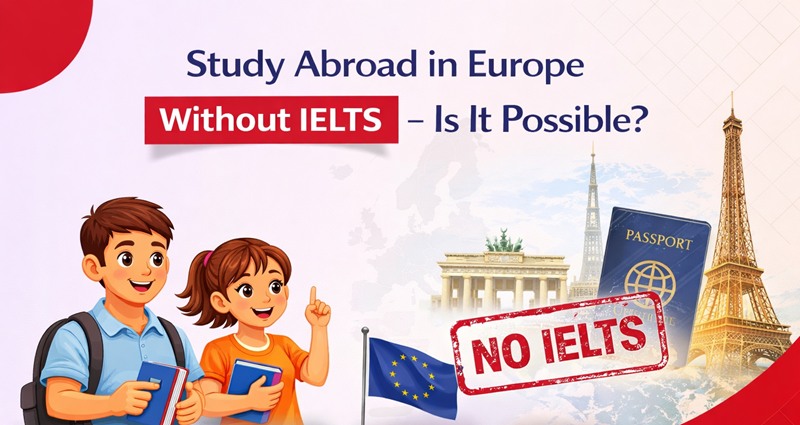
Studying abroad in Europe is a dream for many international students, especially from India. A common hurdle often mentioned is the IELTS (International English Language Testing System) requirement. But here’s the good news: in 2026, yes, it is absolutely possible to study abroad in several European countries without submitting an IELTS score. In this blog, we'll explore the why, where, how, and key alternative routes to achieve your study abroad goals—IELTS-free.
Why are universities waiving IELTS?
Universities across Europe recognize that standardized English tests like IELTS may not always reflect a student’s true proficiency. Many institutions, especially for English-taught programs, now accept alternative proofs, such as:
- A Medium of Instruction (MOI) certificate confirming prior education in English.
- Interviews (video, phone, or in-person) to assess oral and written skills.
- Prior degrees completed in English, especially those from recognized boards.
- Institutional discretion: Many universities evaluate language skills holistically.
These flexible approaches reflect evolving admission practices driven by increasing international interest and diverse applicant profiles. Universities in Europe are waiving IELTS for several practical and strategic reasons:
- Diverse international talent pool- They want to attract more international students, including those from countries where English is widely used but IELTS isn’t common. Waiving the test removes a barrier to applications.
- Alternative proof of proficiency- Many students already study in English-medium schools or universities. A Medium of Instruction (MOI) certificate, academic transcripts, or past qualifications in English can serve as credible proof.
- Direct language assessment- Universities can conduct video or phone interviews to evaluate English skills instead of relying on a standardized test score.
- Cost and accessibility- IELTS can be expensive and less accessible in some regions. Waiving it makes the application process more inclusive.
- Holistic admissions approach- Institutions increasingly prefer assessing students on multiple factors, such as academic records, motivation, and communication skills, rather than a single test.
Which countries and universities allow admission without IELTS?
Here’s a breakdown of nations and institutions in Europe where IELTS Exam may not be mandatory-
Germany-
Germany is known for low or no tuition fees and quality education. Many universities accept alternative proof-
- University of Siegen, University of Koblenz and Landau, Esslingen University of Applied Sciences, University of Giessen, Braunschweig University of Technology, Free University of Berlin, among others, waive IELTS if you present an MOI certificate or equivalent.
Sweden-
For master’s programs, Indian students who have completed a full bachelor's in English (most fields except IT) can apply without IELTS by showing proof of MOI. Top universities include-
- Lund University, Uppsala University, Chalmers University, KTH Royal Institute of Technology, etc.
Poland-
· If your previous studies were in English, universities like Jagiellonian University, Adam Mickiewicz University, and Warsaw University of Technology accept applications without IELTS.
France-
Several private and public institutions offer programs without IELTS, particularly business and design schools, such as:
- American Business School Paris, EBS Paris, EPITA, ESC Rennes, SKEMA, Toulouse Business School, among others.
Italy-
· You may apply to universities like the University of Milan, Pisa, Bologna, Padua, Verona, Florence, and John Cabot University without IELTS if you provide an MOI or attend interviews.
Norway-
While many institutions require IELTS, several may accept alternatives; universities often offer English-taught programs. Examples include:
- University of Bergen, NTNU, University of Oslo, UiT Arctic University, BI Norwegian Business School.
Ireland-
If your education was in English, or if you can provide alternative proof (MOI/interview), universities such as:
- NUI Galway, University of Limerick, RCSI, Maynooth University, etc., may waive IELTS.
Belgium, Latvia, Denmark, UK, Greece-
- Belgium- Institutions like Ghent University may accept MOI in lieu of IELTS.
- Latvia- Universities like the University of Latvia and Riga Technical University may allow applications without IELTS.
- Denmark- University of Copenhagen, Aarhus, ensure English ITV; MOI may be acceptable.
- UK- Several universities may waive IELTS for students with strong English-medium backgrounds or interview performance.
- Greece- English-taught programs are available in universities like Athens University of Economics and Business, University of Crete, etc.; IELTS requirements vary.
When is IELTS still required?
Even with flexible policies, IELTS remains necessary when-
- University policy demands IELTS- Some institutions explicitly list IELTS (or TOEFL) as mandatory for admission, regardless of your educational background.
- No acceptable alternative proof- If you cannot provide a valid Medium of Instruction (MOI) certificate, prior English-medium education, or pass a language interview, the university may require IELTS.
- Visa requirements- Certain embassies or consulates still ask for standardized English test scores, even if the university has waived the requirement.
- Competitive programs- High-demand courses or scholarships may require IELTS to ensure consistent English proficiency standards.
- Post-study or immigration plans- If you plan to settle, work, or pursue further studies in countries where IELTS is part of immigration or job eligibility, having the score is essential.
How to apply without IELTS?
Here’s a step-by-step guide to applying for European universities without IELTS-
- Research universities and programs- Shortlist institutions that accept alternatives to IELTS. Check their official websites for updated language requirements.
- Get a medium of instruction (MOI) certificate- Request this document from your previous school or university, confirming that your education was entirely in English.
- Prepare supporting documents- It includes academic transcripts, recommendation letters, and proof of English-related coursework or projects.
- Ace the language interview- Some universities conduct phone or video interviews to assess English proficiency. Treat this seriously.
- Secure an admission letter stating language waiver- Make sure the offer letter clearly mentions that you meet the language requirement without IELTS.
- Check visa requirements separately- Even if the university waives IELTS, confirm with the embassy/consulate that you can apply for a student visa without it.
What are the advantages and considerations of going IELTS-free?
Advantages-
- Cost savings – You avoid IELTS test fees, preparation courses, and retakes.
- Faster application process – No waiting for test dates or results; you can apply immediately with MOI or other proof.
- Less stress – Removes the pressure of preparing for a high-stakes exam.
- Inclusive opportunity – Helps students from regions where IELTS centers are limited.
- Flexibility – Opens options for last-minute applications or multiple universities.
Considerations-
- Visa risks – Some embassies may still require IELTS despite a university waiver.
- Limited program choice – Not all courses or universities offer IELTS-free entry.
- Extra proof needed – You’ll likely need a strong Medium of Instruction certificate or pass an interview.
- Future Plans – IELTS might be required later for work visas, permanent residency, or further studies.
- Competitive Edge – Having an IELTS score can still strengthen your application for top universities or scholarships.
More and more European countries, such as Germany, Sweden, Poland, France, Italy, Norway, Ireland, Belgium, Latvia, Denmark, the UK, and Greece, offer pathways without IELTS, especially for students with English-medium backgrounds or those open to interviews. For motivated students with strong English academic backgrounds, this approach can reduce stress and cost without compromising eligibility. However, always double-check both university and visa stipulations. When in doubt, consider sitting for IELTS as a backup, as having the score strengthens your applications and supports future academic or visa needs.
Summary Table
|
Country |
Key Institutions / Notes |
|
Germany |
Many public unis accept MOI, e.g., Siegen, Koblenz, Berlin |
|
Sweden |
MOI accepted for masters if prior degree in English (e.g., Lund, Uppsala) |
|
Poland |
Jagiellonian, Adam Mickiewicz, Warsaw Tech accept MOI |
|
France |
Multiple private/public schools (e.g., SKEMA, EPITA) waive IELTS |
|
Italy |
Universities like Bologna, Padua, Milan waive IELTS with MOI |
|
Norway |
Some unis may waive IELTS—check case by case |
|
Ireland |
MOI/interview acceptable at NUI Galway, Limerick, etc. |
|
Belgium |
Institutions like Ghent accept English-medium background |
|
Latvia |
Riga Technical, University of Latvia—English medium background accepted |
|
Denmark |
Universities like Copenhagen, Aarhus may accept MOI |
|
UK |
Top universities sometimes waive IELTS for strong English-medium background |
|
Greece |
English-taught programs available; check each university’s policy |
Final Words-
Studying abroad in Europe without IELTS is indeed possible, thanks to universities that accept alternatives like a Medium of Instruction (MOI) certificate, prior English-medium education, or interviews to assess language skills. Countries like Germany, Sweden, France, Italy, Poland, and more offer this pathway, making it easier and more affordable for international students. However, policies vary across institutions and visa authorities, so thorough research is essential before applying. While IELTS can still strengthen your profile, its absence doesn’t have to limit your opportunities. Strategic planning and proper documentation can open doors to quality European education without the traditional language test barrier.
Explore More | IELTS exam 2026: Registration, Exam Fee, Exam Pattern, Exam Dates, Scores
FAQS on Study Abroad in Europe Without IELTS-
Q1. Can you study in Europe without IELTS?
Ans- Yes, many universities accept alternative proofs like a Medium of Instruction (MOI) certificate or interviews.
Q2. Which countries in Europe allow students to study without IELTS?
Ans- Germany, Sweden, France, Italy, Poland, Norway, Ireland, and more.
Q3. What can replace IELTS?
Ans- MOI certificate, prior English-medium education, or a university-conducted interview.
Q4. Is MOI accepted for visas, too?
Ans- In some countries, yes, but always confirm with the embassy.
Q.5 Do all universities waive IELTS?
Ans- No, requirements vary; check each university’s admission policy.
Q6. Is IELTS-free admission common for master’s programs?
Ans- Yes, especially if your bachelor’s was in English.
Q7. Will skipping IELTS affect my job prospects later?
Ans- Possibly, as some employers and work visas require it.
Q8. Can you get scholarships without IELTS?
Ans- Yes, but competitive scholarships may still ask for test scores.
Q9. Is an English proficiency interview hard?
Ans- Usually not, but you should prepare to speak confidently.
Q10. Should you still take IELTS if you can avoid it?
Ans- It’s wise to use it as a backup for future academic or visa needs



Leave a Comment
Your email address will not be published.