
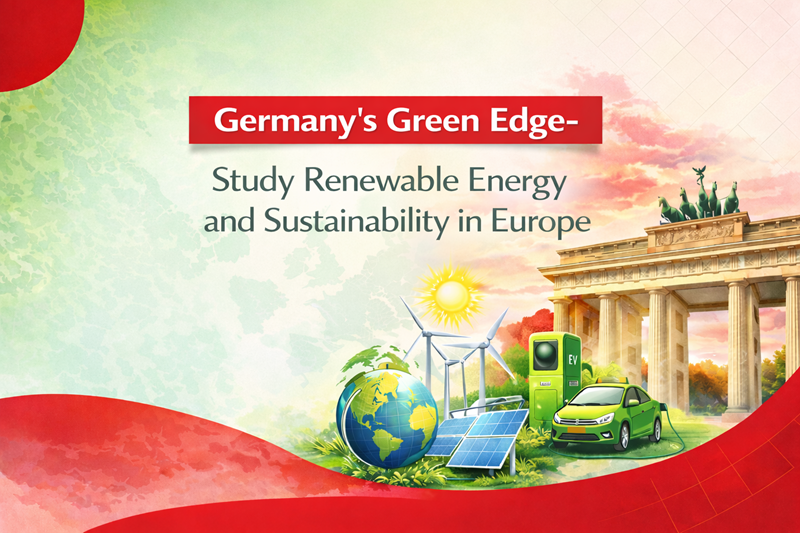
Germany isn’t just talking about a clean-energy future but building it. From community-owned wind parks in the north to solar-positive neighborhoods in the south, the country’s Energiewende (energy transition) has reshaped how Europe thinks about power, mobility, housing, and industry. For students, this means a vibrant classroom: real-world pilot projects, deep partnerships between universities and research institutes, and a job market that values practical problem-solvers who can turn climate goals into engineering, policy, and business reality. This guide is your complete roadmap to studying Renewable Energy and Sustainability in Germany, covering programs and specializations, top universities and research hubs, admissions and funding, industry links, career paths, and how to design a standout application.
Why Germany for renewable energy and sustainability?
- Global leader in renewable energy (Energiewende)- Germany’s Energiewende (energy transition) is one of the world's most ambitious climate and energy transformation projects. The country is rapidly shifting from fossil fuels to wind, solar, biomass, and hydrogen, making it a living laboratory for students.
- World-class universities and research institutes- Germany hosts leading universities such as TUM, RWTH Aachen, KIT, and University of Freiburg, along with Fraunhofer and Helmholtz Institutes, where cutting-edge research in solar, wind, hydrogen, and smart grids happens. Students benefit from hands-on labs and industry projects.
- Strong industry-academia link- Universities closely collaborate with companies like Siemens Energy, Bosch, RWE, and Enercon. Students often get internships, thesis projects, and career opportunities directly linked to industry challenges.
- Affordable, high-quality education- Most public universities in Germany charge little to no tuition fees, especially compared to the US or UK. Students only pay a modest semester contribution while enjoying access to excellent education and facilities.
- Career opportunities in a growing green economy- Germany is a renewable energy powerhouse, offering solar PV, wind engineering, hydrogen technologies, energy storage, and sustainability consulting jobs. Graduates are highly sought after both in Germany and across Europe.
- International environment and English-taught programs- Many Master’s programs in Renewable Energy and Sustainability are taught in English, attracting international students worldwide. This provides a diverse and collaborative learning experience.
- Sustainable lifestyle and culture- Germany embraces eco-friendly living, efficient public transport, recycling culture, cycling infrastructure, and green cities like Freiburg, making it easier to live sustainably while you study.
What can you study in Germany?
Degree pathways and specializations-
Bachelor’s Degrees (3–3.5 years)-
Ideal for building fundamentals across physics, thermodynamics, electrical systems, materials, and data. Common titles include:
- BSc Renewable Energy Engineering / Environmental Engineering
- BEng Energy Systems / Energy & Environmental Technology
- BSc Sustainable Development / Sustainability Science (more policy and systems oriented)
Core themes: energy conversion, power systems, fluids and heat transfer, control, measurement, environmental impact assessment, life cycle thinking, GIS for resource mapping, and programming (e.g., Python/MATLAB) for modelling.
Master’s Degrees (1.5–2 years)-
Where do you specialize? Popular options-
- MSc Renewable Energy Systems (wind/solar/biomass/geothermal, storage, grid integration)
- MSc Sustainable Energy Systems / Energy Engineering
- MSc Power Engineering (with RES focus)
- MSc Environmental & Resource Management
- MSc Sustainable Mobility / Transportation Systems
- MSc Sustainable Materials / Circular Economy
- MSc Energy Economics & Policy (for market design, regulation, carbon pricing)
- MSc Smart Grids & Energy Informatics (data, control, optimisation)
- MSc Hydrogen Technologies / Fuel Cells & Electrolysis
- MSc Sustainable Building / Energy-Efficient Architecture
MBA / Management Tracks-
If you’re aiming at leadership, project finance, or consulting roles:
- MBA or MSc in Sustainability Management / Energy Management
- Technology & Innovation Management with a decarbonization track
- You’ll cover project finance, risk, PPAs, carbon markets, ESG strategy, and change management.
PhD / Doctoral Research-
Suited to deep research in system modelling, advanced materials (perovskites, solid-state batteries), hydrogen systems, sector coupling (power–heat–mobility), and large-scale optimization. Typically tied to research institutes and industry partners.
Which are the top universities in Europe for studying renewable energy and sustainability?
Here’s a list of the top universities in Europe where you can study renewable energy and sustainability-
Germany-
- The Technical University of Munich (TUM) is known for energy systems, sustainable mobility, and green technologies.
- RWTH Aachen University offers power engineering, renewable integration, and industrial collaboration.
- Karlsruhe Institute of Technology (KIT) – This university offers courses in energy research, hydrogen technologies, and smart grids.
- The University of Freiburg is home to Fraunhofer ISE (Europe’s largest solar research institute).
- University of Oldenburg – Leading in offshore and onshore wind energy research.
Visit: Study Abroad in Germany for Indian Students
Denmark-
- The Technical University of Denmark (DTU) is a global leader in wind energy research and sustainable energy systems.
- Aalborg University is known for renewable integration, microgrids, and power electronics.
Visit: Study Abroad in Denmark for Indian Students
Sweden-
- KTH Royal Institute of Technology (Stockholm) – Sustainable energy engineering, smart grids, and energy efficiency.
- Chalmers University of Technology (Gothenburg) – Renewable energy, sustainable transport, and climate systems.
- Lund University – Interdisciplinary programs in environmental science and sustainability.
Visit: Study Abroad in Sweden for Indian Students
Norway-
- Norwegian University of Science and Technology (NTNU) strongly focuses on hydropower, offshore wind, and energy storage.
Netherlands-
- Delft University of Technology (TU Delft) – Renewable energy engineering, offshore wind, and sustainable urban systems are core courses offered by the university.
- Eindhoven University of Technology (TU/e) offers sustainable energy technology and innovation courses.
Switzerland-
- ETH Zurich is renowned for energy systems engineering, environmental sciences, and climate research.
- EPFL Lausanne – Cutting-edge research in solar PV, smart grids, and sustainable materials.
United Kingdom-
- Imperial College London – Energy Futures Lab, renewable integration, and climate change policy.
- University of Cambridge – Sustainability leadership, renewable energy research, and materials science.
- University of Edinburgh – World leader in marine and tidal energy research.
- University of Exeter – Renewable energy engineering programs with practical fieldwork.
Visit: Study Abroad in UK for Indian Students
Finland-
- Aalto University – Energy systems, circular economy, and sustainability-driven innovation.
Research Institutes (often co-supervising theses)-
- Fraunhofer ISE (Freiburg) – Europe’s largest solar research institute; PV technologies, power electronics, building systems.
- Fraunhofer IWES (Bremerhaven/Kassel) – Wind energy and system integration, turbine testing, offshore logistics.
- Helmholtz Association centres – Energy storage, hydrogen, large-scale systems.
- DLR (German Aerospace Centre) – Energy systems analysis, solar-thermal, fuels, mobility.
What will you learn by studying renewable energy and sustainability?
Core Technical Knowledge
- Renewable energy technologies – Solar PV and thermal, wind (onshore/offshore), biomass, hydro, geothermal.
- Energy conversion and power systems – How to generate, transmit, and integrate renewable energy into the grid.
- Energy storage – Batteries, hydrogen, thermal storage, and their role in balancing intermittent energy sources.
- Smart grids and digitalization – Grid management, demand response, IoT in energy, and AI for forecasting.
- Sustainable mobility – Electric vehicles (EVs), charging infrastructure, hydrogen transport solutions.
- Building and urban energy systems – Energy-efficient buildings, district heating, and thoughtful city planning.
Sustainability and Environmental Impact-
- Climate science basics – How human activity impacts climate systems.
- Life cycle assessment (LCA) – Measuring carbon footprint and environmental cost of technologies.
- Circular economy – Designing processes for recycling, reusing, and minimizing waste.
- Sustainable resource management – Water, land, and material use in energy production.
Economics, Policy and Management-
- Energy Economics – Understanding markets, pricing, and financing renewable projects.
- Policy & Regulation – Emission targets, carbon trading, renewable subsidies, and energy transition strategies.
- Project Management – Planning, financing, and implementing renewable energy projects.
- Sustainability Reporting (ESG) – Tools for corporate sustainability, green finance, and compliance.
Research, Tools and Methods-
- Modelling and simulation – Using MATLAB/Simulink, PVSyst, HOMER, EnergyPlus, PowerFactory.
- GIS and resource mapping – Assessing specific regions' solar, wind, and hydro potential.
- Data analysis and programming – Python, R, or MATLAB for optimization and forecasting.
- Lab and field work – Hands-on experiments with PV modules, turbines, batteries, or microgrids.
Soft and Transferable Skills-
- Critical thinking and problem solving – Tackling real-world sustainability challenges.
- Interdisciplinary collaboration – Working across engineering, business, and policy.
- Communication and leadership – Explaining technical solutions to policymakers, businesses, and communities.
- Innovation and entrepreneurship – Developing start-up ideas in cleantech and sustainability.
What about the language of instruction and study modes in Europe?
Language of Instruction in Europe-
- English-Taught Programs-
- Many European universities, especially in Germany, the Netherlands, Denmark, Sweden, and Finland, offer master’s and postgraduate programs in English.
- At the bachelor’s level, German and French universities often teach in their native language, but English options are steadily growing.
- Local Language Options-
- Domestic students usually study in the national language in countries like Germany, France, Italy, or Spain.
- International students can find preparatory language courses (e.g., German, French) that allow them to pursue programs taught in the local language—sometimes with lower or zero tuition fees.
- Dual-Language Programs-
- Some universities offer hybrid structures where first-year courses are in English and later transition into German, French, or another European language.
- This helps international students adapt and increases their employability in the local job market.
Study Modes in Europe-
- Full-Time On-Campus-
- The most common mode is ideal for students who want lab access, research facilities, and direct mentorship.
- Strong networking opportunities with peers and faculty.
- Part-Time Programs-
- Available in many European countries, especially at the master’s level.
- Designed for working professionals already employed in energy, engineering, or environmental sectors.
- Online / Distance Learning-
- Growing rapidly post-pandemic. Universities in Germany, the UK, and Scandinavia now offer fully online or blended renewable energy programs.
- Suitable for international students unable to relocate immediately.
- Blended Learning-
- A mix of online coursework and on-campus workshops/labs.
- Particularly useful in sustainability and renewable energy, where practical training is essential.
- Exchange and Dual-Degree Programs-
- Many European universities collaborate under Erasmus+, allowing students to study across multiple countries while completing their degree.
- Dual-degree programs provide qualifications from two institutions (e.g., a German and a Scandinavian university).
What are the eligibility criteria for admission to European renewable energy and sustainability courses?
1. Academic Qualifications-
· Bachelor’s Programs-
- Completion of 12 years of schooling (equivalent to high school or A-levels).
- Strong background in mathematics, physics, chemistry, or environmental science.
· Master’s Programs-
- A Bachelor’s degree in engineering, energy science, environmental studies, physics, chemistry, or a related field.
- Some universities accept students from economics, management, or social sciences if combined with sustainability modules.
2. English Language Proficiency-
Most renewable energy and sustainability programs in Europe are taught in English, especially at the Master’s level. Requirements include-
- IELTS- Minimum 6.0–7.0 bands
- TOEFL iBT- 80–100+
- PTE Academic- 58–65+
Exemptions- Many universities waive the test if the previous education was in English.
3. Additional Requirements-
- Statement of Purpose (SOP)- Explaining motivation, career goals, and interest in sustainability.
- Letters of Recommendation (LORs)- Usually 2–3 from professors or employers.
- CV/Resume- Highlighting academic background, projects, and internships.
- Entrance Exams (if required)- Some German universities may ask for the GRE, but it is mostly not mandatory.
4. Work Experience (Optional but Preferred)-
- For a Master’s in Sustainability or Energy Management, relevant internships or professional experience can strengthen applications.
5. Country-Specific Notes-
- Germany- Free or very low tuition, strong emphasis on technical background.
- Netherlands and Denmark- Flexible admission and strong sustainability programs, but tuition fees apply.
- Sweden and Finland have high-quality research-based programs and scholarships available for international students.
- France and Spain- Some programs are taught in English, so knowledge of the local language may be an advantage.
Application Windows-
- Winter intake (Oct start): Applications often due April–July.
- Summer intake (April start): Applications often due Oct–Jan.
- Deadlines vary by university—verify each program’s page early.
What is the admission process for renewable energy and sustainability courses in Europe?
Admission Process for Renewable Energy and Sustainability Courses in Europe-
Research programs and universities-
- Start by identifying universities in Germany and Europe that offer renewable energy, sustainability, and related programs.
- Compare program focus (engineering, policy, business, or interdisciplinary).
- Check rankings, curriculum, faculty expertise, industry ties, and research facilities.
Check eligibility requirements-
- Review academic prerequisites: usually a Bachelor’s degree in engineering, environmental science, physics, or related fields for master’s programs.
- A recognized high school/secondary school certificate is required for undergraduate programs.
- Confirm language requirements (IELTS/TOEFL for English-taught programs, TestDaF/DSH for German-taught programs).
Prepare required documents-
- Academic transcripts and certificates (school or university).
- Proof of language proficiency.
- Statement of Purpose (SOP): Explain why you want to study renewable energy.
- Letters of Recommendation (usually 2–3 from professors or employers).
- CV/Resume highlighting academic and professional background.
- Valid passport and passport-sized photos.
Application submission-
- Apply via the university’s official admission portal.
- Some German universities require applications through Uni-Assist (a centralised platform for international student applications).
- Submit all documents before the deadlines (usually Dec–March for winter intake, May–July for summer intake).
Entrance exams or interviews (if required)-
- Some programs may require GRE, subject-specific tests, or an online interview to assess motivation and suitability.
Receive admission decision-
- Universities review applications and send either conditional or unconditional offers.
- Conditional offers may require additional documents (final transcripts, language certificate).
Confirm admission and pay fees-
- Accept the offer by confirming your enrollment.
- Pay semester contribution/administrative fees (Germany often has no tuition fees in public universities, but others in Europe may charge €5,000–€20,000 per year).
Apply for a student visa-
- Gather visa documents: admission letter, proof of funds, health insurance, and accommodation details.
- Apply for a German student visa (or the respective European country’s).
Application Timeline-
- 12–15 months out: Map interests, shortlist programs, and note prerequisites.
- 10–12 months out: Prep language tests; start or finish a portfolio project.
- 6–9 months out: Draft SOP/LoRs; request transcripts; contact potential supervisors (only if appropriate).
- 3–5 months out- Submit applications; begin housing hunt; research scholarships.
- 1–2 months out: Arrange finances, insurance, travel; book registration appointments; join admitted-students’ groups.
What are the costs, funding, and scholarship options for studying renewable energy and sustainability courses in Europe?
1. Cost of studying in Europe-
Tuition and Fees (Public Universities)
- Many public programs charge no or low tuition, but you’ll pay a semester contribution (covers admin + local transit in many regions).
- Some states or programs may charge tuition for non-EU students or specialised English-taught programs. Always check the department page.
Living Costs (Ballpark)
- Housing varies by city; student residences are the most affordable but competitive.
- Budget for health insurance, food, local transport (often subsidised via the semester ticket), study materials, and personal expenses.
2. Funding options-
Students can manage costs through part-time jobs, grants, and assistantships.
- Part-Time Work: Students can typically work 20 hours/week during term and full-time during holidays.
- Research/Teaching Assistantships: Offered by some universities, especially for master’s and PhD students.
- Industry Partnerships: Many renewable energy programs include internships, sometimes paid, which help offset living costs.
3. Scholarships for renewable energy and sustainability courses in Europe-
Several government, university, and external scholarships support international students:
a) Germany-
- DAAD Scholarships – Covers full tuition, living expenses, and travel.
- Deutschlandstipendium – Merit-based, €300/month.
- Erasmus+ Scholarships – For exchange and joint programs.
b) EU-wide-
- Erasmus Mundus Joint Master’s Scholarships – Full funding for selected sustainability and energy programs across multiple universities.
- Marie Skłodowska-Curie Actions (MSCA) – Research-focused funding for PhD/postdoctoral programs.
c) Country-Specific-
- Sweden – Swedish Institute Scholarships for Global Professionals.
- Netherlands – Holland Scholarship, Orange Tulip Scholarship, Erasmus+ programs.
- UK – Chevening Scholarships, Commonwealth Scholarships.
- France – Eiffel Excellence Scholarships, French Government Scholarships.
d) University-Specific-
- TU Munich, Germany – Offers merit-based tuition waivers and DAAD-linked funding.
- KTH Royal Institute of Technology, Sweden – Provides KTH Scholarships for top students.
- ETH Zurich, Switzerland – Excellence Scholarship & Opportunity Program.
- Imperial College London, UK – Sustainability-focused funding schemes.
What about the post-graduation work?
Typical roles:
- Energy Engineer / Power Systems Engineer: Grid integration, protection, DER planning, microgrids, storage sizing.
- Renewable Project Engineer / Developer: Resource assessment, yield modelling, permitting, EPC coordination.
- Energy Analyst / Modeller: Dispatch and capacity expansion modelling, flexibility studies, market simulation.
- Sustainability & ESG Consultant: LCA, decarbonization roadmaps, Scope 1–3 accounting.
- Building Energy Specialist: Simulation, HVAC optimization, heat pump, and retrofit design.
- Product & R&D Engineer: Inverters, converters, BMS, wind drivetrain components, PV modules, thermal storage.
- Hydrogen Systems Engineer: Electrolyzer integration, fuel cells, safety, industrial coupling.
- Policy / Market Design Analyst: Tariffs, PPAs, flexibility markets, regulation for distributed energy.
- Climate-tech Product Manager / Founder: Software for forecasting, DER orchestration, or carbon intelligence.
What about living sustainably in Germany for students?
Living sustainably in Germany as a student is possible and actively encouraged, thanks to the country’s strong culture of environmental responsibility and eco-friendly policies. Here are some key aspects of sustainable living for students in Germany:
- Eco-friendly accommodation- Many German cities have green-certified student dormitories and housing complexes that use renewable energy, efficient insulation, and water-saving systems. Shared housing is common among students, reducing energy and resource consumption.
- Green transport options- Germany is a cycling-friendly nation with extensive bike lanes, making it easy for students to commute sustainably. Public transport (U-Bahn, S-Bahn, trams, and buses) runs efficiently, and students often get discounted semester tickets for unlimited travel within their region. Car-sharing and e-scooter sharing platforms offer affordable and green commuting options.
- Sustainable food and shopping- Germany has a strong culture of organic food markets and affordable student canteens that often provide vegetarian and vegan options. Many students shop at zero-waste stores, bring reusable bags, and buy locally produced goods to reduce packaging and carbon footprint.
- Energy and waste management- Recycling is a way of life in Germany. Students must sort their waste into categories (plastic, paper, organic, and residual waste). Bottle recycling is popular through the Pfand system, where returning bottles earns money. Many student accommodations encourage reduced energy consumption with automatic lights and heating controls.
- University sustainability initiatives- German universities actively promote green living through campus sustainability programs, workshops on renewable energy, and eco-clubs. Some institutions run sustainability hubs, where students can volunteer in projects like urban gardening or solar energy initiatives.
- Budget-friendly sustainability- Living sustainably often helps students save money. For example, cycling or using a semester ticket is cheaper than owning a car. Cooking plant-based meals, reducing food waste, and using second-hand shops make sustainable choices affordable.
What are the common challenges students face while getting admission in European universities?
- Meeting eligibility requirements- Each university has specific requirements, such as prior engineering, science, or environmental studies coursework. Students from non-technical backgrounds may find it challenging to meet prerequisites.
- Language proficiency tests- While many programs are in English, some courses require German, French, or other European languages. Students must often pass standardized tests like IELTS, TOEFL, or TestDaF, which can be difficult without proper preparation.
- Competitive admissions- Top universities like TU Berlin, ETH Zurich, and KTH Sweden receive thousands of applications. Limited seats and high academic standards make the process very competitive.
- Document preparation- Applicants must submit academic transcripts, motivation letters, CVs, recommendation letters, and sometimes research proposals. Missing or poorly written documents can lead to rejection.
- Understanding application portals- Many countries use centralized systems. Navigating these systems and meeting deadlines can be confusing for international students.
- Visa and immigration rules- Securing a student visa requires proof of admission, financial funds, and health insurance. Any mistakes in paperwork or delays in embassy appointments can create hurdles.
- Financial proofs- Germany, for instance, requires a blocked account to prove financial stability. Students from developing countries often face difficulties arranging this amount in advance.
- Recognition of previous degrees- Some universities may not recognize specific international qualifications directly. Students may be required to take a foundation year or additional coursework.
- Cultural and academic adjustment- European universities emphasize independent learning, research, and project-based assessment. Students from rote-learning systems may initially struggle to adapt.
- Limited scholarships and high competition- Though Europe offers many scholarships (e.g., DAAD, Erasmus Mundus, national grants), they are highly competitive. Many students must rely on personal funds or part-time jobs.
Conclusion-
Suppose you want to turn climate ambition into real infrastructure and products. In that case, Germany offers a uniquely fertile ecosystem: practice-rich programs, world-class research, tight university–industry links, and a society actively reimagining how energy flows through daily life. Whether you’re optimizing grid flexibility, engineering next-gen PV inverters, financing wind farms, or designing passive buildings, you’ll find mentors, tools, and testbeds that accelerate your growth. Choose a program aligned with your strengths, craft a focused application, and step into Europe’s most dynamic energy transition. Your classroom is the grid; your lab is the city; your work, if you choose it, helps power a livable future.
Learn More: Best Countries in the World for Climate Change And Sustainability
FAQs
Q1. Do you need German for an English-taught Master’s?
Ans- Not for coursework, but basic German helps with internships, part-time work, and daily life. Aim for A2–B1.
Q2. Is tuition really free?
Ans- Many public programs are low or no-tuition, but semester contributions and living costs apply. Some states or programs charge tuition for non-EU students—always check the exact program page.
Q3. What background is best for energy programs?
Ans-Electrical or mechanical engineering is common, but programs also welcome physics, environmental engineering, CS/data (for energy informatics), and economics (for policy/markets), depending on the program.
Q4. How competitive are scholarships?
Ans-Very. Start early, tailor essays, and show measurable impact or leadership. Look at DAAD, Deutschlandstipendium, Erasmus+, and foundation scholarships.
Q5. Can you work while studying?
Ans-Yes, within visa limits. Many students work as HiWi in labs or secure part-time roles with startups or research institutes.
Q6. What’s the thesis like?
Ans-Often a 5–6 month applied research project with a lab or company, culminating in a written thesis and defence.
Q7. What software should you learn now?
Ans-Python + MATLAB/Simulink, PowerFactory or PSCAD (grids), PVSyst (PV), EnergyPlus/TRNSYS (buildings), and basic GIS.
Q8. Where should you live?
Ans-Apply early for student dorms; popular cities include Berlin, Munich, Hamburg, Freiburg, Aachen, Karlsruhe, and Oldenburg. Proximity to campus and transit matters more than postcode prestige.
Q9. What about jobs after graduation?
Ans-Germany and the EU need talent in grid modernization, storage, hydrogen, retrofits, and mobility. Graduates enter engineering, consulting, product, and policy roles.
Q10. Do programs mix engineering with business?
Ans-Yes, look for energy management, techno-economics, or dual-degree offerings that combine engineering with finance and policy.



Leave a Comment
Your email address will not be published.