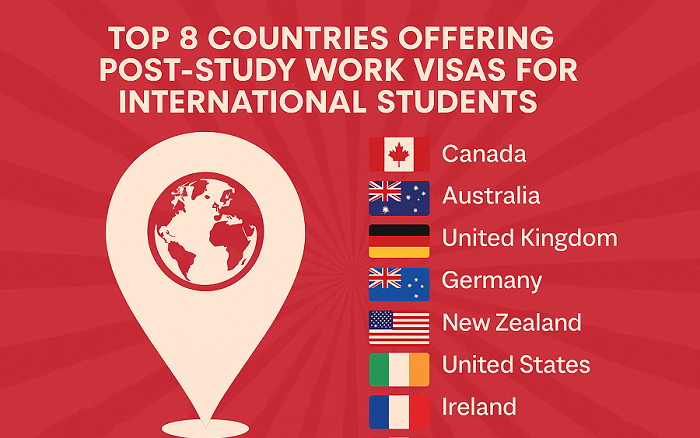
For overseas students, work visa after study alternatives are of great appeal. To work in a foreign nation is an opportunity for students to engage in an entirely distinct society, learn new things, and get a different viewpoint on the global community. The simplicity of obtaining an employment visa after graduation is one of the main reasons why prospective students apply to overseas institutions. You can learn more about post-study work visa opportunities from overseas education consultants. If you are confused about which one is best, then Gateway Abroad Consultants Jaipur is the best, which also offers student visa services to applicants.
There are numerous nations where students can continue their education while remaining to gain some job expertise. Although the US receives 80% more applications for study abroad than other nations, particularly from Indian students, nations like Canada and Australia are now equally popular. This is because they provide immigration options according to the applicant's educational background.
We are sharing a list of post-study work visa countries through this blog.
Many people come to the United States to pursue the American Dream, which is not unexpected given that the US has long been regarded as a beacon of possibility. Your F-1 visa will allow you to find employment in the United States after earning a college degree.
Students from abroad on an F-1 visa are qualified to apply for Optional Practical Training (OPT) as long as they are pursuing coursework in the US for at least a year. This allows international students to remain and work in the United States for an entire year without the need for an employer's sponsorship. A more extended version of the regular OPT, the STEM OPT, gives students 24 months of employment in the United States after graduation rather than just 12.
|
Eligibility |
Advantage |
|
A minimum of one academic year should be the duration spent as a full-time undergraduate on an F-1 visa.
|
Access to a wide range of employment options across multiple industries.
|
Fortunately, if you're thinking about studying in Australia, you are also eligible for a Temporary Graduate Visa. There are two categories for this visa:
|
Eligibility |
Advantage |
|
Students are required to have finished a course at an Australian university.
|
|
The United Kingdom is another excellent place to study. In this case, the Graduate visa requires that you be in the UK at the time of application and permits you to remain in the country for a minimum of two years following your successful graduation with a UK degree.
Although your student visa is not renewable, you can change to a new one, such as an expert worker visa, which enables you to enter or remain in the UK in order to do an appropriate job with an authorized business.
|
Eligibility |
Advantage |
|
Students should have graduated from a UK-accredited educational provider with a bachelor's degree or greater.
|
A varied labour market with openings in numerous sectors.
|
You might work for any firm for one to three years with this post-study work visa, subject to your location during your studies and credentials. In addition, if you have a bachelor's degree, a graduate diploma, a level 7 diploma, or higher, and have studied full-time in New Zealand for at least 30 weeks, you can work in practically any job for any company in the country.
|
Eligibility |
Advantage |
|
Obtaining a New Zealand-based qualifying degree.
|
Strong assistance in assimilating foreign graduates into the local labour market.
|
Studying in Canada is appealing due to its excellent living conditions and educational system. After graduating from an approved academic institution in Canada, you could qualify for a post-graduation work permit (PGWP). The PGWP permits you to work in Canada for a limited time, but you must first fulfil specific requirements to apply for a Canadian work permit. Depending on the duration of the educational course, the PGWP may be granted for a minimum of eight months or an aggregate of a three-year term.
|
Eligibility |
Advantage |
|
Completing a course of study at a designated educational facility.
|
The Express Entry scheme allows experience earned on a PGWP to be applied towards permanent residency.
|
Graduates of German universities from non-EU/EEA nations are permitted to work in Germany for up to 18 months following graduation, thanks to an extension of their residency visa. The 18-month period starts right away as a student completes their last examinations; thus, according to notes, studying in Germany and applying for jobs while still enrolled in school or your final semester is ideal.
In order to sustain yourself till you obtain a full-time occupation, you can work any job you can throughout those 18 months; it is not required to be tied to your subject of study. Once you've found employment in Germany, you are eligible for the EU Blue Card program, which is a work and residency visa for non-EU/EEA nationals.
|
Eligibility |
Advantage |
|
A qualification from an accredited German university is required.
|
A robust economy where there is a great need for qualified personnel.
|
Suppose you hold a degree from an accredited Irish certifying authority. In that case, you might be allowed to stay in Ireland and look for work after completing your education with the Third Level Graduate Program. This permits lawfully resident non-EEA graduates with Irish education who have earned a level 8 or level 9 degree from an accredited Irish certifying authority to stay in Ireland for a year following graduation.
|
Eligibility |
Advantage |
|
Your degree must have come from an authorized Irish educational institution or granting authority.
|
After graduating, you have up to two years to work in any employment in Ireland. Among these is the chance to work for the government.
|
Once your student permit has expired, overseas students will be given a Short-Term Visit Pass that will allow them to search for work for ninety days. An application for a year, a conventional Extended Social Visit Permit, is available to those completing it from Singapore's Institute of Higher Learning. A few post-study employment visas may be available for foreign learners:
|
Eligibility |
Advantage |
|
Students should be graduates from a Singaporean institution with accreditation.
|
A graduate who obtains the LTVP is permitted to remain in Singapore for three years, and then for five years if it is renewed.
|
A post-study employment visa allows Indian students to broaden their career opportunities in their subjects of interest. In order to further their career growth, they may establish relationships with guides, specialists in the field, and potential employers. Being part of a diverse workplace enhances their ability to adapt, communicate, and collaborate with people from different backgrounds and cultures.
This experience not only enhances students' personal lives but also provides them with an international view of things, which is highly beneficial in the connected world of today.
Ans- Favourable post-study work visa laws are well-known in nations like Canada, Australia, and Germany, which permit graduates to work for a predetermined amount of time following graduation.
Ans- The length of time might vary from one to three years, depending on the country. For instance, based on their educational background, graduates in Australia may remain for two to four years.
There are differences in requirements; for example, Canada offers open work permits that don't require a job offer, whereas the UK may require employer sponsorship.
Ans- Yes, in many nations, graduates who find work and fulfil other requirements during their post-study work period can pursue avenues to permanent residency.
Ans-Yes, several nations could need evidence of language competency, mainly if the position entails providing professional services or interacting with clients. IELTS or TOEFL exams may be required in countries like Canada as part of the application procedure.
Author
Content Writer & International Education Specialist
Sakshi Taneja is a content writer specializing in international education, study abroad opportunities, university admissions, student visas, scholarships, and career guidance. She creates accurate, research-driven, and student-focused content to help aspiring international students make informed decisions about their global education journey.
No comments yet
Be the first to share your thoughts!
Please provide your contact information
Free Counselling

9/21/2026

2/26/2026

11/3/2025
11/3/2025
10/27/2025
Want some help figuring out what kind of prep service is right for you?
Help and Support

Leave a Comment
Your email address will not be published.