facebook pixel
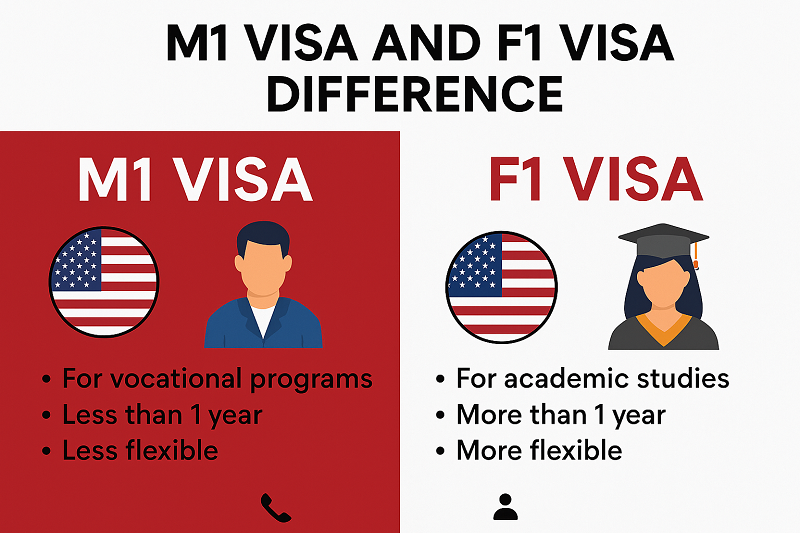
M1 visa and F1 visa difference

Studying in the United States remains a dream for millions of students worldwide. With world-class institutions, cutting-edge research opportunities, and a diverse academic culture, the U.S. is a top destination for international education. However, one crucial step before this journey is obtaining the appropriate visa. Two of the most common student visas are the F1 and M1 visas. While both allow international students to study in the U.S., their purpose, scope, and regulations differ.

This comprehensive guide will break down the key differences between the F1 and M1 visas, including eligibility criteria, academic programs covered, work permissions, application process, and more, so you can make an informed decision.

What Are F1 and M1 Visas?

F1 Visa: Academic Student Visa-

One of the most popular student visas is the F1 visa. This document is granted to international students who want to enroll in educational programs or English language courses in American higher education institutions, universities, high schools, private primary schools, college campuses, or academies.

M1 Visa: Vocational Student Visa-

The M1 visa, on the other hand, is intended for students enrolling in vocational or non-academic programs. This includes courses like culinary arts, mechanical studies, cosmetology, flight training, or other trade-based and technical education programs at vocational or technical schools.

Which kind of education is covered by an F1 and M1 visa?

F1 Visa:

    • Covers traditional academic education.
    • Applicable to:
      • Universities and colleges (Bachelor’s, Master’s, PhD)
      • High schools
      • Language training programs
      • Seminaries and conservatories

M1 Visa-

    • Covers vocational or technical training.
    • Applicable to:
      • Trade schools
      • Technical or mechanical schools
      • Culinary institutions
      • Cosmetology schools
      • Aviation training programs

F1 is for academic programs, while M1 is for hands-on, skill-based education.

What is the duration of stay on an F1 and M1 visa?

·       F1 Visa:

    • Duration is tied to the academic program.
    • Students may remain in the United States for the course length plus 60 days following graduation (grace period).
    • OPT (Optional Practical Training) and CPT (Curricular Practical Training) are two ways to expand it.

·       M1 Visa:

    • Generally issued for one year, but may be extended up to three years depending on the length of the program.
    • Includes a 30-day grace period post-completion.
    • Extensions are harder to obtain and must be justified through formal requests.

Key Difference- The duration of an F1 visa is more flexible and can be extended through practical training; an M1 visa is more rigid and time-bound.

What about the work eligibility for F1 and M1 visas?

·       F1 Visa:

    • May apply for OPT (12 months of work post-graduation) or CPT during their studies.
    • Students can find employment on campus for up to 20 hours per week throughout the school year and during the summer.
    • Applications for a 24-month OPT extension are open to STEM graduates.

·       M1 Visa:

    • No on-campus or off-campus work is permitted during study.
    • Limited to practical training only after the program ends, and if it's directly related to the course.
    • The maximum time for practical training is six months.

Key Difference: F1 students have more work opportunities, including part-time jobs and internships. M1 students are subject to severe limitations and have few employment permits.

What is the application process, and what documents are needed for F1 and M1 visas?

The application process for both the F1 and M1 visas follows a similar framework, as both are non-immigrant student visas for studying in the U.S. However, some minor differences exist in the documentation and financial proof required. This is a detailed explanation of how to apply for an F1 or M1 visa:

Phase 1: Apply to and be accepted into an institution that has received SEVP approval.

  • Before submitting a visa application, you must apply to and be accepted into a school that has earned SEVP certification.
  • You must enroll full-time in a course of study approved by the US Department of Homeland Security.

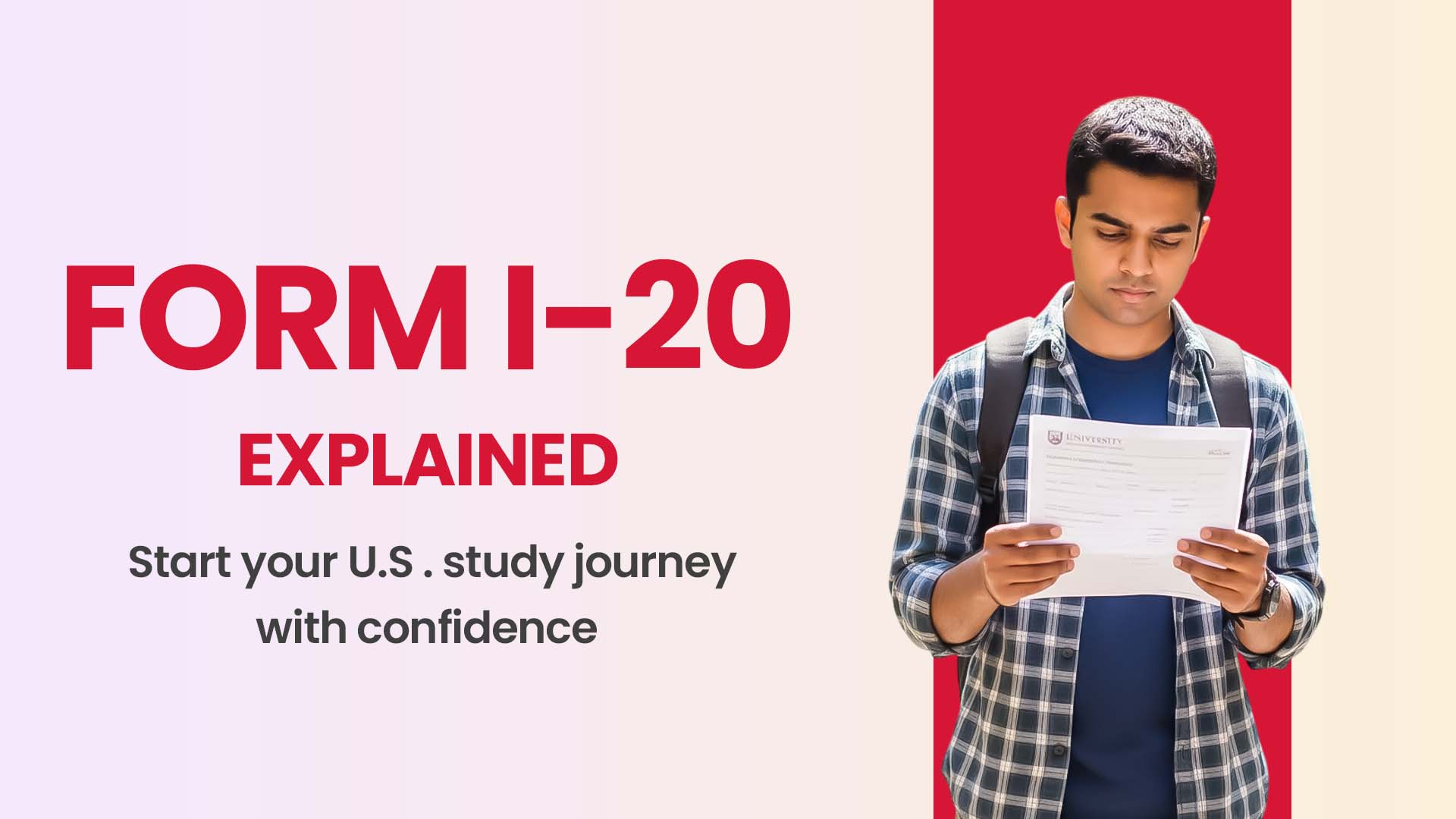
Phase 2: Receive the Form I-20-

  • The school will provide you with a Form I-20 when you are accepted.
  • F1 visa applicants receive Form I-20 for academic programs.
  • M1 visa applicants receive Form I-20 for vocational/trade programs.
  • This form contains:
    • Your SEVIS ID
    • Program start and end dates
    • Tuition and fees
    • Personal and institutional information

Phase 3: Pay the SEVIS I-901 Fee-

  • Before submitting a visa application, you need to pay the Student and SEVIS costs.
  • F1 and M1 visa SEVIS fee: $350 (as of 2025).

Phase 4: Finish the online visa application, DS-160.

  • Fill out the DS-160 Non-immigrant Visa Application form online at https://ceac.state.gov.
  • Upload a passport-style photo.
  • After finishing, you will receive a barcoded DS-160 confirmation sheet, which you will require for your interview.

Phase 5: Pay the Visa Application Fee-

  • Pay the non-refundable visa application fee-

Current fee (as of 2025): $185

Check with your local U.S. Embassy or Consulate for payment instructions (online or bank transfer).

Phase 6: Schedule a Visa Interview-

  • To make an appointment for a visa interview, visit the closest American embassy or consulate.
  • Waiting times can vary by country and season, so book early.

Phase 7: Prepare required documents for the interview-

·       Mandatory Documents for Both F1 and M1:

The candidate should possess a valid passport that has been valid for at least 6 months.

Form I-20 from your U.S. school

DS-160 confirmation page

Visa appointment confirmation letter

SEVIS I-901 fee payment receipt

Visa application fee receipt

Passport-sized photo (as per U.S. guidelines)

  • Supporting Documents:

You must possess all your educational degrees and scorecards for specific tests, such as the TOEFL, GRE, GMAT, and IELTS.

Proof of financial ability:

o   Bank statements

o   Sponsorship letters

o   Scholarship or assistantship letters

  • Ties to home country-
    • Documents proving your intention to return (family ties, job offers, property ownership, etc.)

Phase 8: Attend the Visa Interview-

  • During the interview, the visa officer will ask about:
    • Your study plans
    • Choice of school and program
    • Financial status
    • Future goals (especially your plan to return home after studies)
  • The F1 visa interview may include more questions about long-term academic goals and potential OPT/CPT interests.
  • M1 visa interview focuses more on the vocational nature of your training and your return plan post-completion.

Phase 9: Visa approval and passport collection-

The stamp will be pasted on your passport if the author approves your visa. Moreover, in certain circumstances ex, the authorities may make extra administrative enquiries.

Phase 10: Enter the U.S.-

  • You can enter the U.S.:
    • F1 visa: Up to 30 days before your program start date.
    • M1 visa: Also, up to 30 days before the program starts.

At the port of entry, carry:

  • Your passport and visa
  • Form I-20
  • SEVIS and fee payment receipts
  • Acceptance letter and proof of finances

You will be issued an I-94 arrival/departure record electronically, marking your visa status and duration of stay.

Note: M1 applicants may need to show full financial support for the entire duration of the program, while F1 students typically show proof for the first year only.

Specifics-

·       F1 Visa-

    • Requires proof of academic intent, strong English proficiency, and financial capability.
    • Must prove non-immigrant intent (intent to return home after studies).

·       M1 Visa-

    • Similar requirements, but students must show:
      • Students must show that they have the financial ability to bear tuition and living expenses throughout the program.
      • A clear plan and timeline for returning to their home country.

M1 applicants must show financial proof for the full course upfront; F1 applicants can demonstrate annual support.

What about M1, F1 Visa Flexibility and Transfers?

·       F1 Visa:

    • Offers greater flexibility.
    • Students can transfer schools, change majors, or progress from a Bachelor's to a Master's program.
    • After completing OPT, you can adjust your status to a work visa (e.g., H-1B).

·       M1 Visa:

    • Minimal flexibility.
    • Cannot transfer schools without going through a new visa process.
    • Cannot change from vocational to academic study while in the U.S.
    • Not eligible to change to an F1 status easily from within the country.

F1 is more adaptable for long-term education and career planning; M1 is rigid and short-term focused.

What is the cost of M1 and F1 visa?

The cost for visa processing (DS-160 fee and SEVIS fee) is similar for both:

  • DS-160 application fee: $185 (as of 2025)
  • SEVIS I-901 fee:
    • F1: $350
    • M1: $350

However, M1 students must show upfront full funding, which might create a higher financial entry barrier, even though the programs are usually shorter and less expensive overall.

Who needed F1 and M1 visa?

·       F1 Visa:

    • Students who want to pursue a full academic degree (Bachelor’s, Master’s, Ph.D.).
    • Those looking for more extended stays and possible career opportunities in the U.S. after graduation.
    • Ideal for research-focused or academic careers.

·       M1 Visa:

    • It is best for students who want hands-on technical training or to develop a specific trade skill.
    • Suitable for shorter-term programs with no intention of staying long-term in the U.S.
    • Ideal for careers that value technical certifications or vocational experience.

What are the primary distinctions between an M1 and an F1 visa?

The Academic Student Visa (F1 Visa)-

·       For educational initiatives like universities, colleges, or language instruction.

  • Permits up to 20 hours of work per week during sessions on campus.
  • Qualified for both Curricular Practical Training (CPT) and Optional Practical Training (OPT).
  • More adaptable and able to switch courses or schools.
  • Just the first year’s worth of financial documentation is needed.
  • Visa duration is linked to program length and can be extended.
  • This can lead to longer stays or a status change (e.g., to H-1B or green card).
  • Dependents (F2) can join but cannot work or study full-time.
  • Commonly used for bachelor’s, master’s, Ph.D., and language courses.

M1 Visa (Vocational Student Visa)-

  • For vocational or technical training (e.g., culinary school, mechanics, cosmetology).
  • No employment is allowed during studies (not even on-campus).
  • Only after completing the curriculum (maximum 6 months) is practical training permitted.
  • Neither flexible work permits nor CPT is a possibility.
  • Demands evidence of funding for the duration of the course.
  • Tight and set time frame, hard to renew or expand.
  •  
  • Cannot easily transfer to another school or switch to F1.
  • Dependents (M2) can come but have the same restrictions as F2.
  • It is meant for acquiring specific trade or skill training, not academic degrees

Feature

F1 Visa (Academic)

M1 Visa (Vocational)

Type of Study

Academic

Vocational / Technical

Work During Study

Limited (on-campus, CPT, OPT)

Not allowed

Work After Graduation

OPT (12–36 months)

Max 6 months practical training

Duration of Stay

Based on program + 60 days

Program length + 30 days

School Transfer

Allowed

Very limited

Change of Status

Possible (e.g., H-1B, Green Card)

Rare and difficult

Financial Proof

For 1 year

Full course upfront

Visa Flexibility

High

Low

Dependents

F2 visa (no work)

M2 visa (no work or study)

Conclusion-

Choosing between the F1 and M1 visa depends on your academic goals, type of program, career aspirations, and financial situation. If you aim to pursue higher education, research, or work in the U.S. post-graduation, the F1 visa is the better option. However, if you’re focused on learning a specific trade or technical skill for career growth in your home country, the M1 visa could serve your needs well.

Always consult your institution's international student office or a qualified immigration advisor before making a decision. Understanding these visa categories thoroughly can help you make the right educational and career choices.

FAQs on F1 and M1 Visa differences-

Q.1 What’s the main difference between an F1 and an M1 visa?

Ans- F1 is for academic programs; M1 is for vocational or technical training.

Q.2 Can you work on-campus with both visas?

Ans- F1 students can work part-time on campus; M1 students cannot work during their studies.

Q.3 Do both visas allow practical training after graduation?

Ans- Yes, but F1 allows OPT (up to 12–36 months), while M1 allows only 6 months after course completion.

Q.4 Can you transfer schools with both visas?

Ans- F1 visa holders can transfer schools; M1 students cannot transfer once their program begins.

Q.5 How much financial proof do you need?

Ans- F1 requires proof for the first year; M1 requires funds for the entire program.

Q.6 Can you apply for a student visa for a language course?

Ans- Yes, but only under the F1 visa, not M1.

Q.7 Are dependents allowed under both visas?

Ans- Yes, F2 (F1) and M2 (M1) dependents can come but cannot work or study full-time.

Q.8 Which visa is more flexible for future study plans?

Ans- F1 is more flexible and suitable for continuing education; M1 is more restrictive.

Q.9 Can you change the status from M1 to F1?

Ans- It is difficult and not encouraged; you may need to exit and reapply for an F1 visa.

Q.10 Which visa has a better chance of getting extended?

Ans- The F1 visa is more commonly extended; M1 extensions are rare and tightly regulated.

Share this post:

~ By Admin

Leave a Reply

Your email address will not be published.

Have a question about GMAT?

Want some help figuring out what kind of prep service is right for you?

Help and Support


Study Abroad Help