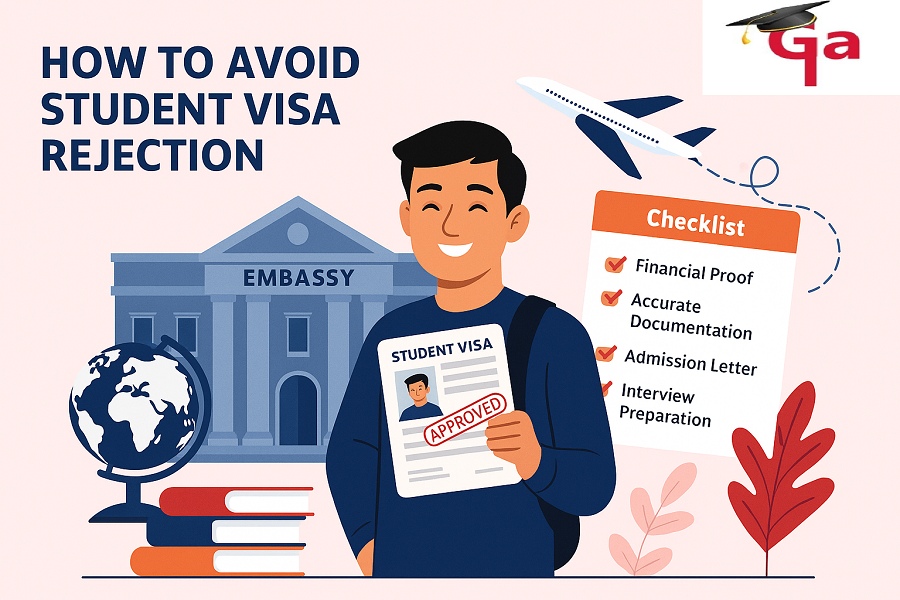
Obtaining a student visa is crucial for those aspiring to study abroad. However, visa rejections can be a significant hurdle, delaying academic plans and causing financial losses. To maximize your chances of approval, it is essential to understand the common reasons for rejection and adopt strategies to avoid them. This guide provides insights into how you can ensure a smooth visa application process and prevent rejection.
What are the common reasons for student visa rejection?
Before diving into preventive measures, it is vital to understand the primary reasons why student visa applications are rejected. Among the most typical explanations are-
- Insufficient financial proof: Inability to demonstrate adequate financial resources to support tuition and living expenses.
- Lack of proper documentation: Missing, incorrect, or incomplete documents.
- Failure to prove ties to home country: Inability to convince the visa officer that you intend to return home after completing your studies.
- Unclear study intentions: Ambiguous or weak justification for choosing a specific course or university.
- Poor visa interview performance: Lack of confidence, unclear answers, or contradicting responses.
- Past visa rejections: Previous rejections can raise concerns about eligibility.
- Suspicious or fraudulent documentation: Providing false information or forged documents.
- Language proficiency issues: Inadequate scores in English proficiency tests like IELTS, TOEFL, or PTE.
Ensuring complete and accurate documentation-
Every country has specific documentation requirements; failing to provide complete and correct documents can lead to rejection. Key documents include:
- Valid Passport: Ensure that your passport is valid for the required duration.
- Admission Letter: Official acceptance letter from a recognized university.
- Proof of Financial Support: Bank statements, affidavits, and sponsorship documents.
- Academic Transcripts: These are official copies of prior academic records.
- English Proficiency Test Scores: IELTS, TOEFL, or PTE scores, if required.
- Medical Certificates: If the country requires health clearance.
- Statement of Purpose (SOP): A well-written SOP explaining your study plans and career goals.
Proving strong ties to the home country-
Visa officers assess whether you have strong incentives to return to your home country after completing your studies. To prove your intent:
- Provide Property Ownership Proof: If applicable, show ownership of assets.
- Highlight Family Ties: Mention strong family connections and responsibilities.
- Explain Career Prospects: Show how your degree will benefit your career in your home country.
- Employment Letters: If returning to a job, provide an employer’s confirmation.
Crafting a strong statement of purpose (SOP)-
An effective SOP can significantly impact whether your visa is approved. Your SOP should:
- Clearly Explain Your Study Goals: State why you chose the course and university.
- Show Relevance to Career: Link your studies to future career aspirations.
- Be Honest and Concise: Avoid exaggeration or false claims.
- Demonstrate Research: Show knowledge about your university and program.
Avoiding fraudulent documentation-
Submitting fake or tampered documents is a serious offense and can lead to permanent visa bans. To avoid this:
- Use Only Genuine Documents: Provide authentic financial and academic records.
- Verify All Information: Double-check documents before submission.
- Avoid Fake Agents: Work with authorized consultants only.
Addressing previous visa rejections-
If your visa has been rejected before, take corrective measures:
- Analyze the Rejection Reason: Review the rejection letter carefully.
- Correct Past Mistakes: Address any deficiencies from your last application.
- Provide Additional Documents: If required, submit more substantial evidence.
- Reapply with a Stronger Case: Ensure your new application is improved.
Meeting English proficiency requirements-
If your destination country requires proof of English proficiency, ensure:
- You Meet the Minimum Score: Research the required scores for your university.
- Retake the Test if Needed: If your score is low, consider retaking the test.
- Prepare Well: Take practice tests and courses if necessary.
Seeking professional guidance-
If you are unsure about the visa process, consider consulting a professional:
- Hire a Certified Visa Consultant: Ensure they have a good track record.
- Attend University Counseling Sessions: Many universities offer visa guidance.
- Join Student Forums: Connect with students who have successfully obtained visas.
How do you demonstrate strengthening financial proof to avoid visa rejection?
Visa officers must be convinced you have enough financial resources to cover your tuition and living expenses. To avoid rejection due to economic insufficiency:
- Provide Bank Statements: Submit at least six months of bank statements showing consistent financial stability.
- Show Sponsorship Documents: If you are funded by parents, guardians, or a sponsor, provide affidavits, income tax returns, and bank statements.
- Scholarship or Funding Proof: Include official documents if you have received a scholarship or financial aid.
- Maintain Transparency: Avoid sudden large transactions before applying, as they might raise suspicion.
How to prepare for the visa interview to avoid visa rejection?
Preparing for your student visa interview is crucial to avoid rejection. Here are some key steps to ensure you make a strong impression and increase your chances of approval:
Research standard visa interview questions officers typically ask questions related to:
- Your study plans and reasons for choosing a particular university.
- Financial stability and how you plan to cover your expenses.
- Your career goals and plans after completing your studies.
- Ties to your home country and intent to return.
Practice your answers-
- Prepare clear and concise responses to possible questions.
- Avoid memorizing answers; instead, focus on being natural and confident.
- Be ready to explain why you chose your course, university, and country.
Organize your documents properly-
- Keep all required documents, like passports, admission letters, financial proof, transcripts, etc., well-organized.
- Be prepared to present any document the officer requests promptly.
Demonstrate financial stability-
- Clearly explain your funding sources, such as self-financed, parental support, scholarships, loans, etc.
- Carry supporting documents such as bank statements, sponsorship letters, and income tax returns.
Show strong ties to your home country-
- Express your intent to return home after completing your studies.
- Evidence of family ties, job prospects, or property ownership in your home country.
Maintain confidence and professionalism-
- Dress formally and professionally to make a good impression.
- Be courteous, speak properly, and keep eye contact.
- Answer questions confidently without hesitation.
Be honest and consistent-
- Never provide false information or contradict previous statements.
- If you don’t know the answer, remain honest instead of making up information.
Avoid nervousness and stay calm-
- Take deep breaths and remain composed throughout the interview.
- Speak at a steady pace and listen carefully before answering.
Know about your university and course-
- Be prepared to explain why you selected your university and course.
- Mention specific reasons like faculty reputation, research opportunities, or curriculum relevance.
Be prepared for unexpected questions-
- Visa officers may ask tricky questions to test your sincerity.
- Stay calm, answer logically, and ensure your responses align with your application.
Conclusion-
Avoiding student visa rejection requires thorough preparation, proper documentation, and a clear demonstration of your study intentions and financial stability. Following these steps can significantly increase your chances of getting your visa approved and achieving your dream of studying abroad. Be honest, stay organized, and approach the process with confidence.
FAQs on how to avoid student visa rejection?
Q.1 Why do student visas get rejected?
Ans- Student visas are often rejected due to insufficient financial proof, incomplete documentation, poor visa interview performance, or failure to demonstrate ties to the home country.
Q.2 How can you prove financial stability for your student visa?
Ans- Provide bank statements, sponsor affidavits, scholarship proof, and income tax returns showing you can afford tuition and living expenses.
Q.3 What documents are essential for a student visa application?
Ans- Common documents include a valid passport, admission letter, financial proof, academic transcripts, English proficiency test scores, and a well-written Statement of Purpose (SOP).
Q.4 How can you perform well in your student visa interview?
Ans- Be confident, dress professionally, give clear and consistent answers, and practice common interview questions about your study plans and financial stability.
Q.5 Can a previous visa rejection affect my new student visa application?
Ans- Yes, previous rejections can impact your application. Address the issues that led to rejection, provide more substantial documents, and write an improved SOP.
Q.6. How can you prove your intent to return home after studying abroad?
Ans- Show strong family ties, property ownership, or future job prospects in your home country to convince the visa officer of your intention to return.
Q.7 What role does an SOP play in avoiding visa rejection?
Ans- A strong SOP explains your study choice, career goals, and reasons for selecting a specific university, helping visa officers understand your intent.
Q.8 Does a low English proficiency score lead to visa rejection?
Ans- Yes, if your score is below the university’s requirement, it may result in rejection. Retake the test if needed and ensure you meet the minimum criteria.
Q.9 Is it okay to use a visa agent for my application?
Ans- Only use certified and reputable agents. Avoid fraudulent consultants who offer fake documents, which can result in a permanent visa ban.
Q.10 What should you do if your student visa is rejected?
Ans- Analyze the reasons for rejection, strengthen weak areas, gather better documentation, and reapply with a well-prepared case.





Leave a Comment
Your email address will not be published.