For students aspiring to study abroad, mastering the English language is more than just learning vocabulary and sentence structure—it's about understanding how language differs in various contexts, particularly in spoken and written forms. Whether you are preparing for standardized tests like TOEFL or IELTS or simply trying to blend in academically and socially in an English-speaking country, knowing the difference between spoken and written grammar is critical.
In this blog, we’ll explore the key differences between spoken and written grammar, why they matter for studying abroad, and how to master both to thrive academically and socially.
Why is grammar so important for Studying Abroad?
Before diving into the differences, let's understand why grammar matters-
- Academic success: Proper grammar is crucial for writing essays, research papers, and assignments clearly and effectively.
- Exam requirements: English proficiency tests like IELTS, TOEFL, and PTE assess your grammar in speaking and writing sections.
- Professional communication: Good grammar helps with writing emails, resumes, and statements of purpose.
- Social integration: Correct spoken grammar improves everyday conversations and helps build friendships and networks.
- Avoiding misunderstandings: Clear grammar reduces the risk of miscommunication in both academic and daily life.
- Building confidence: Strong grammar skills enhance fluency and boost your confidence in new environments.
- Impression management: Correct grammar leaves a positive impression on professors, peers, and potential employers.
- Visa and admission success: Poor grammar can negatively affect applications and interview performance.
- For instance, mastering adjectives and modifiers through a solid understanding of the degrees of comparison is crucial for precision in formal writing.
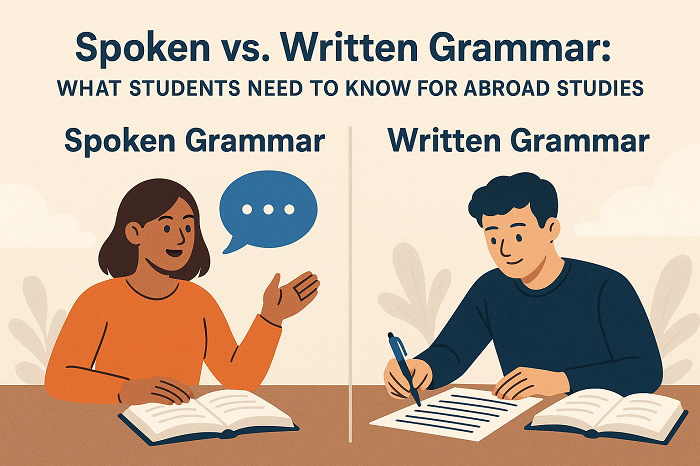
Spoken Grammar: Natural and Fluid
Spoken grammar is more flexible and informal. It reflects our thoughts and emotions in real-time. Native speakers often break traditional grammatical rules during conversations.
Key Features of Spoken Grammar:
- Ellipsis (Omission of Words):
- Common in everyday conversation.
- Example: “Coming?” instead of “Are you coming?”
- Use of Discourse Markers:
- Helps in organizing speech.
- Example: “Well,” “You know,” “Like,” “So,” “I mean”
- Inversion and Question Tags:
- Adds informality and engages listeners.
- Example: “Nice weather, isn’t it?”
- Repetitions and False Starts:
- Acceptable in speech due to spontaneity.
- Example: “I was... I mean, I was thinking we could go tomorrow.”
- Contractions and Informal Phrasing:
- Example: “I’ll” instead of “I will”, “gonna” instead of “going to”.
- Short, Incomplete Sentences:
- Used to respond quickly or show agreement.
- Example: “Sure.” “No problem.” “Absolutely!”
Written Grammar: Structured and Formal
Written grammar follows more rigid rules to maintain clarity and professionalism. Academic and professional settings abroad demand high proficiency in written English.
Key Features of Written Grammar:
- Complete Sentences and Proper Syntax:
- Requires subject + verb + object structure.
- Example: “She submitted the report yesterday.”
- Correct Punctuation and Capitalization:
- Essential for clarity and readability.
- Example: Avoid “i went to the library.” Correct: “I went to the library.”
- Formal Vocabulary and Tone:
- It avoids slang or contractions.
- Example: “The results were significant.” instead of “The results were kinda big.”
- Passive Voice Usage:
- It is often used in academic writing to emphasize the action.
- Example: “The research team conducted the experiment.”
- Logical Flow and Cohesion:
- Ideas must connect through transition words and structured paragraphs.
- Example: “Furthermore,” “In contrast,” “Therefore”
- Avoidance of Repetition and Redundancy:
- Clarity and conciseness are key.
- Example: Prefer “due to” over “because of the reason that”
What are the common mistakes students make while studying abroad?
Academic mistakes-
- Using colloquial or spoken grammar in research papers and essays is an example of disregarding educational writing norms.
- Plagiarism: Not understanding citation rules and accidentally copying others' work.
- Poor time management: Failing to balance studies, part-time jobs, and social life.
- Skipping classes: Assuming attendance is optional, leading to poor academic performance.
- Relying too much on translation tools: This can lead to incorrect or awkward phrasing.
Language and communication mistakes-
- Overusing slang or informal language in professional settings.
- Fear of speaking English: Avoiding conversations due to lack of confidence.
- Misunderstanding local accents or idioms.
Cultural and social mistakes-
- Not respecting local customs or cultural differences.
- Only interacting with citizens of their nation.
- Avoiding extracurricular or networking opportunities.
Practical and administrative mistakes-
- Ignoring visa or health insurance requirements.
- Budgeting poorly and running out of funds.
- Not keeping copies of important documents.
- Mixing Spoken Grammar in Formal Writing:
- Writing “gonna” in essays or assignments is a common error.
- Using Written Grammar in Speaking:
- Over-formalizing speech can sound robotic or awkward in casual settings.
- Overusing Fillers and Slang in Speaking Tests:
- Examiners expect fluency, not filler-heavy responses like “you know” or “like” every few seconds.
- Confusing Contractions in Writing:
- Using “can’t” in formal writing instead of “cannot” reduces the professionalism of your tone.
What are the strategies for mastering both forms?
For Spoken Grammar:
- Watch English shows and movies with subtitles to learn natural usage.
- Engage in learning a language with collaborators or native speakers.
- Record and review your speech to catch grammar slips.
For Written Grammar:
- Read academic journals, essays, and newspapers to understand formal structure.
- Use grammar tools like Grammarly or Hemingway to edit your writing.
- Practice writing essays, emails, and reports with a focus on coherence and structure.
- Get feedback from mentors or peers to improve over time.
Situations where both grammars are important
Situation | Spoken Grammar | Written Grammar |
Class Discussions | ✔️ | ❌ |
Presentations | ✔️ | ✔️ (for script) |
Emails to Professors | ❌ | ✔️ |
Exams (Essays & Reports) | ❌ | ✔️ |
Group Projects / Meetings | ✔️ | ✔️ |
Job Interviews / Networking | ✔️ | ✔️ (for follow-up emails) |
How do English proficiency tests evaluate both?
TOEFL & IELTS:
- Speaking Section: Tests spoken grammar through responses to real-world scenarios.
- Writing Section: Requires essays that demonstrate written grammar proficiency.
- Listening & Reading Sections: Expose students to both forms in audio clips and passages.
Cambridge & PTE:
- Integrated tasks evaluate how well students can use spoken and written grammar together, such as summarizing a lecture in writing.
Conclusion-
Studying abroad demands a functional command of English in both spoken and written forms. The difference lies not just in grammar rules but also in tone, intent, and context. Mastering both enables international students to communicate effectively, excel academically, and integrate socially in a new environment. So, whether you're emailing your professor or ordering coffee at a café, being aware of how to tailor your grammar to the situation is the key to confidence and clarity.
FAQs on Spoken vs. Written Grammar
Q.1 What is the main difference between spoken and written grammar?
Ans- In contrast to written grammar, which is formal, structured, and subject to rigorous rules, grammar in speech is informal, adaptable, and frequently incomplete.
Q.2 Why should students abroad learn both forms of grammar?
Ans- Students need spoken grammar for conversations and presentations, and written grammar for essays, emails, and exams.
Q.3 Can you use contractions like “can’t” or “won’t” in academic writing?
Ans- No, contractions are best avoided in formal writing. Employ complete phrases such as "cannot" or "will not."
Q.4 Is it okay to use fillers like “um” or “you know” in speaking tests?
Ans- Occasional fillers are natural, but overusing them can affect fluency and clarity in exams like IELTS or TOEFL.
Q.5 What are some examples of spoken grammar mistakes in writing?
Ans- Using slang like “gonna” or “wanna,” or writing incomplete sentences such as “Went to the store.”
Q.6 How can you improve your spoken grammar?
Ans- Practice speaking with native speakers, watch English videos, and use language apps like ELSA or Cambly.
Q.7 How is written grammar tested in English proficiency exams?
Ans- Through essays, summaries, and formal email tasks that assess sentence structure, punctuation, and coherence.
Q.8. Do native speakers adhere to grammatical rules when speaking?
Ans- No, native speakers often use informal grammar, contractions, and shortcuts in everyday conversation.
Q.9 Can using spoken grammar in writing lower my academic scores?
Ans- Yes, informal grammar in academic writing can lead to lower grades or negative impressions from professors.
Q.10 What’s a good way to practice switching between the two?
Ans- Try turning spoken sentences into formal written ones and vice versa. It builds awareness and flexibility.







Leave a Comment
Your email address will not be published.