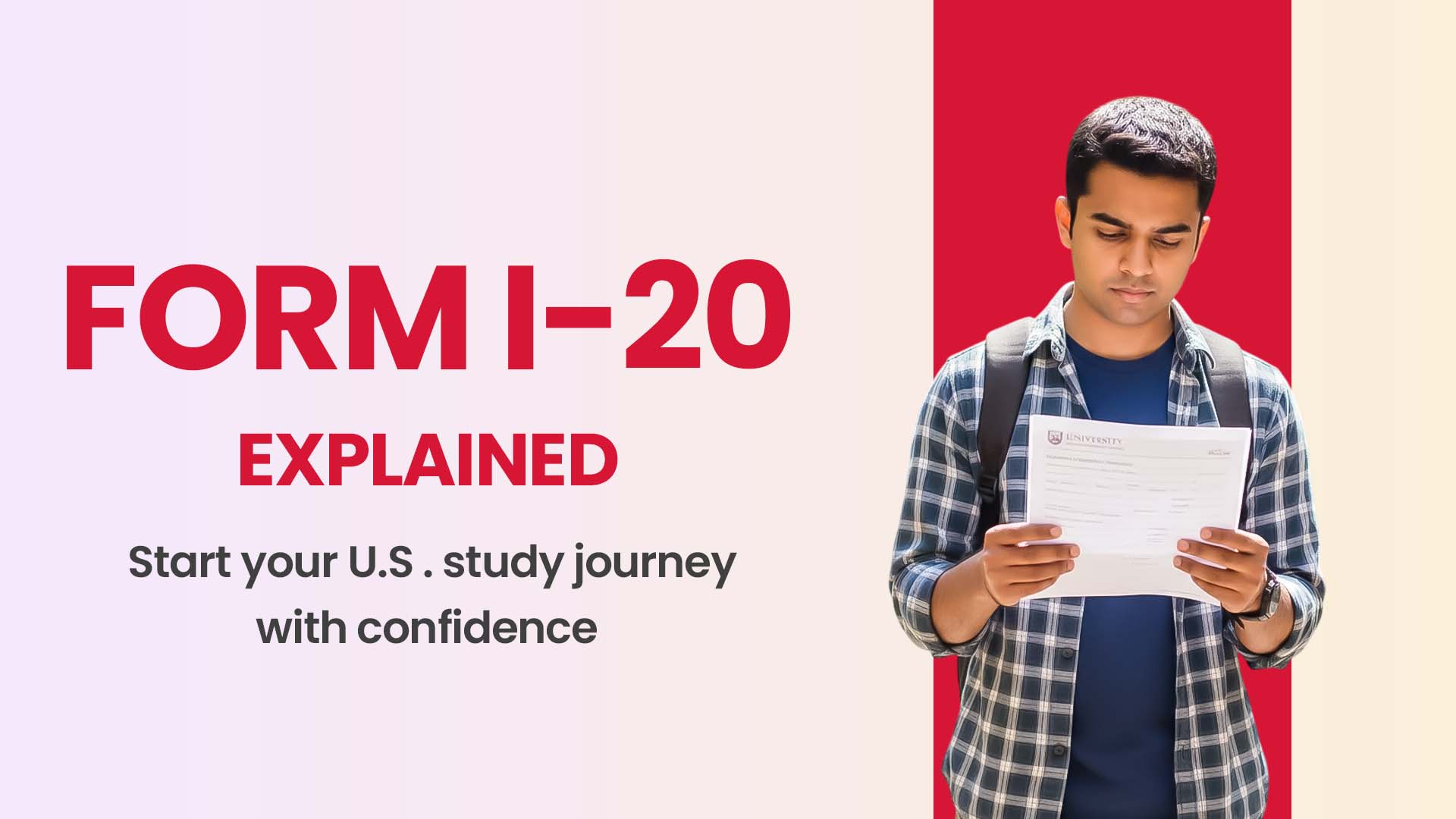
Studying in the United States is a dream for many international students, and securing admission to a U.S. institution is the first step toward fulfilling that dream. One of the most critical documents in this journey is Form I-20, issued by U.S. institutions to students accepted into their programs. This blog provides an in-depth guide to Form I-20, covering its purpose, application process, key sections, and important guidelines.
What is Form I-20?
Form I-20, officially known as the Certificate of Eligibility for Nonimmigrant Student Status, is a document issued by the Student and Exchange Visitor Program (SEVP)-certified U.S. institutions to international students admitted to their academic programs. This document is essential for obtaining an F-1 (academic student visa) or M-1 (vocational student visa) and plays a significant role throughout a student’s stay in the U.S.
What are the requirements for the I-20 Form?
You must fulfill the following prerequisites to receive the I-20 visa application form-
- Obtain admission to a recognized college or university—First, your application must be accepted by the college or university you applied to. The organization must hold an SEVP certification.
- Verify that your information is accurate and current- The college or university you attend needs to attest to your data's accuracy and ability to pay for your expenses while in the US.
How should you proceed after you have an I-20 form?
You must complete the following two procedures after receiving your I-20 form-
- The I-1901 SEVIS charge must be paid as soon as you obtain the I-20 form, and it must be paid before entering the United States. Details from the I-20 form are required to complete the transaction.
- The I-20 is an essential component of the visa application process. This document contains information about the program's finances, the program's cost, how the student intends to pay for it, and the program the aspirant will pursue. During the visa interview, the consulate may request an original copy of the I-20. Verify that the type of visa you are applying for and the one listed on the form match.
What is the purpose of Form I-20?
Form I-20 serves several key purposes:
- Visa Application—This is required to obtain an F-1 or M-1 student visa from the U.S. Embassy or Consulate.
- Proof of Legal Student Status – The document confirms a student’s eligibility to study in the U.S.
- Entry into the U.S. is required when arriving at a U.S. port of entry.
- Maintaining Legal Status – Students must keep their Form I-20 updated throughout their stay.
- Work Authorization is needed when applying for practical training, such as Optional Practical Training (OPT) or Curricular Practical Training (CPT).
- Travel Authorization – Students need a valid Form I-20 to re-enter the U.S. after traveling abroad.
Who needs Form I-20?
Any international student seeking to study in the U.S. under an F-1 or M-1 visa must obtain Form I-20 from their educational institution. This includes:
- Students enrolling in degree programs (Bachelor’s, Master’s, Ph.D.)
- Students attending language training programs
- Students in vocational training programs
How to Obtain Form I-20?
Step 1: Apply to a SEVP-Certified School
To receive a Form I-20, students must first secure admission to a SEVP-certified U.S. educational institution. The school must confirm the student’s acceptance and financial ability to pay for their studies.
Step 2: Submit Required Documents
After acceptance, students typically need to provide:
- A valid passport
- Proof of financial resources (bank statements, affidavits, scholarships, etc.)
- Previous academic records
- English proficiency test scores (TOEFL, IELTS, etc.)
Step 3: The School Issues Form I-20
Once the required documents are verified, the school issues Form I-20, which contains the SEVIS (Student and Exchange Visitor Information System) number and other details.
Step 4: Pay the SEVIS Fee
Students must pay the SEVIS I-901 fee at www.fmjfee.com before submitting a visa application. The receipt is required for the visa application.
Step 5: Apply for a Student Visa
With Form I-20, students can proceed with the F-1 or M-1 visa application by scheduling a visa interview at the nearest U.S. Embassy/Consulate.
What are the key sections of Form I-20?
- Student Information – Includes personal details such as name, date of birth, citizenship, and passport information.
- School Information – Contains details about the institution issuing the I-20, including SEVIS ID and school address.
- Program of Study – Specifies the course name, start and end dates, and education level.
- Financial Information – Lists the total estimated cost of attendance and the financial proof provided.
- School Attestation and DSO Signature – Signed by the Designated School Official (DSO), confirming the student's admission and eligibility.
- Student Certification – The student must sign this section to confirm the accuracy of the information.
How long is your Form I-20 valid?
The major you have selected and the level of study you are pursuing under graduation or postgraduation—determine the completion date on your Form I-20. In addition, the university has estimated how long it might take you to complete all of the prerequisites for your degree. An extension can be sought from the university's foreign office at least one month before the completion deadline, just in case you cannot complete your program by the specified date. Furthermore, the length may differ according to the degree of study-
- Undergraduate: The final exam day of the semester, when all prerequisites for the degree are completed.
- Graduate: If the degree includes research, this is the date on which all requirements are completed. When the criteria for the degree are met, the final exam day of the semester occurs if there is no investigation portion, as in the case of an MBA.
How do we maintain the validity of Form I-20?
To remain in compliance with U.S. immigration laws, students must:
- Maintain full-time enrollment (typically 12 credits for undergraduates and nine credits for graduates)
- Ensure that their I-20 is updated in case of changes in academic programs or funding
- Renew I-20 before expiration
- Get proper authorization before engaging in off-campus work
- Request travel endorsements from their DSO before leaving the U.S.
What to do if Form I-20 is lost or expired?
If Form I-20 is lost, damaged, or expired, students should immediately contact their school’s DSO to request a new copy.
Common Mistakes to Avoid
- Providing incorrect financial information – Ensure that proof of funds meets the requirements.
- Not updating Form I-20 when changing programs – Inform the DSO of any program changes.
- Traveling without a valid signature – Students must have a travel signature from the DSO within the last six months before traveling abroad.
- Failing to maintain full-time enrollment – Dropping below full-time status without prior approval can lead to visa termination.
When should you obtain a fresh Form I-20?
The following situations may result in students receiving a new Form I-20 from their DSO after receiving the original Form I-20 for program acceptance-
- Should the hard copy of the form be lost or destroyed?
- To provide travel endorsement.
- For example, if a student's SEVIS status has shifted from Initial to Active.
- If any other student details, such as the study plan, optional practical training, or personal data, need to be updated.
Final Thoughts-
Form I-20 is a crucial document for international students planning to study in the U.S. Understanding its purpose, application process, and maintenance requirements ensures a smooth transition into academic life in the U.S. Students must carefully review and comply with all the regulations related to their Form I-20 to avoid legal complications during their studies.
FAQs on what is Form I-20
Q.1 What is Form I-20?
Ans- Form I-20 is an official document issued by SEVP-certified U.S. institutions to international students, allowing them to apply for an F-1 or M-1 student visa and study in the U.S.
Q.2 Who needs Form I-20?
Ans- Any international student seeking to study in the U.S. under an F-1 (academic) or M-1 (vocational) visa must have a valid Form I-20 issued by their school.
Q.3 How do you get Form I-20?
Ans-You must first gain admission to a SEVP-certified U.S. school, provide financial proof, and meet all admission requirements. The school will then issue Form I-20.
Q.4 Is Form I-20 the same as a student visa?
Ans- No. Form I-20 is required to apply for a student visa, but it is not a visa. You must present it when applying for an F-1 or M-1 visa at a U.S. embassy or consulate.
Q.5 What should you do after receiving Form I-20?
Ans- You must pay the SEVIS I-901 fee, apply for a student visa, schedule a visa interview, and bring Form I-20 to the U.S.
Q.6 Can you travel outside the U.S. with Form I-20?
Ans- Yes, but you need a valid travel signature from your Designated School Official (DSO) before leaving. The signature should be renewed every six months for re-entry.
Q.7 What happens if you lose your Form I-20?
Ans- You cannot stay in the U.S. or travel without a valid I-20.
Q.8 Can you work with Form I-20?
Ans: Form I-20 allows students to apply for Curricular Practical Training (CPT) and Optional Practical Training (OPT), but separate approval is required before commencing work.
Q.9 What if my Form I-20 expires?
Ans- If your program extends beyond the I-20 expiration date, you must request an extension from your DSO before it expires to maintain your legal status.
Q.10 Do you need to update your Form I-20 if you change your major?
Ans—If you change your major, school, or funding source, you must get a new Form I-20 from your DSO reflecting these changes.
Leave a Reply
Your email address will not be published.
Search
Similar Blogs

Preparing for TOEFL Speaking Scoring section: Key Skills and Practice Techniques
11/3/2025

Educational loan for study abroad: Everyone Should Know in 2026
11/3/2025
How to Apply for a Master's Degree Abroad: Complete Application Checklist
10/13/2025
What is the difference between percentage and percentile
9/30/2025
Have a question about GMAT?
Want some help figuring out what kind of prep service is right for you?
Help and Support