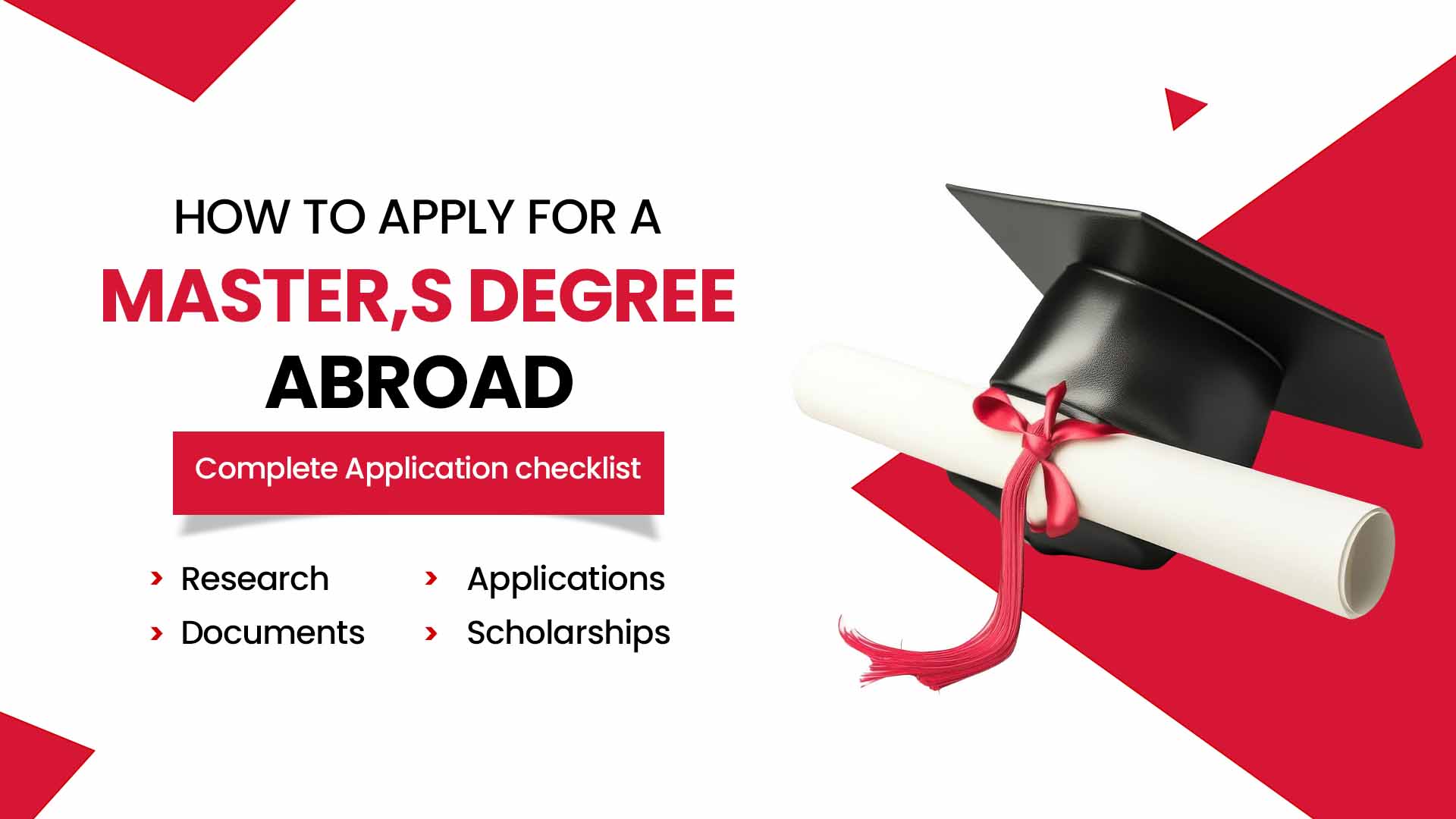
It can be stressful for foreign learners to apply for a master's program. Are you sure you applied for the correct visa? Which linguistic test must you complete? When is the best time to book your flights? There are many things that you have to consider.
You could choose to enlist the assistance of a study abroad consultant, Gateway Abroad Jaipur, who will assist you with the documentation and registration.
To give you peace of mind that the Master's program is complete, here is an overview of all the things you must achieve from the start until you're ready to take flight.
What things should be considered to apply for a Master’s at a foreign university?
You must first finish your bachelor's degree in order to apply for a master's degree overseas. For admission to the majority of master's programs, you must have a specific grade on your bachelor's program of study.
You have to take an English Proficiency Test to prove your linguistic knowledge. At this point, you should also prepare all of your prior records, as you will require them for the application. However, to ensure you are getting everything crucial, it is essential to follow your application process strictly.
Universities that conduct research
The first step is to determine precisely how you intend to spend the next twelve months to two years of your life. However, you most likely already know what you are looking to pursue at this point. The majority of people will find this to be comparable to or equivalent to their bachelor's degree.
Examining universities with a reputation for distinction in your subject is a brilliant idea. Searching for funding to study abroad is also an essential thing to know. Moreover, the language of instruction, the degree's international validity, and your future employment prospects are other crucial considerations.
Take the necessary admission and language tests.
As directed by the institution you attend, the next stage is completing an international language competence exam. This material is included in the prerequisites for the course you choose.
You will probably need to pass either the IELTS or TOEFL because most universities now offer English-language courses.
Additionally, some institutions accept other English language assessments, such as the Duolingo or PTE Academic tests. In addition to the program you choose, you might also be required to take extra qualifying tests, such as the GRE or GMAT.
Prepare your supporting documentation.
All of your original paperwork, such as your prior diplomas and the outcomes of your classwork and language assessments, should now be with you. Letters of recommendation or references, a statement of purpose, or a personal statement may still be required to finish your application.
References, which can come from current employers or former instructors, serve as a means of confirming your qualifications and moral fiber. Remember to allow them adequate time to respond.
A personal statement is a brief essay that enables you to discuss yourself, your motivations for applying to the course, and your belief that you are a qualified applicant.
Look into and submit scholarship applications.
In addition to your application, you might be looking for and qualifying for postgraduate international scholarships. The institution's portal is the ideal starting point for your research. The majority of institutions provide overseas students with substantial scholarships.
To find out about any further government grants, bursaries, or scholarships that might be relevant to you, you can then visit the official pages of the respective governments in the country.
Examining portals that provide a thorough list of funding for study abroad available in every nation, provided by various private or public companies, may also be a wise choice. A brilliant place to start your scholarship search is with well-known international scholarships such as the Fulbright, Chevening, and GREAT grants.
Make an application for a student visa.
Applying for a student visa should be your first course of action after verification from your educational institution. In most cases, if you are an international student who needs a visa to visit a particular nation, you must provide the following papers, although the requirements vary depending on your nationality and the country you intend to travel to.
- A passport that is currently valid.
- An enrolment document from an accredited university.
- Evidence of financial resources, such as the latest statements from banks or fellowship verification.
- Evidence of language ability.
When applying for a student visa, several nations additionally require you to submit a medical certificate and proof of health insurance. The nation's official site has a list of all the things you have to upload.
Verify the cost of tuition.
Verify the tuition costs, whether you are interested in applying for a competitive scholarship program overseas, and whether you want to take out a foreign education loan to cover your expenses before deciding to study abroad.
After confirming your decision, you should make sure that the cost of paying for your education out of pocket or by taking out a student loan will be compensated for by increasing your earning capacity in the future.
Make reservations for your stay.
Choosing accommodation well in advance will help you avoid worrying about where you'll stay for your first couple of nights in a foreign place, whether you choose private or university-provided housing. Furthermore, when you apply for a student visa, some nations additionally require proof of residency.
Obtain health insurance.
Although many nations require it in the visa application process, having foreign medical coverage is always a brilliant idea. When you have health insurance, you can be sure that you will be safe in the event of an accident or unanticipated disease without having to pay a considerable amount of money.
What documents do you need to apply for a master's at a foreign university?
During the application process, overseas colleges require the following documents from you:
Copies of your previous academic credentials: When applying for a master's degree at a foreign university, you have to include verified copies of your English-language test graduation credentials.
Some schools will also demand a high school graduation certificate, even though the majority of master's applications only need an undergraduate degree. Universities require these records as evidence that you have completed and attended prior educational cycles to admit you to a postgraduate degree.
Academic records from your undergraduate studies:
The documents of your academic work provide the institution with comprehensive information about your undergraduate coursework, including modules and lessons taken with grades. The transcripts in question must be official copies, not pictures or written pages, as required by institutions.
Transcripts from academic institutions are crucial because they show which courses you have taken. This information helps colleges determine whether you have the training and experience needed for the Master's program you are applying for.
Evidence of language ability
You are likely going to study in English or another widely used foreign language when pursuing a degree overseas. Because of this, institutions require you to be sure that you are capable of using a foreign language at the level of academia and that it won't be an obstacle to your educational experience.
For those who are learning English, IELTS, PTE Academic, TOEFL, C1 Advanced, and other formal language certifications are usually required by Master's programs. They are genuinely expecting you to have a specific score when they demand it. The higher your score, the more specific they are in believing that you are proficient in English.
Statement of purpose or motivation letter
Many learners need direction when they are required to submit a motivation letter or statement of purpose with their application. Although they seem very comparable, a statement of purpose and a motivation letter are not the same thing.
Nonetheless, both documents should focus on your educational experiences and the reasons you are applying for a certain degree. They should also generally be well-written, concise, and organized.
Universities anticipate that in a motivation letter, you will emphasize in greater detail your career ambitions and the background related to the course of study. Additionally, they may ask you to specify the course or area of specialization you wish to pursue for your master's.
In your statement of purpose, colleges expect you to discuss your background, hobbies, and career aspirations, as well as what has shaped and motivated your educational and career path so far. Put differently, it's a far more intimate document that allows you to make your application stand out.
Curriculum Vitae
Your academic resume serves as your business card. However, you should absolutely discuss your professions and extracurricular interests; schools will only show a little interest in hearing about them in great detail.
They want to evaluate how your background aligns with or demonstrates your interest in the course of study you wish to pursue. Because of this, you should concentrate on adding published scholarly papers, work in academic groups, pertinent think-tanks, etc., to your resume.
Leave a Reply
Your email address will not be published.
Search
Similar Blogs

Preparing for TOEFL Speaking Scoring section: Key Skills and Practice Techniques
11/3/2025
Educational loan for study abroad: Everyone Should Know in 2026
11/3/2025
Form I-20 Explained: Start Your U.S. Study Journey with Confidence
10/27/2025
What is the difference between percentage and percentile
9/30/2025
Have a question about GMAT?
Want some help figuring out what kind of prep service is right for you?
Help and Support