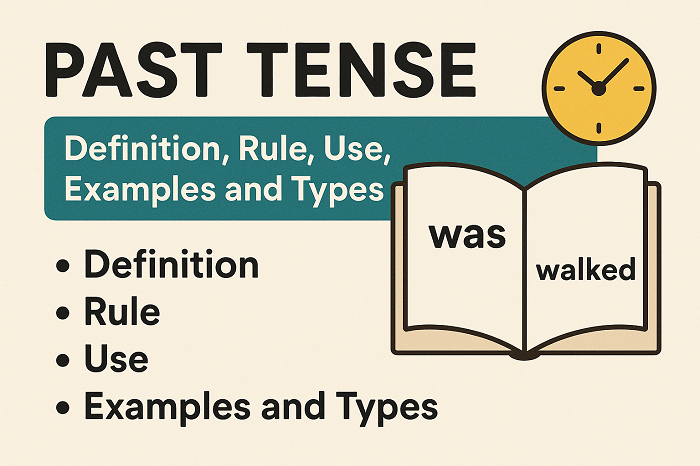
Things that took place and were finished in the past are described in the simple past tense. These behaviors may be one-time or recurring.
Subject + past form of verb + object
Examples:
Usage:
Definition:
An activity that was in progress at a particular moment in the past is described in the past continuous tense. It frequently sets the stage for a previous occurrence.
Subject + was/were + verb(-ing) + object
Examples:
Usage:
Definition:
An activity that was finished before another event or period in the past is expressed using the past perfect tense.
Subject + had + past participle + object
Examples:
Usage:
Definition:
The Past Perfect Continuous Tense is used to indicate an action that began in the past and continued until another time or action in the past. It highlights the duration of the action.
Subject + had been + verb(-ing) + object
Examples:
Usage:
Comparison Table-
|
Tense |
Structure |
Example |
Use Case |
|
Simple Past |
Subject + past verb |
She danced beautifully. |
Completed past actions |
|
Past Continuous |
Subject + was/were + verb(-ing) |
She was dancing when it rained. |
Ongoing past actions at a specific time |
|
Past Perfect |
Subject + had + past participle |
She had danced before dinner. |
Action completed before another past action |
|
Past Perfect Continuous |
Subject + had been + verb(-ing) |
She had been dancing for an hour. |
Action ongoing until a point in the past |
· Understand the basic rules:
§ Regular verbs add -ed (e.g., walk → walked).
§ Irregular verbs change form (e.g., go → went).
· Make a list of common irregular verbs: Group them by patterns or similarities to remember easily.
· Learn with timelines: Visualize past events on a timeline to grasp when and how past tense is used.
· Read simple past-tense stories: Use children’s books or short stories written in the past tense to see it in context.
· Practice rewriting present-tense sentences in the past: Convert “She eats lunch at 1 PM” to “She ate lunch at 1 PM.”
· Use memory tricks and rhymes: Create rhymes or mnemonics for irregular verbs (e.g., "Go went gone, never wrong").
· Listen to conversations or songs in past tense: Pay attention to how native speakers describe past events.
· Talk about your day: Practice saying what you did yesterday using the past tense.
· Write a daily journal entry in past tense: Summarize your day or a past event using simple past verbs.
· Take quizzes or play grammar games: Reinforce learning with interactive tools that test your knowledge.
The past tense plays a crucial role in helping us express actions, events, and situations that have already occurred. Whether narrating a personal story, reporting historical events, or describing previous experiences, the use of past tense allows for clear and chronological communication. Understanding the different forms of simple past, past continuous, past perfect, and past perfect continuous enables more precise and nuanced expression. Mastery of the past tense not only enhances writing and speaking skills but also lays the foundation for effective storytelling and accurate reporting. As with all aspects of language, consistent practice is key to using past tenses with confidence and clarity.
Ans- To describe previous events or acts, the past tense is employed.
Ans- Past perfect, past continuous, past simple, and simple past.
Ans-By adding -ed to regular verbs (e.g., walk → walked), irregular verbs have special forms (e.g., go → went).
Ans- It describes actions that were happening at a specific time in the past (e.g., "I was reading").
Ans- To show that one past action happened before another (e.g., "She had left before I arrived").
Ans-Subject + had + past participle (e.g., "They had eaten").
Ans- It shows a past action that was ongoing before another action (e.g., "He had been studying for hours").
Ans-No, irregular verbs change in different ways (e.g., "run → ran", "eat → ate").
Ans- No, when using 'did' in questions or negatives, use the base form (e.g., "Did you go?" not "Did you went?").
Ans-Common ones include: yesterday, last night, in 2010, two days ago, etc.
Author
Content Writer & International Education Specialist
Sakshi Taneja is a content writer specializing in international education, study abroad opportunities, university admissions, student visas, scholarships, and career guidance. She creates accurate, research-driven, and student-focused content to help aspiring international students make informed decisions about their global education journey.
No comments yet
Be the first to share your thoughts!
Please provide your contact information
Free Counselling

9/21/2026

2/26/2026

11/3/2025

11/3/2025
10/27/2025
Want some help figuring out what kind of prep service is right for you?
Help and Support

Leave a Comment
Your email address will not be published.