Studying abroad is a life-changing decision, and choosing the right Intake can significantly impact your academic journey. Most international universities offer multiple intakes to accommodate diverse applicants from around the world. Among these, May and September are two prominent options.
Suppose you're planning to study abroad, especially in countries like Canada, the UK, Australia, or the USA. In that case, it’s crucial to weigh the pros and cons of each Intake before making a decision. This blog provides an in-depth comparison of May vs September Intake, helping you decide which suits you best.
What about university intakes?
Before diving into the comparison, let’s understand what intakes mean.
- Intake refers to the specific time of year when universities accept new applications and start new academic sessions.
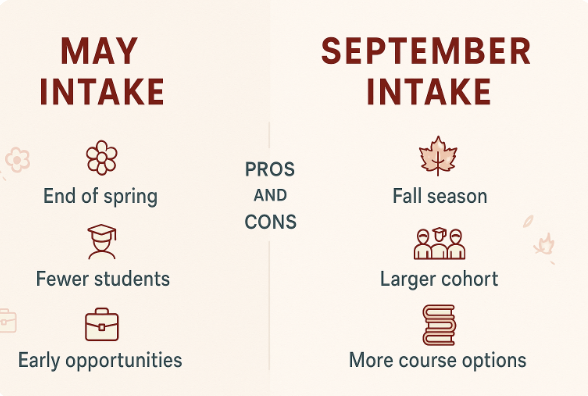
- The predominant Intake in the majority of nations is the September Intake, often known as the Fall Intake. It provides the most chairs and the greatest range of programs.
- May Intake (Spring/Summer Intake) is usually a secondary intake, offering limited courses and fewer seats.
What about the pros and cons of Intakes?
September Intake-
- Offers the widest range of programs and disciplines.
- All major undergraduate and postgraduate courses are open.
- Electives, specializations, and unique modules are usually available.
- Extremely competitive due to high application volume.
- Requires early application (usually 8–12 months in advance).
May Intake:
- Suitable for students with niche course preferences or those who missed earlier deadlines.
- Less competition in some programs.
- Limited course availability; many programs are not offered.
- Elective subjects or special tracks may not be available.
If you want broader choices and a rich academic curriculum, the September Intake wins.
Admission and Visa process-
September Intake:
- Most institutions are better staffed and organized for this Intake.
- A strong alum presence and orientation programs help make it easy to adjust.
- Longer processing times for applications and student visas due to high volume.
- Early deadlines demand faster decisions and document preparation.
May Intake:
- Faster processing time due to lower volume.
- Less stress in documentation and visa interviews.
- Shorter timelines to prepare for travel and settling abroad.
If you are applying late or want quicker processing, May Intake is more convenient.
3. Job opportunities and internships-
September Intake-
- Aligns perfectly with academic calendars and internship cycles.
- Recruiters actively hire interns and freshers around this time.
- There are plenty of social gatherings and job opportunities going on.
- There is fierce rivalry for part-time work and fellowships.
May Intake-
- Fewer students = less competition for available jobs.
- Some companies may look for summer interns.
- Internship and career opportunities are less organized.
- You may miss the key recruitment drives held during the fall semester.
If internship and job placement are high on your priority list, the September Intake has better prospects.
4. Campus life and extracurricular activities-
September Intake-
- Major campus events, clubs, and activities start during this Intake.
- Easier to make friends, join clubs, and engage socially.
- Freshers' week, orientations, and workshops help ease the transition.
- Bigger class sizes might make networking more competitive.
May Intake:
- More individualized relationships with instructors result from smaller class numbers.
- Easier to stand out academically and socially in a smaller crowd.
- May miss out on several social events and activities.
- There may not be many clubs or groups for students.
For a vibrant campus life, the September Intake offers more engagement.
5. Academic performance and faculty interaction-
September Intake-
- Full faculty availability.
- Structured academic calendars with consistent assessments and breaks.
- Large student numbers may reduce personal attention from faculty.
May Intake-
- Smaller class sizes can lead to stronger professor-student connections.
- Easier access to research projects or teaching assistant positions.
- Shorter semesters or compressed schedules in some cases.
For more individual attention, May Intake may work in your favor.
6. Accommodation and housing-
September Intake-
- Universities are prepared to accommodate large student groups.
- On-campus housing is widely available if applied for early.
- Higher demand = higher rental costs, especially in urban areas.
- Need to apply for housing very early.
May Intake:
- Easier to secure accommodation, both on-campus and off-campus.
- Fewer roommates or a student community initially.
For better housing options with less competition, May Intake has an edge.
7. Climate and Adaptation
September Intake-
- In most countries, September means pleasant autumn weather.
- Students have time to adjust gradually when winter arrives.
- Winter sets in soon after, which can be challenging for those from tropical climates.
May Intake-
- Warmer months (spring/summer) make the transition easier.
- More daylight and outdoor activities help students adjust.
- Some regions may experience very hot summers.
In terms of weather comfort and adaptation, May Intake is favorable.
8. Tuition fees and scholarships-
September Intake-
- A maximum number of scholarships and financial aid is available.
- Universities budget most funding during this Intake.
- Scholarship deadlines are often early and competitive.
May Intake:
- There are fewer applicants, making departmental fellowships simpler to get.
- Fewer scholarship opportunities; some may not be offered.
If you rely on scholarships or financial aid, the September Intake offers more funding options.
9. Post-graduation timeline and career planning-
September Intake-
- Graduate earlier in the year, align with corporate recruitment cycles.
- Easier entry into post-study work visa programs or further education.
- Immediate job-hunting pressure after graduation.
May Intake-
- Graduation in mid-year can be strategically beneficial in specific industries.
- May miss out on synchronized graduate programs or hiring events.
If your goal is a smooth transition into the workforce, the September Intake offers better alignment.
Final comparison table-
|
Feature
|
May Intake
|
September Intake
|
|
Course Availability
|
Limited
|
Wide Range
|
|
Admission & Visa Process
|
Quicker, Less Competitive
|
Long, Highly Competitive
|
|
Job & Internship Opportunities
|
Moderate
|
Excellent
|
|
Campus Life
|
Less Vibrant
|
Highly Active
|
|
Faculty Interaction
|
High
|
Moderate
|
|
Accommodation
|
Easier, Less Competition
|
Competitive
|
|
Climate Comfort
|
Warmer, Easy Adaptation
|
Autumn Start, Colder Winters
|
|
Scholarships
|
Limited
|
Abundant
|
|
Career Planning
|
Mid-year Completion
|
Aligned with Global Hiring Cycles
|
Which Intake should you choose?
Choosing between May and September intakes is ultimately a personal decision. Here’s how to decide:
Choose May Intake if-
- You missed the September deadlines.
- You favor greater faculty participation and smaller group ratios.
- You want quicker application and visa processing.
- You are flexible with course and scholarship options.
Choose September Intake if-
- You wish to have access to all available financing and educational possibilities.
- You seek vibrant campus life and extensive job opportunities.
- You want alignment with academic calendars and career cycles.
No matter which intake you choose, planning early is essential. Consult with educational advisors, consider university deadlines, and review visa timelines before applying. With the right preparation, both intakes can offer fulfilling academic experiences and life-changing international exposure.
Conclusion
Your goals in education, schedule, and individual tastes will all play a role in your decision between the May and September intakes. A greater selection of courses of study, more financial aid, a lively campus community, and improved career compatibility are all available for the September intake. On the other hand, although there are fewer program possibilities, the May intake offers faster receipt of applications, lower class numbers, and less competitiveness.
Both intakes have their advantages—what matters most is selecting the one that aligns with your readiness and aspirations. With proper planning and guidance, Intake can lead to a successful and enriching experience in studying abroad.
FAQs-
Q.1 Which Intake, May or September, is more popular?
Ans- A larger selection of programs, grants, and loans, as well as improved campus involvement, make the September intake more appealing.
Q.2 Will all courses be offered during the May intake?
Ans- No, the May intake typically has limited program options compared to the September intake.
Q.3 Is visa processing faster for the May intake?
Ans- Yes, visa processing can be faster due to the lower application volume during the May intake.
Q.4 Do both intakes offer scholarships?
Ans- Yes, however, there are additional financing and fellowship possibilities for the September intake.
Q.5 Can you apply for internships after the May intake?
Ans- You can, but internship timelines may not align as smoothly as with the September intake.
Q.6 Which intake has more international students?
Ans- The September intake attracts more international students, offering a richer multicultural experience.
Q.7 Is campus life affected by intake choice?
Ans- Yes, the September intake offers a fuller campus experience with more events and student activities.
Q.8 Can you transfer from the May to the September intake later?
Ans- In most cases, transfers are not allowed, so choose your Intake carefully.
Q.9 Is May intake good for late planners?
Ans- Yes, the May intake suits students who missed the September deadline and want to start sooner.
Q.10 Which Intake offers better job opportunities post-study?
Ans- The September intake usually aligns better with job recruitment cycles and career fairs.






Leave a Comment
Your email address will not be published.