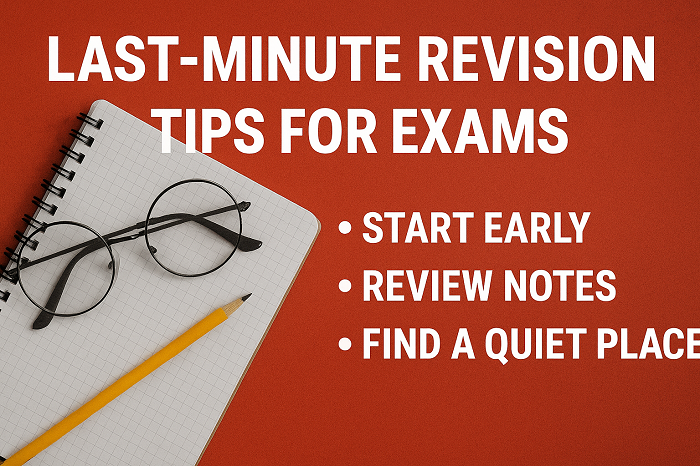
Exams are right around the corner. You’ve spent weeks—maybe months—preparing, but now the clock is ticking, and there’s no time to waste. Whether you’re a student preparing for school finals, competitive exams like the SAT, GMAT, or professional certifications, last-minute revision can make a critical difference in your performance. The final few days or hours before an exam can be the most crucial in locking in key information and boosting your confidence.
This blog explores practical and effective last-minute revision tips to help you revise smarter, retain more, and walk into the exam room well-prepared.
At the last minute, it's essential to focus on what matters most.
How to do it:
It is not about covering everything; it’s about maximizing your returns from the limited time left.
Passive reading won’t help much now. Active recall is the science-backed method of retrieving information from memory, which significantly boosts retention.
Methods:
Active recall helps cement information into long-term memory faster than just rereading notes.
The genuine thing is the best way to get ready for it. Past papers simulate the exam environment and test your understanding under pressure.
Why this helps:
Focus on solving at least 2-3 past papers per subject in the last few days.
Cheat sheets are concise one-page summaries of key formulas, dates, definitions, or concepts.
How to do it:
These serve as quick revision aids just before entering the exam hall.
Visual memory works wonders, especially when you're pressed for time.
Cramming for hours nonstop is ineffective. Instead, use the Pomodoro technique or similar time-blocking strategies.
What is it?
Structured time management boosts efficiency and memory retention.
The temptation to cover “everything” is strong, but now’s not the time to learn new or difficult topics from scratch.
Exceptions:
Spreading yourself too thin can cause confusion and anxiety.
Visual learners retain better through imagery and spatial understanding.
Try this:
The more visually engaging your revision is, the easier it will be to recall in the exam.
Your brain processes and stores memories during sleep. Therefore, what you study right before sleeping is likely to be remembered.
Strategy:
Sleep acts as a “save button” for memory.
Cluttered space = cluttered mind.
How to optimize:
Even a 10-second distraction can derail a 30-minute focus cycle.
Studying with friends can help clarify doubts and reinforce learning, but it needs to be structured.
Do’s:
Don’ts:
Learning is amplified when you explain or debate concepts with peers.
Your brain is a high-performance engine. Fuel it well.
Essentials:
A tired mind won’t retain or recall efficiently.
It’s easy to spiral into self-doubt when time is running out. However, stress can paralyze your brain’s ability to recall and analyze.
How to stay calm:
A calm brain performs better than a stressed one.
Mnemonics are powerful for remembering lists, sequences, or formulas.
Examples:
Rhymes, acronyms, and visuals make dull facts stick better.
Time yourself, switch off your phone, and sit with a pen and paper like it’s the real thing.
Benefits:
Train the way you race and simulate real conditions for best results.
Prepare stuff the night before to save stress at the last moment.
Checklist:
An effective exam can be influenced by a carefully thought-out morning.
Last-minute revision is not about overloading your brain; it's about reinforcing what you already know, eliminating stress, and walking into the exam with a clear mind. By focusing on high-yield topics, using active techniques, and maintaining your well-being, you can significantly enhance your performance even with limited time.
Ans- Focus on high-weightage topics, use active recall (like flashcards or self-quizzing), and review concise notes or cheat sheets instead of reading full chapters.
Ans- It is not recommended unless the topic is very important. Instead, reinforce what you already know to avoid confusion and panic.
Ans- Quality matters more than quantity. Aim for 6–8 focused hours with breaks, using techniques like the Pomodoro method (e.g., 50 minutes of study, 10 minutes of rest).
Ans- Yes, practicing past papers helps you understand the question pattern, manage time, and test your knowledge under exam conditions.
Ans- Yes, if it's well-organized and focused. Use it to quiz each other, clarify doubts, or quickly explain difficult concepts.
Ans- Take deep breaths, use positive affirmations, stay hydrated, and get enough sleep. Avoid cramming all night before the exam.
Ans- Quickly revise keynotes or flashcards, organize your exam materials, and get at least 6–8 hours of sleep to keep your mind fresh.
Author
Content Writer & International Education Specialist
Sakshi Taneja is a content writer specializing in international education, study abroad opportunities, university admissions, student visas, scholarships, and career guidance. She creates accurate, research-driven, and student-focused content to help aspiring international students make informed decisions about their global education journey.
No comments yet
Be the first to share your thoughts!
Please provide your contact information
Free Counselling

9/21/2026

2/26/2026

11/3/2025

11/3/2025
10/27/2025
Want some help figuring out what kind of prep service is right for you?
Help and Support

Leave a Comment
Your email address will not be published.