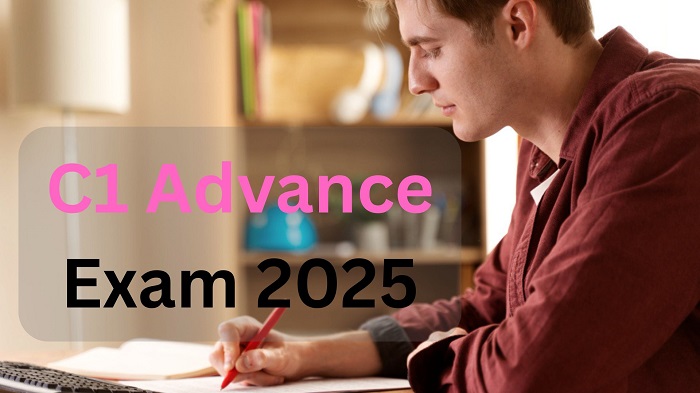
Cambridge Assessment English offers a high-level English proficiency examination called the C1 Advanced exam, which was formerly known as Cambridge English: Advanced (CAE). It is commonly accepted as evidence of advanced English proficiency by governments, businesses, and academic institutions worldwide. This blog thoroughly explains the C1 Advanced exam's registration procedure, format, syllabus, cost, eligibility, and dates.
The C1 Advanced exam evaluates applicants' proficiency in English in professional and educational contexts. One of the Cambridge English Qualifications that assesses your proficiency in the English language is the C1 Advanced exam (CAE), formerly known as Cambridge English: Advanced. Many students who want to study abroad take this exam. C1 Advanced, sometimes known as CAE, is recognized for admission purposes in the US, UK, and Canada and is accepted by more than 9,000 universities and institutes worldwide. The cost of the CAE Exam varies depending on the testing facility, so it is necessary to contact them directly to determine the exact cost.
It is available in both paper and computer-based formats and can be taken at specific test centres, of which there are about 40 in India. The four sections of the CAE—Reading and Use of English, Writing, Listening, and Speaking—have a structure akin to other English proficiency tests like the TOEFL and IELTS. It is intended for people who want to study or work in an environment that speaks English and shows they possess the language skills necessary to succeed in such settings.
|
Highlight |
Details |
|
CEFR Level |
C1 |
|
Scale Score |
180-199 |
|
Test Format |
Computer or paper-based |
|
Number of Papers |
4 |
|
Reading & Use of English |
8 parts, 56 questions, 1 hour 30 minutes |
|
Writing |
2 tasks, 220-260 words each, 1 hour 30 minutes |
|
Listening |
4 parts, 30 questions, 40 minutes |
|
Speaking |
4 parts, 15 minutes |
|
Cambridge English Scale |
Scores range from 142-210 |
|
Grading |
Grades A, B, C for C1 level |
More than 9,000 enterprises, government agencies, and educational institutions worldwide recognise this test. As a result, it is a commonly used language proficiency exam that professionals and students can take. A strong CAE score demonstrates your excellent linguistic ability and comfort with the English language.
Adequate exam preparation is very beneficial for both professionals and students. You gain language proficiency through the preparation, which enhances your capacity to interact with coworkers and peers. Learning these abilities can help you quickly and easily adapt to a nation where English is the primary language if you wish to study or work there. You demonstrate that you can-
The dates for the CAE exam vary by area; however, it is offered all year. It is recommended that candidates register at the nearby CAE centres. To register for the CAE (C1 Advanced) exam, follow these crucial steps-
The four primary portions of the CAE (C1 Advanced) exam evaluate various language proficiency levels. The format that candidates need to be aware of is explained below. They must know they only have a certain amount of time to finish the parts.
The CAE exam takes roughly four hours to complete. Applicants perform this test either on a computer or paper. It assesses advanced English proficiency at the C1 level by covering a broad variety of language abilities, such as speaking, writing, listening, and reading.
The cost of the C1 Advanced exam ranges from $150 to $250, depending on the nation and testing location. Candidates can contact their local testing facility for exact fee information.
For C1 Advanced, which is administered several times a year, there are both computer-based and paper-based choices. The precise dates are announced beforehand by the testing facilities. For the most recent exam timelines, applicants should consult the official Cambridge English website or contact their testing location.
Although the CAE is available everywhere through authorized testing locations, applicants should contact their local facility to get specific information about their area. Test centres are essential for helping applicants register and giving them the information they need to have a good exam experience. The following are the key facts about CAE (C1 Advanced) testing locations-
The format of the test you took will determine when your C1 Advanced (CAE) exam results are released-
The CAE exam uses the Cambridge English Scale to evaluate students' performance, which ranges from 142 to 210 points. Each of the four talents has a distinct score, and the average of these five scores is used to get the overall score.
Based on their evaluations, applicants' proficiency levels are divided into three grades. Scores between 180 and 192 are equivalent to a C, scores between 193 and 199 are comparable to a B, and scores between 200 and 210 are equivalent to the highest grade, an A.
|
Cambridge English Scale Score |
Grade/CEFR |
CEFR Level |
|
200–210 |
Grade A |
C2 |
|
193–199 |
Grade B |
C1 |
|
180–192 |
Grade C |
C1 |
|
160–179 |
Level B2 |
B2 |
The CAE test assesses C1-level language skills by the Common European Framework of Reference (CEFR). Competency at this level is shown by scores between 180 and 199, with both B and C grades indicating achievement of the C1 norm.
The results obtained from CAE are forever valid. However, some institutions emphasize the significance of current scores by imposing a validity term of two to three years for admission purposes.
The students must first understand the syllabus and format. Recognize the various portions of the CAE exam, their structure, and the kinds of questions and objectives you may face. Here are some additional strategies to improve your ability to respond to CAE questions-
A renowned test of English proficiency, the C1 Advanced (CAE) exam is designed for people who want to succeed in academic and professional contexts. Candidates can register online through approved exam centers, and the registration process is simple. The carefully designed exam pattern evaluates a candidate's overall language proficiency, which includes Reading and Use of English, Writing, Speaking, and Listening components.
The curriculum is intended to assess advanced English competency in terms of vocabulary, grammar, and oral and written communication abilities. Exam fees differ by location and testing facility, so applicants must confirm precise costs with the one they've selected. Because of the liberal eligibility standards, non-native speakers with advanced English proficiency are welcome to apply. Exam dates are available all year round, allowing candidates to select a period that works best for their preparation. Candidates can improve their educational and professional prospects and attain outstanding outcomes with careful planning and a calculated approach.
Ans- Register online or in person through an authorized Cambridge exam center. Visit the official Cambridge English website to find a test center near you.
Ans- The exam is held in paper-based and computer-based formats multiple times yearly. Availability depends on the test centre.
Ans- The exam consists of four sections:
Ans- The syllabus includes grammar, vocabulary, reading comprehension, writing, listening, and speaking skills.
Ans- The Cambridge English Scale (160-210) scores the exam. A score of 180-199 qualifies for the C1 level, while 200-210 can earn a C2-level certification.
Ans- The exam fee varies by country and test centre, but generally ranges between $150 and $250.
Ans- There are no age restrictions, but it is recommended for students, professionals, and individuals aiming for academic or work opportunities in English-speaking environments.
Ans- You can retake the exam as often as needed. However, each attempt requires a separate registration and fee payment.
Ans- The C1 Advanced certificate does not expire and is valid for life. However, some institutions may require a recent score (within 2-3 years).
Ans- Check the official Cambridge English website for the latest exam schedules or contact your nearest test center.
Author
Content Writer & International Education Specialist
Sakshi Taneja is a content writer specializing in international education, study abroad opportunities, university admissions, student visas, scholarships, and career guidance. She creates accurate, research-driven, and student-focused content to help aspiring international students make informed decisions about their global education journey.
No comments yet
Be the first to share your thoughts!
Please provide your contact information
Free Counselling

9/21/2026

2/26/2026

11/3/2025

11/3/2025
10/27/2025
Want some help figuring out what kind of prep service is right for you?
Help and Support

Leave a Comment
Your email address will not be published.