
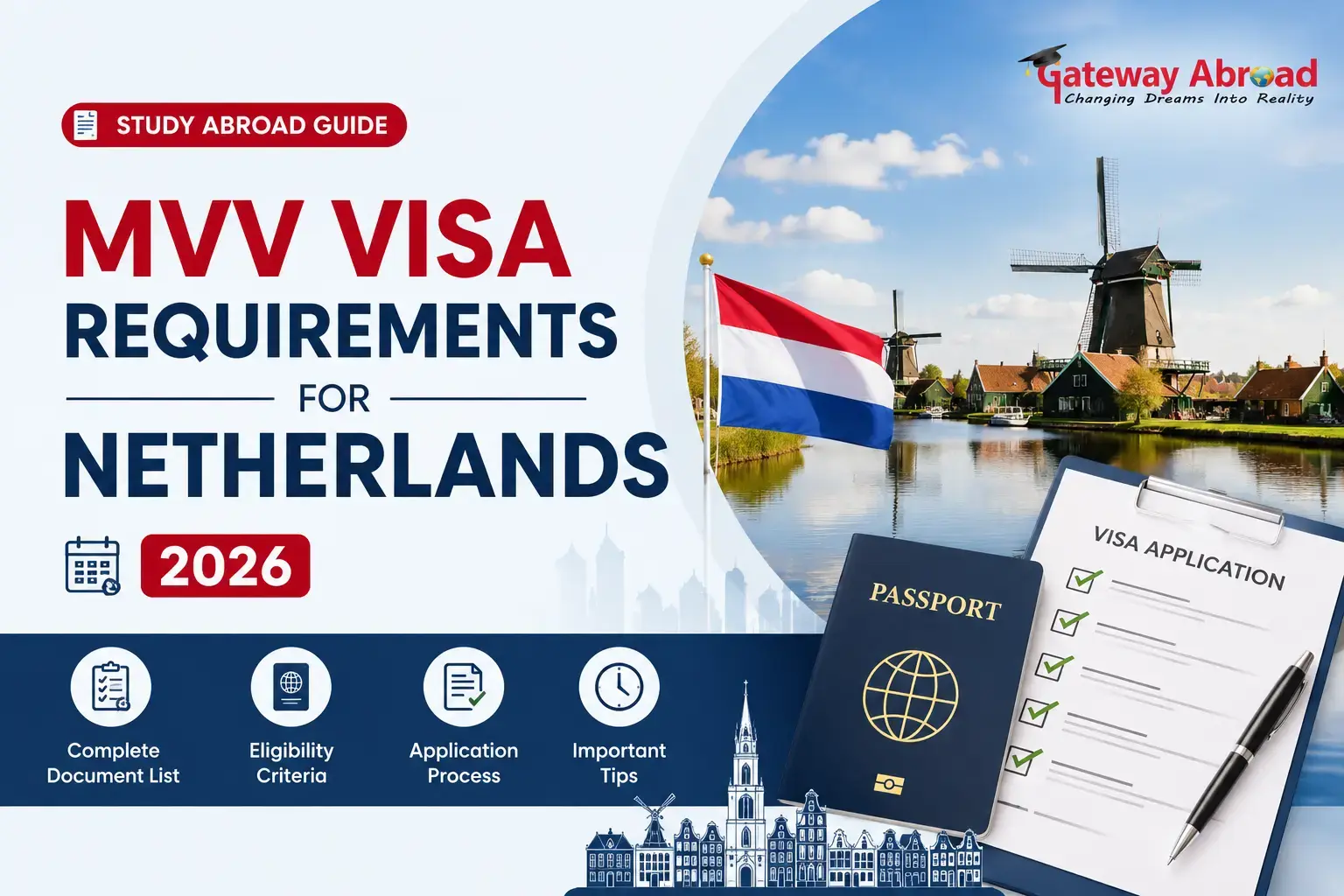
Studying in the Netherlands attracts thousands of international students every year. The country offers high-quality education, globally recognized universities, and a welcoming multicultural environment. Because of this reputation, many students choose the Netherlands for bachelor’s and master’s programs. However, before packing your bags and planning your journey, it is important to understand the visa process that allows you to enter and stay in the country legally.
If you plan to study in the Netherlands for more than 90 days, you will usually need an MVV visa. In simple terms, the MVV works as an entry visa that allows you to travel to the Netherlands and later collect your residence permit for study. Understanding the requirements early can make the process smoother and less stressful for students preparing for their academic journey abroad.
What is an MVV Visa?
The MVV (Machtiging to Voorlopig Verblijf) is a long-stay entry visa issued to non-EU students who plan to study in the Netherlands for more than three months. In simple terms, it allows international students to enter the country and begin their academic journey legally. Think of the MVV as the first step toward living and studying in the Netherlands. Once your MVV is approved and you arrive in the country, you will receive a residence permit that allows you to stay for the full duration of your study program.
In most cases, the process is student-friendly because universities help manage the application. For example, if a student from India gets admission to a master’s program in Amsterdam, the university usually starts the MVV and residence permit application on the student’s behalf. This makes the process easier and more organized for international students.
Key highlights of the MVV Visa-
- The MVV is a long-stay entry visa required for studies longer than 90 days.
- It is mainly required for students from outside the EU, EEA, or Switzerland.
- The visa allows students to enter the Netherlands before receiving their residence permit.
- Most Dutch universities submit the MVV application on behalf of the student.
- After arrival, students collect their residence permit to stay during their studies.
- The MVV usually appears as a visa sticker placed in the student’s passport.
Who needs an MVV Visa?
The need for an MVV visa depends mainly on a student’s nationality and the length of the study program. If you plan to stay in the Netherlands for more than 90 days, you should first check whether this visa applies to you. The following points explain who typically needs an MVV visa.
- Non-EU/EEA Students: Students from countries outside the European Union (EU), European Economic Area (EEA), or Switzerland usually need an MVV visa to study in the Netherlands.
- Students Staying Longer Than 90 Days: If your study program lasts more than three months, the MVV is normally required before entering the country.
- Students From Countries Like India or China: Applicants from countries such as India, Pakistan, China, and Nigeria generally must obtain an MVV before traveling.
- University-Supported Applications: In most cases, the Dutch university where you receive admission will start the MVV and residence permit application on your behalf.
- Students from MVV-Exempt Countries: Students from countries like the United States, Canada, Australia, Japan, South Korea, and New Zealand usually do not need an MVV, but they must still apply for a residence permit after arrival.
What about the basic MVV Visa requirements for students?
To qualify for an MVV visa, you must meet several requirements. These rules help the Dutch authorities confirm that you are a genuine student who can support yourself during your stay.
- Admission to a recognized university- First and most importantly, you must receive admission from a recognized Dutch educational institution. Your university plays a key role in the visa process. In fact, most institutions submit the MVV and residence permit application to immigration authorities on behalf of their students. For instance, once you accept your admission offer, the university will request documents such as your passport copy, proof of finances, and academic records.
- Valid passport- You must hold a valid passport that remains valid for the entire duration of your stay or at least the first part of it. Authorities also require copies of all important passport pages during the application process.
- Proof of financial means- The Netherlands requires students to show they can cover their living expenses. In most cases, students must demonstrate they have enough money to support themselves for one year of study. This amount usually covers housing, food, insurance, and daily expenses.
- For example, many universities ask students to transfer the required living cost amount to the institution first. Later, the university releases the funds to the student monthly after arrival.
- Health Insurance- Healthcare is mandatory in the Netherlands. Therefore, students must arrange valid health insurance before or shortly after arriving. Many universities guide students on choosing suitable insurance providers. Some even recommend specific student insurance plans.
- Tuberculosis (TB) test requirement- Students from certain countries must undergo a tuberculosis (TB) test after arriving in the Netherlands. This test ensures public health safety. However, not every nationality needs it. Students usually receive instructions from their university if the test applies to them.
- Signed declaration and application forms- Applicants must complete and sign several forms as part of the visa process. These forms confirm that you understand the rules and agree to follow Dutch immigration laws. In most cases, universities provide these forms and guide students through the process step by step.
How does the MVV application process work?
The MVV application process for studying in the Netherlands is usually straightforward because universities guide students through most of the steps. In many cases, the university submits the application to the immigration authorities on the student’s behalf. This system makes the process smoother and easier to manage. Here is how the process typically works.
Step-by-step process-
- Receive admission from a Dutch University- The process begins after you receive an official admission letter from a recognized university in the Netherlands and accept the offer.
- Submit required documents- Next, the university asks for important documents such as a passport copy, proof of finances, academic records, and signed application forms.
- University submits the visa application- Once your documents are complete, the university submits the MVV and residence permit application to the Dutch immigration authorities.
- Application review and approval- Immigration officials review your application and check whether you meet all the requirements. If everything is in order, they approve the request.
- Collect the MVV Visa from the Embassy- After approval, you visit the Dutch embassy or consulate in your home country to collect the MVV visa sticker in your passport.
- Travel to the Netherlands and receive a residence permit. Finally, you travel to the Netherlands. After arrival, you collect your residence permit, which allows you to stay in the country for the duration of your studies.
Processing Time for the MVV Visa
The processing time for an MVV visa is usually quite reasonable, but it can vary depending on the time of year and how quickly documents are submitted. In most cases, the Dutch immigration authorities process the MVV application within 2 to 4 weeks after receiving a complete application. However, during busy admission seasons, such as the months before the fall semester, the process may take a little longer. Because of this, universities often encourage students to submit their documents as early as possible.
In most situations, the university sends the application to the immigration authorities on the student’s behalf. Once the application is approved, the student receives instructions to visit the Dutch embassy or consulate in their home country to collect the MVV visa sticker. To avoid last-minute stress, many universities recommend starting the visa process at least two to three months before the program begins. Early preparation gives you enough time to gather documents, complete formalities, and plan your travel smoothly.
What are the common mistakes students should avoid when applying for an MVV Visa?
Even though the MVV visa process is usually straightforward, some common mistakes can slow down the application or create unnecessary stress for students. Paying attention to small details can make the process much smoother.
- It is important to avoid submitting incomplete or incorrect documents, such as missing forms or unclear passport copies.
- This often happens when students rush through the application, which can lead to small errors in the forms or supporting documents.
- It is also common for students to start the visa process too late, leaving very little time to fix issues if additional documents are required.
- This can become a problem if the financial proof is unclear, because authorities must confirm that students can cover their living expenses.
- It is equally important to check passport validity, as an expired or nearly expired passport can delay the process.
- This is why students should carefully follow all instructions from their university, since the university usually manages the MVV application.
Conclusion-
The MVV visa plays an important role for international students planning to study in the Netherlands. It acts as the entry visa that allows you to travel to the country and begin your academic journey. Without this step, students from many non-EU countries cannot enter the Netherlands for long-term study programs. Fortunately, the process is quite student-friendly. Universities guide applicants, submit the visa request, and help students prepare the required documents. This support makes the procedure easier, especially for first-time international students.
As long as you meet the key requirements, such as securing admission, showing financial proof, holding a valid passport, and arranging health insurance, the application usually moves forward without major difficulties. With proper planning and timely preparation, obtaining your MVV visa can become a simple step toward studying, gaining international experience, and building your future in the Netherlands.
FAQs on MVV Visa Requirements for Studying in the Netherlands
Q.1 What is an MVV visa?
Ans- The MVV is a long-stay entry visa that allows non-EU students to enter the Netherlands for studies lasting more than 90 days.
Q.2 Who needs an MVV visa to study in the Netherlands?
Ans- Students from countries outside the EU, EEA, and Switzerland usually need an MVV visa.
Q.3 Do all international students require an MVV visa?
Ans- No, students from some countries, such as the USA, Canada, Australia, and Japan, are usually exempt from the MVV requirement.
Q.4 Who applies for the MVV visa?
Ans- In most cases, the Dutch university where you receive admission submits the MVV application on your behalf.
Q.5 How long does the MVV visa process take?
Ans- The processing time usually takes about 2 to 4 weeks after submitting a complete application.
Q.6 What documents are required for an MVV visa?
Ans- Common documents include a valid passport, admission letter, financial proof, health insurance, and completed visa forms.
Q.7 Do students need to show proof of funds?
Ans- Yes, students must show that they have enough money to cover their living expenses during their stay in the Netherlands.
Q.8 What happens after the MVV visa is approved?
Ans- Students must visit the Dutch embassy or consulate to collect the MVV visa sticker in their passport.
Q.9 What should students do after arriving in the Netherlands?
Ans- After arrival, students collect their residence permit, which allows them to stay for the duration of their study program.
Q.10 Can the MVV visa be extended?
Ans- The MVV itself is not extended, but the residence permit issued after arrival can be extended if your study program continues.

Leave a Comment
Your email address will not be published.