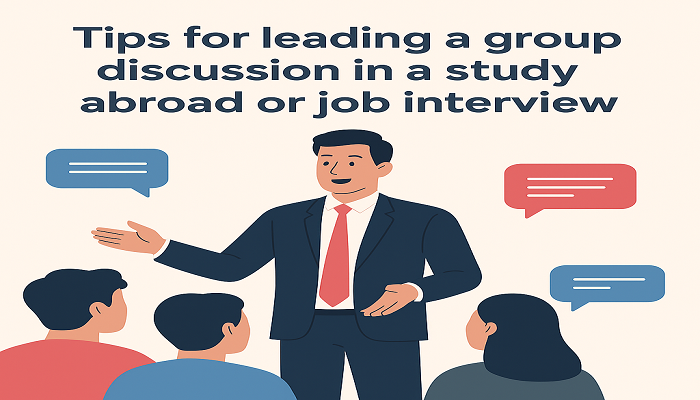
Group discussions (GDs) are a popular assessment technique used in both job interviews and study abroad programs. They are used by businesses and universities to evaluate your teamwork, leadership, communication, and problem-solving capabilities. Effectively facilitating a group discussion can help you stand out from the competition. Taking charge in a GD while preserving professionalism and teamwork will be covered in this article.
The meaning of a successful group discussion is straightforward: an important discussion about a specific topic, or possibly a variety of topics, held in a group size that permits involvement by every participant. Focus on listening actively, clearly communicating your ideas, showing respect for others' opinions, starting the conversation when it is suitable, summarizing important points, and making sure the conversation remains pertinent to the subject while promoting involvement from all participants if you want to lead a group discussion in a study abroad or job interview.
Prior to delving into leadership tactics, it's critical to comprehend the purpose of group talks in both employment screenings and study abroad selections. The following important factors are being assessed-
Study abroad programs and job interviews often use trending topics, abstract themes, or case studies for discussions. Read news articles, opinion pieces, and industry-specific trends. For study abroad GDs, topics may involve education, globalization, or sustainability. If it is a job interview, be aware of business challenges, market trends, and innovations.
Leading a discussion requires strong verbal and non-verbal communication. Work on speaking clearly and confidently. Structure arguments logically and support them with facts. Maintain good eye contact, use hand gestures appropriately, and adopt a confident posture.
To effectively lead a GD, practice to understand others' perspectives before responding. Draw in quieter members by asking for their opinions. Keep track of the discussion and recap crucial points.
It is key in group discussions. How successfully you convey your opinions and educate the interviewers and other participants of your points of view is what counts. Speaking with complete clarity is essential for both making your point and making a good impression. Another thing to remember is that you should not just sit back after you've made your opening statement. Whenever you feel it is acceptable, use the terms from the earlier part to add something to the conversation.
Taking the lead in summarizing the conversation, you can grab the interviewers' attention by summarizing the entire group discussion and emphasizing the most crucial issues. Keep your summary brief and pertinent, and make sure it is objective rather than biased.
Participants in group discussions frequently use aggressive presentation techniques to influence the group. They are unaware that being angry and yelling can cost them points.
Making several submissions during your session is the final piece of advice for group discussions. If you have a compelling response to other participants' viewpoints, you are welcome to join the conversation more than once. This will support your position.
Summing-Up-
Leading a group discussion in a study abroad or job interview setting requires confidence, inclusivity, and the ability to keep the discussion structured. By preparing in advance, actively engaging others, and managing the flow of conversation, you can stand out as a strong candidate. Practice these strategies, and you’ll be well-equipped to lead any GD successfully.
Ans- Begin with a brief introduction, state the topic clearly, and set a positive tone by encouraging participation.
Ans- Gently steer the conversation back by summarizing key points and refocusing on the main subject.
Ans- Encourage quieter members by inviting their opinions and avoid letting one person dominate the conversation.
Ans- Acknowledge their viewpoint respectfully, provide logical reasoning, and find common ground when possible.
Ans- Politely ask for turns to speak and remind the group of the importance of active listening.
Ans- Maintain eye contact, use open gestures, and sit upright to appear engaged and confident.
Ans- Adapt to the setting—use professional but conversational language in job interviews and a balanced approach in study discussions.
Ans- Summarize key points, highlight agreements, and offer a final takeaway or action plan.
Ans- Introduce a new angle, ask open-ended questions, or provide an example to restart the conversation.
Ans- Show confidence, listen actively, and facilitate a balanced, insightful discussion while keeping the group engaged.
Author
Content Writer & International Education Specialist
Sakshi Taneja is a content writer specializing in international education, study abroad opportunities, university admissions, student visas, scholarships, and career guidance. She creates accurate, research-driven, and student-focused content to help aspiring international students make informed decisions about their global education journey.
No comments yet
Be the first to share your thoughts!
Please provide your contact information
Free Counselling

9/21/2026

2/26/2026

11/3/2025
11/3/2025
10/27/2025
Want some help figuring out what kind of prep service is right for you?
Help and Support

Leave a Comment
Your email address will not be published.