
Common Synonyms to Improve IELTS Score
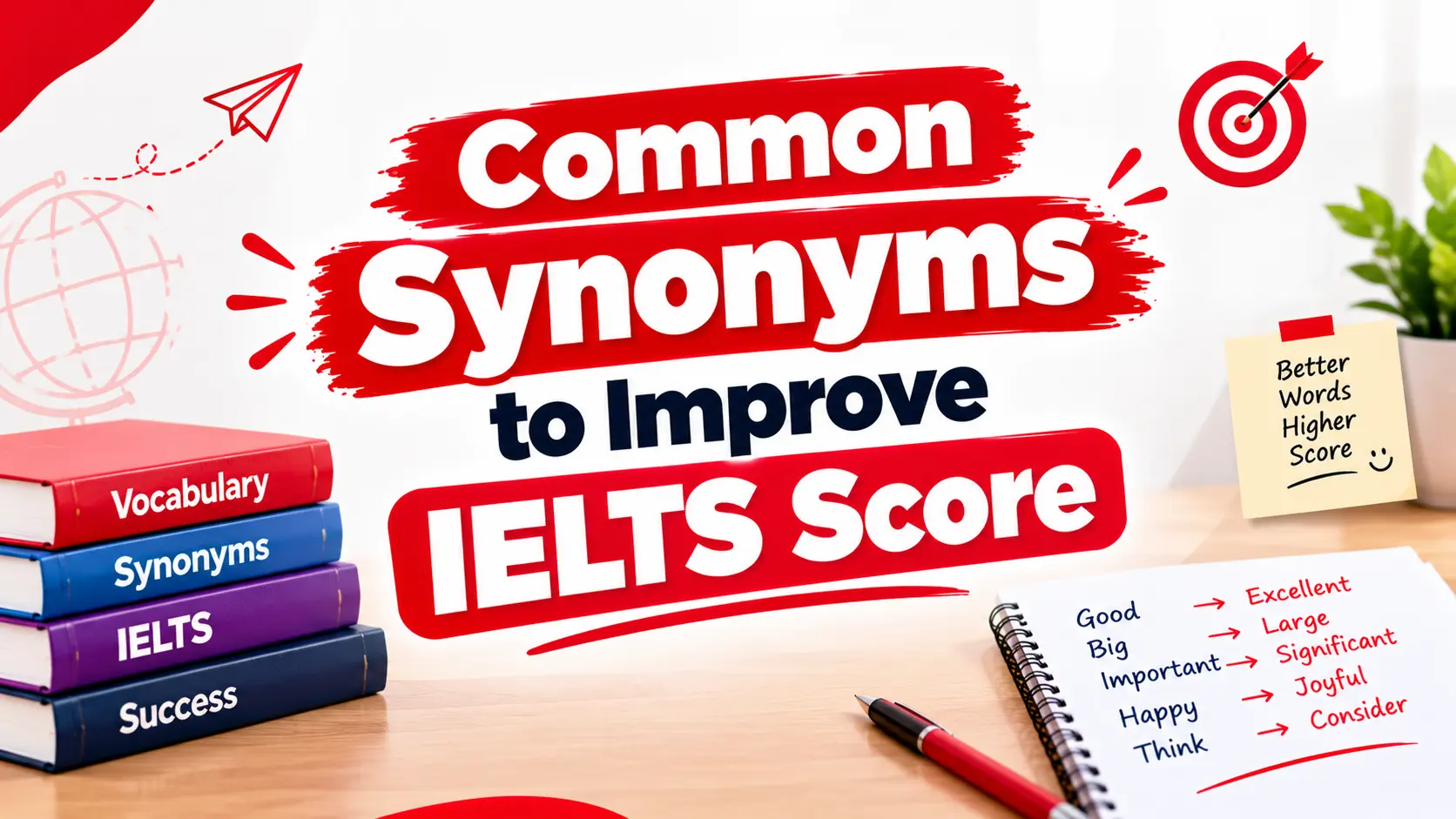
Improving your IELTS score is not just about knowing grammar rules or writing long essays. To improve your IELTS score, particularly in the Speaking and Writing portions, using synonyms to increase your list of words is one of the best strategies. Using a variety of words helps you avoid repetition, demonstrate lexical resources (a key assessment criterion), and present your ideas more effectively. This thorough tutorial will assist you in comprehending:
|
Before working on your vocabulary, it is helpful to understand the IELTS exam format and its assessment criteria. Read our detailed guide to the IELTS exam to understand the test structure and requirements.
Why are synonyms meaningful in IELTS?
Particularly in the Writing, Speaking, and Reading portions of the IELTS exam, synonyms are crucial. This is the reason:
- Exhibits a broad vocabulary: IELTS examiners seek a vast vocabulary. One of the main scoring factors, your Lexical Resource score, may be raised by using synonyms to demonstrate your ability to express the same concept in several ways.
- Prevents repetition: If you keep using the same words (like "important," "people," or "big"), your writing or speaking may sound repetitive and less fluent. By using synonyms, you can keep your language fascinating and create diversity.
- Enhances paraphrasing abilities: Paraphrasing is crucial for both the writing and reading portions. In Reading, questions often use synonyms of words in the passage. In writing, rephrasing the task question using synonyms shows that you understand the topic and can express ideas flexibly.
- Enhances listening comprehension: In the Listening section, questions may not use the exact words you hear in the audio. Instead, they use synonyms. If you can recognize these, you will answer correctly.
- Sounds more natural and fluent: Using synonyms correctly helps you speak and write more like a native speaker. It makes your communication smooth, professional, and easy to follow.
- Raises your band score: The IELTS scoring algorithm gives points to applicants who:
- Use varied and precise vocabulary
- Avoid word repetition
- Show paraphrasing skills
Using synonyms effectively can help you move from Band 6 to Band 7 or higher in the Lexical Resource criterion. To understand how your performance is evaluated across the four test sections, read our guide to IELTS band score calculation.
Example
Without synonyms: The number of visitors to the museum is displayed in the graph. The number of people increased in 2010. In 2011, the population declined.
With synonyms: The graph illustrates the number of visitors to the museum. Attendance rose in 2010 but dropped in 2011.
The second example sounds more natural and scores higher in the lexical range.
What are the advantages of utilizing synonyms to improve your IELTS score?
Using synonyms correctly and effectively in the IELTS exam offers multiple benefits that can directly improve your score, especially in the Writing, Speaking, Reading, and Listening sections. Here are the key advantages:
Improves lexical resource score
- Lexical Resource is one of the four scoring criteria in IELTS Writing and Speaking.
- You need to demonstrate a broad vocabulary in order to receive a Band 7 or above.
- Using synonyms helps you demonstrate that you can express the same idea in different ways, which increases your lexical variety and impresses the examiner.
Reduces word repetition
- Repeating the same word multiple times (like "important," "people," "problem") can make your writing and speaking sound boring and unskilled.
- Using synonyms allows you to avoid unnecessary repetition and makes your language sound more fluent and professional.
Enhances paraphrasing skills
- In IELTS Writing and Reading, paraphrasing is essential.
- In Writing Task 2, you should restate the question using synonyms to show that you fully understand the topic.
- In Reading and Listening, the questions often paraphrase information from the text or audio using synonyms, so recognizing them can help you find the correct answers.
Improves fluency and coherence
- In Speaking, using a variety of vocabulary (including synonyms) makes your answers sound smooth and natural.
- It helps you connect ideas better and show coherence, which is another scoring criterion in IELTS.
Makes communication more precise
- Some synonyms are more suitable or precise in specific contexts.
- By choosing the correct synonym, you can convey your ideas more accurately and effectively, which can help you avoid miscommunication.
Demonstrates a higher language level
- Native speakers naturally use synonyms to express themselves.
- Using appropriate synonyms in IELTS shows that you are working towards a higher, more advanced level of English.
Increases listening and reading accuracy
- In IELTS Listening and Reading, questions rarely use the exact words from the passage or recording.
- Recognizing synonyms quickly can help you identify correct answers faster and improve your score.
Makes your responses more interesting
- Using synonyms helps add variety and depth to your answers.
- It keeps the reader or listener engaged and shows that you can communicate ideas in more than one way.
Which are the common synonyms for improved IELTS scores?
Below are frequently used words in IELTS with their suitable synonyms:
1. Increase
- Grow
- Rise
- Expand
- Climb
- Soar
- Escalate
Example: The population increased → The population grew/rose/escalated.
2. Decrease
- Reduce
- Decline
- Drop
- Fall
- Plummet
- Diminish
Example: The prices decreased significantly → The prices fell/dropped significantly.
3. Important
- Essential
- Significant
- Crucial
- Vital
- Key
- Fundamental
Example: It is essential to exercise → It is vital/crucial to exercise.
4. Show
- Display
- Demonstrate
- Present
- Indicate
- Exhibit
Example: The chart shows a trend → The chart demonstrates/indicates a trend.
5. Big
- Large
- Huge
- Enormous
- Massive
- Gigantic
Example: A big increase in sales → A massive/significant increase in sales.
6. Small
- Little
- Minor
- Tiny
- Minimal
- Slight
Example: A small decline → A slight/minimal decline.
7. Good
- Positive
- Beneficial
- Advantageous
- Favorable
- Excellent
Example: A good solution → A beneficial/effective solution.
8. Bad
- Negative
- Detrimental
- Harmful
- Unfavorable
- Damaging
Example: A bad effect → A harmful/detrimental effect.
9. People
- Individuals
- Citizens
- Residents
- Population
- Members of society
Example: People should recycle → Individuals/citizens should recycle.
10. Help
- Assist
- Support
- Aid
- Facilitate
- Contribute to
Example: Technology helps students → Technology assists/supports students.
Topic-wise synonyms for IELTS
A. Education
- School → Institution / Academy
- Teacher → Instructor / Educator
- Students → Pupils / Learners
- Learning → Studying / Acquiring knowledge
B. Environment
- Pollution → Contamination
- Protect → Preserve / Safeguard
- Damage → Harm / Destroy
- Waste → Garbage / Rubbish
C. Technology
- Computers → Digital devices
- Internet → The web / Online platform
- Develop → Advance / Evolve
- Improve → Enhance / Upgrade
D. Health
- Disease → Illness / Sickness
- Cure → Treatment / Remedy
- Medicine → Drug / Pharmaceutical
- Exercise → Physical activity / Workout
E. Work and Economy
- Job → Occupation / Profession / Career
- Money → Income / Earnings / Revenue
- Company → Organization / Firm / Corporation
- Salary → Wage / Pay
F. Society
- Crime → Offense / Illegal activity
- Rules → Laws / Regulations
- Government → Authorities / Administration
- Culture → Tradition / Heritage
Helpful advice for IELTS synonym use
- Understand the context: Not all synonyms can be used interchangeably. For example, "big" and "massive" are similar, but "massive" is not suitable for all formal academic contexts.
- Check word forms: Some synonyms may be nouns, others verbs, adjectives, or adverbs. Example: "Assist" (verb), "Assistance" (noun).
- Vary sentence structures: Instead of just replacing words, change the sentence style to show variety. Example: "Crime is increasing" → "There has been a rise in criminal activities."
- Practice paraphrasing: Regularly paraphrase IELTS questions and essay topics using synonyms.
- Use collocations correctly: Some words commonly pair together (collocations), e.g., "make progress" and "pay attention." Learn common word combinations to avoid awkward sentences.
- Learn academic vocabulary: Focus on words from the Academic Word List (AWL), which frequently appear in IELTS.
- Avoid overcomplicating: Don't use rare or difficult words to sound smart. Clarity is more critical.
- Use IELTS practice materials: When reading IELTS sample answers, note how synonyms are used naturally.
Which common mistakes should IELTS candidates avoid while using synonyms?
Using synonyms can significantly improve your IELTS score, but only when done correctly. Many candidates try to use advanced vocabulary or replace common words with synonyms without fully understanding the meaning or context. This leads to errors that can negatively affect their Writing and Speaking scores, especially in the Lexical Resource and Coherence & Cohesion criteria.
Along with choosing appropriate synonyms, candidates should avoid grammatical mistakes that affect clarity and accuracy. Read our guide to grammar errors that reduce IELTS band scores to identify common errors and learn how to correct them.
1. Using inaccurate synonyms
Choosing a synonym that doesn't convey the exact meaning in context. Not all synonyms are perfect replacements. Some may change the tone or meaning.
Right: "The government must reduce or tackle poverty."
Wrong: "The government must eliminate poverty."
In this example, "eliminate" suggests completely removing poverty, which may not be realistic.
2. Ignoring collocations
Replacing a word with a synonym that doesn't naturally pair with other words. English relies on natural word combinations. Wrong combinations sound unnatural.
Right: "Commit a crime."
Wrong: "Make a crime."
"Make" doesn't collocate with "crime" in English.
3. Overusing synonyms in one sentence
Replacing too many words with synonyms, making the sentence confusing or unnatural. Overuse of synonyms can break clarity and coherence.
Wrong: "The metropolis's administration and urban development officials must collaborate efficiently."
Right: "City planners and local authorities must work together effectively."
4. Using informal or slang synonyms in academic writing
Using casual or slang words that are inappropriate for formal essays. IELTS Academic Writing requires a formal tone.
Wrong: "Kids these days are into fast food."
Right: "Children nowadays consume a lot of fast food."
5. Choosing rare or uncommon words
Using difficult or rarely used synonyms to sound smart. Obscure vocabulary can confuse the reader and reduce clarity.
Wrong: "The populace must eschew deleterious comestibles."
Right: "People should avoid unhealthy food."
6. Using the wrong word form
Changing a word but forgetting to adjust its grammatical form (noun, verb, adjective, etc.). This leads to grammatical errors.
Wrong: "Technology has develop our lives."
Right: "Technology has developed our lives."
7. Assuming all synonyms are fully interchangeable
Believing all synonyms can replace each other in every situation. Some synonyms have different levels of intensity or emotional tone.
Wrong: "It was a gigantic issue."
Right: "It was a major or serious issue."
"Gigantic" is usually for physical size, not problems.
To improve vocabulary accuracy, candidates should also strengthen their understanding of English grammar. Read our guide to essential English grammar for study abroad aspirants to review important grammar concepts.
8. Translating directly from your native language
Using synonyms that seem correct based on your first language. Direct translations may not work naturally in English.
Wrong: "He made his homework." (from many European languages)
Right: "He did his homework."
9. Over-paraphrasing the IELTS task question
Changing too many words in the task question when rephrasing it. It can make your sentence unclear or inaccurate.
Wrong: "Numerous individuals opine that cyber usage fosters seclusion."
Right: "Many people believe the internet causes social isolation."
10. Not practicing synonym usage in context
Memorizing synonym lists without using them in real writing or speaking. Words must be used in context to be effective and correct.
Quick example: paraphrasing using synonyms
IELTS Task 2 Question: Some people think that watching television is bad for children. Do you agree or disagree?
Possible paraphrase: Specific individuals believe that viewing television has a negative impact on youngsters. Do you agree or disagree?
Strategies to improve IELTS vocabulary with synonyms
- Read IELTS materials daily (essays, articles, reports) to observe synonym use.
- Maintain a vocabulary journal with words, meanings, synonyms, and example sentences.
- Practice paraphrasing questions using appropriate synonyms.
- Use flashcards or apps like Quizlet to memorize and revise synonyms.
- Learn topic-specific vocabulary for education, environment, health, etc.
- Understand collocations to avoid unnatural word combinations.
- Practice writing essays using newly learned synonyms in context.
- Use English-English dictionaries to grasp subtle meaning differences.
- Record yourself speaking with varied vocabulary for fluency.
- Review and correct errors with feedback or model answers.
To expand your vocabulary further, explore our guide to synonyms and antonyms with meanings and examples for additional vocabulary practice. and For structured preparation and guidance on improving your English skills, explore our IELTS preparation course.
Conclusion
Mastering common synonyms is an innovative and effective way to improve your IELTS score, especially in the Writing and Speaking sections. Using appropriate synonyms helps demonstrate a wide range of vocabulary, avoids repetition, and enhances fluency and coherence. It also shows the examiner that you can express ideas clearly and naturally, which are skills that are essential for scoring Band 7 or higher. However, it's important to use synonyms accurately and in the proper context. Incorrect usage or overuse can reduce clarity and lower your score. By practicing regularly, learning topic-specific vocabulary, and understanding the nuances of word meanings and collocations, you can confidently improve your lexical resource. A strong vocabulary with well-chosen synonyms can set your IELTS response apart and significantly boost your overall band score.
FAQs on Common Synonyms to Improve IELTS Score
Q.1 What are synonyms in IELTS?
Ans: Synonyms are words with similar meanings used to avoid repetition and show vocabulary range.
Q.2 Why are synonyms meaningful in IELTS?
Ans: They help improve your lexical resource score by demonstrating variety and flexibility in language use.
Q.3 In which IELTS sections are synonyms applicable?
Ans: Synonyms are helpful in the Writing, Speaking, Reading, and Listening sections.
Q.4 Can you use any synonyms in IELTS?
Ans: No, only use synonyms that match the context and tone accurately.
Q.5 What is a common synonym for "important"?
Ans: Significant, essential, or crucial.
Q.6 How can you learn IELTS synonyms effectively?
Ans: Read widely, keep a vocabulary journal, and practice paraphrasing.
Q.7 Do synonyms help in IELTS Listening?
Ans: Yes, as questions often use words different from the audio.
Q.8 Is using too many synonyms a mistake?
Ans: Yes, overusing them can make your writing sound unnatural.
Q.9 What is the best way to practice synonyms?
Ans: Write essays and paraphrase IELTS questions using varied vocabulary.
Q.10 Do synonyms improve IELTS Speaking fluency?
Ans: Yes, they make your speech more natural and expressive.
Author
Sakshi Taneja
Content Writer & International Education Specialist
Sakshi Taneja is a content writer specializing in international education, study abroad opportunities, university admissions, student visas, scholarships, and career guidance. She creates accurate, research-driven, and student-focused content to help aspiring international students make informed decisions about their global education journey.
Comments (0)
No comments yet
Be the first to share your thoughts!
Contact Details
Please provide your contact information
Free Counselling
Similar Blogs

Top 10 Universities in Germany
9/21/2026

How to become a great Communicator?
2/26/2026

Preparing for TOEFL Speaking Scoring section: Key Skills and Practice Techniques
11/3/2025

Educational loan for study abroad: Everyone Should Know in 2026
11/3/2025
Form I-20 Explained: Start Your U.S. Study Journey with Confidence
10/27/2025
Have a question about GMAT?
Want some help figuring out what kind of prep service is right for you?
Help and Support
Leave a Comment
Your email address will not be published.