
Synonyms and Antonyms: 200+ Words, Meanings and Practice set
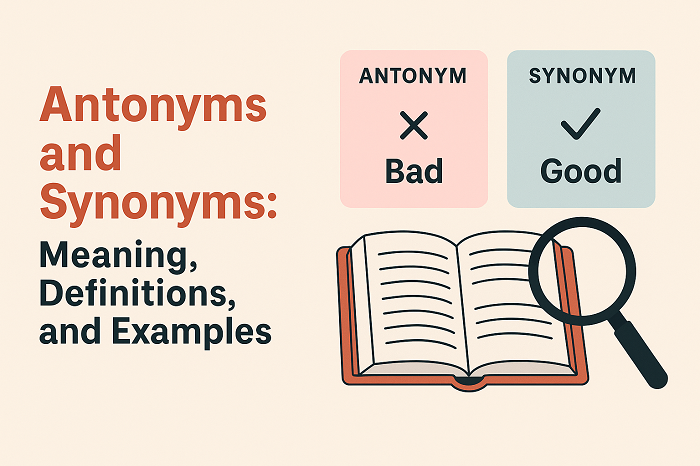
What are Synonyms?
Synonyms are words that have similar or nearly the same meanings as another word in the same language. In many situations, they are employed interchangeably to prevent redundancy and provide variation in writing and speech.
Example:
| Word | Synonym | Antonym |
|---|---|---|
| Happy | Joyful | Sad |
| Big | Large | Small |
| Fast | Quick | Slow |
| Strong | Powerful | Weak |
| Important | Crucial | Unimportant |
In simple terms: Synonyms show similarity in meaning, while antonyms show contrast or opposition.
Importance of Synonyms-
- Enrich language and expression- Synonyms help in expressing ideas more vividly and precisely by offering alternatives to commonly used words. Example: Instead of saying “very tired,” you can say “exhausted” for a more substantial impact.
- Avoid repetition- Using synonyms allows variety in language, preventing the monotonous repetition of the exact words. Example: Rather than using “said” repeatedly, use “replied,” “stated,” “mentioned,” or “announced.”
- Enhance vocabulary knowledge- Learning synonyms expands your word bank and deepens your understanding of word meanings and nuances.
- Boost academic and competitive exam scores- Many standardized tests (like IELTS, TOEFL, GRE, and SAT) include synonym-based questions. Knowing synonyms can improve comprehension and help you score higher in vocabulary sections.
- Enable precise communication: Synonyms help you select the most accurate word in context, improving the clarity of your message. Example: “House” and “home” are similar, but “home” conveys emotional attachment.
- Strengthen reading comprehension- When you encounter unfamiliar words while reading, knowing synonyms helps you infer meanings and better understand the text.
- Support creative writing and storytelling: Writers use synonyms to craft more descriptive and imaginative narratives, enhancing character development and scene-setting.
Types of synonyms and their usage-
Not all synonyms are perfectly identical. There are three main types of synonyms based on how closely their meanings align and how interchangeable they are in different contexts-
- Absolute Synonyms (Perfect Synonyms)- Words that have the same meaning in all contexts and are entirely interchangeable.
Usage- Rare in language because most words carry subtle differences in connotation or usage.
Example-
o Begin ↔ Start
o Buy ↔ Purchase
- Partial Synonyms- Words that are similar in meaning but not identical. They may differ in intensity, formality, usage, or emotional tone.
Usage: Common in language. It is essential to utilize them appropriately.
Example-
o Big ↔ Huge (Huge is more intense.)
o Speak ↔ Talk (Talk is more informal.)
- Near Synonyms (Contextual or Relative Synonyms)- Words that are related in meaning, but their usage depends heavily on the specific context, collocation, or emotional shade.
Usage: These words are not interchangeable in all situations.
Example-
o Smart ↔ Clever (Clever can sometimes imply trickiness.)
o Job ↔ Career (Career implies a long-term professional path.)
Summary Table-
Type of Synonym | Description | Interchangeability | Example |
Absolute | Same meaning in all contexts | Always | Begin – Start |
Partial | Similar meaning, slight difference in tone | Sometimes | Big – Huge |
Near (Contextual) | Related meaning, context-specific | Rarely | Smart – Clever |
List of common synonym examples
Word | Synonyms |
Fast | Quick, Rapid, Speedy |
Beautiful | Pretty, Lovely, Attractive |
Sad | Unhappy, Miserable, Downcast |
Strong | Powerful, Robust, Sturdy |
Smart | Intelligent, Bright, Brainy |
Angry | Mad, Furious, Irritated |
Happy | Joyful, Content, Cheerful |
Big | Large, Huge, Enormous |
Cold | Chilly, Freezing, Icy |
Important | Vital, Crucial, Significant |
Usage of Synonyms in Sentences-
- Happy: She was happy to receive the award.
→ She was joyful to receive the award.
- Strong: The bridge is strong enough to hold heavy traffic.
→ The bridge is sturdy enough to hold heavy traffic.
- Angry: He was angry at the unfair decision.
→ He was furious at the unfair decision.
What are Antonyms?
Antonyms are words that have opposite meanings. An antonym is a word that means the opposite of another word in meaning, emotion, or quality. They help express contrast, highlight differences, and clarify what something is by describing what it is not. They are also essential in describing and diversifying language usage.
Example:
- “Hot” is the antonym of “Cold.”
- “Love is the antonym of Hate.”
Importance of Antonyms-
Antonyms play a crucial role in mastering the English language. They help us understand concepts more deeply by providing contrast, enriching our vocabulary, and making our communication more precise and expressive. Below are the key reasons why antonyms are essential:
- Enhance vocabulary and language skills- Learning antonyms alongside new words helps expand your vocabulary by introducing both meanings and their opposites.
o Example- Learning the word “generous” becomes more meaningful when you also know its antonym “stingy.”
- Improve understanding through contrast- Antonyms help us understand the whole meaning of a word by showing what it is not. This contrast builds stronger language comprehension.
o Example- Understanding “success” becomes clearer when contrasted with “failure.”
- Enrich writing and speaking- Using antonyms in speech and writing allows you to create strong contrasts, comparisons, and more dynamic sentences, making your communication engaging and powerful.
o Example: “He wasn’t just happy; he was ecstatic after being miserable for so long.”
- Aid in expressing opposing ideas- Antonyms help clearly communicate opposite ideas or changes in condition, which is especially useful in arguments, storytelling, and explanations.
o Example: “Before the project, he was idle; now, he is productive.”
- Boost reading comprehension- When reading knowing antonyms helps decode unknown words by using context clues.
o Example: “Unlike her arrogant brother, she was quite humble.”
→ Even if you don’t know humility, the word arrogant gives a clue.
- Useful in Exams and Vocabulary Tests- Many competitive exams test antonym knowledge through vocabulary sections. A good grasp of antonyms improves performance in MCQs, cloze tests, and comprehension.
- Promote critical thinking and comparison- Antonyms encourage learners to analyze relationships between concepts and make logical comparisons, strengthening cognitive and linguistic abilities.
- Improve conversational skills- In conversations, being able to articulate opposites makes your language more interactive, natural, and clear.
o Example: Instead of repeating, “That’s bad,” you could say, “That’s the opposite of what we wanted.”
Types of Antonyms and its usage-
Antonyms are generally categorized into three types:
- Gradable Antonyms – Words that exist on a continuum or scale, representing degrees of opposition rather than absolutes.
Usage- These opposites allow for comparative or superlative forms (hotter, colder) and often include intermediary states.
Example-
o Hot ↔ Cold ("Warm" and "cool" exist between them.)
o Young ↔ Old (Middle-aged lies in the centre.)
· Complementary Antonyms – Words that are absolute opposites with no overlap or degree; the existence of one excludes the other.
Usage- These pairs are mutually exclusive—something cannot be both at the same time.
Example-
o Alive ↔ Dead (A person is either one or the other.)
o Married ↔ Single (No intermediate state is possible.)
- Relational Antonyms (Converses) – Pairs where one implies the existence of the other through a reciprocal relationship.
Usage: These opposites rely on roles or perspectives; one cannot exist without the other.
Example-
o Buy ↔ Sell (One buys what another sells.)
o Teacher ↔ Student (A teacher teaches, and a student learns.)
- Auto-antonyms (Contronyms) – Single words that can mean their opposites depending on context.
Usage- Context must clearly indicate the intended meaning to avoid ambiguity.
Example-
o Dust (To add fine particles: “She dusted the cake with sugar” vs. To remove them: “She dusted the shelf.”)
o Sanction (To permit or to penalize: “The law was sanctioned” vs. “The country faced sanctions.”)
Table of popular common antonym examples
Word | Antonym |
Big | Small |
Happy | Sad |
Fast | Slow |
Early | Late |
Love | Hate |
Clean | Dirty |
Win | Lose |
Full | Empty |
Young | Old |
Rise | Fall |
Usage of Antonyms in sentences-
- Tall: He is tall for his age.
- → He is short for his age.
- Easy: The test was easy for me.
- → The test was difficult for me.
- Love: She loves adventure.
- → She hates adventure.
What is the general difference between antonyms and synonyms?
- Definition-
o Synonyms: Words that have the same or very similar meanings.
Example: Big ↔ Large
o Antonyms: Words that have opposite meanings.
Example: Big ↔ Small
- Function in language-
o Synonyms: Enhance variety and richness in writing or speech by avoiding repetition.
o Antonyms: Emphasize contrast or opposition, helping clarify or strengthen statements.
- Relationship between words-
o Synonyms: It shows a similarity or closeness in meaning.
o Antonyms: Show a polar or contrasting relationship.
- Usage context-
o Synonyms- Often interchangeable but depend on context, tone, or connotation.
Example: Smart vs. Clever – “Clever” may imply slyness.
o Antonyms- Used to express direct contrast, often in comparisons or debates.
Example: Good vs. Bad
- Types-
o Synonyms- It includes absolute (identical meaning) and near/contextual (similar but not identical) synonyms.
o Antonyms- Include gradable, complementary, relational, and auto-antonyms.
- Impact on tone and style-
o Synonyms- It allows writers to choose words that match the desired tone (formal, casual, emotional).
o Antonyms: Help writers highlight differences, conflicts, or turning points in a narrative or argument.
- Common Usage Examples
- Synonyms-
o Happy ↔ Joyful
o Begin ↔ Start
- Antonyms-
o Happy ↔ Sad
o Begin ↔ End
- Role in communication skills-
o Synonyms- Improve vocabulary and fluency, making communication more engaging.
o Antonyms- Enhance critical thinking and clarity by establishing contrasts and opposing ideas.
Feature | Synonyms | Antonyms |
Meaning | Words with similar meanings | Words with opposite meanings |
Purpose | Add variety, avoid repetition | Show contrast or opposition |
Example | Begin – Start | Hot – Cold |
Usage in context | Enhances tone and style | Highlights contrast or polarity |
Which strategies are best for learning synonyms and antonyms?
- Make use of a dictionary and thesaurus together- Look for synonyms and antonyms for a term in a thesaurus, then use a dictionary to grasp minor variations in application and meanings.
- It avoids incorrect substitutions and builds contextual awareness.
- Create word maps or visual charts- Draw a central word and branch out its synonyms and antonyms using lines. Visual learning helps in remembering relationships and seeing patterns.
- Group words by theme or category- Learn words in sets like emotions (happy, sad, joyful, gloomy), size (big, large, tiny, small), or speed (fast, quick, slow). It is easier to recall words when grouped by context or situation.
- Use flashcards with contextual sentences- On one side, write a word, and on the other, its synonyms, antonyms, and a sentence. Reinforces meaning through real usage rather than memorization alone.
- Practice through writing and speaking- Use new synonyms and antonyms in short paragraphs, stories, or conversations. Active usage strengthens memory and improves fluency.
- Play vocabulary games- Engage with apps or games like word matching, crosswords, or “word ladders.” Gamification makes learning fun and boosts retention.
- Read actively and widely- Read books, articles, and essays while noting unfamiliar words and looking up their synonyms/antonyms. Contextual exposure helps understand tone and usage differences.
- Practice with synonym-antonym pairs- Make a list where each word has at least one synonym and one antonym next to it. Forces side-by-side comparison and deeper understanding.
- Teach or explain to others- Share what you have learned with friends or explain meanings aloud. Teaching reinforces your own understanding and highlights gaps in knowledge.
- Take daily vocabulary quizzes- Use online quizzes or apps like Quizlet or Vocabulary.com to test yourself regularly. Frequent testing boosts recall and learning confidence.
- Fun ways to learn synonyms and antonyms-
o Word Games like Scrabble and Boggle.
o Mobile Apps like Quizlet or Memrise.
o Crossword Puzzles and Word Searches.
o Story Writing Challenges where each paragraph must use synonyms of a word.
o Daily Word Lists to memorize new pairs of words.
What are the common mistakes you should avoid while learning synonyms and antonyms?
- Treating all synonyms as fully interchangeable- Not all synonyms can be swapped in every sentence. Many carries subtle differences in tone, formality, or emotional meaning, making context essential.
- Ignoring context and usage- Words can change meaning based on context. Using synonyms or antonyms without understanding the situation often leads to awkward or incorrect usage.
- Relying only on thesauruses- It gives a list of related words, but they don’t explain how to use them. Always verify meanings with a dictionary to ensure accuracy.
- Overlooking connotation and tone- Some words may have a positive or negative feel, even if they seem similar. Using the wrong one can change the tone of your message unintentionally.
- Forgetting formality and register- Some synonyms are formal, others informal. Using a formal word in casual conversation or vice versa can make your language sound unnatural.
- Misunderstanding antonym types- Antonyms aren’t always direct opposites. There are gradable, complementary, and relational antonyms. Understanding the type helps in choosing the correct opposite.
- Failing to practice with real sentences- Learning words in isolation limits retention—practice writing and speaking new words in sentences to solidify their meanings and usage.
Synonyms and antonyms in language exams-
Many competitive and language proficiency exams test knowledge of synonyms and antonyms.
Common Exam Types-
- Fill in the blanks
- Choose the closest/opposite meaning
- Match columns
- Word analogies
Example Questions-
- Choose the synonym of “Elegant”:
- a) Ugly
- b) Graceful
- c) Rude
- d) Awkward
- → Answer: b) Graceful
- Choose the antonym of “Generous”:
- a) Mean
- b) Kind
- c) Loving
- d) Honest
- → Answer: a) Mean
Exercises for practice-
Exercise 1 – Synonyms: Match the word with its synonym-
Word | Match With |
Happy | A. Furious |
Angry | B. Cheerful |
Smart | C. Intelligent |
Strong | D. Powerful |
Answers-
Happy – B, Angry – A, Smart – C, Strong – D
Exercise 2 – Antonyms: Choose the opposite-
- The antonym of “Bright” is:
a) Clever
b) Light
c) Dull
d) Sharp
→ Answer: c) Dull
- The antonym of “Victory” is:
a) Champion
b) Failure
c) Celebration
d) Game
→ Answer: b) Failure
Conclusion-
Mastering synonyms and antonyms is crucial for academic success and effective communication. Understanding the nuances between similar and opposite words enhances vocabulary and expression. Whether you're studying for exams or aiming to improve your English fluency, learning these word relationships sharpens your language skills. This knowledge not only enriches writing and speaking but also builds confidence in various contexts. Investing time in synonyms and antonyms leads to long-term linguistic growth and empowers you to communicate with clarity and precision.
FAQs on Antonyms and Synonyms
Q.1 What is a synonym?
Ans- A synonym is a word that has a similar or the same meaning as another word.
Q.2 What is an antonym?
An antonym is a word that means the opposite of another word.
Q.3 Are synonyms always interchangeable?
Ans-No, context matters. Not all synonyms can replace each other in every sentence.
Q.4 Why should you learn antonyms and synonyms?
Ans-To enhance your vocabulary, improve writing and speaking, and perform better in exams.
Q.5 What are gradable antonyms?
Ans-Antonyms that exist on a scale, like "hot" and "cold."
Q.6 What is an example of a relational antonym?
Ans-Buy ↔ Sell or Parent ↔ Child.
Q.7 How can you learn synonyms quickly?
Use word maps, read regularly, and practice with quizzes.
Q.8 What is a thesaurus?
Ans- A reference book that lists synonyms and antonyms of words.
Q.9 Can a word have more than one antonym?
Yes, depending on the context. For example, "fast" can have "slow" or "delayed" as antonyms.
Q.10 What is the best way to practice antonyms and synonyms daily?
Ans- Read newspapers, maintain a vocabulary journal, and use learning apps.
Author
Sakshi Taneja
Content Writer & International Education Specialist
Sakshi Taneja is a content writer specializing in international education, study abroad opportunities, university admissions, student visas, scholarships, and career guidance. She creates accurate, research-driven, and student-focused content to help aspiring international students make informed decisions about their global education journey.
Comments (0)
No comments yet
Be the first to share your thoughts!
Contact Details
Please provide your contact information
Free Counselling
Similar Blogs

Top 10 Universities in Germany
9/21/2026

How to become a great Communicator?
2/26/2026
Preparing for TOEFL Speaking Scoring section: Key Skills and Practice Techniques
11/3/2025

Educational loan for study abroad: Everyone Should Know in 2026
11/3/2025
Form I-20 Explained: Start Your U.S. Study Journey with Confidence
10/27/2025
Have a question about GMAT?
Want some help figuring out what kind of prep service is right for you?
Help and Support
Leave a Comment
Your email address will not be published.