
Formal Letter Writing: Type, Example, format, how to write and tips
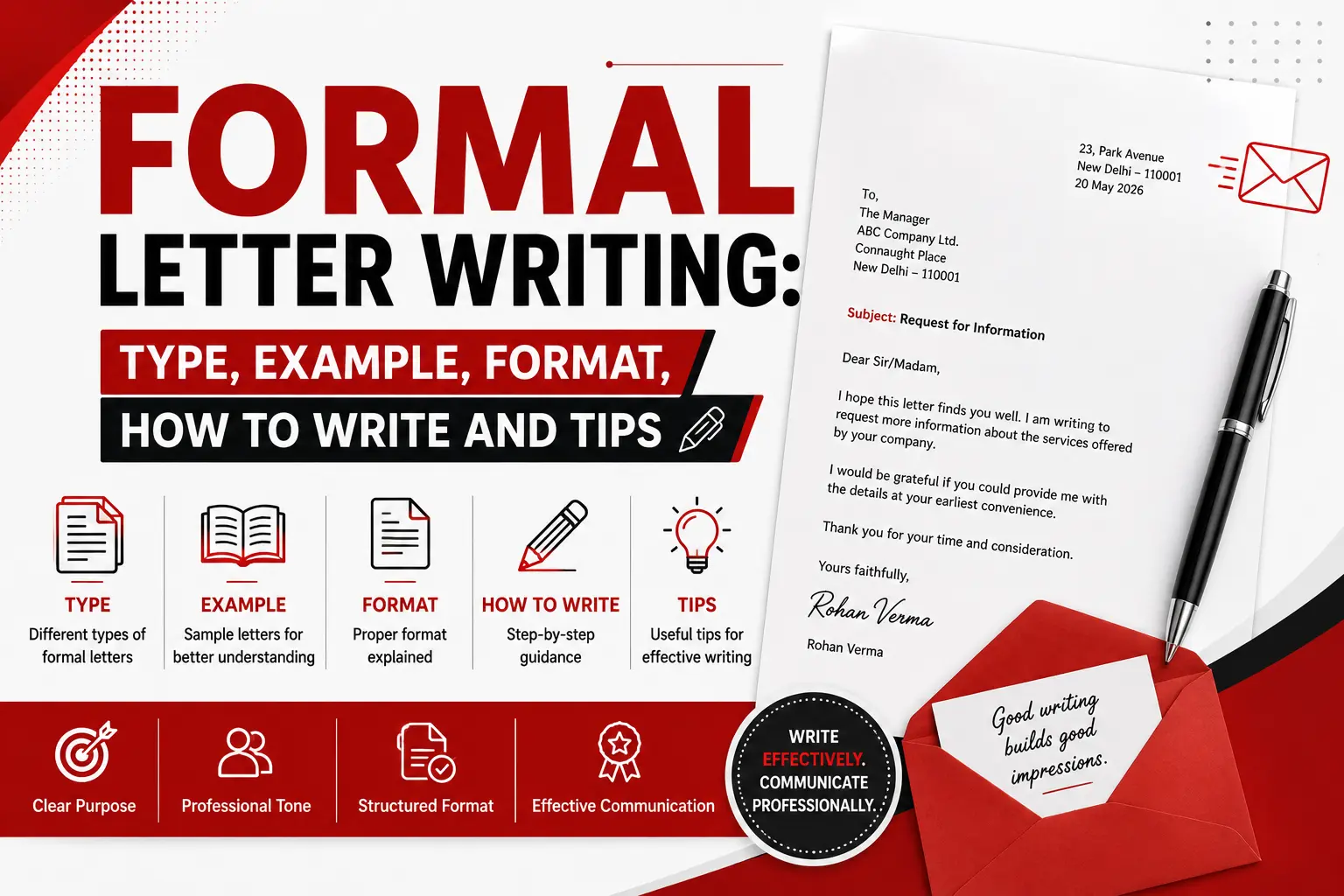
In today’s digital-first world, the art of formal letter writing remains a crucial skill across professional, academic, and official communication. Whether applying for a job, submitting a complaint, or requesting information, a well-written formal letter reflects clarity, respect, and professionalism.
This comprehensive guide explores the essentials of formal letter writing, including its format, tone, types, and expert tips to craft impactful communication.
What is a Formal Letter?
A formal letter is a written communication that adheres to a structured and professional tone, typically used for official or business-related correspondence. Unlike informal letters, which are personal and casual, formal letters follow a specific format and are used in:
- Business transactions
- Job applications
- Academic communication
- Legal correspondence
- Governmental or institutional letters
What is the importance of Formal Letters?
Formal letters serve as official documentation, providing a tangible record of communication. Their significance includes:
- Establishing professionalism
- Ensuring clarity of communication
- Demonstrating etiquette and courtesy
- Building trust with organizations
- Supporting requests, applications, or complaints with a formal record
In professional environments, a poorly structured or casually written letter can damage your credibility. Mastering formal letter writing enhances your communication and career prospects.
What are the types of Formal Letters?
a. Job Application Letters-
Used to apply for employment opportunities, often accompanied by a resume.
b. Cover Letters-
Highlights key skills and motivations behind applying for a specific job.
c. Business Letters-
Written for business proposals, inquiries, or correspondence with clients.
d. Complaint Letters-
Address service or product-related issues to companies or institutions.
e. Recommendation Letters-
Used to endorse someone's skills, character, or achievements.
f. Invitation Letters-
For inviting guests or delegates to events or functions formally.
g. Resignation Letters-
Used by employees to formally resign from a position.
h. Request Letters-
For formally requesting information, documents, or services.
i. Leave Letters-
To request leave of absence in an academic or corporate setting.
What about the standard format of a Formal Letter?
A formal letter follows a universally accepted structure. Here's a breakdown of its format:
1. Sender’s Address
- Top-right or top-left corner
- Includes the full address of the sender
- No abbreviations
2. Date
- Placed below the sender’s address
- Format: [Day] [Month] [Year] (e.g., 29 May 2026)
3. Recipient’s Address
- Below the date, aligned to the left
- Include name, designation, organization, and full address
4. Subject Line
- Summarizes the purpose of the letter
- Use bold or underline for emphasis
5. Salutation
- Use “Dear Sir/Madam” if the recipient’s name is unknown
- Use “Dear Mr. Smith” or “Dear Dr. Sharma” if known
6. Body of the Letter
- Paragraph 1: Introduction and purpose
- Paragraph 2: Main content/details
- Paragraph 3: Conclusion or call to action
7. Complimentary Close
- Use phrases like “Yours sincerely” (if the name is known)
- Use “Yours faithfully” (if name is unknown)
8. Signature
- Leave space for a handwritten signature (in print)
- Below the signature, write the sender's full name
- Include job title (if applicable) and contact info
What is the standard process for writing a formal letter?
- Step 1: Identify the Purpose- Start by understanding the reason behind the letter—are you requesting, informing, applying, or complaining?
- Step 2: Gather Details- Collect all relevant facts, documents, and addresses before you begin writing.
- Step 3: Use the Correct Format- Follow the standard structure as detailed above to ensure a professional appearance.
- Step 4: Write with Clarity and Precision- Use clear, direct language. Avoid slang, contractions (e.g., don’t), and emotional language.
- Step 5: Revise and Proofread- Always review for grammar, punctuation, and tone. Typos can ruin credibility.
Tips for Writing an Effective Formal Letter
- Maintain a polite and professional tone- Avoid being overly casual or aggressive. Even in complaint letters, remain courteous.
- Keep it concise- Be to the point. Most formal letters are one page long—three paragraphs are ideal.
- Avoid jargon and complex vocabulary- Unless writing to a specialized audience, keep the language simple and accessible.
- Personalize where appropriate- If you know the recipient's name or title, use it. Avoid generic salutations when possible.
- Proof of purpose- State the reason for the letter in the first paragraph and reaffirm it at the end.
- Use formal language- Examples include-
- “I am writing to inform you…”
- “I would like to request…”
- “Kindly find enclosed…”
- Use professional fonts and layouts-Use a clean, legible font like Times New Roman or Arial in size 12. Align text to the left.
- Include contact information- Especially for follow-up or reply purposes.
What are the common mistakes to avoid when writing a formal letter?
|
Mistake |
Why It’s a Problem |
|
Using informal tone |
Reduces professionalism |
|
Over-explaining |
Makes the letter wordy and confusing |
|
Grammatical errors |
Reduces credibility |
|
Wrong format |
Looks unprofessional |
|
Not proofreading |
Leads to avoidable mistakes |
|
Using abbreviations or emojis |
Unacceptable in formal communication |
Format for Formal Letter Writing
Sample 1: Job Application Letter
John Carter
45 Maple Street
Boston, MA 02114
USA
29 May 2026
Hiring Manager
Gateway Abroad Education
123 Innovation Drive
Jaipur, 30206
Subject: Application for the Role of Data Analyst
Dear Hiring Manager,
I am writing to express my interest in the Data Analyst position at Gateway Abroad Education as advertised on your careers page. With a strong background in data science and over three years of professional experience, I am confident in my ability to contribute significantly to your data team.
In my previous role at DataCore Inc., I implemented predictive models that improved client reporting accuracy by 30%. I hold a Master’s degree in Statistics and have hands-on experience with Python, SQL, and Tableau.
I have enclosed my resume for your review. Thank you for considering my application. I look forward to the opportunity to discuss my suitability for this position further.
Yours sincerely,
John Carter
john.carter@email.com
The formal letter needs a lot of structuring; hence, the importance of understanding the application letter format cannot be overstated. It will help you to distinguish your personal information from the subject line and paragraphs of your letter.
Sample 2: Complaint Letter
Aditi Mehra
Flat 12-B, DLF Phase II
Gurgaon – 122002
India
29 May 2026
Customer Service Department
ZoomTelecom Pvt. Ltd.
Sector 18, Cyber City
Gurgaon – 122015
Subject: Complaint Regarding Internet Service Disruption
Dear Sir/Madam,
I am writing to bring to your attention the frequent internet disruptions I have been facing at my residence since 15 May 2026. Despite repeated calls to your customer care helpline, the issue remains unresolved.
As a remote worker, this has severely impacted my productivity. I kindly request that a technician be assigned to investigate and resolve this matter at the earliest.
I hope to receive prompt assistance regarding this issue. Kindly contact me on +91 98101 12345.
Yours faithfully,
Aditi Mehra
aditimehra@email.com
Differences between Formal and Informal Letters Writing
Purpose and Audience
- Formal Letters: Professional, official and business purpose. The target audience may comprise employers, governmental authorities, schools, or any other business organization.
- Informal Letters: Informal letter writing is a personal letter that is supposed to be written to friends, families, relatives, and other people well-known to the sender.
Tone and Style
- Formal Letters: Objectively-oriented, polite and formally professional tone. Does not include emotionally colored phrases and completely focuses on the topic.
- Informal Letters: Emotional and personally-oriented tone.
Language and Vocabulary
- Formal Letters: Formal language, accurate words, formal vocabulary and passive voice usage. No colloquial words, abbreviations and contractions ("can't", "won't" etc.) are allowed.
- Informal Letters: Casual language, slang words and active voice usage. Contractions and colloquial words are allowed.
Structure and format
- Formal Letters: Rigorous structure that includes such obligatory components as address of the writer, date, address of the recipient, subject line, formal salutation (Dear Sir/Madam) and official sign-off (Yours sincerely).
- Informal Letters: Flexible structure that includes only the following elements: address of the writer, date, casual greeting (Hi John) and sign-off (Love, Best wishes).
Conclusion
Mastering formal letter writing is essential in both personal and professional realms. It reflects not just what you communicate but how effectively you convey your message. A structured, polite, and concise letter can open doors, resolve issues, and build lasting professional relationships.
Whether you're applying for a job, writing to your university, or addressing a service complaint, the ability to write a formal letter gives you an edge. With the tips, format, and examples provided in this guide, you're now equipped to communicate with clarity, confidence, and professionalism.
FAQs Formal letter writing: tips, format-
Q.1 What’s the difference between a formal and an informal letter?
Ans- Formal letters are professional and follow a set structure; informal letters are personal and conversational.
Q.2 Can you email a formal letter?
Ans- Yes, but use a formal email format—start with “Dear…” and include a formal closing.
Q.3 What font is best for a formal letter?
Ans- Times New Roman or Arial, 12-point size, with single or 1.15 spacing.
Q.5 Can a formal letter be handwritten?
Ans- Preferably type it. Handwritten letters are acceptable only in rare personal formal situations.
Q.6 How long should a formal letter be?
Ans- A formal letter should ideally be one page long, with three concise paragraphs. Keep it brief, clear, and to the point.
Q.7 What font and size should I use for a formal letter?
Ans- Use a professional font, such as Times New Roman or Arial, in 12-point size. The layout should be clean and easy to read.
Q.8 What tone should I use in a formal letter?
Ans- Use a polite, respectful, and professional tone. Avoid slang, contractions (e.g., “I’m,” “don’t”), and overly casual phrases.
Q.9 What are common types of formal letters?
Ans- Common types include:
- Job application letters
- Complaint letters
- Business correspondence
- Request letters
- Resignation letters
- Academic letters
Q.10 Can you send a formal letter by email?
Ans- Yes. When sending by email:
- Use a clear subject line
- Begin with a formal salutation
- Follow the same structure and tone as a printed letter
- Attach documents if required
Q.11 What are the most common mistakes in formal letter writing?
Ans-
- Using informal or emotional language
- Misspellings and grammatical errors
- Incorrect or missing addresses
- Unclear purpose or rambling content
- Ignoring standard format
Q.12 Do you need to include my contact information in the letter?
Ans- Yes. Always include your full name, address, phone number, and email at the beginning (in the sender’s address) and/or at the end, especially if a reply is expected.
Author
Sakshi Taneja
Content Writer & International Education Specialist
Sakshi Taneja is a content writer specializing in international education, study abroad opportunities, university admissions, student visas, scholarships, and career guidance. She creates accurate, research-driven, and student-focused content to help aspiring international students make informed decisions about their global education journey.
Comments (0)
No comments yet
Be the first to share your thoughts!
Contact Details
Please provide your contact information
Free Counselling
Similar Blogs

Top 10 Universities in Germany
9/21/2026

How to become a great Communicator?
2/26/2026

Preparing for TOEFL Speaking Scoring section: Key Skills and Practice Techniques
11/3/2025

Educational loan for study abroad: Everyone Should Know in 2026
11/3/2025
Form I-20 Explained: Start Your U.S. Study Journey with Confidence
10/27/2025
Have a question about GMAT?
Want some help figuring out what kind of prep service is right for you?
Help and Support
Leave a Comment
Your email address will not be published.