
Informal letter writing: format, example and how to write in 2026
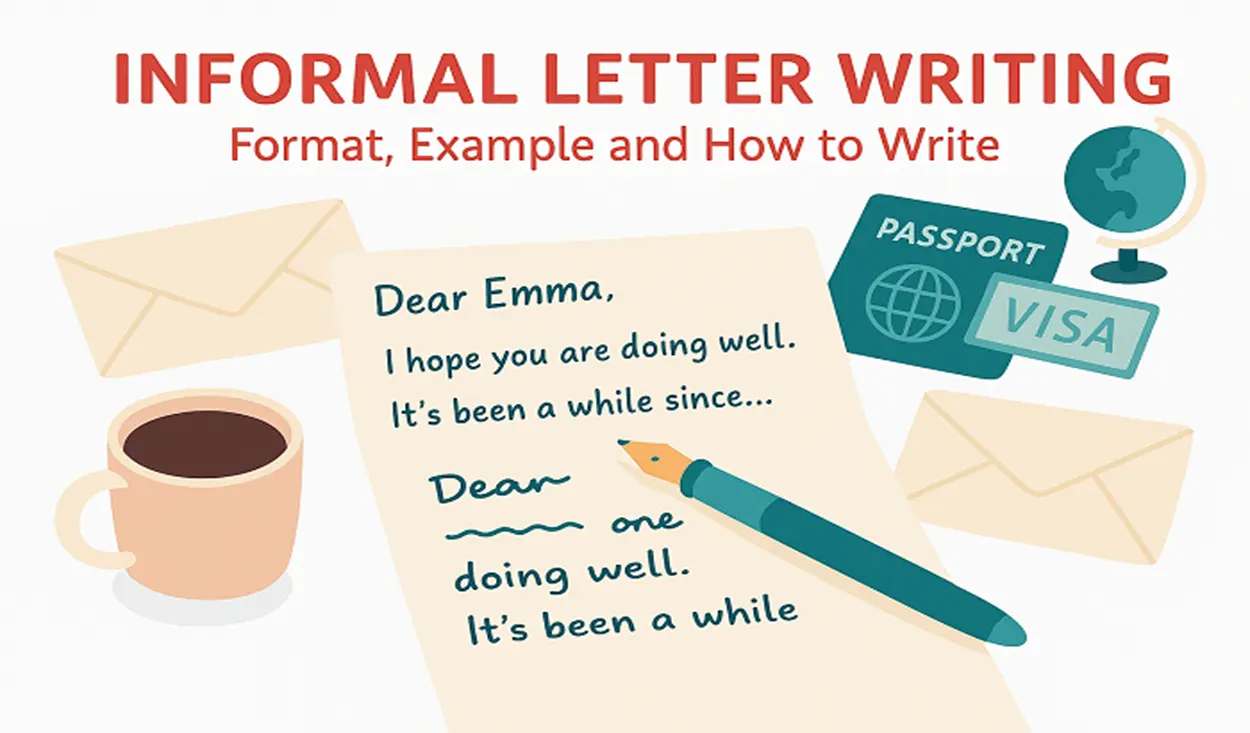
Letter writing, though somewhat eclipsed by modern technology, remains an essential life skill. Whether you are penning a heartfelt note to a friend or a casual message to a family member, informal letters carry personal warmth, emotions, and authenticity that digital messages often lack. Unlike formal letters, informal letters are relaxed in tone and flexible in structure. This blog will explore the essentials of informal letter writing, including format, key elements, style, tone, examples, and tips for writing impressive personal letters.
What is an Informal Letter?
An informal letter is a written communication exchange between people who share a personal relationship, such as friends, family members, or close acquaintances. Unlike formal letters, which follow a strict format and professional tone, unofficial letter are casual, expressive, and often written in a conversational style.
They are typically used for:
- Sharing personal news or experiences
- Expressing emotions and feelings
- Congratulating or inviting someone
- Thanking or apologizing informally
- Offering advice or suggestions
- Checking in on someone
What is the importance of Informal Letters?
Informal letters hold significant value in both personal and educational contexts. Despite the rise of instant messaging and social media, the role of informal letter writing remains meaningful and impactful. Here's its importance-
- Strengthens personal relationships- Informal letters are a heartfelt way to stay in touch with loved ones. Writing to family or friends deepens bonds, especially when separated by distance or time.
- Expresses emotions freely- Unlike formal writing, informal letters allow full expression of emotions such as joy, sadness, excitement, or concern—making communication more genuine and meaningful.
- Preserves memories- Letters often capture memories, experiences, and thoughts in a timeless format. They serve as keepsakes that people can revisit for years.
- Enhances writing skills- Writing informal letters helps improve narrative ability, sentence structuring, grammar, vocabulary, and overall communication skills in a relaxed format.
- Encourages thoughtfulness- Letter writing requires reflection and thought, unlike quick texts. It encourages writers to pause, think, and convey their feelings more intentionally.
- Useful in education- Students are taught informal letter writing in school to enhance creative writing, language use, and personal expression. It also appears in many exam syllabi.
- Improves mental well-being- Writing a letter can be therapeutic. It helps people process emotions and feel connected to others, reducing loneliness and stress.
- Builds cultural and family traditions- In many cultures, letter writing is a traditional way to share news, invite others, or mark special occasions, keeping family values alive.
- Provides a personal touch- Unlike digital communication, a handwritten or carefully composed letter feels more sincere and personal, making the reader feel valued.
- Encourages better communication habits- It teaches people to communicate thoughtfully, clearly, and respectfully, which are skills that benefit both personal and professional life.
Format of an Informal Letter
While the format for informal letters offers more freedom of expression, they still follow a basic structure that helps maintain clarity and coherence. Here’s a standard format:
1. Sender’s Address
This appears at the top right corner of the letter. It includes the writer’s full address and sometimes the date.
Example:
Hiranandani Estate
Mumbai– 501502
India
31st May, 2026
2. Salutation/Greeting
The greeting is friendly and informal, based on the relationship.
Examples:
- Dear Mom,
- Hi Rahul,
- My dearest Riya,
Avoid overly formal greetings like “Respected Sir/Madam” in an informal letter.
3. Introduction
Begin with a warm opening. Ask about the recipient’s health or life, and state the reason for writing.
Example:
"I hope this letter finds you in great health and good spirits. It’s been a while since we last caught up, and I wanted to share some exciting news with you."
4. Body of the Letter
This is the main part, where you express your thoughts in detail. It can be one or multiple paragraphs.
Structure your thoughts clearly:
- First paragraph: Explain the reason for writing.
- Middle paragraphs: Share details, anecdotes, or emotions.
- Final paragraph: Conclude with hopes, well wishes, or an invitation to reply.
Learn more: how to write a perfect paragraph in English
5. Closing
Sign off warmly. Choose closings that match your tone and relationship.
Examples:
- Lots of love,
- Yours affectionately,
- Take care,
- Warm regards,
Then, sign your name beneath the closing.
Key features of Informal Letter Writing-
To write an effective informal letter, consider the following characteristics:
- Conversational tone- Use simple, friendly, and engaging language. You can use contractions, idioms, and even interjections (e.g., “Wow!” or “Oh no!”).
- Personal touch- Express emotions, share personal stories, and include specific details that make your letter feel genuine.
- Informal language- Avoid jargon, clichés, or overly formal expressions. It's okay to write as you speak within reason.
- Varied sentence structures- Use a mix of short and long sentences to keep the letter engaging and natural.
- Proper paragraphing- Even if informal, structure your letter into paragraphs for readability.
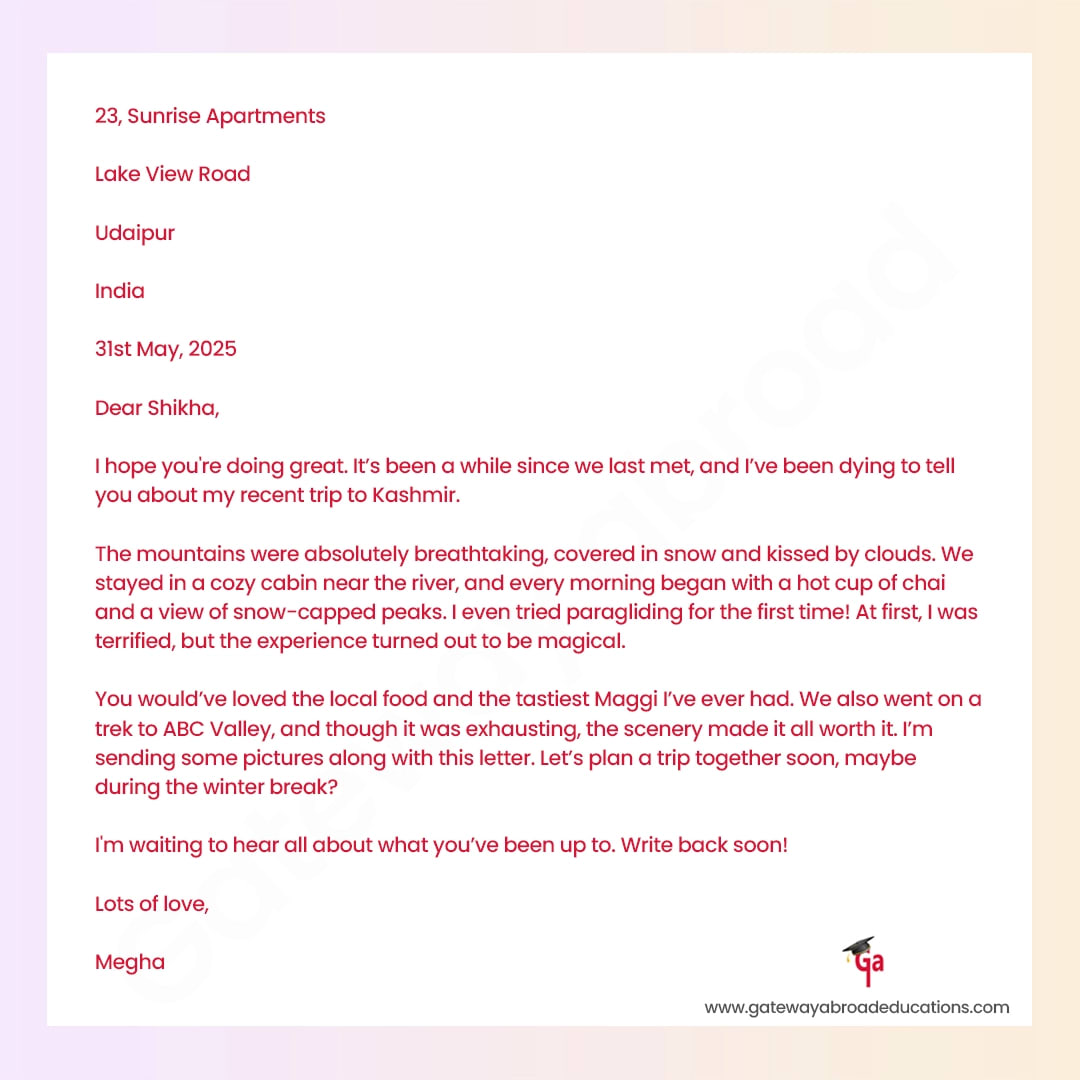
Sample Informal Letter-
Scenario: Write to a friend about your recent trip.
23, Sunrise Apartments
Lake View Road
Udaipur
India
31st May, 2026
Dear Shikha,
I hope you're doing great. It’s been a while since we last met, and I’ve been dying to tell you about my recent trip to Kashmir.
The mountains were absolutely breathtaking, covered in snow and kissed by clouds. We stayed in a cozy cabin near the river, and every morning began with a hot cup of chai and a view of snow-capped peaks. I even tried paragliding for the first time! At first, I was terrified, but the experience turned out to be magical.
You would’ve loved the local food and the tastiest Maggi I’ve ever had. We also went on a trek to ABC Valley, and though it was exhausting, the scenery made it all worth it. I’m sending some pictures along with this letter. Let’s plan a trip together soon, maybe during the winter break?
I'm waiting to hear all about what you’ve been up to. Write back soon!
Lots of love,
Megha
Other Some More Informal Letter Sample
What are some simple informal letter samples for students?
1. Letter to a Friend About Holidays
Dear Rahul,
I hope you are doing well. I want to tell you about my summer holidays. I visited my grandparents in the village. The weather was pleasant, and I enjoyed fresh food every day. I also played cricket with my cousins.
Moreover, we went to a nearby river for a picnic. It was a wonderful experience. I felt relaxed and happy after a long time.
I am excited to meet you soon and share more stories.
Yours lovingly,
Amit
2. Letter to a Cousin Inviting to a Function
Dear Neha,
How are you? I hope everything is fine at your end. I am writing to invite you to my birthday party next week.
The party will be held at my home on Sunday evening. Many of my friends will come, and we will have games and music. I really want you to join us and make the day special.
Please come with your parents. I am waiting for your reply.
Yours affectionately,
Riya
3. Letter to a Friend About Exam Preparation
Dear Suman,
I hope you are studying well. Exams are coming soon, so I want to share my preparation plan with you.
I study for three hours daily and revise my notes regularly. I also solve previous year question papers. This helps me understand the pattern better.
You should also make a timetable and follow it strictly. I am sure you will do great.
Best wishes,
Anjali
4. Letter to Parents About Hostel Life
Dear Mom and Dad,
I hope you both are healthy and happy. I am doing well in my hostel. The environment is good, and my roommates are friendly.
I follow a daily routine and attend all my classes on time. The food is okay, but I miss your cooking a lot. Still, I am learning to adjust.
Do not worry about me. I am taking good care of myself.
Yours lovingly,
Karan
5. Letter to a Friend Thanking for a Gift
Dear Priya,
Thank you so much for the lovely gift you sent me on my birthday. I really liked it. The watch looks beautiful, and I wear it every day.
Your gift made my day more special. I feel lucky to have such a caring friend like you.
Once again, thank you for your kindness. I hope to see you soon.
With love,
Sneha
What are the common topics for Informal Letters?
Here are some popular themes and topics for informal letter writing:
- Sharing holiday experiences
- Thanking someone for a gift or favor
- Congratulating a friend on their success
- Inviting someone to a party or event
- Giving or seeking advice (on studies, relationships, health)
- Apologizing for a mistake
- Describing a new home, school, or city
- Expressing emotions like missing someone, excitement, or gratitude
Informal Letter Writing Tips
Here are practical tips to elevate your informal writing skills:
- Know your audience- Write in a tone and style that suits the recipient. A letter to a childhood friend will differ from one to an elderly relative.
- Be honest and natural- Authenticity makes a letter memorable. Share how you feel instead of using pre-written phrases or artificial expressions.
- Avoid slang overload- Some informal words are fine, but excessive slang may confuse the reader or appear disrespectful.
- Check grammar and spelling- Even informal writing should be grammatically correct and easy to read.
- Add personal touches- Mention shared memories, jokes, or names to make the letter feel more intimate.
Difference between Formal and Informal Letters
Aspect | Formal Letter | Informal Letter |
Purpose | Professional or official | Personal |
Tone | Polite, respectful | Friendly, emotional |
Language | Formal, structured | Casual, conversational |
Greeting | Dear Sir/Madam | Dear [Name]/Hi [Name] |
Closing | Yours sincerely/faithfully | Yours lovingly/Take care |
Usage | Job applications, complaints, official communication | Personal notes, friendly chats, invitations |
Informal Letter for Exams (CBSE/ICSE)
In many school exams, students are asked to write unofficial letter. Here are some points to remember:
- Stick to the prescribed format.
- Address the question directly (don’t go off-topic).
- Use paragraphs to separate ideas.
- Avoid overly casual expressions like “BTW” or emojis.
- Keep the tone friendly but respectful.
Sample Exam Prompt:
Write a letter to your cousin describing how you celebrated your birthday.
Begin like this:
16, Park Lane
Jaipur – 302001
India
31st May, 2026
Dear Rohan,
Then describe your celebration, gifts received, people who attended, food served, and how you felt.
Conclusion
Informal letter writing is more than just a writing exercise. It's a beautiful way to maintain relationships, express emotions, and reflect on personal experiences. While the digital world offers speed, a well-written informal letter offers depth, warmth, and authenticity.
Whether you're preparing for an exam or planning to surprise a loved one with a letter, remember that the best informal letters come from the heart. Use your voice, be sincere, and write as if you’re speaking directly to the person. With a little thought and care, you can turn a simple piece of paper into a lasting memory.
Explore More: Format of the formal letter
FAQs on Informal Letter Writing:
Q.1 What is an informal letter?
Ans- An informal letter is a personal letter written to friends, family, or close acquaintances in a casual tone.
Q.2 To whom do we write informal letters?
Ans- We usually write them to people we have personal relationships with, such as parents, siblings, cousins, or friends.
Q.3 What is the tone of an informal letter?
Ans- The tone is friendly, relaxed, and conversational.
Q.4 What are the key parts of an informal letter?
Ans- The main parts are the sender’s address, date, greeting, body, closing, and signature.
Q.5 Can you use contractions like "I’m" or "don’t" in an informal letter?
Ans- Yes, contractions are commonly used in informal letters to reflect natural speech.
Q.6 Is correct grammar important in informal letters?
Ans- Yes, grammar and spelling should still be accurate, even if the tone is casual.
Q.7 How should you start an informal letter?
Ans- Start by asking about the recipient’s well-being or sharing a warm greeting.
Q.8 Do informal letters need a subject line?
Ans- No, subject lines are used in formal letters or emails, not in informal letters.
Q.9 How should you end an informal letter?
Ans- Use closings like “Yours lovingly,” “Take care,” or “Lots of love” before signing your name.
Q.10 Can informal letters be written by hand or typed?
Ans- Both are acceptable, but handwritten letters often feel more personal and heartfelt.
Author
Sakshi Taneja
Content Writer & International Education Specialist
Sakshi Taneja is a content writer specializing in international education, study abroad opportunities, university admissions, student visas, scholarships, and career guidance. She creates accurate, research-driven, and student-focused content to help aspiring international students make informed decisions about their global education journey.
Comments (0)
No comments yet
Be the first to share your thoughts!
Contact Details
Please provide your contact information
Free Counselling
Similar Blogs

Top 10 Universities in Germany
9/21/2026

How to become a great Communicator?
2/26/2026
Preparing for TOEFL Speaking Scoring section: Key Skills and Practice Techniques
11/3/2025

Educational loan for study abroad: Everyone Should Know in 2026
11/3/2025
Form I-20 Explained: Start Your U.S. Study Journey with Confidence
10/27/2025
Have a question about GMAT?
Want some help figuring out what kind of prep service is right for you?
Help and Support
Leave a Comment
Your email address will not be published.