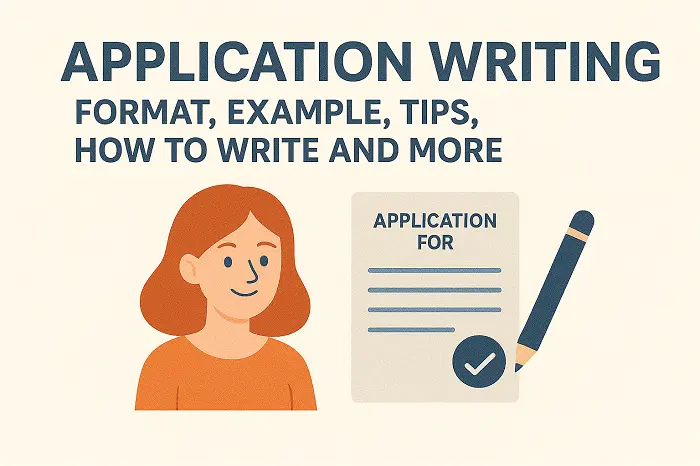
Application writing is a formal means of communication used in educational institutions, businesses, government offices, and professional environments. Whether you are applying for leave, a job, admission, or requesting services, understanding the correct application writing format is crucial for ensuring clarity, professionalism, and effectiveness.
This guide provides a detailed breakdown of the standard format, types of applications, writing tips, and practical examples to help you master application writing for various purposes.
An application is a formal written request addressed to an authority, organization, or individual seeking permission, information, or a specific service. It follows a structured format and is written in polite, concise, and respectful language.
Applications are typically written for:
Application writing holds significant importance in academic, professional, and official settings. It is much more than just drafting a request. It is a formal communication tool that can influence decisions and outcomes. Here are the key reasons why application writing is essential-
The most widely accepted format for formal applications includes the following parts:
Include your:
Full name
Address
Contact information
Date of Writing
· Example-
Ravi Sharma
123, Green Park, Delhi – 110016
Phone: ******
Date: 24 June 2026
Include the name, designation, and address of the recipient.
· Example-
The Principal
ABC Public School
New Delhi – 110019
Write a short, direct summary of the purpose of your application.
· Example-
Subject: Application for Sick Leave for Two Days
Use a respectful greeting.
· Examples:
§ Dear Sir/Madam,
§ Respected Principal,
§ To the Branch Manager,
The body is typically divided into three key paragraphs:
· Clearly state the purpose of your application.
· Explain your request in detail. Include relevant dates, reasons, and any supporting information.
· Politely request action and express gratitude.
Use formal closing phrases.
· Examples:
Yours sincerely,
Yours faithfully,
Yours truly,
Include your full name and sometimes your designation or roll number if applicable.
Here’s how the full format would look-
[Sender’s Address]
[City, Postal Code]
[Contact Number]
[Date]
[Receiver’s Designation]
[Organization Name]
[Address]
Subject: [Write the Subject Clearly]
Respected Sir/Madam,
[Paragraph 1: Introduction]
[Paragraph 2: Detailed Explanation]
[Paragraph 3: Conclusion]
Thank you.
Yours sincerely,
[Full Name]
[Roll No./Employee ID if applicable]
Example: Sick Leave
Subject: Application for Sick Leave for Three Days
Respected Sir,
I am writing to ask for three days of sick leave from June 25 to June 27, 2026, as I have a bad case of the flu, and my doctor has told me to take it easy. For your information, I've included the medical certificate.
I promise that when I return, I will finish any unfinished business.
Thank you.
Yours sincerely,
Ravi Sharma
Class 10, Roll No. 45
Example: Application for the Post of Accountant
Subject: Application for the Post of Accountant
Dear Sir/Madam,
As stated on your website, I am writing to express my interest in the accountant position at your prestigious company. I have three years of experience in the accounting industry and a Bachelor of Commerce degree.
I've included my certifications and résumé for your review. I would value the chance to discuss how my abilities can benefit your business.
Thank you for your time.
Yours sincerely,
Ravi Sharma
Example: Admission to a Degree Program
Subject: Application for Admission to B. Com Program
Respected Sir,
I am writing to express my interest in enrolling in your college's Bachelor of Commerce program for the 2026–2026 academic year. With an 85% grade in my 12th grade, I would like to continue my education at your esteemed university.
All necessary paperwork, including my grade report and identification evidence, is enclosed.
Kindly consider my application favorably.
Thank you.
Yours faithfully,
Ravi Sharma
Example: Application for the Issue of a Bank Passbook
Subject: Application for Issuance of New Passbook
To
The Branch Manager
XYZ Bank, Delhi
Respected Sir,
I am writing to request a new passbook for my savings account (Account No: XXXXXXXX), as my current passbook has been misplaced. Kindly issue me a duplicate passbook at the earliest.
I have attached a copy of my ID and bank details.
Thank you.
Yours truly,
Ravi Sharma
Example: Application for Visa Extension
Subject: Application for Visa Extension Due to Medical Emergency
Dear Sir/Madam,
I am writing to request an extension of my current tourist visa, which expires on June 30th, 2026. Due to a medical emergency, I require additional time in the country for treatment and recovery.
I have attached supporting medical documents. Kindly grant me an extension of 30 days to complete the necessary medical care.
I appreciate your consideration.
Yours sincerely,
Ravi Sharma
1. Be Clear and Concise
2. Use Formal Language
3. Stick to the Format
4. Be Polite and Respectful
5. Proofread Your Application
6. Attach Necessary Documents
7. State Exact Dates and Duration
8. Follow Instructions
|
Feature |
Formal Application |
Informal Application |
|
Tone |
Respectful, professional |
Friendly, casual |
|
Language |
No slang, no contractions |
Can include casual phrases |
|
Structure |
Strict, follows a standard format |
Flexible, less structured |
|
Purpose |
Official requests (leave, job, service) |
Personal requests (to friends, relatives) |
|
Salutation & Closing |
Formal greetings and closings |
Informal greetings like "Hi" or "Bye" |
| Also Know About: Formal Letter Writing Format | Informal Letter Writing Format | Application Writing Format |
In the modern world, many applications are submitted via email or online forms. While the basic structure remains the same, some key adjustments are:
Application writing is essential for students, employees, professionals, and travelers. Whether you are requesting leave, applying for a job, or requesting a service, writing a well-structured, polite, and professional application ensures your request is taken seriously. A correctly written application can influence decisions and showcase your sense of responsibility and respect for formal procedures.
To write a practical application, it is essential to use the correct format, be clear and to the point, maintain a formal tone, and attach all necessary supporting documents. These elements make your application more convincing, help the reader process your request efficiently, and reduce the chances of delay or rejection.
Mastering application writing helps you in school or work settings and significantly improves your overall communication abilities, allowing you to handle formal correspondence confidently in various life situations.
Ans- The application writing format refers to the structured layout of formal applications. It includes essential parts such as the sender’s details, recipient’s details, subject, salutation, body, closing, and signature.
Ans- Using the correct format ensures clarity, professionalism, and ease of reading. It helps the recipient quickly understand your request and shows that you respect formal communication protocols.
Ans-
The main parts include:
Ans- An application should always use formal, respectful, and polite language. Informal words, slang, and abbreviations should be avoided.
Ans- Application writing is commonly used for leave requests, job applications, admissions, service requests, visa processes, and official permissions in schools, offices, and government organizations.
Ans- Failure to follow the correct format can make your application appear unprofessional, confusing, or incomplete, which may lead to rejection or delayed processing.
Ans- The basic structure remains the same, but email applications may skip the sender’s address and use an email signature, while printed applications require the complete address at the top.
Ans- You can improve by practicing different types of applications, studying sample formats, proofreading carefully, and seeking feedback from teachers or mentors to correct mistakes.
Author
Content Writer & International Education Specialist
Sakshi Taneja is a content writer specializing in international education, study abroad opportunities, university admissions, student visas, scholarships, and career guidance. She creates accurate, research-driven, and student-focused content to help aspiring international students make informed decisions about their global education journey.
No comments yet
Be the first to share your thoughts!
Please provide your contact information
Free Counselling

9/21/2026

2/26/2026

11/3/2025

11/3/2025
10/27/2025
Want some help figuring out what kind of prep service is right for you?
Help and Support

Leave a Comment
Your email address will not be published.