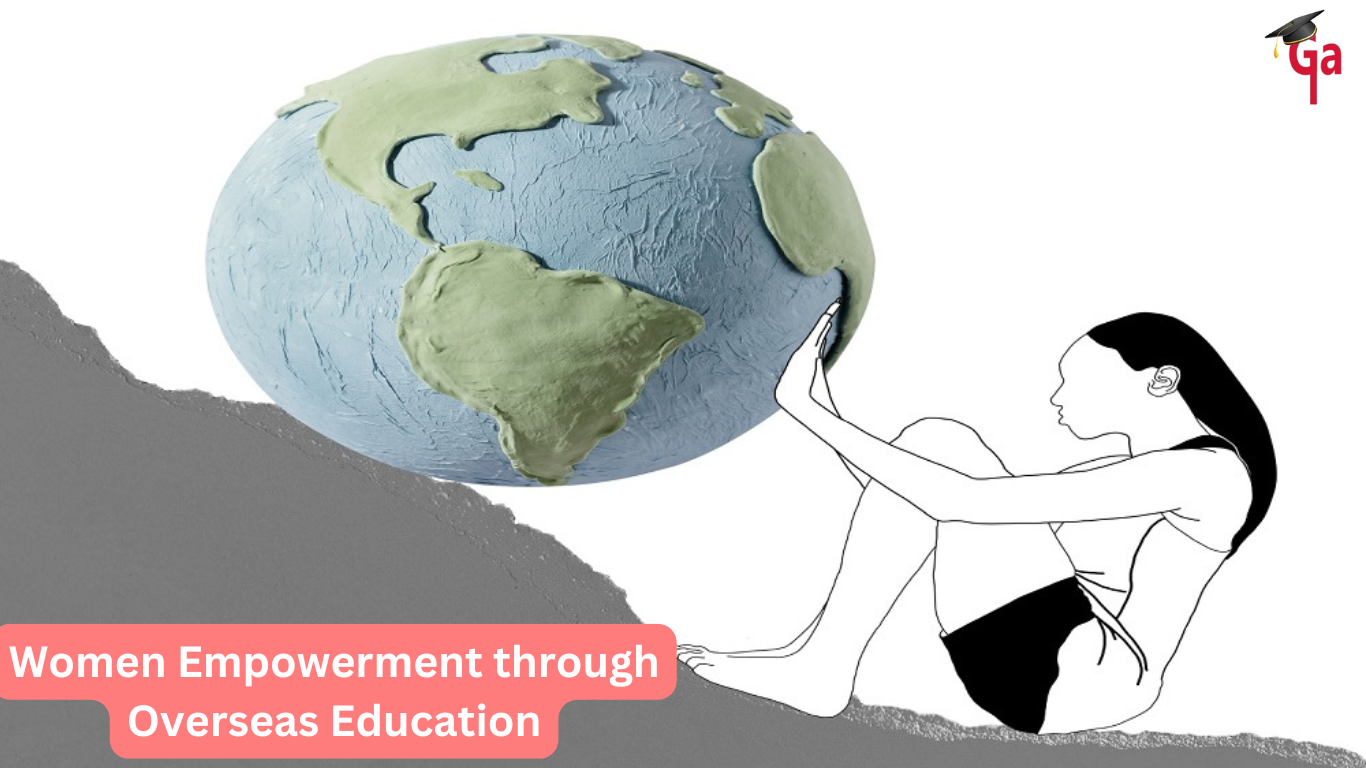
A key component of social and economic advancement is the empowerment of women. When women are educated and given the opportunity to continue their education abroad, their personal and professional lives can change significantly. Women who study abroad gain exposure to the world, specialized skills, and the self-assurance to question social norms and barriers. This blog examines the ways in which studying abroad empowers women and dives into the institutions, procedures, and resources that are available to help them on their global academic adventures.
Overseas Education Significance for Women's Empowerment-
Study abroad education gives them access to high-quality education, a variety of cultural experiences, and more employment opportunities; international education is essential to women's empowerment. Here's how:
- Worldwide exposure: Women who study abroad are exposed to a variety of viewpoints, which promotes tolerance and cultural flexibility.
- Professional development: Women's employability and leadership potential are increased by international education, which gives them access to cutting-edge skills and global competencies.
- Social independence: Women who live and study overseas get the ability to make decisions, solve problems, and handle their finances, which enables them to live independent lives.
- Challenging prejudices: Studying overseas frequently dispels gender prejudices, allowing women to pursue unusual professions and career trajectories.
Government programs to help Women Study Abroad-
Numerous governments and organizations around the world have launched programs to encourage women to pursue higher education overseas. By lowering cultural and financial barriers, these programs hope to empower women to enter international academic settings.
Government Schemes in India-
National Overseas Scholarship (NOS): This program offers financial aid for postgraduate and doctorate study overseas to women from Scheduled Castes (SC), Scheduled Tribes (ST), and Other Backward Classes (OBC). It pays for living expenses, travel expenses, and tuition.
- Eligibility: Women from Scheduled Castes, Scheduled Tribes, and other backward classes (OBCs).
- Benefits: Covers tuition fees, airfare, living expenses, and medical insurance.
- Focus Areas: Science, engineering, management, and social sciences.
Padho Pardesh Scheme: This program, which was created especially for minority communities, provides interest subsidies on student loans to women who are studying for master's or doctoral degrees overseas.
- Eligibility: Women from minority communities.
- Objective: Provide interest subsidies on education loans for postgraduate studies abroad.
Dr. Ambedkar Scheme for Overseas Studies: The Dr. Ambedkar Central Sector Scheme of Interest Subsidy on Educational Loans for Overseas Studies is a scheme to provide interest subsidies to students from Other Backward Classes (OBCs) and Economically Backward Classes (EBCs). The scheme is administered by the Department of Social Justice and Empowerment, Ministry of Social Justice and Empowerment. This program encourages students from underprivileged backgrounds, with a focus on women, to enroll at international universities in order to further their education.
· Advantages: Financial aid for study abroad in disciplines like engineering, law, and medicine.
· The economically disadvantaged classes (EBCs) are the target group.
Women in Science Education (WISE) Program:
- Focus: Encourages women to pursue STEM (Science, Technology, Engineering, and Mathematics) education abroad.
Women's International Scholarships-
- Fulbright Scholarships (USA): This program, which aims to encourage academic brilliance, frequently gives preference to women from developing nations.
- Chevening Scholarship (UK): Fully funded master's degree scholarships that support women's professional growth and leadership.
- Erasmus Mundus Joint Master Degrees (EU): This initiative promotes women's enrolment in joint master's programs at European academic institutions.
- The Schlumberger Foundation Faculty for the Future supports postdoctoral or doctoral study for women in STEM from developing countries.
Private and Nonprofit Initiatives:
- For women who want to study overseas, groups like the Aga Khan Foundation, Inlaks Foundation, and Tata Trusts offer mentorship programs and scholarships.
Popular Overseas Educational Programs for Women-
The choice of academic programs often depends on career aspirations, societal needs, and global trends. Here are some fields that attract women students:
STEM (Science, Technology, Engineering, and Mathematics):
- AI, data science, renewable energy, and engineering courses are highly sought after in the STEM (science, technology, engineering, and mathematics) fields.
- More and more women are pursuing careers in historically male-dominated industries like aeronautical engineering and robotics.
Healthcare and medicine:
- Women who are enthusiastic about enhancing healthcare systems are drawn to programs in public health, nursing, and medical sciences.
Business and management:
- Women looking for leadership positions frequently enroll in MBA programs and specialized courses in marketing, finance, and entrepreneurship.
Social Sciences and Arts:
- Courses in media, gender studies, and international relations appeal to women because they empower them to promote equality and social justice.
Sustainability and environmental studies:
- Women who want to support international ecological initiatives are increasingly enrolling in courses that address climate change, environmental policy, and sustainability.
Creative arts & design:
- In order to exhibit their inventiveness and originality, women are increasingly pursuing careers in fashion, graphic design, and cinematography.
Which examinations are required for women to study abroad?
Women frequently have to pass particular tests to prove their academic and linguistic skills in order to be admitted to overseas universities.
Tests of language proficiency-
IELTS (International English Language Testing System)
- The International English Language Testing System, or IELTS, is accepted in nations like Australia, Canada, and the United Kingdom.
- This test assesses speaking, writing, listening, and reading abilities.
TOEFL (Test of English as a Foreign Language)
- American universities promote the TOEFL (Test of English as a Foreign Language).
- Emphasizes the use of academic English.
PTE (Pearson Test of English)
- The Pearson Test of English, or PTE, is accepted for use in evaluating English ability in a number of nations.
Standardized Academic Assessments-
- GRE- The Graduate Record Examination (GRE) is a prerequisite for postgraduate courses in the humanities, sciences, and engineering.
- GMAT- The Graduate Management Admission Test, or GMAT, is required for management degrees such as the Master of Business Administration.
- SAT- The Scholastic Assessment Test, or SAT, is taken by applicants for undergraduate degrees.
- MCAT- Medical College Admission Test (MCAT) o For US and Canadian medical programs.
- LSAT- The Law School entrance Test, or LSAT, is a prerequisite for entrance to law schools in several nations.
Which certificates and documents are required for women to study abroad?
When applying to study abroad, women need to prepare a comprehensive set of documents. These typically include:
- Academic Documents: Transcripts and mark sheets from previous institutions and degree certificates.
- Statement of Purpose (SOP): An essay outlining career goals, reasons for choosing a specific program, and aspirations post-graduation.
- Letters of Recommendation (LORs): Endorsements from professors or employers highlighting academic and professional capabilities.
- Proof of Financial Support: Bank statements, scholarship confirmation letters, or education loan sanction letters.
- Passport and Visa Documents: Valid passports and supporting documents for visa applications.
Women's Education Loans and Financial Aid-
Women who want to study abroad often face financial obstacles, but there are a number of programs and loans available to help close the gap.
Loans for Education-
- Nationalized Banks: Special education loans with reduced interest rates are available from banks such as SBI, PNB, and Bank of Baroda.
- Private Financial Institutions: Businesses that offer loans specifically designed for international schooling include Avanse, Credila, and Prodigy Finance.
- Government Subsidies: Minority women might receive interest subsidies on loans through initiatives like Padho Pardesh.
Grants and Scholarships-
- Scholarships given based on merit are provided to students who have excelled academically.
- The goal of scholarships based on needs is to support low-income women.
- Country-specific scholarships are provided by governments or academic institutions that focus on particular areas.
Crowdfunding-
- Many women have been able to raise money for their overseas education thanks to websites like Milaap and GoFundMe.
What are the visa requirements for women studying abroad?
One of the most important steps in the process of studying abroad is getting a visa. The country and the nature of the program determine the type of visa.
USA:
- F-1 Visa: For academic study conducted full-time.
- For exchange programs, a J-1 visa is required.
UK:
- Tier 4 Student Visa: For extended study.
- Short-Term Study Visa: For up to six-month courses.
Canada:
- Study Permit: Needed for all professional, vocational, and academic programs.
Australia:
- Subclass 500 student visa: Permits students to remain for the length of their studies.
Europe:
- Schengen Visa: for temporary study in Schengen nations.
What are the challenges faced by women in overseas education?
For women, studying abroad might change their lives, but it also presents a special set of difficulties. These difficulties can include anything from social and financial obstacles to safety issues and cultural adaptations. The most frequent issues that women have when studying abroad are thoroughly examined below, along with possible remedies.
- Financial issues- The high cost of tuition, housing, and living expenses is one of the biggest obstacles for women who want to study abroad. Many women may find it difficult to pay for these costs, particularly those from disadvantaged families.
- Cultural and social barriers, norms, and societal expectations often discourage women from studying overseas. Concerns about safety, independence, or social rejection may make families reluctant to send their girls abroad.
- Safety issues- For women who live and travel overseas, safety is a major worry. It might be intimidating to deal with problems like harassment, discrimination, or a lack of assistance in strange settings.
- Adjustment to a new culture and homesickness-For women, adjusting to a new culture, language, and way of life can be extremely difficult. Unfamiliarity with local customs and traditions sometimes causes feelings of homesickness and loneliness.
- Barriers to language- Language barriers can be a major problem for non-native English speakers or students studying in non-English-speaking nations.
- Racism against women- Women may still experience prejudice in some areas or institutions, notwithstanding progress made in gender equality. This could manifest as unfair treatment, a lack of opportunities, or underrepresentation in particular professions, such as STEM.
- Well-being and health- Adjusting to a new environment, food, or academic stress can have a detrimental effect on women's physical and mental health. It can also be difficult to get healthcare that is attentive to cultural differences.
- Poor participation in STEM domains- Women are still under-represented in STEM programs overseas despite increased awareness. Social conventions and gender biases frequently deter women from choosing these careers.
- Immigration and visa difficulties- For women, navigating complicated immigration laws and visa requirements can be intimidating, particularly if they are not familiar with the procedure.
Conclusion
Empowering women via international education is a life-changing experience with significant advantages for individuals, businesses, and society as a whole. Governments, organizations, and communities can unleash women's potential and create a more inclusive and equitable world by assisting them in their pursuit of global education. Putting money into women's education overseas is an investment in the future of economies and societies around the world, not just in people.
Women's Empowerment Through Overseas Education FAQs-
Q.1 Why is schooling abroad so important for women?
Ans- It gives women independence, exposure to the world, and advanced skills, enabling them to succeed both personally and professionally.
Q.2 Which government programs encourage women to pursue higher education overseas?
Ans- Women can receive financial assistance for their studies abroad through programs like Padho Pardesh and the National Overseas Scholarship.
Q.3 Which courses are most popular with female international students?
Ans- Programs in STEM, healthcare, business, social sciences, and sustainability are popular.
Q.4 Which tests are necessary for studying overseas?
Ans- Academic exams like the GRE, GMAT, and SAT, as well as language assessments like the IELTS and TOEFL, are frequently necessary.
Q.5 How can women afford to study abroad?
Ans- Women can afford through part-time employment, college loans, and scholarships.
Q.6 Which kinds of visas are necessary for studying overseas?
Ans- F-1 (USA), Tier 4 (UK), Study Permit (Canada), and Subclass 500 (Australia) are examples of student visas.
Q.7 What obstacles do female students encounter when studying overseas?
Ans- Language hurdles, cultural adaptations, safety worries, and financial limitations.
Q.8 Are there any scholarships designed especially for female STEM students?
Ans- Yes, programs such as the Schlumberger Foundation encourage women to pursue careers in STEM.
Q.9 How can women make sure they are safe when studying overseas?
Ans- Women can feel safe by using emergency contacts, participating in safety orientations, and maintaining ties with neighborhood networks.
Q.10 In what ways does education abroad empower women?
Ans- It breaks down social and professional boundaries by enhancing confidence, employability, and leadership abilities.


Leave a Comment
Your email address will not be published.