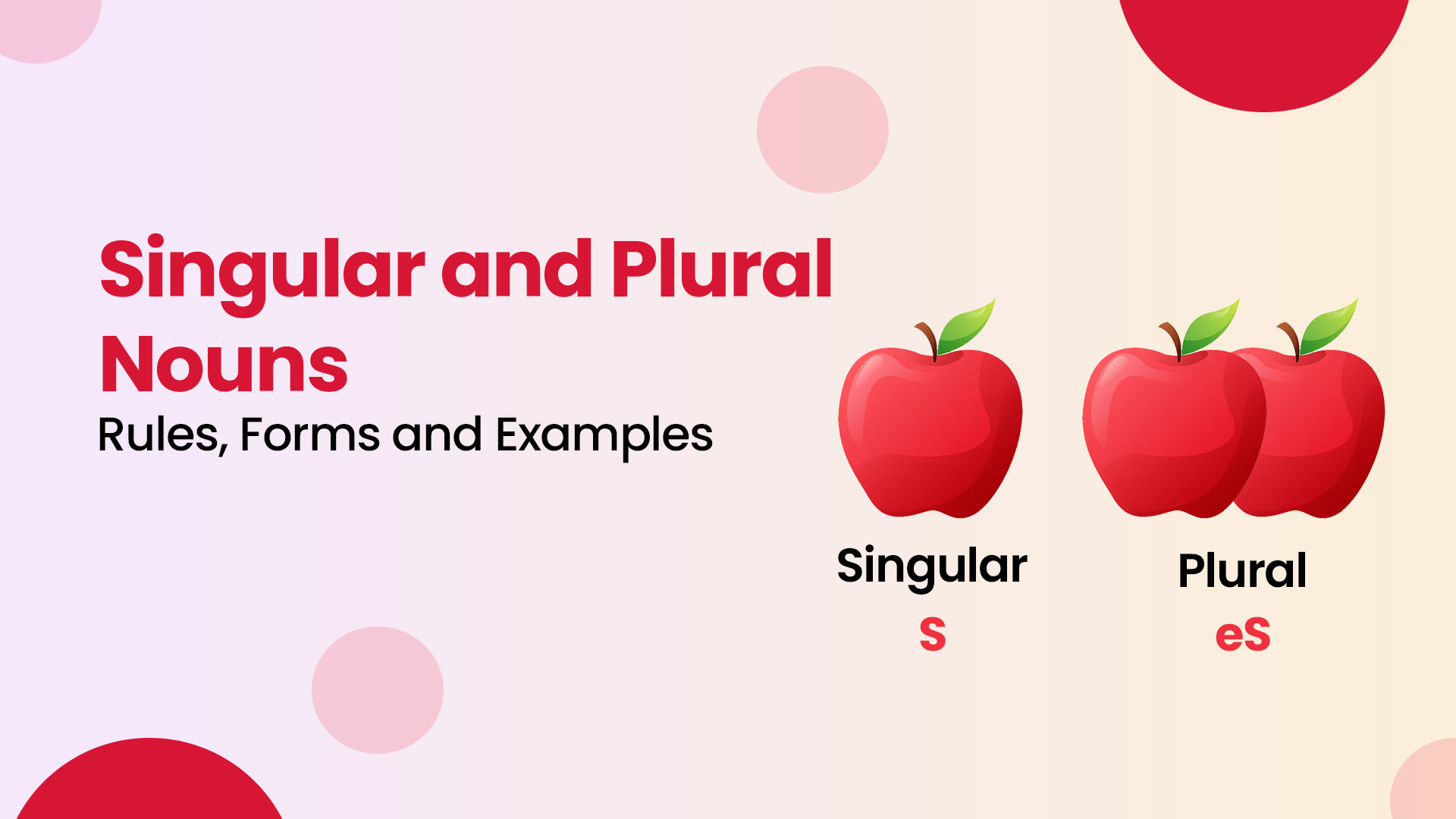
Understanding the difference between singular and plural nouns is one of the most fundamental aspects of mastering English grammar. Whether you are writing essays, speaking fluently, or preparing for competitive exams, a firm grasp of this concept will improve your overall communication skills.
What are Singular and Plural Nouns?
Singular nouns-
A singular noun refers to one person, place, thing, or idea. It represents a single unit or item. Understanding singular and plural nouns is essential in mastering English grammar. These terms relate to the number a noun refers to, whether it's one item or more than one.
- Examples:
§ A boy is playing.
§ She has a book.
§ That is a table.
§ He found an apple.
§ The sun is bright.
Plural nouns-
A plural noun refers to more than one person, place, thing, animal, or idea. Most plural nouns in English are formed by adding -s or -es to the singular form.
- Examples-
§ The boys are playing.
§ She has many books.
§ These are tables.
§ He found two apples.
§ The stars are shining.
What are the key differences between singular and plural nouns?
Understanding the difference between singular and plural nouns is crucial for correct grammar, especially in subject-verb agreement and sentence structure. Below is a clear breakdown of the main differences-
Definition-
- Singular Nouns- Refer to one person, place, animal, thing, or idea.
- Plural Nouns- Refer to more than one person, place, animal, thing, or idea.
Quantity-
- Singular: Indicates a single unit.
- Plural: Indicates two or more units.
Word Formation-
- Singular: Basic or root form of the word (e.g., book, apple, car).
- Plural: Usually formed by:
- Adding -s (e.g., books)
- Adding -es (e.g., boxes)
- Changing spelling in irregular forms (e.g., man → men, child → children)
Article Usage-
- Singular Nouns:
- Often used with “a” or “an” (e.g., a dog, an egg).
- Plural Nouns:
- Do not use “a” or “an” (e.g., dogs, eggs).
- You can use words like some, many, few, and several.
Verb Agreement-
- Singular Nouns:
- Take a singular verb form (e.g., The cat is sleeping.)
- Plural Nouns:
- Take a plural verb form (e.g., The cats are sleeping.)
Example Words-
- Singular Examples:
- pen, tree, girl, foot, mouse
- Plural Examples:
- pens, trees, girls, feet, mice
Use in Sentences-
- Singular Sentence: A boy is running in the park.
- Plural Sentence: Boys are running in the park.
Pronoun Compatibility-
- Singular Nouns:
- Match with he, she, it, this, that
- Plural Nouns:
- Match with they, these, those
Context and Usage-
- Singular- Used when focusing on individuality or a single entity.
- Plural- Used to indicate groups, collections, or multiple entities.
Compare with singular and plural nouns examples-
|
Aspect |
Singular Nouns |
Plural Nouns |
|
Definition |
Refers to one person, place, thing, or idea |
Refers to more than one person, place, thing, or idea |
|
Quantity |
One (1) |
More than one (2 or more) |
|
Form |
Basic/root form (often unchanged) |
Usually formed by adding -s, -es, or using irregular forms |
|
Examples |
Dog, car, house, child |
Dogs, cars, houses, children |
|
Article Usage |
Can use “a” or “an” |
Do not use “a” or “an” |
|
Verb Agreement |
Takes a singular verb |
Takes a plural verb |
|
Sentence Example |
The boy runs fast. |
The boys run fast. |
|
Usage Context |
When talking about a single unit |
When referring to multiple items |
|
Singular Sentence |
Plural Sentence |
|
A cat is on the sofa. |
Three cats are on the sofa. |
|
She bought an apple. |
She bought some apples. |
|
The child is playing. |
The children are playing. |
|
There is a book on the table. |
There are books on the table. |
Why is it important to know the differences between singular and plural nouns?
Understanding singular and plural forms is essential for
- Maintains grammatical accuracy- It helps form grammatically correct sentences. It even ensures the proper usage of noun-verb combinations.
- Supports subject-verb agreement- Aids in choosing the correct verb form based on the noun. Moreover, it prevents mismatched sentence structures.
- Enhances communication clarity- Clearly conveys whether one or multiple items are being discussed. Reduces ambiguity in both writing and speech.
- Improves exam and academic performance- Essential for scoring well in grammar-related questions. Demonstrates language proficiency in assessments.
- Expands vocabulary knowledge- Encourages learning of word patterns and variations. Develops understanding of regular and irregular noun forms.
- Guides proper use of articles and quantifiers- Assists in selecting the right articles and quantity words. Promotes accurate expression of numbers and amounts.
- Strengthens sentence structure- Helps maintain consistency across sentence elements. Supports logical sentence construction.
- Minimizes common errors- Reduces frequent mistakes made by English learners. Builds confidence in speaking and writing.
- Enhances professional communication- Ensures precision in emails, reports, and formal documents. Reflects a strong command of English grammar.
- Aids reading and listening comprehension- Facilitates better understanding of the number being referred to. It also helps to interpret texts and conversations more accurately.
What are the general rules for forming plural nouns?
Rule 1: Add –s to Most Nouns
This is the simplest and most common way to form the plural.
Examples:
- Book → Books
- Chair → Chairs
- Pen → Pens
Rule 2: Nouns Ending in –s, –ss, –sh, –ch, –x, or –z – Add –es
To make these nouns plural, add –es.
Examples:
- Bus → Buses
- Glass → Glasses
- Dish → Dishes
- Church → Churches
- Box → Boxes
- Quiz → Quizzes (double the z)
Rule 3: Nouns Ending in a Consonant + y – Change y to I and add –es
When a noun ends in a consonant followed by y, change y to i and add –es.
Examples:
- Baby → Babies
- City → Cities
- Lady → Ladies
Note: If there is a vowel before the y, simply add –s:
- Boy → Boys
- Key → Keys
Rule 4: Nouns Ending in –f or –fe – Change to –ves
Many nouns ending in –f or –fe change the f to v and add –es.
Examples:
- Knife → Knives
- Leaf → Leaves
- Life → Lives
- Wolf → Wolves
Exceptions: Some nouns just add –s.
- Roof → Roofs
- Chief → Chiefs
- Belief → Beliefs
Rule 5: Nouns Ending in –o – Add –es or –s
Some nouns ending in –o add –es, others just add –s.
Add –es:
- Potato → Potatoes
- Tomato → Tomatoes
- Hero → Heroes
Add –s (usually for foreign words or musical terms):
- Piano → Pianos
- Photo → Photos
- Zero → Zeros (sometimes Zeros/Zeroes both accepted)
Summary table of plural rules-
|
Rule Type |
Examples |
|
Add –s |
Book → Books, Pen → Pens |
|
Add –es |
Bus → Buses, Box → Boxes |
|
–y to –ies |
Baby → Babies |
|
–f/–fe to –ves |
Life → Lives, Knife → Knives |
What are the types of singular and plural nouns?
Here is a clear explanation of the types of singular and plural nouns, organized respectively to help you understand each category in detail-
Types of Singular Nouns
Singular nouns refer to one person, place, thing, animal, or idea. They can be classified into several types-
1. Common Nouns-
- Refer to general names of people, places, or things.
- It is not capitalized unless it is at the beginning of a sentence.
Examples- girl, city, table
2. Proper Nouns-
- Refer to specific names of people, places, or organizations.
- Always capitalized.
Examples- India, John, Amazon
3. Concrete Nouns-
- Refer to things that can be seen, touched, heard, smelled, or tasted.
Examples- flowers, music, apple
4. Abstract Nouns-
- Refer to ideas, qualities, or feelings that cannot be touched or seen.
Examples- honesty, love, freedom
5. Collective Nouns-
- Refer to a group of people or things but are treated as singular in form.
Examples- team, family, committee
6. Countable Nouns (Singular Form)-
- Refer to things that can be counted.
- Have both singular and plural forms.
Examples- chair, book, egg
7. Uncountable Nouns (Singular Form Only)-
- Refer to things that cannot be counted.
- They do not have a plural form and are used only in the singular.
Examples- information, furniture, water
Types of Plural Nouns-
Plural nouns refer to more than one person, place, thing, or idea. Like singular nouns, they can also be grouped into various types-
1. Regular Plural Nouns
- Formed by adding –s or –es to the singular noun.
Examples- pens, buses
2. Irregular Plural Nouns-
- Do not follow standard pluralization rules.
- It often involves changes in spelling or completely different words.
Examples- children, mice, feet
3. Foreign-Origin Plural Nouns-
- Words borrowed from other languages (like Latin or Greek) that retain original plural forms.
Examples- criteria (plural of criterion), bacteria (plural of bacterium)
4. Compound Plural Nouns-
- Made of two or more words, the most meaningful word takes the plural form.
Examples- mothers-in-law, commanders-in-chief
5. Collective Nouns (Plural Use)-
- It can be treated as plural when referring to the group members as individuals.
Examples- the team are wearing their uniforms (British English)
6. Unchanging Plural Nouns-
- The plural and singular forms are identical.
Examples- sheep, deer, aircraft
7. Plurals of Letters, Numbers, and Symbols-
- Often made by adding –'s to avoid confusion.
Examples: mind your p's and q's, find all the 7's
Summary table-
|
Singular Nouns |
Plural Nouns |
|
Refer to one item |
Refer to more than one item |
|
Include common, proper, abstract, etc. |
Include regular, irregular, foreign-origin, etc. |
|
Used with "a" or "an" |
Often used with numbers or quantifiers |
|
Verb: singular form |
Verb: plural form |
Plural-Only Nouns
Some nouns exist only in plural form and are treated as plural.
Examples:
- Scissors
- Pants
- Trousers
- Glasses
- Binoculars
- Clothes
- Earnings
- Annals
- Cattle
- Police
Usage:
- My pants are torn.
- The scissors are on the table.
Singular-Only Nouns
These nouns have no plural form and are always singular.
Examples:
- Information
- Advice
- Luggage
- Furniture
- Bread
- Knowledge
- Progress
- News
Spelling rules and exceptions in singular and plural nouns-
1. Add –s to Most Nouns-
For most nouns, simply add –s to the singular form.
- Book → Books
- Girl → Girls
- Computer → Computers
2. Nouns Ending in –s, –ss, –sh, –ch, –x, or –z: Add –es-
If a noun ends in a sibilant sound, add –es to make it plural.
- Bus → Buses
- Brush → Brushes
- Box → Boxes
- Buzz → Buzzes
3. Nouns Ending in a Consonant + y: Change “y” to “i” and add –es-
If a noun ends in a consonant + y, change the “y” to “i” and add –es.
- Baby → Babies
- City → Cities
- Puppy → Puppies
4. Nouns Ending in a Vowel + y: Add –s-
If a noun ends in a vowel + y, simply add –s.
- Key → Keys
- Toy → Toys
- Boy → Boys
5. Nouns Ending in –f or –fe: Change to –ves-
Many nouns ending in –f or –fe form the plural by changing –f/–fe to –ves.
- Knife → Knives
- Leaf → Leaves
- Life → Lives
6. Some –f or –fe Nouns Just Add –s (Exception)-
Not all nouns ending in –f/–fe follow the “–ves” rule. Some just add –s.
- Roof → Roofs
- Chief → Chiefs
- Belief → Beliefs
7. Nouns Ending in –o: Add –es or –s-
Some nouns ending in –o take –es, others take –s.
Add –es:
- Tomato → Tomatoes
- Potato → Potatoes
- Hero → Heroes
Add –s:
- Photo → Photos
- Piano → Pianos
- Memo → Memos
8. Change Vowels in Irregular Nouns-
Some irregular nouns change the vowel in the word to form the plural.
- Man → Men
- Woman → Women
- Foot → Feet
- Tooth → Teeth
9. Change Entire Words in Irregular Nouns-
Some nouns change entirely from the plural.
- Child → Children
- Person → People
- Mouse → Mice
- Goose → Geese
10. Nouns with No Change in Spelling
Some singular and plural nouns stay the same.
- Sheep → Sheep
- Deer → Deer
- Series → Series
- Species → Species
What are the common mistakes in avoiding using these nouns?
Using Plural Verbs with Singular Nouns (Subject-Verb Disagreement)
- Error: Using a plural verb with a singular noun.
- Avoid it by ensuring that singular nouns take singular verbs.
Using Singular Verbs with Plural Nouns
- Mistake: Matching a plural noun with a singular verb.
- Solve it by remembering that plural nouns require plural verbs.
Adding “s” to Uncountable Nouns
- Mistake: Trying to make uncountable nouns plural by adding “s” (e.g., informations, advices).
- Avoid it by using quantifiers like some, a piece of, or a bit of with uncountable nouns.
Incorrect Use of Irregular Plurals
- Error: Using incorrect plural forms for irregular nouns (e.g., childs, mouses).
- Solve it by memorizing and practicing irregular plural forms.
Using Plural-Only Nouns as Singular
- Mistake: Treating nouns like scissors, trousers, and binoculars as singular.
- Avoid it by always using them with plural verbs and treating them as plural nouns.
Forgetting to Change “y” to “i” in Some Plurals
- Error: Writing babies instead of babies.
- Solve it by applying the correct spelling rule: change y to i and add –es when preceded by a consonant.
Misapplying “–ves” Rule
- Mistake: Using rooves or chives instead of roofs or chiefs.
- Avoid it by knowing which –f/–fe nouns take –ves and which take –s.
Treating Collective Nouns Incorrectly
- Mistake: Using plural verbs with singular collective nouns (e.g., The team is playing in American English).
- Avoid it by checking whether the context or regional style (British/American) affects verb agreement.
Not Pluralizing Compound Nouns Correctly
- Error: Writing mothers-in-law instead of mothers-in-law.
- Solve it by pluralizing the main noun in the compound structure.
Confusing Words with Similar Singular and Plural Forms
- Mistake: Misinterpreting words like deer, sheep, and species, which remain the same in the plural.
- Avoid it by checking the context to determine whether they are singular or plural.
Using “a” or “an” with Plural Nouns
- Error: Writing a dogs or an apples.
- Solve it by remembering that “a” or “an” is only used with singular, countable nouns.
Using Plural Nouns Without Appropriate Determiners
- Mistake: Saying I have books without context.
- Avoid it by adding quantifiers or numbers when needed for clarity (e.g., some books, many books).
Overgeneralizing Rules
- Mistake: Applying the same rule to all nouns (e.g., assuming all nouns ending in –o take –es).
- Avoid it by learning exceptions and irregularities through practice and examples.
Practice Examples-
Change the following from singular to plural:
- Tomato → Tomatoes
- Woman → Women
- Hero → Heroes
- Leaf → Leaves
- Baby → Babies
- Ox → Oxen
- Tooth → Teeth
- Photo → Photos
- Thesis → Theses
- Sheep → Sheep
Learning strategy for getting mastery in nouns-
- Practice with real sentences- Use nouns in complete sentences to understand context and subject-verb agreement.
- Acquire irregular forms- Make a chart or flashcards including irregular plural forms, then go over them frequently.
- Read widely- As you read more, you'll notice more instances of proper usage of single and plural nouns.
- Focus on exceptions- Make a special list of exception words and review them separately.
Conclusion-
Understanding singular and plural nouns is essential for building correct English grammar. Knowing the rules and forms helps ensure proper subject-verb agreement, enhances clarity in writing, and improves communication skills. From regular and irregular plurals to exceptions and spelling rules, mastering these concepts strengthens both written and spoken English. With consistent practice and attention to common mistakes, learners can confidently use singular and plural nouns in everyday language, academic writing, and professional communication.
FAQs on Singular and Plural nouns-
Q.1 Can all nouns be pluralized?
Ans- No. Traditional pluralization is impossible for words that are uncountable or plural-only.
Q.2 How are the majority of English nouns formed in the plural?
Ans- Most nouns become plural by simply adding -s (e.g., book → books).
Q.3 When do we add –es instead of –s to form plurals?
Ans- Add -es when the noun ends in -s, -sh, -ch, -x, or -z (e.g., box → boxes).
Q.4 What are irregular plural nouns?
Ans- The conventional norms of pluralization (e.g., man → men, kid → children) are not followed by irregular plural nouns.
Q.5 How do we pluralize nouns ending in “-y”?
Ans- If a noun ends in a consonant + y, change y to i and add –es (e.g., city → cities). If it ends in a vowel + y, just add –s (e.g., toy → toys).
Q.6 Which nouns possess the identical pattern in the singular and plural cases?
Ans- Some nouns remain unchanged in the plural form, such as sheep, deer, and series.
Q.7 Are specific nouns limited to the plural form?
Ans- Yes, some nouns like scissors, trousers, and glasses are always plural and have no singular form.
Q.8 What are uncountable nouns, and can they be pluralized?
Ans- Uncountable nouns (e.g., information, furniture) cannot be counted individually and do not have plural forms.
Q.9 How do you pluralize compound nouns like “mother-in-law”?
Ans- Make the main noun plural: mother-in-law → mothers-in-law.
Q.10 Why is it essential to know singular and plural noun rules?
Ans- It helps maintain grammatical accuracy, proper subject-verb agreement, and clear communication in both speech and writing.
Leave a Reply
Your email address will not be published.
Search
Similar Blogs

Preparing for TOEFL Speaking Scoring section: Key Skills and Practice Techniques
11/3/2025

Educational loan for study abroad: Everyone Should Know in 2026
11/3/2025

Form I-20 Explained: Start Your U.S. Study Journey with Confidence
10/27/2025

How to Apply for a Master's Degree Abroad: Complete Application Checklist
10/13/2025

What is the difference between percentage and percentile
9/30/2025
Have a question about GMAT?
Want some help figuring out what kind of prep service is right for you?
Help and Support