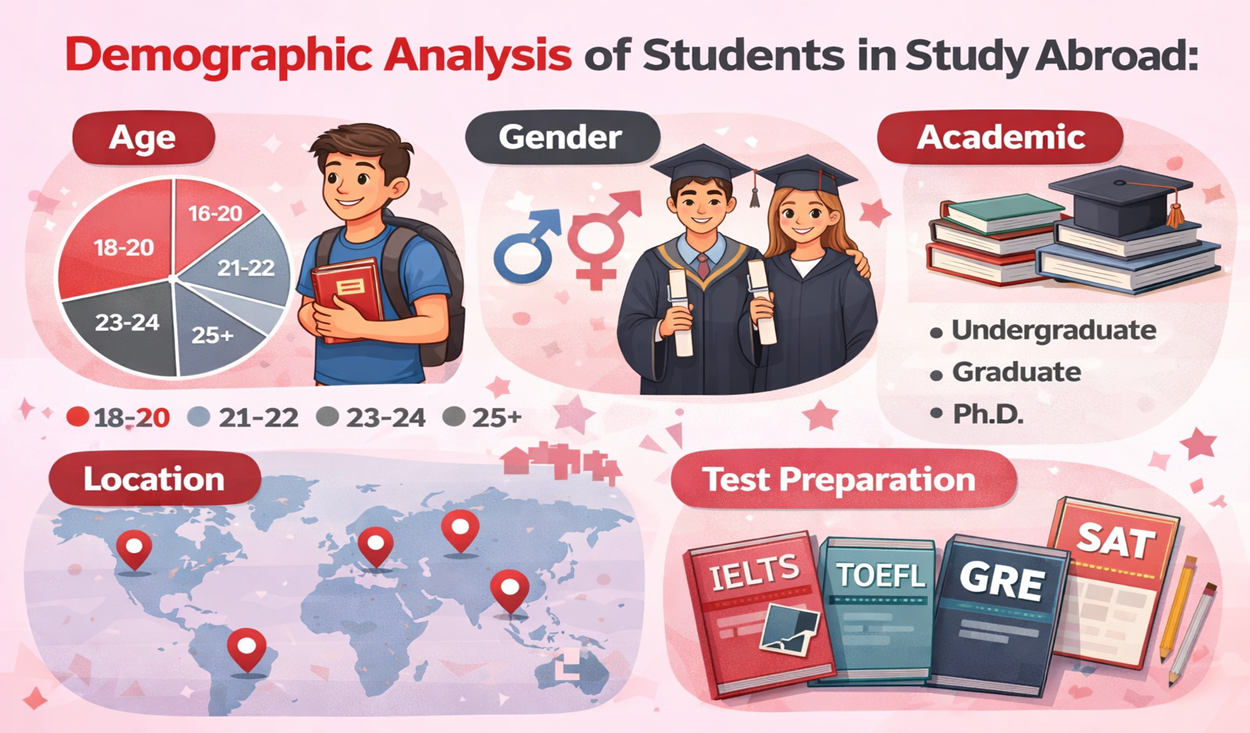
A combination of aspirations, academic achievement, and the prospect of international exposure have been driving an exponential increase in the number of Indian students pursuing education overseas. Let's examine the demographic profile of these students in order to gain a better understanding of this trend. We will look at important aspects such as age, gender, academic background, intended locations, geographic location, and test preparation choices.
Most Indian students who choose study abroad programs are between the ages of 18 and 24, and they are primarily undergraduates and recent graduates. People in this age range are pursuing bachelor's and master's degrees because they want to further their careers and receive high-quality education. Nonetheless, a sizable proportion of people in the 25–30 age range are mid-career professionals who want to improve their career chances by pursuing additional degrees like MBAs or specialized master's programs.
It's interesting to note that fewer students over 30 are studying overseas, particularly for research-based studies or executive programs. This pattern demonstrates how Indian professionals are beginning to embrace lifelong learning.
In recent years, there has been a notable improvement in gender parity in study abroad patterns. Historically, the majority of students were male, although the number of female students has been rising gradually. Due to shifting social norms and a greater focus on female education, women currently make up between 40% and 45% of all international students.
Because they are known for being safe and inclusive, certain nations, like Canada and Australia, have greater female enrolment rates. Additionally, gender patterns differ by field, with males mostly choosing technologists and engineers, while women prefer fields like medical care, higher learning, and social studies.
One characteristic of Indian students studying overseas is their academic diversity. About 60% to 70% of the entire student body is made up of STEM (science, technology, engineering, and mathematics) majors. The need for qualified workers in the international technology and healthcare sectors is what is driving this trend.
Another well-liked option is business and management courses, which draw individuals with backgrounds in business and commerce. Even though they are less common, the humanities, arts, and multidisciplinary disciplines have steadily increased in number as more students look into unconventional career choices.
Because of its top-notch universities, a wide range of programs, and plentiful employment possibilities, the United States remains the most sought-after location for Indian students. But other nations are catching up quickly:
In India, the percentage of students studying overseas varies greatly per Indian state because they have more access to resources like knowledge, money, and coaching centers; urban centers like Delhi, Mumbai, Hyderabad, Bangalore, and Chennai predominate.
It's interesting to note that Tier-2 and Tier-3 cities like Chandigarh, Pune, Coimbatore, and Surat are starting to make major contributions to the pool. This pattern demonstrates the growing consciousness and ambitions in small towns, which are run by government funding for scholarships and online communities.
A student's decision about exam preparation is crucial to their experience studying overseas. Indian students, who make a substantial contribution to the global education scene, exhibit a variety of test-taking behaviors depending on their personal preferences, academic objectives, and intended destinations. The demographics and test-taking strategies of Indian pupils are examined in this investigation.
Most students who want to study in English-speaking nations must take language competence exams like the TOEFL (Test of English as a Foreign Language) and IELTS (International English Language Testing System). Students' comprehension, speaking, reading, and writing skills in English are evaluated by these exams.
Age and academic objectives-Students in the 18–22 age range should concentrate on undergraduate examinations (SAT, ACT) and language tests (IELTS, TOEFL).
Various socio-economic circumstances, goals, and international possibilities influence the demographic composition of Indian students studying overseas. International education is becoming more and more popular among young, driven people from a variety of academic and geographic backgrounds. Additionally, India's changing educational environment necessitates specialized support networks. This trend emphasizes the need for such networks to fulfill the goals of this generation.
Ans- For undergraduate and graduate degrees, the majority of students are between the ages of 18 and 24. Only 25–30% choose to pursue professional degrees like MBAs.
Ans- With 40% to 45% of students being female, the gender gap is closing, especially in social sciences, healthcare, and education.
Ans- Business and management come in second and third, respectively, to STEM (60–70%). Programs in the humanities and multidisciplinary fields are gradually expanding.
Ans- The United States is at the top. Other countries in the top ten include Canada, Australia, the United Kingdom, and European countries like France and Germany.
Ans- Participation from Tier-2 and Tier-3 cities is increasing. However, students from urban centers like Delhi, Mumbai, and Bangalore still make up the majority.
Ans- Depending on their degree and study destination, popular options include the IELTS, TOEFL, GRE, GMAT, SAT, and PTE.
Ans- Traditional coaching is still popular in large cities. However, many people prefer online platforms and AI-driven technologies for their flexibility and affordability.
Ans- Traditional coaching is available in urban regions, although online or hybrid preparation methods are more common in smaller places.
Ans- Engineering, technology, and business students who are male. Students in the fields of social sciences, medical care, and administration are female.
Ans- Good education, interaction with the world, post-study employment options, and immigration chances are important variables.
Author
Content Writer & International Education Specialist
Sakshi Taneja is a content writer specializing in international education, study abroad opportunities, university admissions, student visas, scholarships, and career guidance. She creates accurate, research-driven, and student-focused content to help aspiring international students make informed decisions about their global education journey.
No comments yet
Be the first to share your thoughts!
Please provide your contact information
Free Counselling

9/21/2026

2/26/2026

11/3/2025
11/3/2025
10/27/2025
Want some help figuring out what kind of prep service is right for you?
Help and Support

Leave a Comment
Your email address will not be published.