
Degrees of comparison: Defination, Type, Example, Rule and Exercise
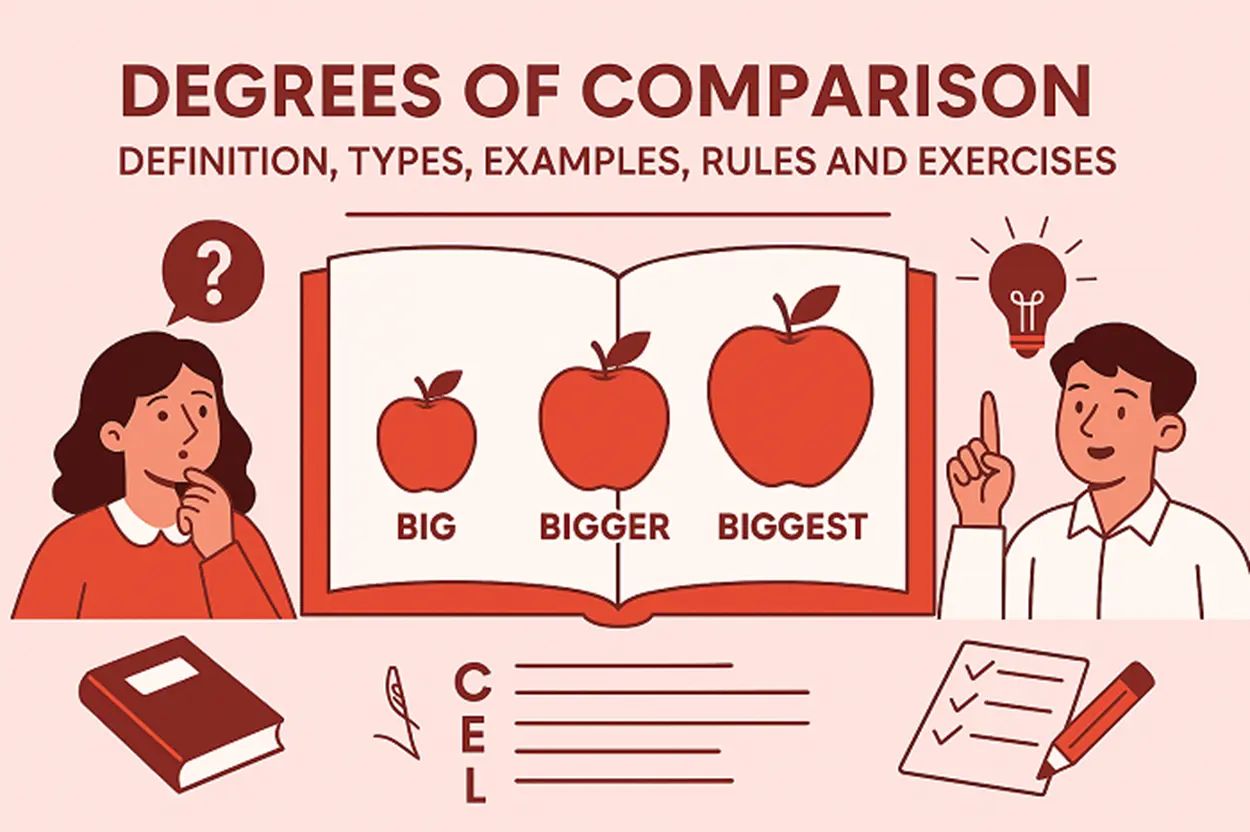
The English language thrives on clarity and precision, and adjectives play a central role in achieving both. When we want to describe the qualities of a noun, we use adjectives. But often, we want to compare these qualities between two or more nouns, and that's where Degrees of Comparison come into play.
Whether you're writing an academic paper, preparing for competitive exams, or simply brushing up on your grammar, understanding the Degrees of Comparison is essential for effective communication. In this blog, we will cover-
What is a Degree of Comparison?
Degrees of comparison play an important role in English grammar. They help you compare the qualities of different people or things. In simple words, they show whether something has more, less, or the same quality as another. Once you understand the rules, you can use them easily in daily life. Degree of comparison refers to the form of an adjective or adverb that shows comparison. There are three main degrees:
Three Degrees of Comparison
- Positive Degree – describes the quality without comparison.
- Comparative Degree – compares two entities.
- Superlative Degree – compares more than two entities or shows the extreme degree of quality.
1. Positive Degree-
The Positive Degree is the simplest form of an adjective. It simply describes the noun without making any comparison.
Rule- Use the base form of the adjective
Structure:
- Subject + verb + positive adjective + object.
Examples:
- She is tall.
- This book is interesting.
- He is kind.
Positive Degree is also used in similes, often introduced by “as…as”:
- She is as tall as her sister.
- This cake is as delicious as that one.
· Usage Tip: Use the positive degree when you describe one person or thing without comparing it.
2. Comparative Degree-
The Comparative Degree is used when comparing two nouns or pronouns. It often ends in “-er” or is formed using “more” or “less.”
· Rules:
- Add -er to short adjectives
- Use more before longer adjectives
- Use than to show comparison
Structure:
- Subject + verb + comparative adjective + than + object.
Examples:
- She is taller than her brother.
- This book is more interesting than the last one.
- He is less confident than before.
Keywords for Comparative Degree:
- than
- rather than
- compared to
- more…than
· Usage Tip: Always remember to use “than” when you compare two things.
3. Superlative Degree-
The Superlative Degree expresses the highest or lowest degree of quality among three or more entities. It often ends in “-est” or is formed using “most” or “least.”
· Rules:
- Add -est to short adjectives
- Use most before long adjectives
- Use the before the adjective
Structure:
- Subject + verb + the + superlative adjective + object.
Examples:
- She is the tallest girl in the class.
- This is the most interesting book I have read.
- He is the least confident speaker on the panel.
Keywords for Superlative Degree:
- the most
- the least
- the best
- of all
- among
· Usage Tip: Use the superlative degree when you talk about one thing that stands above all others.
Special rules in Degree of Comparison-
Some adjectives follow special spelling rules.
1. Adjectives Ending in “Y”
· Rule- If an adjective ends with y, change y to i and then add -er or -est.
· Examples:
o Happy → Happier → Happiest
o Easy → Easier → Easiest
o Busy → Busier → Busiest
· Sentences-
o This task is easier than the last one.
o She is the happiest person here.
2. One-Syllable Words Ending in Consonant-Vowel-Consonant (CVC)
· Rule- If a short adjective ends in consonant + vowel + consonant, double the last consonant before adding -er or -est.
· Examples-
o Big → Bigger → Biggest
o Hot → Hotter → Hottest
o Fat → Fatter → Fattest
· Sentences-
o This box is bigger than that one.
o Today is the hottest day of the week.
3. Adjectives Ending in “E”
· Rule- If an adjective ends with e, add only -r or -st.
· Examples-
o Large → Larger → Largest
o Nice → Nicer → Nicest
· Sentences-
o This room is larger than that one.
o She is the nicest girl in the class.
4. Irregular Adjectives
· Rule- Some adjectives do not follow any fixed pattern. You must remember their forms.
· Examples-
o Good → Better → Best
o Bad → Worse → Worst
o Far → Farther → Farthest
· Sentences-
o She is better than me in English.
o This is the best movie.
5. Use of “More” and “Most”
· Rule- Use more and most with long adjectives (two or more syllables).
· Examples-
o Beautiful → More beautiful → Most beautiful
o Difficult → More difficult → Most difficult
· Sentences-
o This problem is more difficult than the last one.
o She is the most beautiful girl in the group.
6. No Double Comparison
· Rule- Do not use two comparative forms together.
· Incorrect:
o More better
o Most tallest
· Correct:
o Better
o Tallest
Using “As…As” for Equal Comparison
We use “as…as” to show equal comparison.
· Rule-
§ Use as + adjective + as
· Examples-
§ She is as tall as her sister.
§ This book is as interesting as that one.
· Negative Form-
§ She is not as tall as her sister.
What are the rules for forming degrees of comparison?
Degree of comparison of Adjectives and adverbs forms in several ways:
A. One-Syllable Adjectives
Add “-er” for Comparative and “-est” for Superlative.
|
Positive |
Comparative |
Superlative |
|
tall |
taller |
tallest |
|
small |
smaller |
smallest |
|
quick |
quicker |
quickest |
Rule-
- If the adjective ends with e, just add -r/-st:
- large → larger → largest
- If it ends with a consonant + vowel + consonant, double the last consonant:
- big → bigger → biggest
B. Two-syllable adjectives-
If the adjective ends in “-y,” change y to i and add “-er/-est.”
|
Positive |
Comparative |
Superlative |
|
happy |
happier |
happiest |
|
busy |
busier |
busiest |
Other two-syllable adjectives usually use more/most-
|
Positive |
Comparative |
Superlative |
|
careful |
more careful |
most careful |
|
peaceful |
more peaceful |
most peaceful |
C. Adjectives with Three or More Syllables-
Use more for Comparative and most for Superlative.
|
Positive |
Comparative |
Superlative |
|
beautiful |
more beautiful |
most beautiful |
|
intelligent |
more intelligent |
most intelligent |
|
interesting |
more interesting |
most interesting |
Examples and sentence formation-
Let’s look at real-world examples with different types of adjectives-
|
Positive |
Comparative |
Superlative |
|
strong |
stronger |
strongest |
|
kind |
kinder |
kindest |
|
expensive |
more expensive |
most expensive |
|
useful |
more useful |
most useful |
|
bad |
worse |
worst |
|
good |
better |
best |
Sample Sentences-
- My phone is expensive. (Positive)
- My phone is more expensive than yours. (Comparative)
- My phone is the most expensive in the store. (Superlative)
D. Irregular Adjectives-
Some adjectives are irregular—they do not follow typical rules for forming comparatives or superlatives.
|
Positive |
Comparative |
Superlative |
|
good |
better |
best |
|
bad |
worse |
worst |
|
far |
farther |
farthest |
|
little |
less |
least |
|
many |
more |
most |
Examples-
- She sings well. (Positive)
- She sings better than her sister. (Comparative)
- She sings the best in her class. (Superlative)
Degrees of Comparison for Adverbs-
Just like adjectives, adverbs also have degrees of comparison.
Examples of Degree of Comparison
|
Adverb |
Comparative |
Superlative |
|
fast |
faster |
fastest |
|
hard |
harder |
hardest |
|
well |
better |
best |
|
badly |
worse |
worst |
|
slowly |
more slowly |
most slowly |
What are the common mistakes you should avoid while using Degree of Comparison?
Many learners make small mistakes while using degrees of comparison. However, you can avoid them easily if you understand the rules clearly. Let’s look at the common mistakes along with correct usage.
1. Using Double Comparison
· Incorrect: She is more better than me.
· Correct: She is better than me.
· Explanation: Do not use “more” with adjectives that already take -er.
2. Forgetting to Use “Than” in Comparative
· Incorrect: He is taller me.
· Correct: He is taller than me.
· Explanation: Always use “than” when you compare two things.
3. Not Using “The” in Superlative Degree
· Incorrect: She is tallest girl in the class.
· Correct: She is the tallest girl in the class.
· Explanation- Always use “the” before a superlative adjective.
4. Comparing More Than Two Things with Comparative
· Incorrect: She is taller of all the girls.
· Correct: She is the tallest of all the girls.
· Explanation: Use the superlative degree when you compare more than two.
5. Using Wrong Form with Long Adjectives
· Incorrect: This book is interestinger than that one.
· Correct: This book is more interesting than that one.
· Explanation: Use “more/most” with long adjectives, not “-er/-est”.
6. Incorrect Use of Irregular Forms
· Incorrect: He is gooder than me.
· Correct: He is better than me.
· Explanation: Some adjectives have special forms, so you must remember them.
7. Mixing Different Degrees
· Incorrect: This is more best option.
· Correct: This is the best option.
· Explanation: Do not mix comparative and superlative forms in one sentence.
8. Wrong Use of “As…As”
· Incorrect: She is as taller as her sister.
· Correct: She is as tall as her sister.
· Explanation: Use the base form of the adjective with “as…as”.
9. Comparing Different Things
· Incorrect: My car is faster than his house.
· Correct: My car is faster than his car.
· Explanation: Always compare similar things.
10. Leaving Out Important Words
· Incorrect: This is best movie.
· Correct: This is the best movie.
· Explanation: Do not forget to use important words like “the”.
Transformation of sentences using degrees of comparison-
Example 1:
- Positive: She is as smart as her sister.
- Comparative: She is not smarter than her sister.
- Superlative: Among her peers, she is the smartest.
Example 2:
- Positive: This road is as wide as that one.
- Comparative: This road is wider than that one.
- Superlative: This is the widest road in the city.
|
Explore More: |
What is the importance of learning degrees of comparison?
- Enhances Communication Skills- Degrees of comparison help you clearly express differences and similarities between people, objects, or situations.
For example- This book is more interesting than that one.
- Builds a Stronger Grammar Foundation: Understanding how to form and use the positive, comparative, and superlative degrees strengthens your overall grammar, making your English more accurate and natural.
- Improves Writing Quality- Correct use of degrees of comparison adds clarity, variety, and depth to your writing. It is especially useful in essays, reports, and descriptions.
For example- Among all the candidates, she gave the best presentation.
- Aids in Effective Public Speaking- In presentations or debates, degrees of comparison help you emphasize points effectively.
For example- This method is faster and more efficient than the previous one.
- Supports Academic and Competitive Exams- Mastery of comparison is important for exams like IELTS, TOEFL, GRE, and school-level grammar tests, where such questions frequently appear.
- Useful in Daily Life Communication- From shopping (cheaper, better) to giving opinions (more useful, most helpful), degrees of comparison are used daily in both speech and writing.
Quick revision table
|
Degree |
Use |
Example |
|
Positive |
Describes quality |
The movie is good. |
|
Comparative |
Compares two |
This movie is better than that. |
|
Superlative |
Compares more than two / shows extreme |
This is the best movie of all. |
Practice Exercise
Convert the following into all three degrees:
- Wise
- Difficult
- Brave
- Fas
- Happy
Answers:
- Wise → Wiser → Wisest
- Difficult → More difficult → Most difficult
- Brave → Braver → Bravest
- Fast → Faster → Fastest
- Happy → Happier → Happiest
Conclusion
Mastering the Degrees of Comparison is crucial for anyone aiming to become a great communicator in English. From simple conversations to academic writing, knowing when and how to use the positive, comparative, and superlative forms of adjectives and adverbs can make your expressions precise and impactful. Knowing the correct form, whether by adding or using, along with recognizing irregular adjectives, ensures grammatical accuracy. Additionally, avoiding common mistakes such as double comparatives or misplacing words enhances clarity and professionalism in both speech and writing. With regular practice and attention to rules, learners can confidently apply degrees of comparison in academic writing, professional communication, and everyday conversation. Mastery of this topic not only improves grammar but also enriches one’s ability to compare, evaluate, and express thoughts with precision. If you are a student or teacher, using a worksheet on the degree of comparison is the best way to build fluency.
FAQs on Degree of Comparison
Q.1 What is a Degree of Comparison?
Ans- A Degree of Comparison shows the level or intensity of an adjective or adverb when comparing one or more things.
Q.2 What are the three types of Degrees of Comparison?
Ans-
- Positive Degree – no comparison (e.g., "She is tall.")
- Comparative Degree – compares two (e.g., "She is taller than him.")
- Superlative Degree – compares more than two or shows the extreme (e.g., "She is the tallest in the class.")
Q.3 How do you form Comparative and Superlative Degrees?
Ans-
- For short adjectives: tall → taller → tallest
- For long adjectives: beautiful → more beautiful → most beautiful
- Some are irregular: good → better → best
Q.4 What are common errors to avoid?
Ans- Avoid double comparatives (e.g., "more better") and remember to use "the" with superlatives (e.g., "the best").
Q.5 Can adverbs also have degrees of comparison?
Ans- Yes. For example:
- fast → faster → fastest
- badly → worse → worst
Author
Sakshi Taneja
Content Writer & International Education Specialist
Sakshi Taneja is a content writer specializing in international education, study abroad opportunities, university admissions, student visas, scholarships, and career guidance. She creates accurate, research-driven, and student-focused content to help aspiring international students make informed decisions about their global education journey.
Comments (0)
No comments yet
Be the first to share your thoughts!
Contact Details
Please provide your contact information
Free Counselling
Similar Blogs

Top 10 Universities in Germany
9/21/2026

How to become a great Communicator?
2/26/2026
Preparing for TOEFL Speaking Scoring section: Key Skills and Practice Techniques
11/3/2025

Educational loan for study abroad: Everyone Should Know in 2026
11/3/2025
Form I-20 Explained: Start Your U.S. Study Journey with Confidence
10/27/2025
Have a question about GMAT?
Want some help figuring out what kind of prep service is right for you?
Help and Support
Leave a Comment
Your email address will not be published.