Language is a powerful tool that shapes how we communicate, connect, and navigate the world. A strong vocabulary enhances our ability to express ourselves clearly, fosters confidence, and opens up opportunities in both personal and professional spheres. While developing a rich vocabulary may seem daunting, focusing on practical words and phrases can transform your daily interactions. This blog explores strategies and essential vocabulary to help you thrive in everyday situations.
Why does vocabulary matter in daily life?
A robust vocabulary improves communication, comprehension, and problem-solving abilities. Here’s why it is crucial-
- Clarity in communication: The right words allow you to articulate thoughts precisely, avoiding misunderstandings.
- Social interaction: A good vocabulary enhances conversations, helping you connect with others on various topics.
- Professional growth: In the workplace, using appropriate terminology reflects competence and confidence.
- Lifelong learning: Expanding your vocabulary broadens your understanding of the world, making every day experiences richer.
What are the strategies for building vocabulary?
Building a robust vocabulary enhances communication and comprehension, and it’s achievable with the right strategies. Here are practical methods to expand your word bank effectively-
- Read regularly- Books, newspapers, and online articles expose you to new words in context. Choose diverse genres to encounter a range of vocabulary.
- Keep a Vocabulary Journal- Write down unfamiliar words, their meanings, and examples of usage. Revisiting these helps reinforce learning.
- Learn words in context- Memorizing word lists can be overwhelming. Instead, understand how words fit into sentences or situations.
- Set realistic goals- Aim to learn a specific number of new words daily or weekly. Consistency is more effective than cramming.
- Engage in Conversations: Practice new words in daily interactions. Speaking with others helps you remember and apply vocabulary naturally.
- Watch Movies and Shows: Watching content with subtitles exposes you to conversational language, idioms, and cultural expressions.
- Use Flashcards: Create physical or digital flashcards for quick reviews. Test yourself on the go to reinforce retention.
Which is the essential vocabulary for everyday situations?
A practical vocabulary for daily life helps you communicate clearly and confidently in various situations. Here are key categories of words and phrases you should know-
- Greetings and polite expressions- Start and end interactions gracefully with phrases like "Hello," "Good morning," "Thank you," "You're welcome," and "Excuse me." Politeness fosters positive social exchanges.
- Shopping and transactions- Words like "price," "discount," "receipt," and "cash" are essential. Common phrases include, "How much does this cost?" and "Do you accept cards?"
- Navigating directions- Familiar terms include "left," "right," "straight," and "intersection." Use phrases like "Where is the nearest [location]?" or "How do I get to [destination]?"
- Food and dining- Words such as "menu," "bill," "reservation," and "dish" are useful. Practice phrases like, "I’d like to order [dish]" or "Can I have the bill, please?"
- Health and wellness- Learn terms like "appointment," "prescription," "symptoms," and "emergency." Key phrases include, "I need to see a doctor," or "What are the side effects?"
- Workplace communication- Words like "deadline," "feedback," and "meeting" are crucial. Use professional phrases such as "Can we discuss this further?" or "I’ll follow up on this."
- Travel and transportation- Master words like "ticket," "platform," "schedule," and "destination." Questions like "What time does the bus leave?" are essential.
What about idiomatic expressions for everyday use?
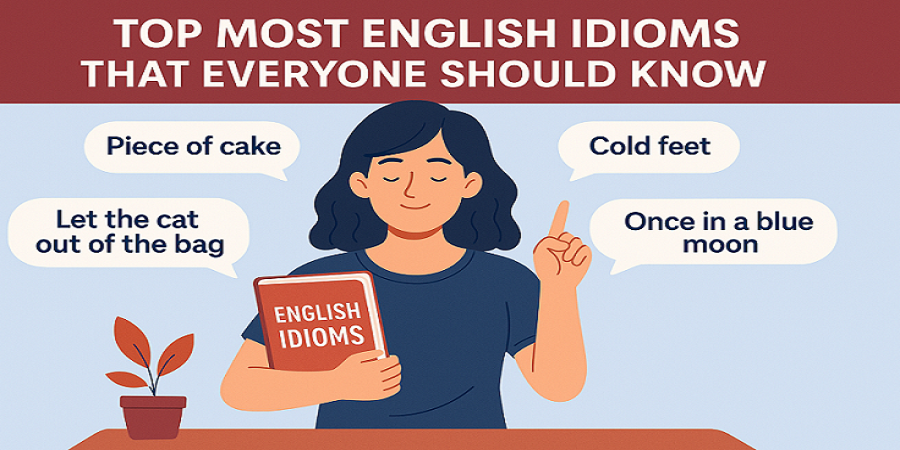
Idiomatic expressions add depth and natural fluency to your speech, making conversations more engaging and relatable. Here are some commonly used idioms that fit everyday situations-
1. Break the ice– To initiate conversation in a social setting.
- Example: She told a funny story to break the ice at the party.
2. Piece of cake – Something very easy to do.
- Example: Don’t worry about the test; it’s a piece of cake.
3. Under the weather – Feeling unwell or sick.
- Example: I am feeling under the weather so I will skip work today.
4. Hit the nail on the head– To describe something accurately or solve a problem perfectly.
- Example: You hit the nail on the head with your analysis of the situation.
5. Spill the beans – To reveal a secret.
- Example: Don’t spill the beans about the surprise party.
6. Bite the bullet – To face a difficult situation bravely.
- Example: I decided to bite the bullet and confront my boss about the workload.
7. Cost an arm and a leg – Extremely expensive.
- Example: That luxury car costs an arm and a leg.
8. I am on cloud nine – Extremely happy.
- Example: She was on cloud nine after getting her dream job.
Conclusion-
Building a strong vocabulary doesn’t require memorizing a dictionary. By focusing on practical, everyday words and phrases, you can enhance your communication skills and confidence. Incorporate these strategies into your routine, and watch as your vocabulary grows, enriching both your personal and professional life.
Building vocabulary for daily life FAQs-
Q.1 Why is vocabulary important for daily life?
Ans- It enhances communication, helps express thoughts clearly, and fosters confidence in various situations.
Q.2 How can you start building your vocabulary?
Ans- Read regularly, note unfamiliar words, and practice using them in conversations.
Q.3 What are some basic words for polite expressions?
Ans- "Please," "Thank you," "Sorry," "Excuse me," and "You're welcome."
Q.4 What vocabulary is essential for shopping?
Ans- Words like "price," "discount," "receipt," and "cash," and phrases like "How much does this cost?"
Q.5 What are useful words for giving or asking directions?
Ans- "Left," "right," "straight," "intersection," and "landmark." Phrases like "Where is [place]?" are helpful.
Q.6 How can you expand your vocabulary while watching TV?
Ans- Use subtitles to learn new words in context and note idiomatic expressions used in dialogue.
Q.7 What workplace vocabulary should you know?
Ans- Terms like "meeting," "deadline," "feedback," "project," and phrases like "Let’s discuss further."
Q.8 Which idiomatic expressions are useful for daily life?
Ans- Common idioms like "break the ice," "piece of cake," and "under the weather" fit everyday conversations.
Q.9 Are there apps available to help with vocabulary improvement?
Ans- Yes, apps like Duolingo, Quizlet, and Vocabulary.com make learning engaging and interactive.
Q.10 How long does it take to improve vocabulary?
Ans- Consistent daily practice can show results within weeks. Start small with 5–10 new words a day.
Leave a Reply
Your email address will not be published.
Search
Similar Blogs

Preparing for TOEFL Speaking Scoring section: Key Skills and Practice Techniques
11/3/2025

Educational loan for study abroad: Everyone Should Know in 2026
11/3/2025

Form I-20 Explained: Start Your U.S. Study Journey with Confidence
10/27/2025

How to Apply for a Master's Degree Abroad: Complete Application Checklist
10/13/2025

What is the difference between percentage and percentile
9/30/2025
Have a question about GMAT?
Want some help figuring out what kind of prep service is right for you?
Help and Support