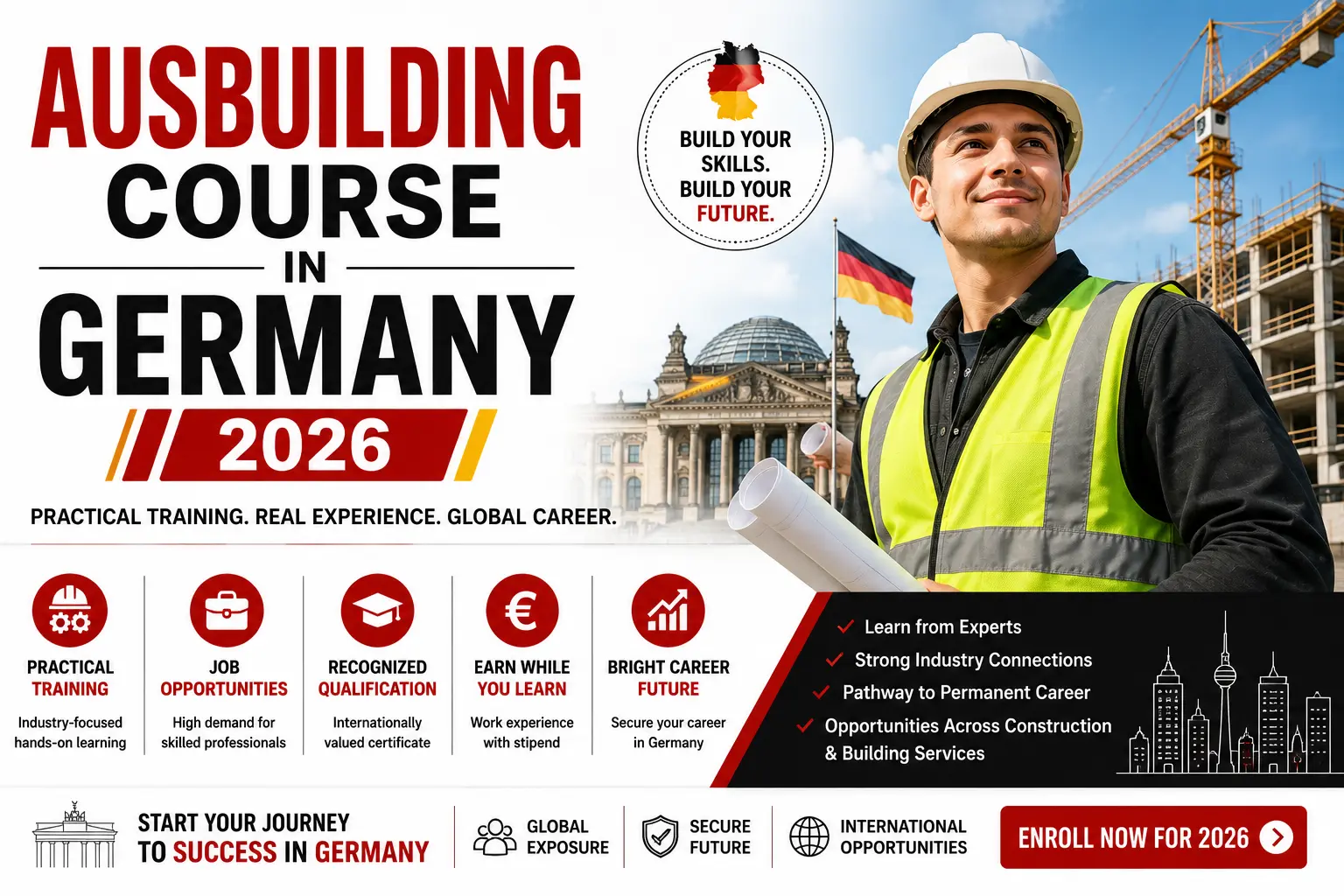
Germany’s dual education system, globally admired for its practicality and industry relevance, offers a unique opportunity for young professionals through Ausbildung programs. As of 2026, Ausbildung continues to be a gateway for both domestic and international students, aiming to combine vocational training with paid work experience.
In this blog, we will dive into everything you need to know about Ausbildung courses in Germany in 2026, covering what they are, the types of courses available, eligibility, application process, benefits, top programs, and frequently asked questions.
What is an Ausbildung?
Ausbildung is the German word for vocational training programs that blend classroom education with on-the-job training. These programs are a component of the dual educational system and typically run for two to three and a half years.
Participants work in a company for several days a week while attending a vocational school for theoretical knowledge. Unlike traditional academic degrees, Ausbildung is geared towards equipping students with practical skills that lead directly to employment.
Types of Ausbildung programs in 2026-
There are over 320 officially recognized Ausbildung occupations in Germany. These can be roughly divided into two categories:
1. Dual Vocational Training (Duale Ausbildung)
- Blend’s vocational school study with working part-time at a business.
- A most common form of Ausbildung.
- Suitable for fields like business, engineering, IT, healthcare, retail, and logistics.
2. School-Based Vocational Training (Schulische Ausbildung)
- All instruction is provided at a vocational school, frequently with required internships.
- Common in fields like nursing, physiotherapy, childcare, and design.
- Some private schools charge tuition, but public institutions often remain free.
Why choose Ausbildung in Germany in 2026?
Here are key reasons why Ausbildung programs remain attractive in 2026:
- Free education: The majority of Ausbildung programs offer no tuition or very low costs. This makes them highly accessible and cost-effective for international students.
- Earn while you learn- Trainees receive a monthly salary throughout the course duration, making it financially sustainable. In 2026, average monthly stipends range from €800 to €1,200 depending on the industry and region.
- High demand for skilled workers- Germany faces a shortage of skilled professionals, especially in healthcare, engineering, IT, and hospitality. Ausbildung graduates are in high demand and often secure permanent jobs upon completion.
- Route to permanent residence: Graduates of an Ausbildung program are permitted to work in Germany on a post-training work visa and may subsequently seek a residence permit.
- No university degree required- Ausbildung is ideal for students who prefer practical training over academic study in Germany. Even students without a university background can apply, provided they meet language and school-leaving certificate requirements.
Top Ausbildung Courses for 2026
Here’s a list of popular Ausbildung programs in 2026 for international students, categorized by industry:
A. Healthcare and Nursing-
- Nursing Specialist
- Medical Assistant
- Dental Assistant
Due to Germany’s ageing population, the healthcare sector continues to have the highest demand for trained workers.
B. Engineering and Technology-
- Mechatronics Technician
- Electronics Technician
- Industrial Mechanic
These technical programs are essential for Germany’s manufacturing and automotive industries.
C. Information Technology-
- IT Specialist - System Integration
- IT Specialist - Application Development
With the digitization of industries, IT skills are in growing demand.
D. Business and Commerce-
- Retail Salesperson
- Industrial Clerk
- Office Administrator
These programs are great for students with strong organizational and communication skills.
E. Hospitality and Tourism-
- Hotel Management Assistant
- Chef
- Restaurant Specialist
Germany’s growing tourism sector values hands-on professionals trained through the Ausbildung route.
F. Construction and Skilled Trades-
- Bricklayer
- Plumbing and Heating Installer
- Painter and Varnisher
Vocational training in trades offers stable job prospects and good wages.
Eligibility criteria for international students in 2026
To apply for an Ausbildung program in Germany in 2026, international students must fulfil the following requirements-
- Educational qualifications- A recognized school-leaving certificate equivalent to German secondary school level, depending on the program. Higher academic credentials may be necessary for some technical or medical degrees.
- German language proficiency- Minimum B1 level of German according to the Common European Framework of Reference. B2 or above may be required for several programs, particularly in the healthcare industry.
- Age limit- The majority of candidates are in the 18–30 age range. There is no strict age limit, but younger candidates may be preferred.
- Residence permit and visa- Students from outside the EU must apply for an Ausbildung Visa. Before applying, you must have a contract for instruction that a German business has validated.
How do you apply for an Ausbildung in 2026?
Here’s a step-by-step application process for Ausbildung programs-
- Choose your course- Research and select the Ausbildung course that is aligned with your interests and career goals.
- Locate a training provider- You need to sign an agreement with a German vocational education provider. Platforms like-
§ Ausbildung.de
§ Berufenet
§ Jobbörse der Bundesagentur für Arbeit
§ The assets in Germany are excellent.
- Prepare your application documents-
§ Updated CV (in Europass format)
§ Motivation letter (in German)
§ Copies of certificates (translated into German)
§ Proof of language proficiency (Goethe, TELC, TestDaF, etc.)
- Apply directly to companies-Submit your application either through online job portals or company websites. Adapt every application to the needs of the business.
- Attend interviews (Online or In-Person)- If shortlisted, you may be interviewed. Some companies conduct video interviews for international applicants.
- Get an Ausbildungsvertrag (Training contract)- After being approved, you will be given a formal contract that is required for the visa application procedure.
- Apply for an Ausbildung visa- Apply at the German embassy/consulate in your country with the required documents:
§ Valid passport
§ Training contract
§ Proof of German proficiency
§ Health insurance
§ Financial resources (approx. €903/month or a blocked account)
Cost of Living for Ausbildung Students
Even though Ausbildung is paid, understanding the living costs is crucial-
|
Expense
|
Monthly Estimate (in Euros)
|
|
Rent (shared apartment)
|
€300 - €500
|
|
Food
|
€200 - €300
|
|
Health Insurance
|
€100 - €120
|
|
Transportation
|
€50 - €100
|
|
Miscellaneous
|
€100 - €200
|
|
Total
|
€750 - €1,200
|
Trainees' Ausbildung pay frequently covers these expenses.
Post-Ausbildung opportunities in 2026-
- Full-time employment- After graduation, you can be hired by the same company or explore opportunities elsewhere.
- Post-training residence permit- Germany allows Ausbildung graduates to stay for up to 12 months to find a job. Once employed, you can convert your permit into a work visa.
- Further education- You may choose to pursue a Techniker (advanced vocational qualification), Meister (master craftsman training), or even a university degree.
- Permanent residency and citizenship: You can apply for permanent residency after 33 months of employment (or 21 months with B1 German proficiency) and, eventually, for German citizenship.
What are the challenges and tips for Ausbildung courses in Germany in 2026?
By combining classroom instruction with real-world experience, completing an Ausbildung (vocational training) in Germany in 2026 offers a structured path to skilled work. However, international applicants may encounter several challenges.
- Language proficiency- Most Ausbildung programs are conducted in German, necessitating at least a B1-level proficiency. B2-level abilities may be necessary in some professions, such as nursing.
- Cultural adaptation- Adjusting to Germany's formal and structured work culture, which emphasizes punctuality and direct communication, can be demanding.
- Financial constraints- While Ausbildung programs are tuition-free and offer stipends ranging from €700 to €1,400 per month, living expenses in cities like Munich or Frankfurt can be high.
- Housing difficulties- Securing affordable accommodation, especially in urban areas, is a common hurdle.
- Bureaucratic processes- Navigating visa applications, health insurance, and residence permits requires careful attention to detail and timely preparation.
- Recognition of qualifications- International applicants must ensure their educational credentials are recognized in Germany, typically requiring a minimum of 9–10 years of schooling.
Tips for Success-
- Enhance language skills- Invest in German language courses to achieve the necessary proficiency, facilitating both academic success and daily interactions.
- Understand cultural norms- Familiarize yourself with German workplace expectations to ease integration and foster positive professional relationships.
- Plan financially- Research the cost of living in various regions and consider smaller cities to reduce expenses. Explore part-time work opportunities that comply with your visa conditions.
- Seek housing early- Begin your accommodation search well in advance, considering options like shared apartments or company-provided housing.
- Prepare documentation- Gather all necessary documents, including proof of qualifications, language certificates, and financial means, to streamline the application process.
- Leverage support services- Utilize resources offered by training companies, vocational schools, and integration courses to navigate administrative procedures and cultural adaptation.
Final thoughts-
In 2026, Ausbildung programs in Germany will provide overseas students wishing to establish a profession in Europe with a useful, economical, and fulfilling route. With strong industry connections, real-world experience, and the opportunity to earn while learning, Ausbildung is more than just vocational training—it’s a stepping stone to a successful life in Germany.
Whether you are interested in healthcare, technology, business, or skilled trades, there’s an Ausbildung program tailored to your ambitions. Just make sure you meet the language and qualification requirements, apply smartly, and prepare for a life-changing journey.
Frequently Asked Questions (FAQs)
Q.1 Is English proficiency enough for Ausbildung?
Ans- No. Most programs are taught in German, and workplace communication is also in German. B1 or higher proficiency is required.
Q.2 Are Ausbildung certificates internationally recognized?
Ans-They are recognized in Germany and often in other EU countries, but outside Europe, they may require additional validation.
Q.3 Can you transfer from Ausbildung to a university?
Ans-Yes. If you meet university entry requirements, you can pursue higher studies, often with advanced standing or credit transfer.
Q.4 Who can apply for Ausbildung programs?
Ans- Anyone with at least 9–10 years of schooling, basic German skills (B1 or B2), and recognized educational qualifications can apply.
Q.5 Is Ausbildung free for international students?
Ans- The answer is that trainees often earn a stipend every month and that Ausbildung courses are free of tuition.
Q.6 What proficiency in German is necessary for Ausbildung?
Ans- Most programs require at least a B1-level German proficiency; healthcare-related fields may require B2.
Q.7 How long does an Ausbildung program last?
Ans- Ausbildung programs typically last between 2 and 3.5 years, depending on the profession.
Q.8 Will you get paid during your Ausbildung?
Ans- Yes, trainees are paid between €700 and €1,400 per month, depending on their sector and training year.
Q.9 Can you stay in Germany after completing Ausbildung?
Ans- Yes, you can apply for a work visa and continue working in Germany after completing your training.
Q.10 What are the popular fields for Ausbildung in 2026?
Ans- Nursing, IT, mechatronics, hospitality, and retail are among the most in-demand Ausbildung fields.



Leave a Comment
Your email address will not be published.