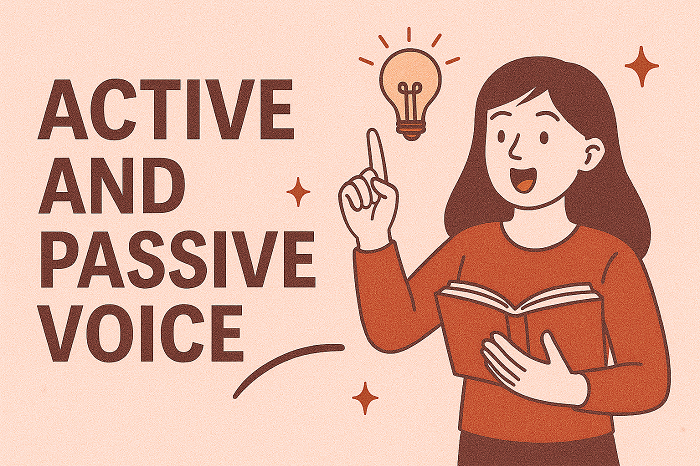
To write properly and clearly, one must be aware of the distinction between the active and passive voices. Both voices serve their purpose in communication, but each is best suited to different situations. Let’s explore what these voices are, how they’re used, and when to choose one over the other.
Voice in grammar is the structure of a verb that indicates whether the action described in the statement is performed by or received by the person or thing being discussed.
The sentence's subject acts in the active voice. It is direct, clear, and typically preferred in most forms of writing, especially academic, business, and creative content.
· Subject + Verb + Object
When an expression is in the passive voice, the role of acting is given to the subject. Passive constructions are more indirect and are often used when the doer of the action is unknown, unimportant, or implied.
Object + Auxiliary Verb (be) + Past Participle + (by + Subject)
A delicious meal was cooked by the chef.
|
Feature |
Active Voice |
Passive Voice |
|
Focus |
Subject (doer of the action) |
Object (receiver of the action) |
|
Sentence Structure |
Subject + Verb + Object |
Object + Be Verb + Past Participle (+ by Subject) |
|
Example |
The teacher praised the student. |
The student was praised by the teacher. |
|
Clarity |
More direct and concise |
More formal or indirect |
|
Usage |
Preferred in most writing |
Used for emphasis, formality, or when doer is unknown |
Rearranging a sentence to ensure an action's object turns into the sentence's subject is known as shifting it from active to passive. Use these procedures to change an active sentence to a passive one-
Active: The manager approved the proposal.
Passive: The proposal was approved by the manager.
Tense-wise Passive Voice Conversion Rules-
|
Tense |
Passive Structure |
Example (Active → Passive) |
|
Simple Present |
Obj + is/am/are + past participle + (by S) |
She writes a letter → A letter is written by her |
|
Present Continuous |
Obj + is/am/are being + past participle + (by S) |
They are eating apples → Apples are being eaten by them |
|
Present Perfect |
Obj + has/have been + past participle + (by S) |
He has done the work → The work has been done by him |
|
Simple Past |
Obj + was/were + past participle + (by S) |
I wrote a report → A report was written by me |
|
Past Continuous |
Obj + was/were being + past participle + (by S) |
She was reading a book → A book was being read by her |
|
Past Perfect |
Obj + had been + past participle + (by S) |
They had finished the job → The job had been finished by them |
|
Simple Future |
Obj + will be + past participle + (by S) |
He will repair the car → The car will be repaired by him |
|
Future Perfect |
Obj + will have been + past participle + (by S) |
She will have written the note → The note will have been written by her |
|
Modal Auxiliaries |
Obj + modal + be + past participle + (by S) |
They can solve it → It can be solved by them |
|
Non‑Convertible Tenses |
— |
No passive for perfect continuous / future continuous |
The format of "to be" that is used determines the verb's tense. Here’s how active and passive sentences look across tenses-
|
Tense |
Active Voice |
Passive Voice |
|
Present Simple |
She writes a letter. |
A letter is written by her. |
|
Past Simple |
He cleaned the room. |
The room was cleaned by him. |
|
Future Simple |
They will deliver the package. |
The package will be delivered by them. |
|
Present Perfect |
She has sent the invitation. |
The invitation has been sent by her. |
|
Past Perfect |
He had finished the work. |
The work had been finished by him. |
|
Future Perfect |
They will have built the house. |
The house will have been built by them. |
|
Modals |
You should read the instructions. |
The instructions should be read by you. |
Passive voice can be tricky, but here are some easy and reliable tips to help you spot it quickly:
Examples:
If you see something like “was opened,” “is made,” “has been stolen” — chances are it's passive voice.
Examples:
If the person or thing doing the action isn't clearly stated, it may be passive.
Examples:
Compare:
Examples:
Not all passive sentences include “by,” but if you see it, check for passive structure.
Writing effectively and clearly requires an understanding of the distinction between the active and passive voice. Your sentences are clear, powerful, and simple to understand when you use the active voice. It emphasizes the subject performing the action, which is perfect for the majority of writing scenarios, particularly in creative, business, and academic writing. On the other hand, the passive voice is useful when the action itself, rather than the person performing it, should be the primary focus, or when the individual acting is unidentified or meaningless.
The active voice is typically chosen for its clarity and conciseness, even though both voices have a place in the English language. Being able to recognize and modify each voice as well as know when to use it will greatly enhance the accuracy and caliber of your communications.
Ans- Active voice is when the subject acts as a sentence.
Ans- Passive voice is when the subject receives the action.
Ans- Active voice is more common because it's clearer and more direct.
Ans- Use passive voice when the doer is unknown, unimportant, or when you want to emphasize the action or object.
Ans- Look for a form of the verb “to be” + past participle, often followed by “by.”
Ans- No, passive voice is grammatically correct. It’s just used less frequently in casual or direct writing.
Ans- Only transitive verbs (verbs with an object) can be converted to passive voice.
Ans- Yes, passive sentences are usually longer and may seem more formal or wordy.
Ans- It creates an objective tone by focusing on the action or result rather than the person performing it.
Ans- Move the object to the subject’s position, use the correct form of “to be”, and add the past participle of the verb.
Author
Content Writer & International Education Specialist
Sakshi Taneja is a content writer specializing in international education, study abroad opportunities, university admissions, student visas, scholarships, and career guidance. She creates accurate, research-driven, and student-focused content to help aspiring international students make informed decisions about their global education journey.
No comments yet
Be the first to share your thoughts!
Please provide your contact information
Free Counselling

9/21/2026
2/26/2026
11/3/2025

11/3/2025
10/27/2025
Want some help figuring out what kind of prep service is right for you?
Help and Support

Leave a Comment
Your email address will not be published.