
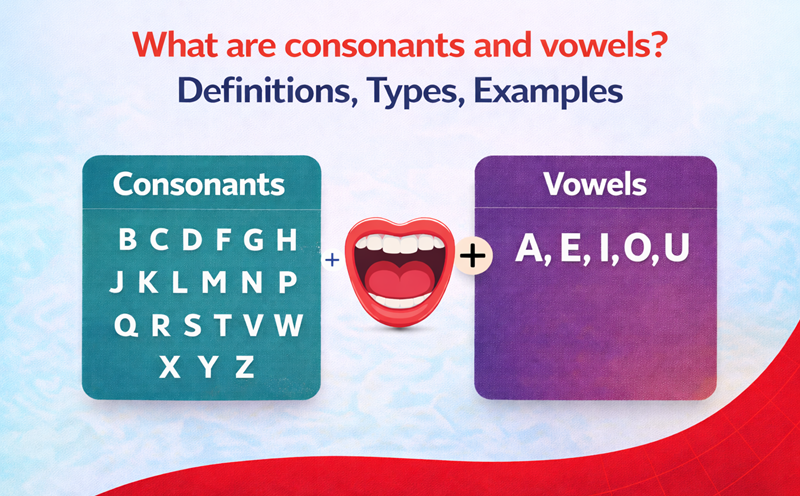
Language is built from sounds. Every word we speak, write, or read is formed using a limited set of basic sound units. In English, these sound units are broadly divided into vowels and consonants. Understanding consonants and vowels is one of the first and most essential steps in learning English grammar, pronunciation, phonetics, and spelling. Whether you are a school student, an English learner, a competitive exam aspirant, or someone preparing for study abroad, a firm grasp of vowels and consonants will significantly improve your language skills.
This detailed guide explains what consonants and vowels are, their definitions, types, rules, and examples, along with pronunciation tips and common mistakes. By the end of this blog, you will have a complete and clear understanding of how vowels and consonants work in English.
What are letters and sounds in English?
The English alphabet has 26 letters, which are symbols used in writing. However, spoken English is made up of sounds, not just letters. These sounds are classified into-
- Vowel sounds
- Consonant sounds
While the alphabet contains 5 vowel letters and 21 consonant letters, the number of vowel and consonant sounds is much higher. This difference between letters and sounds is the reason why English spelling and pronunciation can sometimes feel confusing.
Understanding the difference between letters and sounds helps learners pronounce words correctly and avoid common spelling errors.
Key differences in letters and sounds-
Letters and sounds are closely connected, but they are not the same. Understanding their differences is essential for correct pronunciation, reading, and spelling.
- Nature- Letters are written symbols that belong to the English alphabet and are used to form words in written language. Sounds, on the other hand, are spoken units of language that we hear and pronounce while speaking.
- Quantity- The English language has 26 letters in its alphabet. However, it contains around 44 different sounds, also known as phonemes, which explains why English spelling and pronunciation do not always match.
- Visibility- Letters are visible and can be written or printed on paper or screens. Sounds cannot be seen; they exist only when they are spoken and heard.
- Representation- A single letter can represent more than one sound depending on the word in which it is used. For example, the letter A is pronounced differently in cat, cake, and call. Similarly, one sound can be represented by different letters or letter combinations. For example, the /f/ sound appears in both fan and phone.
- Consistency- Letters generally remain the same in spelling and shape across words. Sounds, however, can change depending on the word, stress, or surrounding letters.
- Role in language- Letters play a key role in writing and reading, helping us recognize and form words visually. Sounds are essential for speaking and listening, allowing effective verbal communication.
- Learning focus- Letters are usually learned through memorizing the alphabet. Sounds are learned through phonics, listening practice, and pronunciation training.
Why does this difference matter?
- It helps learners understand that English has more sounds than letters, so depending only on spelling can cause pronunciation errors.
- It enables more accurate and confident pronunciation by recognizing that the same letter can represent different sounds.
- It improves reading skills by allowing learners to decode unfamiliar words using sounds instead of memorizing spellings.
- It supports the development of phonics and fluency, especially for children and second-language learners.
- It enhances spelling skills by explaining why some words sound similar but are spelled differently.
- It reduces confusion in writing and increases overall spelling accuracy.
- It strengthens listening and speaking skills by helping learners distinguish between similar-looking words with different sounds.
- It helps avoid miscommunication by improving understanding of spoken English.
- It is essential for success in language proficiency exams such as IELTS, TOEFL, and PTE, where pronunciation, listening, and reading are tested.
- Overall, it allows learners to read fluently, speak clearly, write accurately, and communicate with confidence.
What are Vowels?
Definition of Vowels-
A vowel is a speech sound produced without any significant blockage or restriction of airflow in the mouth. When pronouncing a vowel, the air flows freely from the lungs through the mouth.
In written English, vowels are represented by the letters-
A, E, I, O, U
Sometimes, the letter Y also functions as a vowel, depending on its use in a word.
Key characteristics of Vowels-
- Vowels are speech sounds produced without any significant blockage or restriction of airflow in the mouth.
- Air flows freely from the lungs through the mouth while pronouncing vowel sounds.
- Vowels form the core or nucleus of a syllable, and every English word contains at least one vowel sound.
- They are voiced sounds, meaning the vocal cords vibrate during their pronunciation.
- Vowel sounds can be short or long, depending on how long they are held while speaking.
- The quality of vowel sounds changes based on tongue position and lip shape.
- Vowels play a major role in giving words their sound, rhythm, and clarity in speech.
Examples of vowels in words-
- A in apple
- E in elephant
- I in ink
- O in orange
- U in umbrella
What are the types of Vowels in English?
Vowels can be classified in several ways based on length, sound quality, and mouth position. The most common classifications include-
- Short vowels
- Long vowels
- Diphthongs
- Pure vowels (monophthongs)
· Short Vowels- Short vowels are vowel sounds that are pronounced quickly and briefly. They do not sound like the letter name.
The five short vowel sounds example
|
Vowel |
Short Sound |
Example |
|
A |
/æ/ |
cat, bat |
|
E |
/e/ |
pen, bed |
|
I |
/ɪ/ |
sit, pig |
|
O |
/ɒ/ or /ɑ/ |
hot, dog |
|
U |
/ʌ/ |
cup, sun |
Examples in Sentences
o The cat sat on the mat.
o She has a red pen.
o The dog is very playful.
Short vowels are very common in everyday English and are often found in closed syllables (syllables ending in a consonant).
· Long Vowels- Long vowels are vowel sounds that sound like the name of the vowel letter. They are pronounced for a longer duration than short vowels.
The five long vowel sounds example-
|
Vowel |
Long Sound |
Example |
|
A |
/eɪ/ |
cake, name |
|
E |
/iː/ |
tree, see |
|
I |
/aɪ/ |
time, kite |
|
O |
/oʊ/ |
home, rope |
|
U |
/juː/ or /uː/ |
use, flute |
Common Spellings of Long Vowels
o Silent e: cake, bike
o Vowel pairs: rain, boat
o Single vowel in open syllables: me, go
· Diphthongs- A diphthong is a vowel sound that begins with one vowel sound and glides into another within the same syllable.
Common diphthongs in English example-
|
Diphthong |
Example |
|
/aɪ/ |
time, fly |
|
/aʊ/ |
cow, house |
|
/ɔɪ/ |
boy, coin |
|
/eɪ/ |
day, rain |
|
/oʊ/ |
go, road |
Diphthongs are essential for natural pronunciation and are frequently tested in spoken English exams.
· Pure Vowels (Monophthongs)- Pure vowels, also known as monophthongs, are vowel sounds that remain stable and do not change during pronunciation.
Examples-
o /iː/ in see
o /ɑː/ in father
o /ʊ/ in book
· R-Controlled Vowels- R-controlled vowels are vowel sounds that occur when a vowel is followed by the letter r, which changes the usual sound of the vowel.
Examples-
o /ɑːr/ in car
o /ɜːr/ in her
o /ɜːr/ in bird
o /ɜːr/ in word
o /ɜːr/ in turn
What Are Consonants?
· Definition of Consonants
A consonant is a speech sound produced when the tongue, teeth, lips, or throat wholly or partially block the airflow. There are 21 consonant letters in the English alphabet-
B, C, D, F, G, H, J, K, L, M, N, P, Q, R, S, T, V, W, X, Y, Z
Key characteristics of consonants
- Consonants are speech sounds produced when the tongue, teeth, lips, or throat wholly or partially block the airflow.
- They usually require the support of a vowel sound to form a complete syllable.
- Consonant sounds can be either voiced or voiceless, depending on whether the vocal cords vibrate.
- They often appear at the beginning or end of words and syllables.
- Consonants help give words structure, shape, and clarity in speech.
- Their pronunciation depends on the place and manner of articulation.
- Consonants play a vital role in distinguishing one word from another in spoken English.
Types of Consonants in English
Consonants in English are classified based on how they are produced and how the airflow is controlled during pronunciation. The main types of consonants in English are:
1. Voiced and Voiceless Consonants- Voiced consonants are produced when the vocal cords vibrate during pronunciation, such as /b/ in bat, /d/ in dog, and /z/ in zoo. Voiceless consonants are produced without vocal cord vibration, such as /p/ in pen, /t/ in top, and /s/ in sun.
2. Consonants by Place of Articulation- This classification is based on where the sound is produced in the mouth. Bilabial consonants are produced using both lips, such as p, b, and m. Labiodental consonants are produced using the lips and teeth, such as f, v. Dental consonants involve the tongue and teeth, such as th. Alveolar consonants are produced by placing the tongue against the ridge behind the teeth, such as t, d, s, z. Velar consonants are produced using the back of the tongue and the soft palate, such as k, g. Glottal consonants are produced in the throat, such as h.
3. Consonants by Manner of Articulation- This type describes how the airflow is restricted. Plosives are produced by completely stopping the airflow and then releasing it, such as p, b, t, d, k, g. Fricatives are produced by forcing air through a narrow passage, such as f, v, s, z, th. Affricates begin as plosives and end as fricatives, such as ch and j. Nasals are produced when air flows through the nose, such as m, n, ng. Liquids allow the air to flow around the tongue, such as l and r. Glides are produced with a smooth movement of the tongue, such as w and y.
· Special consonant cases
The Letter Y
o Acts as a vowel in my, gym
o Acts as a consonant in yes, yellow
The Letter W
o Often works with vowels to form digraphs: cow, snow
· Consonant clusters
A consonant cluster is a group of two or more consonants with no vowel between them.
Examples:
o stop (st)
o school (sch)
o string (str)
Difference between vowels and consonants-
|
Feature |
Vowels |
Consonants |
|
Airflow |
Free |
Blocked |
|
Syllable formation |
Can form syllables |
Cannot alone |
|
Letters |
5 (sometimes Y) |
21 |
|
Role |
Core of words |
Shape words |
What is the importance of learning vowels and consonants?
Learning vowels and consonants is fundamental to understanding and using the English language effectively. They serve as the building blocks of communication and support all language skills.
- Improves pronunciation- A clear understanding of vowels and consonants helps learners pronounce words correctly. It enables them to produce accurate sounds, differentiate between similar words, and speak with clarity and confidence.
- Strengthens reading skills- Knowledge of vowel and consonant sounds allows learners to decode unfamiliar words instead of memorizing them. This improves reading fluency, speed, and overall comprehension.
- Enhances spelling accuracy- When learners understand the relationship between sounds and letters, they can spell words more accurately. It reduces confusion caused by similar-sounding words and irregular spellings.
- Boosts listening and speaking skills- Recognizing vowel and consonant sounds helps learners understand spoken English more easily. It improves listening accuracy and helps avoid misunderstandings during conversations.
- Supports phonics and early learning- For beginners and young learners, vowels and consonants are the foundation of phonics. Mastering them helps develop strong language skills from an early stage.
- Helps in language exams- Understanding vowels and consonants is essential for exams like IELTS, TOEFL, and PTE, where pronunciation, listening, and reading abilities are evaluated.
- Builds overall communication skills- Mastery of vowels and consonants leads to better fluency, clearer speech, and more effective communication in both academic and real-life situations.
What are the common mistakes learners make during learning vowels and consonants?
While learning vowels and consonants, many learners face similar challenges. Recognizing these common mistakes can help improve pronunciation, spelling, and overall language accuracy.
- Confusing letters with sounds- One of the most common mistakes is assuming that letters and sounds are the same. Learners often expect each letter to have only one sound, which leads to incorrect pronunciation.
- Mixing up short and long vowels- Learners frequently confuse short and long vowel sounds, such as pronouncing ship like sheep or bit like beat. This can change the meaning of words.
- Mispronouncing diphthongs- It involves a glide between two vowel sounds, but learners often pronounce them as pure vowels, resulting in unnatural or incorrect speech.
- Ignoring voiced and voiceless consonants- Many learners do not notice whether the vocal cords vibrate while producing consonant sounds. This leads to confusion between pairs like b and p or z and s.
- Overlooking silent letters- English contains many silent letters, especially in vowel combinations. Learners may try to pronounce every letter, leading to errors in words like knife or write.
- Difficulty with consonant clusters- Pronouncing groups of consonants without vowels, such as str or spl, can be challenging. Learners often insert extra vowel sounds to make pronunciation easier.
- Misusing the letter Y- Learners sometimes struggle to identify whether Y is acting as a vowel or a consonant, which affects both pronunciation and spelling.
- Lack of listening practice- Focusing only on reading and writing without enough listening practice prevents learners from recognizing natural vowel and consonant sounds in spoken English.
- Not practicing regularly- Irregular practice leads to weak sound recognition and poor pronunciation habits, making it harder to achieve fluency.
What are the strategies you should opt for to get mastery in vowels and consonants?
Mastering vowels and consonants requires consistent practice, active listening, and a clear understanding of sound patterns. The following strategies can help learners improve accuracy and confidence in English pronunciation.
- Learn sounds, not just letters- Focus on learning vowel and consonant sounds rather than memorizing letters. Understanding how sounds work in different words helps reduce pronunciation errors.
- Practice phonics regularly- Phonics practice strengthens the connection between sounds and letters. Reading phonics-based texts and practicing sound patterns daily builds a strong foundation.
- Use phonetic symbols- Learning basic phonetic symbols (IPA) helps learners understand correct pronunciation. It allows you to pronounce unfamiliar words accurately by checking dictionaries.
- Practice minimal pairs- Minimal pairs are words that differ by only one sound, such as ship/sheep or bat/pat. Practicing them improves sound distinction and clarity.
- Listen to native speech- Listening to native speakers through podcasts, videos, and audiobooks helps learners recognize correct vowel and consonant sounds, stress, and rhythm.
- Read aloud daily- Reading aloud improves sound awareness and pronunciation. It also helps learners become comfortable producing difficult vowel and consonant sounds.
- Record and analyze your speech- Recording your voice and comparing it with native pronunciation helps identify mistakes and track improvement.
- Focus on mouth position- Pay attention to tongue placement, lip movement, and airflow while producing sounds. This is especially helpful for complex vowels and consonants.
- Practice consonant clusters- Regular practice with consonant clusters helps learners pronounce complex words smoothly without adding extra vowel sounds.
- Get feedback and correct errors- Seek feedback from teachers, language partners, or pronunciation tools. Correcting mistakes early prevents the formation of bad habits.
Conclusion-
Vowels and consonants form the foundation of the English language and play a crucial role in both spoken and written communication. Vowels allow unrestricted airflow and create the core sounds of words, while consonants shape and structure those sounds by restricting airflow in different ways. Understanding their definitions, types, and examples helps learners recognize how words are formed, pronounced, and spelled. From short and long vowels to diphthongs and r-controlled vowels, and from voiced to voiceless consonants, each category contributes to clear and accurate speech. Mastery of vowels and consonants improves pronunciation, reading fluency, spelling accuracy, and listening skills. Overall, a firm grasp of these basic sound elements builds confidence and supports effective communication in English.
FAQs on consonants, vowels, type, and examples-
Q1. What is a vowel?
Ans- A vowel is a speech sound produced without any significant blockage of airflow, represented by the letters A, E, I, O, U (and sometimes Y).
Q2. What is a consonant?
Ans- A consonant is a speech sound produced when airflow is partially or entirely blocked by the lips, tongue, teeth, or throat.
Q3. How many vowel letters are there in English?
Ans- There are five main vowel letters: A, E, I, O, U, and sometimes Y acts as a vowel.
Q4. How many consonant letters are there in English?
Ans- There are 21 consonant letters in the English alphabet.
Q5. What are short vowels?
Ans- Short vowels are vowel sounds pronounced quickly and do not sound like the letter name, e.g., a in cat, e in pen.
Q6. What are long vowels?
Ans- Long vowels are pronounced for a longer duration and usually sound like the letter name, e.g., a in cake, i in time.
Q7. What are diphthongs?
Ans- Diphthongs are vowel sounds that glide from one vowel to another within the same syllable, e.g., /ai/ in time or /oi/ in boy.
Q8. What are voiced and voiceless consonants?
Ans- Voiced consonants involve vocal cord vibration (e.g., /b/ in bat), while voiceless consonants do not (e.g., /p/ in pen).
Q9. Can a letter represent more than one sound?
Ans- Yes, one letter can have multiple sounds, like a in cat, cake, and call.
Q10. Why is learning vowels and consonants important?
Ans- It improves pronunciation, reading, spelling, listening, and overall communication in English.






Leave a Comment
Your email address will not be published.