
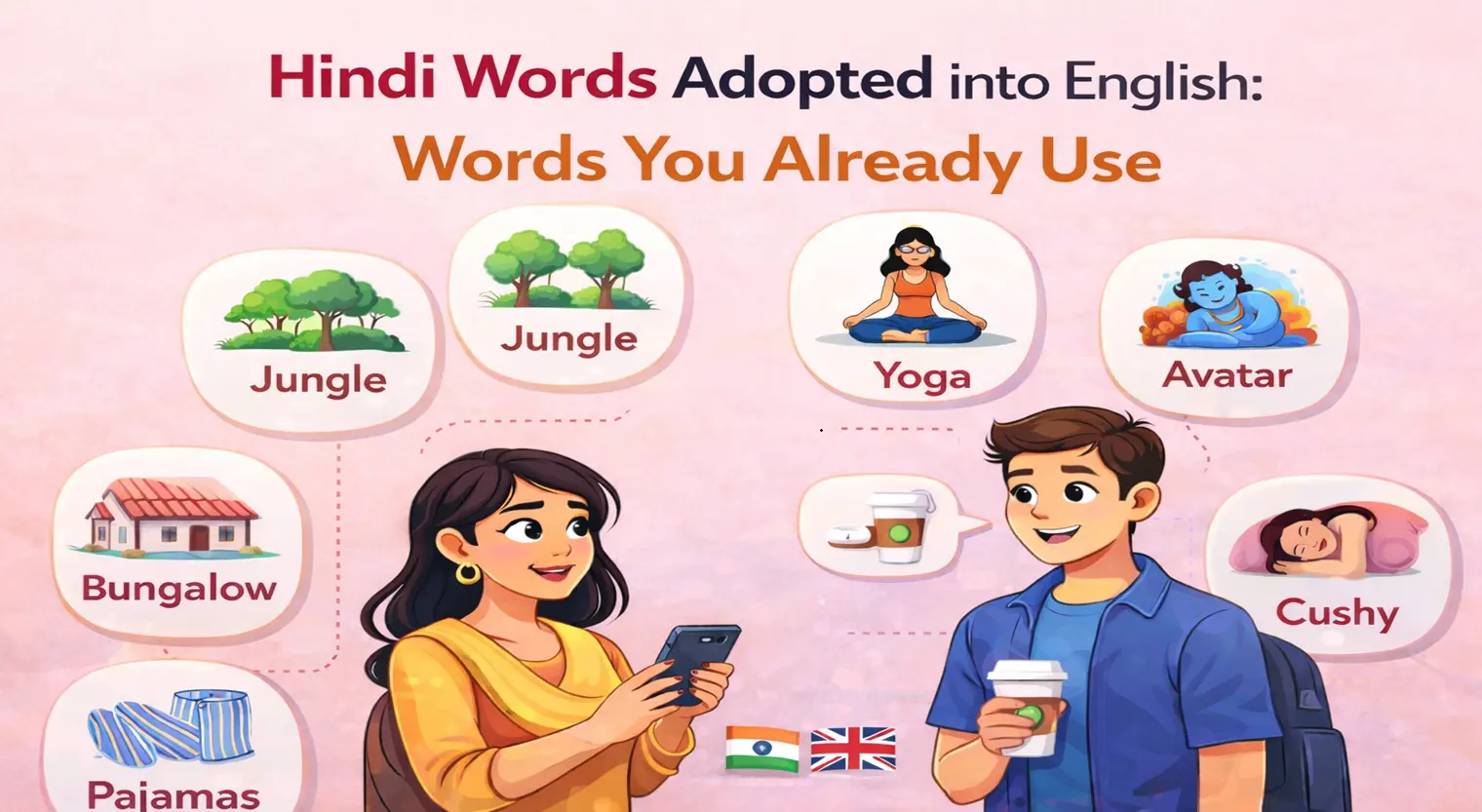
Language is a living, evolving force—one that grows richer every time cultures meet, interact, and influence one another. One of the greatest examples of this linguistic exchange is the close relationship between Hindi and English. For centuries, Hindi has contributed many words to the English language, some through direct borrowing, some through colonial history, and others through cultural influence, travel, literature, and cinema.
Today, many English speakers, whether in India, the UK, the US, or anywhere in the world, use Hindi-origin words every single day without realizing they are speaking Hindi. Words like shampoo, jungle, bungalow, pyjamas, and guru are now so deeply embedded in everyday English that most people don’t even pause to think about where they came from.
This blog explores the fascinating journey of Hindi words into the global English vocabulary, their historical background, the stories behind them, how they are used today, and why language borrowing remains one of the strongest bridges between cultures.
How did Hindi enter the English language historically?
To understand how Hindi words made their way into English, we need to explore the historical contexts that facilitated this exchange.
· The British Colonial Period
The most significant phase of borrowing happened during British colonial rule in India (17th to 20th century). As the British began trading, governing, and interacting with diverse Indian communities, they encountered new objects, foods, clothing styles, social structures, and cultural ideas—many of which did not exist in Europe. Naturally, they needed names for these unfamiliar things.
Hindi (and related languages like Urdu and Sanskrit) provided convenient words. Many of these terms travelled from:
· Daily conversation
· Administrative interactions
· Trade and commerce
· Military vocabulary
· Cultural practices
· Food and agriculture
These words began appearing in British letters, diaries, government records, and newspapers. Eventually, English dictionaries started recording them.
· Indian Culture’s Global Spread
Post-independence, as Indian culture, especially yoga, meditation, Bollywood, cuisine, and philosophy gained popularity across the world, more Hindi words entered English through:
· Cultural exchange
· Globalization
· Tourism
· Literature and media
· Migration
Words like chai, mantra, karma, and pundit became popular primarily through global interest in Indian traditions and wellness practices.
· The Influence of Bollywood and Indian Diaspora
Indian communities abroad have introduced colloquial Hindi words into cities like London, New York, Dubai, and Toronto. Terms such as masala, desi, bindi, and Gulab jamun are now widely recognized. In short, Hindi has shaped English because of both history and modern culture.
What are some everyday English words that come from Hindi?
You may be surprised to learn how many English words you use daily originated in Hindi. Here are some of the most common ones, along with their meanings and origins.
Jungle
- Hindi origin: Jangal
- Meaning in English: A dense forest or wild land
The British encountered India’s lush forests and adopted the Hindi word jangal to describe them. Today, “jungle” refers worldwide to untamed natural landscapes.
Shampoo
- Hindi origin: Champu (to massage)
- Meaning in English: To wash hair with soap or detergent
In India, champi refers to a head massage with oil. The British adapted the word, and its meaning slowly shifted to hair washing. Today, shampoo is one of the most widely used Hindi-origin words in English.
Bungalow
- Hindi origin: Bangla (a house in the Bengali style)
- Meaning in English: A small, single-storey house
Originally, bangla referred to houses built in Bengal with sloping roofs. The British adopted the structure—and the word—as "bungalow," which is now part of everyday English architecture terminology.
Pyjamas
- Hindi origin: Paayjama / Paijama
- Meaning in English: Loose-fitting sleepwear
The term was used for comfortable trousers tied at the waist. Today, “pajamas” (American spelling) refers to nightwear around the world.
Khaki
- Hindi/Urdu origin: Khak meaning “dust.”
- Meaning in English: A light brown or beige colour
British military uniforms in India were dyed with local dust to blend into the environment, hence the term “khaki,” now a global clothing colour.
Thug
- Hindi origin: Thag (a cheat or swindler)
- Meaning in English: A violent criminal
The original thags were organized highway robbers in India. The English word “thug” comes directly from them.
Veranda
- Hindi/Bengali origin: Varanda
- Meaning in English: A roofed platform along the outside of a house.
Common in Indian houses, the term was adopted by colonial architects and spread across the world.
Guru
- Hindi/Sanskrit origin: Guru (teacher)
- Meaning in English: A spiritual guide or expert
In modern English, “guru” can mean any expert, from a fitness guru to a tech guru.
Loot
- Hindi origin: Loot (to steal)
- Meaning in English: Stolen goods or to steal
The term became widely used in English during the colonial era but is now standard slang for money or earnings (“holiday loot,” “loot box,” etc.).
Chutney
- Hindi origin: Chatni
- Meaning in English: A spicy sauce or condiment
Chutney made its way into British cuisine centuries ago and remains a staple in global food culture. These are just the beginning; there are dozens more Hindi-origin words used worldwide.
What Hindi words are used in food and culture?
Indian food and culture have had a massive impact on the world. Many dish names, spices, garments, and cultural terms have been absorbed into English.
Words related to food-
- Chai – from chaay, meaning tea
- Masala – spice mix
- Curry – believed to come from kari (Tamil), but widely associated with Indian cuisine
- Dal – lentils
- Halwa – sweet dish
- Paan – betel leaf preparation
- Ghee – clarified butter
- Achaar – pickles
These words often appear unchanged in English menus, cookbooks, and restaurants—even outside South Asia.
Words for clothing and accessories-
- Sari / Saree
- Bindi
- Kurta
- Dhoti
- Chappal
- Bandana (from bandhna, meaning "to tie")
- Jooti / Jutti
Global fashion houses often use these words to describe Indian clothing styles.
Indian concepts adopted globally-
- Yoga, though in Sanskrit, is widely adopted through Hindi usage
- Mantra – sacred sound or phrase
- Karma – the principle of cause and effect
- Nirvana – spiritual liberation
- Sutra – rule or guideline
These terms entered English mainly through India’s spiritual and philosophical traditions.
What Hindi words are used in administration, objects, and everyday items?
Many administrative, agricultural, and everyday terms entered English during colonial governance.
Administrative and Military Terms
- Lathi – baton
- Sepoy – Indian soldier
- Jodhpurs – horseback riding trousers
- Adda – meeting place (now trendy in some Western media)
Household and Object Names
- Cot – from khat, meaning bed
- Bandh – embankment
- Bazaar – market (Persian origin but entered English primarily through Hindi usage)
- Charpoy – woven bed frame
These terms describe everyday items in Indian households that were unfamiliar to Europeans.
What are some popular Hindi words known worldwide today?
Globalization, Bollywood, and digital media have popularized many conversational Hindi words internationally.
Examples include-
- Desi – referring to the Indian subcontinent
- Bhai – brother
- Didi – sister
- Jugaad – a clever workaround
- Timepass – leisure activity or distraction
- TikTok ke zamane ka “swag” – Swag in English is often used alongside Hindi expressions
- Bollywood terms like item number, filmi, and masala movie
Tourists returning from India often pick up words like namaste, bazaar, and chai and use them in daily speech.
Why does English continue to borrow Hindi words?
English has always been a language that absorbs words from different cultures, and Hindi remains one of the most influential contributors. Even today, many Hindi terms continue entering everyday English. Here’s why-
- To describe unique cultural concepts- Some Indian ideas, traditions, foods, or objects do not have exact English equivalents. Words like chai, jugaad, paan, rangoli, and bindi express meanings that are difficult to translate into a single English word. Borrowing the original Hindi term becomes the easiest and most accurate way to communicate the idea.
- Growing global popularity of Indian culture- Indian cuisine, yoga, Ayurveda, Bollywood, meditation, festivals, and fashion have become global phenomena. As people outside India engage with these cultural elements, they naturally adopt the Hindi words associated with them, such as masala, namaste, guru, mantra, and karma.
- Influence of the Indian diaspora- Millions of Indians live in countries like the UK, USA, Canada, and Australia. Through daily communication, restaurants, cultural events, businesses, and media, the diaspora introduces Hindi expressions into the local English vocabulary. Words like desi, chai, biryani, and mehndi are now widely understood.
- Ease of communication in a globalized world- As India’s economic and cultural influence grows, English speakers worldwide encounter Hindi words more frequently in movies, travel blogs, social media, and international business. Borrowing these terms makes communication smoother and richer, especially when discussing Indian contexts.
- Digital media and pop culture- The internet has sped up language exchange. Viral videos, Bollywood songs, global collaborations, and cross-cultural humour often include Hindi words. Even global audiences now understand terms like yaar, swag, dhamaka, and jugnu, thanks to online content.
- English as a flexible, borrowing language- Historically, English has always absorbed words from other languages, Latin, French, Arabic, Persian, and Hindi. Borrowing makes English more expressive. Hindi words add flavour, uniqueness, and cultural depth to the language.
- Rising interest in Indian spirituality and wellness- Global interest in meditation, yoga, and mindfulness has increased the use of Hindi/Sanskrit-derived words such as karma, dhyana, nirvana, prana, sutra, and asanas. These terms are now standard in wellness communities worldwide.
Tell about the fascinating stories behind some popular Hindi loanwords
Some Hindi-English borrowings have incredible histories. Here are a few-
- The Curious Case of “Shampoo”- Originally, champi meant a head massage, usually with warm oil. Europeans who visited India fell in love with this relaxing treatment. Gradually, “massage” turned into “washing the hair,” and the word evolved into “shampoo.” Interestingly, early English dictionaries defined shampoo as “to knead or massage,” not “to wash.”
- “Jungle” and the Colonial Imagination - For British officers, Indian forests were unlike anything they had encountered in Europe. The animals, climate, and terrain inspired adventure literature, leading to the global popularity of the term and giving rise to imagery like “jungle safari.”
- “Bungalow”: A house style that traveled the world. In the 1800s, British officials used single-storey houses built in the Bengal style, known as Bangla. These became summer retreats in England, fashionable cottages in America, and even influenced modern Western suburban design.
- “Loot”: From Indian roads to global slang- Originally meaning “plunder,” loot appears frequently in British accounts of Indian battles. Eventually, it became slang for money, earnings, or even rewards.
| Explore More | How do you learn English vocabulary fast and easily | 50 difficult English words 2025: Meaning, Synonyms, Antonyms| Spoken English in Hindi translation apps |
Hindi Loanwords in Modern English Literature and Media-
English today is a global language, shaped by centuries of cultural exchange. One of its richest influences comes from Hindi and other Indian languages. In modern English literature and media, Hindi loanwords are not just occasional additions; they help convey cultural depth, authenticity, and emotional nuance that English words alone sometimes cannot express.
- Cultural authenticity in literature- Contemporary authors often use Hindi loanwords to portray Indian settings and characters more realistically. Writers like Salman Rushdie, Arundhati Roy, Jhumpa Lahiri, and Rohinton Mistry frequently include words such as bazaar, chai, pukka, guru, and sahib. These terms add local color and cultural texture, allowing readers to experience Indian life more vividly without lengthy explanations.
- Expressing Concepts Beyond Direct Translation- Some Hindi words capture ideas that are difficult to translate precisely into English. Words like karma, dharma, guru, and maya convey philosophical and spiritual meanings deeply rooted in Indian thought. Modern writers and thinkers use these terms directly because English equivalents often fail to express their full depth.
- Influence in films and television- Hindi loanwords are increasingly common in global films, web series, and television shows. Words such as jungle, bungalow, pyjamas, and thug appear naturally in dialogues without viewers realizing their Indian origins. In shows set in South Asia or featuring Indian characters, terms like chai, yaar, and namaste are used to reflect everyday speech and cultural identity.
- Hindi words in global journalism and media- International news outlets and documentaries regularly use Hindi-derived words such as bandh, guru, yoga, and ashram when reporting on Indian politics, spirituality, and society. These words have become part of the global media vocabulary, requiring little or no explanation for international audiences.
- Popular culture and social media- In modern pop culture, Hindi loanwords thrive on social media, music, and advertising. Terms like desi, chai, jugaad, and karma are widely used in captions, memes, podcasts, and brand campaigns. Their popularity reflects growing global curiosity about Indian culture and the influence of the Indian diaspora.
- Children’s Literature and educational texts- Many modern children’s books and educational materials include Hindi words to promote cultural awareness and diversity. Words like diya, roti, rangoli, and puja are often retained in English texts to familiarize young readers with Indian traditions and everyday life.
Why are Hindi loanwords continuing to grow in English?
The rise of Indian authors writing in English, global migration, digital media, and India’s cultural visibility have all contributed to the spread of Hindi loanwords. Rather than replacing English, these words enrich it, making modern English more inclusive, expressive, and globally representative. Moreover, writers like Rudyard Kipling, E.M. Forster, and Mark Twain used Hindi words in their works. Today, Indian authors writing in English—such as Arundhati Roy, Salman Rushdie, Jhumpa Lahiri, and Chetan Bhagat—continue the trend by using Hindi expressions in dialogue and storytelling, making them familiar to global audiences.
Hollywood movies also use Hindi words, especially:
- Namaste
- Guru
- Karma
- Avatar (Sanskrit but popularized through Indian culture)
Even American sitcoms like The Big Bang Theory introduced words like mitai, diwali, and chai to Western viewers.
How do Hindi borrowings enrich English?
English is often described as a “borrowing” language, constantly absorbing words from cultures it encounters. Hindi, one of the most influential contributors, has enriched the English vocabulary by adding cultural depth, expressive power, and a global perspective.
- Adding cultural depth and context- Hindi borrowings bring cultural meaning that cannot always be conveyed through native English words. Terms like bazaar, guru, ashram, and chai instantly evoke Indian social life, spirituality, and everyday habits, helping English express experiences tied to a specific culture.
- Filling lexical gaps- Many Hindi words entered English because no exact equivalents existed. Words such as karma, jungle, bungalow, and pyjamas filled gaps in English vocabulary, offering precise terms for new ideas, landscapes, and lifestyles encountered through cultural contact.
- Enhancing expressiveness and style- Hindi loanwords often add color and emotion to English writing and speech. Words like jugaad, desi, and masala are frequently used metaphorically in modern English to suggest creativity, identity, or a mix of elements, making language more vivid and flexible.
- Strengthening global communication- As English evolved into a global language, Hindi borrowings helped it reflect multicultural realities. These words enable speakers from different backgrounds to connect through shared vocabulary, reinforcing English as an inclusive and internationally adaptable language.
- Influencing literature, media, and pop culture- From novels and films to journalism and social media, Hindi words are used naturally to create authenticity and realism. Their presence in global media normalizes cultural diversity and broadens readers’ and viewers’ understanding of Indian traditions and perspectives.
- Reflecting historical and social exchange- Hindi borrowings also tell stories of history, trade, colonization, migration, and globalization. Words like loot, thug, and sahib reflect historical encounters, while newer borrowings show ongoing cultural exchange in the modern world.
Will more Hindi words enter English in the future?
Absolutely. With India’s growing cultural, economic, and demographic influence, more Hindi expressions are entering global conversations. Words from Indian pop culture like-
- jugaad
- dhaba
- gully cricket
- rangoli
They are already trending among global youth. However, digital platforms, Bollywood, travel content creators, and the South Asian diaspora will continue spreading Hindi vocabulary worldwide.
Conclusion-
Language is a powerful storyteller, carrying tales of history, culture, and human connection. The journey of Hindi words into the English language reflects centuries of interaction from colonial encounters to modern globalization. Today, words like shampoo, jungle, pajamas, chutney, guru, and chai fit so naturally into everyday English that most speakers rarely notice their Indian roots. Yet, each of these words quietly carries a piece of India with it, a tradition, an object, a flavour, a philosophy, or a story born on the subcontinent.
As Indian cuisine, cinema, yoga, literature, and digital culture spread across the globe, Hindi continues to offer expressive and meaningful vocabulary to English speakers everywhere. This linguistic exchange proves that languages do not exist in isolation; they grow together, shape one another, and create richer forms of expression. The Hindi words we already use are more than borrowed terms; they are reminders of India’s deep cultural influence and the natural blending of cultures in a connected world. And as the world becomes even more globalized, the list of Hindi words in English will only continue to grow.
FAQs
Q1. What are Hindi loanwords in English?
Ans- Hindi loanwords are words borrowed from Hindi that are now commonly used in English vocabulary.
Q2. Why did English adopt words from Hindi?
Ans-English adopted Hindi words due to historical contact, trade, colonization, and cultural exchange.
Q3. Is “jungle” really a Hindi word?
Ans-Yes, jungle comes from the Hindi word jangal, meaning forest or wild land.
Q4. Where does the word “bungalow” come from?
Ans-Bungalow originates from Bangla, referring to a house built in the Bengali style.
Q5. How is “shampoo” connected to Hindi?
Ans- The word comes from chāmpo, meaning to massage or knead, a traditional Indian practice.
Q6. Is “guru” used in the same way in English as in Hindi?
Ans-Not exactly. In Hindi, a guru is a spiritual teacher, while in English, it also means an expert.
Q7. Which common clothing word in English comes from Hindi?
Ans-Pyjamas comes from pāy-jāma, meaning loose trousers worn in South Asia.
Q8. Does “loot” have Indian origins?
Ans-Yes, loot comes from the Hindi word lūṭ, meaning to plunder or steal.
Q9. Are food-related Hindi words used in English?
Ans-Yes, words like chai, chutney, and curry are widely used in English today.
Q10. Why do we use these Hindi words without realizing it?
Ans- We use these Hindi words without realizing it because they have become fully naturalized in English through long-term everyday use.
Q11. Which Common Hindi Words in English like Hinglish?
Ans- Desi, Jugaad, Yaar, Fatafat, Accha, Pakka, Fundas, Masti, Guru, Pundit, Loot, Bungalow, Shubh Naam, Prepone.
If you want a blog on Hinglish, Hindi in English words, please write a comment!






Leave a Comment
Your email address will not be published.