
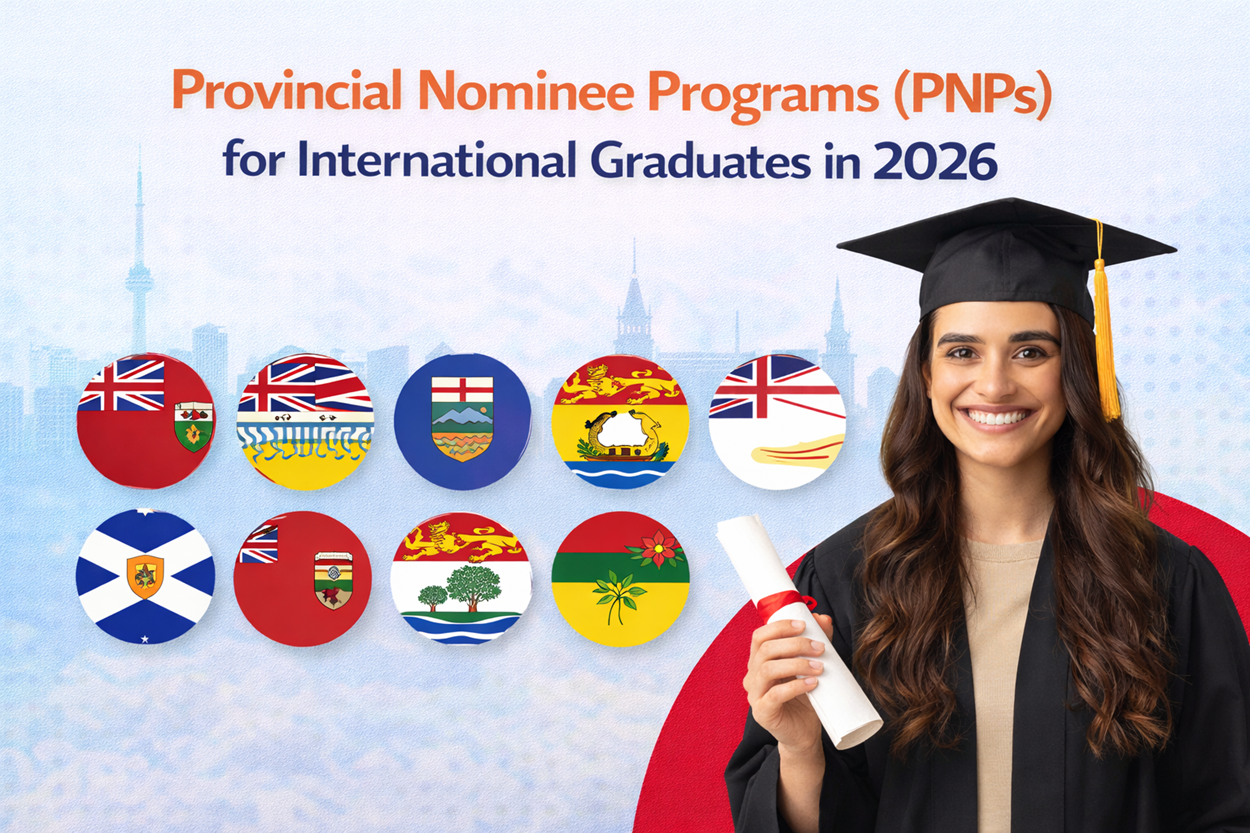
For international graduate individuals who are intent on making Canada a permanent place of residence, the process does not end after graduation. Most cases lead further, and the concentration of the intent is on how this can be related and linked to making the experience in Canada a permanent residence. In this way, one of the main methods is Provincial Immigration Systems. These methods, which lead to Provincial Nominee Programs, help provinces in Canada nominate immigrants who are willing to stay in a province and also meet some of the labor and settlement requirements.
As we look forward to the year 2026, the landscape of the International Graduate streams of PNPs is constantly in motion. Some of the programs are either being expanded or modified, and others are stagnant due to changes in the quota size, changes in the labor market, or several reforms. Through this blog, we will take you through the PNPs for International Graduates, the top international graduate programs you need to be aware of, what to look out for in terms of eligibility criteria for the year 2026, the application strategies you need to adhere to, and what to look out for in terms of pitfalls.
Why PNPs matter for international graduates?
· A Direct Pathway to Permanent Residency- Provincial Nominee Programs (PNPs) give international graduates a clear and faster route to permanent residency (PR) compared to federal immigration options. Many provinces nominate graduates who have studied and lived locally, allowing them to apply for PR even with moderate Comprehensive Ranking System (CRS) scores. This direct link between education and immigration helps students plan long-term settlement in Canada confidently.
· Recognition of Canadian Education and Local Experience- PNPs value candidates who have earned a Canadian degree or diploma and gained work experience in the same province. Graduates are considered well-integrated into the community and familiar with the local work culture. This gives them an edge over foreign applicants with no prior Canadian connection. Provinces aim to retain this talent to strengthen their local economies.
· Lower CRS Score Requirements and Greater Flexibility- Compared to Express Entry, PNPs offer more flexibility and lower CRS thresholds. Many provinces award additional points or direct nominations to graduates in high-demand fields such as healthcare, technology, and skilled trades. For example, students who studied in provinces like Saskatchewan, Nova Scotia, or Manitoba often find it easier to qualify for nomination due to regional labour shortages.
· Strong Connection Between Education and Employment- PNPs bridge the gap between study and professional employment. They encourage graduates to gain local work experience through co-ops, internships, or PGWPs in the same province. This local engagement not only builds skills but also demonstrates a graduate’s commitment to contributing to the provincial economy, a key selection criterion in most PNP streams.
· Targeted Opportunities Across Provinces- Each province tailors its PNP streams to meet specific economic needs. For example-
o Ontario focuses on tech, business, and healthcare sectors.
o British Columbia targets skilled professionals in IT, hospitality, and engineering.
o Manitoba and Saskatchewan prioritize graduates with job offers in regional industries.
o This ensures that international graduates can find niche opportunities aligned with their academic background and career goals.
· Stability and Security for Post-Graduation Plans- For many students, planning life after graduation can be uncertain. PNPs offer stability and assurance, allowing graduates to stay and work in Canada without depending solely on Express Entry draws. Provincial pathways provide a realistic and structured transition from study to permanent settlement, reducing anxiety about future immigration prospects.
· Encouragement for Regional Settlement and Growth- PNPs encourage international graduates to settle in smaller cities and rural regions, helping distribute skilled talent across Canada. Provinces like New Brunswick and Prince Edward Island actively promote their PNPs to attract young professionals. This regional distribution benefits both graduates (through easier PR access) and communities that need skilled labour to sustain economic growth.
· Support for Canada’s Labour Market Needs- Through PNPs, provinces align immigration with local labour shortages. Graduates trained in Canadian institutions are already equipped with the skills and cultural understanding needed to fill these gaps efficiently. Fields such as nursing, renewable energy, AI, and skilled trades are among the top sectors where PNP graduates are in demand.
· Protection Against Policy Uncertainty- Immigration policies can change at the federal level, affecting Express Entry or PGWP rules. However, PNPs offer a more stable alternative because provinces adjust their programs independently. Graduates who plan early and stay informed about their province’s nomination criteria can secure a path to PR even when national policies tighten.
· Long-Term Benefits for Graduates and Provinces Alike- For international graduates, PNPs lead to career stability, permanent status, and social inclusion. For provinces, they bring long-term economic benefits through a steady supply of skilled, educated, and diverse professionals. This mutual advantage makes PNPs a cornerstone of Canada’s regional development and immigration success.
Explore More: Top Countries That Offer Permanent Residency (PR) After Postgraduate Studies
Key Provinces and Streams for International Graduates in 2026
Here are some of the central provinces with international graduate streams under their PNPs, with updated conditions and notes for 2026
- Ontario (Ontario Immigrant Nominee Program – OINP)- Ontario remains one of the most active jurisdictions for international graduate streams. Key streams relevant for graduates include:
o Employer Job Offer: International Student Stream for recent graduates with a full-time job offer in Ontario (NOC TEER 0,1,2,3).
o Master’s Graduate Stream for those who completed a Master’s degree in Ontario; no job offer is required.
o PhD Graduate Stream for graduates with a PhD from an eligible Ontario university; no job offers required.
o Eligibility often includes proof of residence in Ontario for a specific period (e.g., 1 year in the past 2 years) and meets language, education, and settlement requirements.
- Prince Edward Island (PEI) (PEI Provincial Nominee Program)- PEI offers an “International Graduates” stream that is relatively accessible for graduates of public institutions in PEI who have a full-time job offer from a PEI employer. The advantages include lower language requirements (e.g., CLB 4 for some occupations) and a focus on retaining graduates in the local economy.
- Saskatchewan (Saskatchewan Immigrant Nominee Program – SINP)- Saskatchewan offers the “Worker with Saskatchewan Work Experience – Student Sub-category” for graduates who studied in a designated institution in Saskatchewan and now hold a full-time job offer from a Saskatchewan employer (NOC TEER 0-3 or designated trade). This stream is notable for its relatively accessible eligibility (including a valid PGWP or open work permit) and strong results for those willing to settle in Saskatchewan.
- Nova Scotia (Nova Scotia Nominee Program – NSNP)- Nova Scotia has the “International Graduates in Demand” stream and “International Graduate Entrepreneur” stream for recent graduates of eligible Nova Scotia institutions. Job offers are required in demand occupations for the first stream; business ownership is required for the entrepreneur stream. This is a possible route for graduates in Atlantic Canada who want a smaller-scale community setting.
- New Brunswick (New Brunswick Provincial Nominee Program – NBPNP)- In New Brunswick, there is a “New Brunswick Graduates Pathway” and a “Private Career College Graduate Pilot Program” for graduates of specific private career colleges, especially those who may not qualify for a PGWP. These streams highlight that smaller provinces are increasingly creating customized pathways for graduates, especially in sectors like healthcare, logistics, education, and business administration.
- British Columbia (British Columbia Provincial Nominee Program – BC PNP)- BC has been a flagship province for graduate streams. However, as of 2025 and moving into 2026, the BC PNP’s previous “International Graduate” and “International Post-Graduate” streams have been discontinued or paused. BC announced planned new streams (“Bachelor’s Stream”, “Master’s Stream”, “Doctorate Stream”) starting Jan 2025, but as of 2025, they remain suspended due to overall nomination allocation issues. Graduates considering BC must monitor developments closely.
Eligibility Criteria for Graduate-PNP Streams (2026)-
While each province and stream has its own criteria, there are standard features to watch for:
Common Requirements
- Graduated from an eligible Canadian post-secondary institution within the province (typically within the last 3 years) or met the program’s graduate timeframe.
- Hold a valid work permit, often an open work permit under PGWP. Or a job offer, depending on the stream.
- A job offer may be required in many streams (especially where employment is a key retention factor). The job often must be full-time, indeterminate/permanent (or for a specified minimum duration, e.g., 1-2 yrs), and in a skilled occupation (NOC TEER 0-3 or designated trades).
- Language proficiency (Canadian Language Benchmark [CLB]) at the required level — streams increasingly raise language requirements (e.g., CLB 7 or CLB 8), especially for higher degrees.
- Demonstrated intent to reside in the province, and sometimes proof of settlement funds.
- Some streams require you to live and work in the province for a specified period before nomination (for example, be employed full-time).
- Specific stream conditions may involve program length, level of credential (Bachelor’s, Master’s, PhD), field of study, or employer eligibility.
Key Trends for 2026-
- Provinces are gravitating toward giving priority to higher credentials (Bachelor’s, Master’s, PhD) rather than short-term diplomas/certificates. For example, BC’s proposed new streams exclude diploma/certificate programs for international graduates.
- More provinces require full-time employment or a job offer for graduate streams, reflecting the emphasis on retention and labour contribution.
- Some provinces may exclude PGWP-ineligible programs from graduate-stream eligibility.
- EOI (Expression of Interest) systems are used in many provinces: you register a profile, are invited to apply, and then submit a full application.
- Graduate streams are becoming more competitive, with limited province/territory allocation of nomination spots. Graduates must act early and strategically.
Application Strategy for 2026: What Graduates Should Do?
Here’s a step-by-step strategy you should follow if you are an international graduate aiming to secure PR via a PNP in 2026.
- Step 1: Research and target the proper province & stream- Look into which provinces have open graduate-PNP streams, check their current eligibility criteria, job-offer requirements, language levels, and whether the stream is actively issuing ITAs or currently paused. For example, BC currently has its graduate streams paused. Ensure you pick a province where your profile aligns.
- Step 2: Graduated from an eligible program & institution- Ensure your study credential is from a recognized/designated institution in the province and you meet time-limits (e.g., graduated within the past 3 years). Gather transcripts, proof of completion, PGWP eligibility (if required) and other documents.
- Step 3: Secure a qualifying job offer where needed- If your chosen stream requires a job offer, aim for full-time employment in a skilled occupation (TEER 0-3 or a designated trade). Confirm with the employer that the job offer meets the requirements of the stream (duration, permanence, NOC code).
- Step 4: Meet language and settlement criteria- Take an approved language test (IELTS, CELPIP, etc) and obtain scores meeting or exceeding the required CLB level. Gather proof of funds if required by the stream. Demonstrate your intent to live permanently in that province.
- Step 5: Register and wait for invitation (if EOI system applies)- If your province uses an Expression of Interest (EOI) system, register your profile, select the correct stream, review required point-score thresholds or draw history, and wait for an Invitation to Apply (ITA). Once you get ITA, submit a complete application with supporting documents before the deadline.
- Step 6: Prepare supporting documentation meticulously- Compile your resume/CV, job offer letter, employer letter, proof of graduation, transcripts, work permit/PGWP, proof of current employment, language test results, settlement funds, and evidence of ties (residence/living in province). Double-check eligibility, ensure accurate NOC codes.
- Step 7: Monitor quotas and processing timelines- Be aware that provincial nominations are limited and draw volumes may vary. A stream may pause or change criteria (as seen in BC). Monitor official provincial PNP announcements and act early. Also, prepare for some wait time.
- Step 8: After nomination – apply for permanent residence- Once you receive a provincial nomination, you will apply to the federal government (Immigration, Refugees and Citizenship Canada, IRCC) for permanent residence. This often involves additional medical, security/background checks and obtaining or maintaining proper status while waiting. Being nominated often gives you a significant boost in Express Entry or may allow a non-Express Entry application, depending on the stream.
Recent Changes and 2026-Focused Developments-
It’s essential to be up-to-date because many changes have occurred recently, and 2026 will have further refinements.
- In British Columbia, the International Graduate and International Post-Graduate streams have respectively closed and been paused, with new streams (Bachelor’s, Master’s, Doctorate) planned for 2025–26. But as of now, the streams are suspended due to reduced nomination allocation.
- Provinces are prioritizing higher-level graduates (Bachelor’s and above) and sometimes excluding diploma and certificate programs for graduate-PNP streams.
- Some provinces are introducing pilot programs specifically targeting private college graduates who may not qualify under the PGWP or other federal streams (e.g., New Brunswick’s Private Career College Graduate Pilot).
- Given federal caps on nomination allocations and shifting labour demands, provinces may revise eligibility, pause draws, or change criteria — meaning that graduate PNPs are more dynamic and competitive than before.
- For 2026, candidates should expect stronger job/skills requirements, more emphasis on employment in-province, community settlement, and faster tracking of labour-market outcomes by provinces.
- Monitoring draw history and quotas is essential; fewer spots may drive more competition and faster closures of streams.
Challenges and things to watch for (PNPs) for international graduates in 2026-
Even though graduate-PNP streams offer strong opportunities, there are pitfalls and considerations you must keep in mind.
- Evolving Immigration Policies- Immigration rules and eligibility criteria under PNPs continue to change as provinces align their nomination systems with local labor market needs. Graduates must remain attentive to official updates to avoid missing new requirements. Additionally, each province operates under specific nomination caps and quotas, which may fill quickly. When the quota is reached, applications may be paused until the next intake cycle, causing delays for prospective applicants.
- Province-Specific Eligibility Criteria- Every province has unique rules for its PNP streams. A candidate eligible in British Columbia may not meet the criteria in Saskatchewan due to differing job offer, education, or language requirements. Furthermore, many provinces prefer applicants who already have a connection to the region—such as prior education, work experience, or family ties. Graduates without such links may find it harder to secure nominations.
- Job Offer and Employment Requirements- A valid job offer remains a cornerstone for most PNPs targeting international graduates. However, obtaining such offers can be challenging due to competitive labor markets. Moreover, not all employers qualify to support immigration nominations. Graduates must verify that their employer meets the program’s eligibility conditions to avoid complications later.
- Work Experience Limitations- Fresh graduates often have limited post-study work experience, whereas many PNPs demand six months to one year of professional employment before applying. It is also vital that this experience matches the eligible National Occupational Classification (NOC) codes, as mismatched roles may lead to ineligibility.
- Proof of Settlement Funds- Some provinces ask for evidence of sufficient funds to ensure the applicant can sustain themselves during settlement. It can be challenging for new graduates who are still establishing financial independence. Fund requirements also vary depending on the province and family size, so careful financial planning is essential.
- Competition and Processing Times- With growing numbers of international graduates applying, PNP nomination draws are becoming increasingly competitive, especially in provinces like Ontario and British Columbia. Consequently, processing times for both provincial nominations and federal permanent residency applications can be lengthy, testing applicants’ patience.
- Provincial Retention Expectations- Provinces nominate candidates, expecting them to live and work locally for the long term. Moving to another province soon after receiving permanent residency can raise questions about the applicant’s intent to stay. To ensure retention, authorities often monitor settlement patterns and employment consistency.
- Balancing Federal and Provincial Pathways- Navigating between provincial and federal immigration pathways can be confusing. Some PNPs are linked with Canada’s Express Entry system, offering faster processing, while others use traditional paper-based applications that take longer. Graduates must understand how each pathway impacts their Comprehensive Ranking System (CRS) score and overall timeline.
- Language Proficiency Requirements- Certain provinces, such as Quebec and Nova Scotia, demand higher English or French language test scores. Moreover, test results like IELTS or CELPIP must remain valid throughout the application process; expired results can lead to delays or disqualification.
- Educational Credential Recognition- Provinces tend to prioritize applicants who studied within their borders. Graduates from other provinces or those holding additional foreign degrees may need an Educational Credential Assessment (ECA) to validate their qualifications, adding another layer of documentation.
- Post-Graduation Work Permit (PGWP) Expiry- The PGWP, typically valid for up to three years, gives graduates time to gain work experience and apply for PNPs. However, if the process takes too long, there’s a risk of losing valid status in Canada. Managing application timelines within the PGWP period is crucial.
- Documentation and Application Accuracy- PNP applications are document-heavy and demand precision. Missing papers or incorrect details can lead to outright rejection. Applicants must also demonstrate genuine intent to settle in the province through employment records, housing arrangements, or community involvement.
- Cost and Financial Planning- Applying for PNPs can be expensive, with separate provincial and federal fees, medical exams, and document verification costs. During this waiting period, graduates must also cover living expenses, making financial preparation vital for a stress-free process.
- Changes in Labor Market Demand- Provinces update their occupation lists based on evolving labor needs. A profession in demand today may be removed tomorrow, affecting eligibility. Economic fluctuations or sector-specific downturns can further complicate employment opportunities.
- Navigating the Transition to PR- After receiving a provincial nomination, graduates may apply for a Bridging Open Work Permit (BOWP) while waiting for permanent residency. However, any delay in this process may disrupt employment continuity, emphasizing the need to maintain a valid status until PR approval.
- Regional and Rural Program Challenges- Regional and rural PNP streams offer faster nominations but come with limitations such as fewer job opportunities, smaller communities, and limited amenities. Adjusting to these environments may be difficult for graduates used to urban lifestyles.
- Documentation of Work and Study History- Work records, pay slips, and tax forms must accurately match job descriptions under the NOC system. Likewise, study-related documents—such as transcripts and completion letters must be authentic and up to date to ensure credibility.
- Technology and Application Portal Issues- Technical errors in online portals can delay submissions, especially during peak periods. Incorrectly formatted or incomplete uploads can also hinder successful submission, making attention to detail crucial.
- Awareness and Professional Guidance- Many graduates misinterpret immigration requirements due to unreliable online sources. Consulting certified immigration advisors or official government portals ensures accuracy and prevents costly mistakes.
- Emotional and Planning Stress- The uncertainty of long processing times and frequent policy shifts often causes anxiety. Balancing career progression, financial responsibilities, and immigration timelines demands patience, resilience, and proper planning for long-term success.
Practical tips for success in 2026-
Here are some practical tips to give you the best chance of success with a graduate-PNP in 2026.
- Start early: From job search to getting your documents ready, start your planning well before graduation.
- Choose the proper province: Consider the cost of living, job opportunities, settlement support, and stream accessibility. Some provinces may offer more favorable conditions for specific fields.
- Secure employment: If a job offer is required, aim for a job that meets NOC TEER 0-3 or a designated trade and is related to your study field.
- Stay in the province: In many streams, you must reside and work in the province; moving elsewhere may affect eligibility.
- Maintain legal status: Make sure you have a valid work permit (often PGWP) while applying.
- Keep all records: Transcripts, proof of graduation, job offer letters, employer compliance letters, and proof of residence — these will matter when you apply.
- Upgrade language skills: If your stream demands a higher CLB level, don’t wait — prepare and take the test early.
- Monitor quota and draw dates: Streams may close or pause; be ready to act fast.
- Explore alternate provinces: If your first-choice province pauses its stream, have a backup province in mind.
- Consider entrepreneurship streams: Some provinces have graduate-entrepreneur tracks for those wanting to start or buy a business in the province.
- Use qualified advice: Immigration policy is complex and dynamic. Use credible and licensed immigration consultants or lawyers if you’re unsure.
- Demonstrate settlement intention: Provinces want you to live and contribute locally — show your ties, your plan, your understanding of the local labour market.
- Stay updated: Policy, quotas, and draw criteria change; check provincial PNP websites regularly and keep abreast of changes.
Future of PNP: What to expect in 2026 and beyond?
The trends for graduate-PNP streams suggest several developments for 2026:
- A tightening of slots and increased competition due to fewer provincial nomination allocations and more substantial labour-market alignment.
- Higher credential levels will likely be favoured (Bachelor’s and up) over certificates and short courses.
- Provinces will continue shifting toward job-offer and work-experience-based criteria rather than purely “recent graduate” status.
- Some provinces may introduce regional or rural-based graduate streams to retain talent outside major metro areas.
- More rigorous verification and documentation of job offer, employer eligibility, work experience, and residence compliance.
- Streams may increasingly be tailored for sector-specific needs (e.g., healthcare, trades, IT) rather than broad-based graduate access.
- Graduates must be nimble: if your chosen stream closes or the criteria shift, have backup options (another province, alternate stream).
- Monitoring federal immigration targets, quota changes, and provincial allocations will become even more critical to your strategy.
Conclusion
In 2026, PNPs remain a vital and realistic pathway for international graduates in Canada to transition from student to permanent resident. But the environment is more competitive and sophisticated than in previous years. The key to success lies in choosing the proper province, aligning your job and credential profile with eligibility, acting early, and ensuring you fulfil all documentation and residence requirements. While policies are evolving, the underlying opportunity remains strong: you studied in Canada, you’ve integrated into the community, you’ve worked, and a province recognizes your potential to stay and thrive. With careful planning, the graduate-PNP route can turn your Canadian study dream into a long-term reality.
FAQs
Q1. What is a Provincial Nominee Program (PNP)?
Ans: A PNP allows Canadian provinces and territories to nominate skilled workers and international graduates for permanent residency based on their local labour market and economic needs.
Q2. Why are PNPs important for international graduates in 2026?
Ans: PNPs offer graduates a faster, region-specific route to permanent residency, mainly if they studied or worked in that province.
Q3. Do you need a job offer to apply for a PNP as a graduate?
Ans: In most provinces, yes, a valid job offer from a local employer increases eligibility. However, some provinces like Ontario and Nova Scotia have streams for graduates without job offers.
Q4. Can you apply for a PNP while holding a Post-Graduation Work Permit (PGWP)?
Ans: Yes. PGWP holders are ideal candidates for PNPs as they can gain local work experience and meet residency requirements before applying.
Q5. Which provinces are most popular for international graduate PNPs?
Ans: Ontario, British Columbia, Manitoba, Saskatchewan, and Nova Scotia lead in offering dedicated international graduate streams with clear PR pathways.
Q6. How long does the PNP process take in 2026?
Ans: Processing times vary by province but generally take 6 to 12 months after nomination, depending on your profile and IRCC workload.
Q7. Can international graduates apply to a PNP in a province different from where they studied?
Ans: Yes, but you must show intent to live and work in that province and meet its eligibility criteria. Most programs prefer applicants who have local ties.
Q8. Do all PNP nominations guarantee permanent residency?
Ans: A provincial nomination greatly increases your chances but does not automatically guarantee PR. You must still pass federal immigration checks by the IRCC.
Q9. Are master’s and PhD graduates given preference under PNPs?
Ans: Yes. Many provinces, including Ontario and British Columbia, have dedicated streams for master’s and PhD graduates, often without requiring job offers.
Q10. Can PNP graduates eventually apply for Canadian citizenship?
Ans: Yes. Once you become a permanent resident and meet the residency requirement (usually 3 years), you can apply for Canadian citizenship.



Leave a Comment
Your email address will not be published.