
Words are the building blocks of language, and understanding their structure helps us speak, write, and comprehend more effectively. Among the different classifications of words, monosyllabic and polysyllabic words are two basic but essential categories. This blog will explain what these terms mean, their characteristics, usage, significance, and how mastering them can improve your language skills, especially in reading, writing, and pronunciation.
What are syllables?
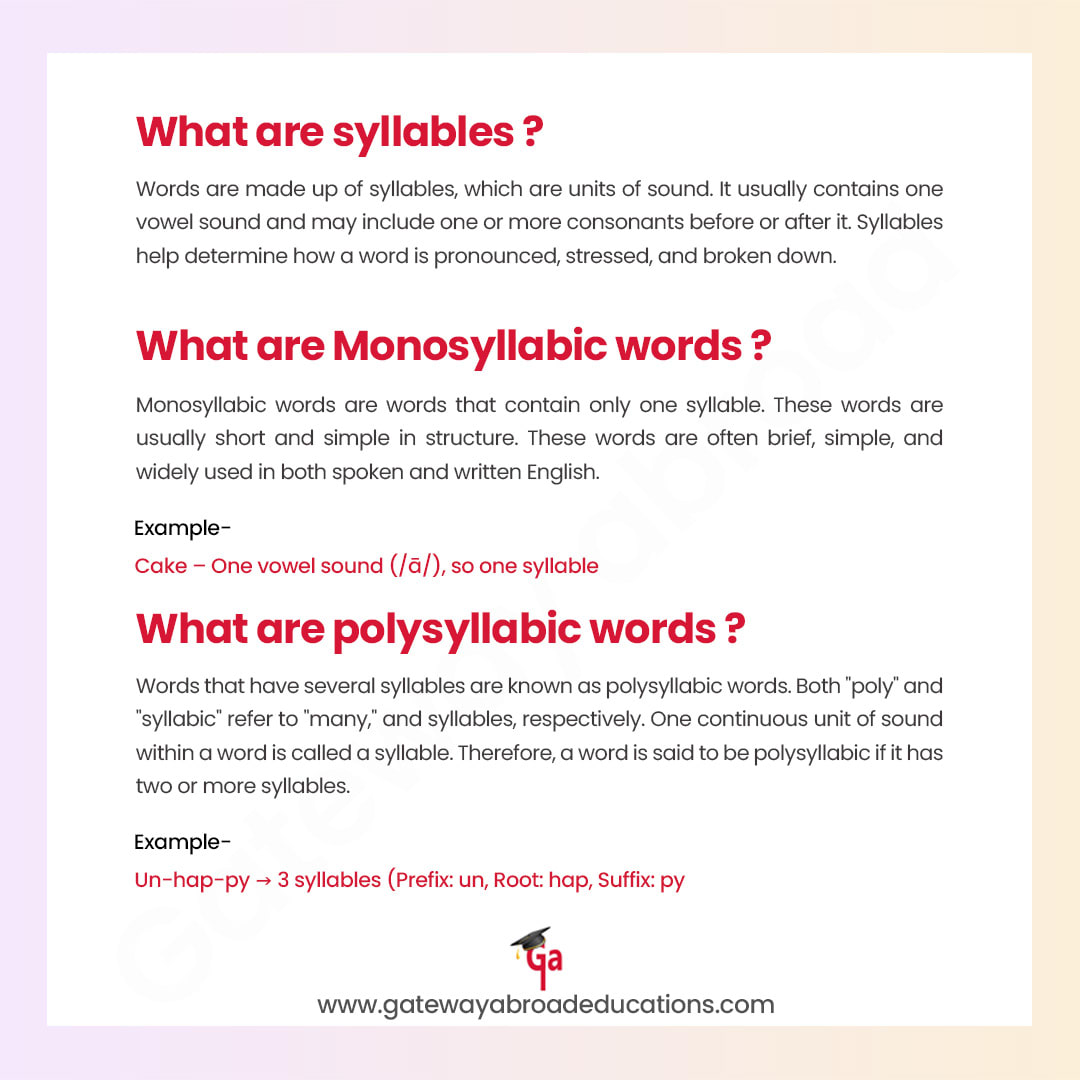
Words are made up of syllables, which are units of sound. It usually contains one vowel sound and may include one or more consonants before or after it. Syllables help determine how a word is pronounced, stressed, and broken down. For example
- Cat has one syllable.
- Happy has two syllables: hap-py.
- Elephant has three syllables: el-e-phant.
What are Monosyllabic words?
Monosyllabic words are words that contain only one syllable. These words are usually short and simple in structure. These words are often brief, simple, and widely used in both spoken and written English.
Examples
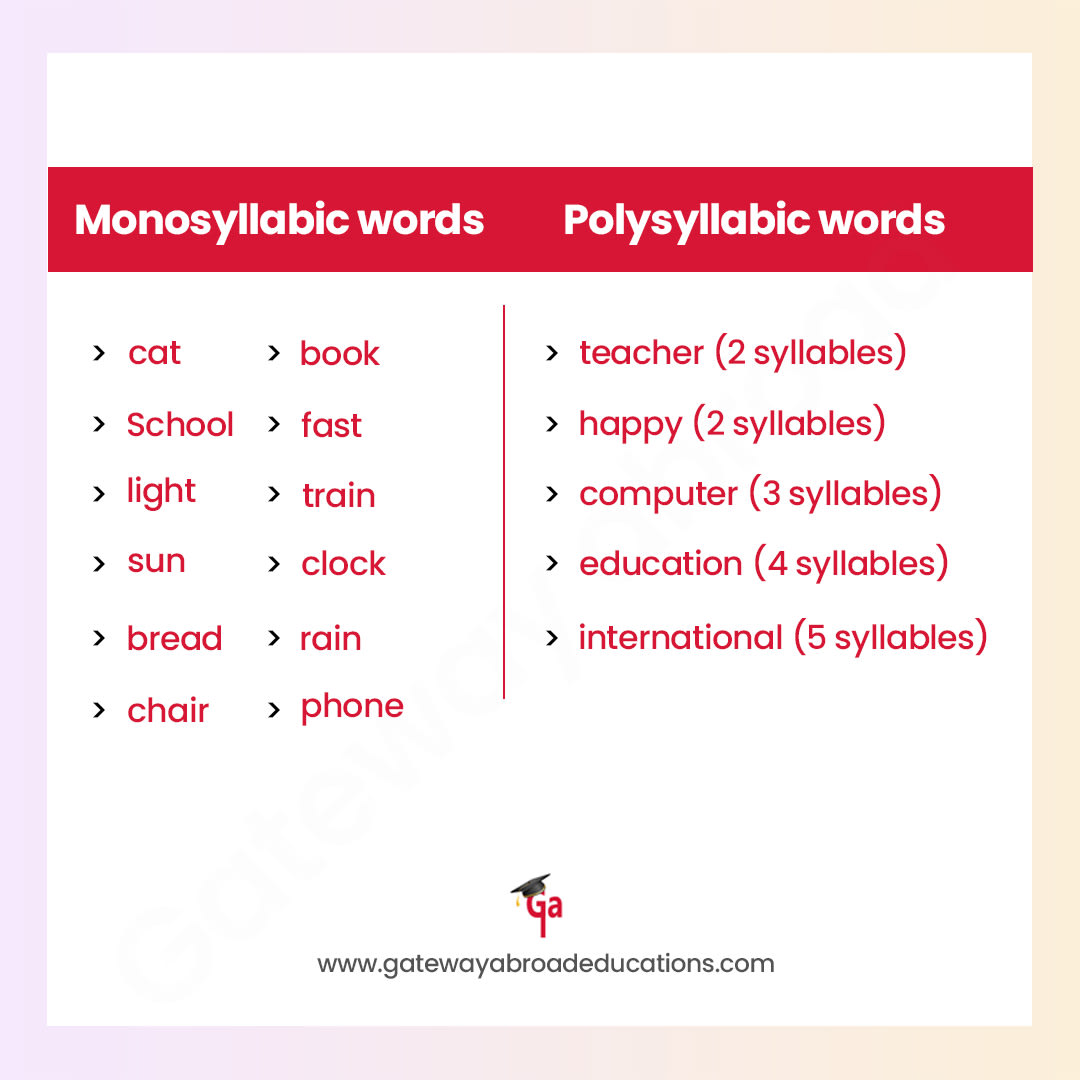
- Cat
- Run
- Sky
- Love
- Jump
- Book
- Moon
Characteristics of monosyllabic words
- One syllable only- No matter how many letters there are, there is only one vowel sound in each syllable.
- Example- Dog, Sky, Run.
- Straightforward pronunciation- Easy to speak and read, even for beginners.
- Usually short in length- Most monosyllabic words have 3 to 5 letters, though some may be longer (e.g., strength).
- Common in everyday use- Used in casual conversation, instructions, and commands.
- Can serve any part of speech-
Examples-
- Noun: book, sun
- Verb: run, sit
- Adjective: big, cold
- Adverb: fast, now
Usage of monosyllabic words
Monosyllabic words are used in a wide range of contexts-
- Everyday speech- It is found in common expressions and casual language.
- Examples- Go now., Come here., Yes. / No.
- Poetry and literature- It is used to create rhythm and punch in poetry. Monosyllables often bring clarity and emotion.
- Example from poetry- “I love the way you smile so bright, it lights my world, it feels so right.”
- Advertising and slogans- It helps convey short, strong messages.
- Examples- Think big, just do it, save more.
- Commands and instructions- Useful for giving direct and clear commands.
- Examples- Stop! Sit down! Jump!
- Children’s language learning- Often, the first words learned by toddlers and young children.
Advantages of monosyllabic words
- Easy to learn and use- It is ideal for beginners and young learners due to its simplicity.
- Enhances clarity- It promotes direct and concise communication.
- Improves reading fluency- It helps in building reading confidence among early learners.
- Increases intensity and emphasis- It is helpful for theatrical or psychological consequences in writing and speaking.
- Great for poetic rhythm- It contributes to strong meter and rhyme in poems and songs.
- Used universally- It is found across all forms of English—spoken, written, formal, and informal.
How do you define polysyllabic words?
Words that have several syllables are known as polysyllabic words. Both "poly" and "syllabic" refer to "many," and syllables, respectively. One continuous unit of sound within a word is called a syllable. Therefore, a word is said to be polysyllabic if it has two or more syllables.
Examples-
- Teacher (2 syllables)
- Computer (3 syllables)
- Information (4 syllables)
- Responsibility (6 syllables)
More Example
Characteristics of polysyllabic words
- Contain two or more syllables- The defining feature is the presence of multiple syllables. These can range from two (dislike) to many (unintelligibility).
- Complex pronunciation- Polysyllabic words are often longer and may require more effort to pronounce correctly compared to monosyllabic words.
- Root words and affixes- Many polysyllabic words are formed by adding prefixes and suffixes to a root word.
- Example-Unbelievable = un- (prefix) + believe (root) + -able (suffix)
- Stress patterns- In English, stress placement is crucial in polysyllabic words. One syllable is typically more strongly pronounced.
- Example- com-PU-ter (stress on the second syllable)
- Often abstract or formal- These words are frequently used in academic, technical, or professional contexts and tend to express more abstract ideas.
- Part of advanced vocabulary- Polysyllabic words are often associated with higher-level vocabulary, suitable for advanced learners, essay writing, and formal letter writing.
Usage of polysyllabic words
Polysyllabic words are essential across various forms of communication, especially in
- Academic writing- It is used to express complex ideas accurately.
- Example- The implementation of renewable energy technologies is crucial.
- Professional and business communication- It adds formality and clarity.
- Example- We need a detailed evaluation of the proposal.
- Scientific and technical fields- Many scientific terms are inherently polysyllabic due to Latin and Greek roots.
- Example- Photosynthesis, microbiology, electromagnetic
- Everyday speech — while not as common in casual speech, many polysyllabic words are still used.
- Example- I had a conversation with the manager.
- Literature and creative writing- Writers use them to enhance imagery, rhythm, and tone.
- Example- Her beauty was beyond comprehension.
- Public speaking and debates- help convey authority, knowledge, and seriousness.
Advantages of polysyllabic words
- Precision in communication- They allow you to express complex ideas clearly and specifically.
- Example- "Deforestation" conveys more than just "cutting trees".
- Enhances vocabulary- Knowing and using polysyllabic words builds a richer and more versatile vocabulary, useful for standardized tests like the GRE, TOEFL, or IELTS.
- Boosts formal writing skills- Academic and official documents often require a more sophisticated tone. Polysyllabic words make your writing appear polished.
- Improves reading comprehension- Familiarity with such words enhances your ability to understand advanced texts in literature, science, and philosophy.
- Creates a professional impression- The correct use of polysyllabic vocabulary during interviews or presentations shows command over the language and confidence.
- Linguistic development- To learning polysyllabic words helps in understanding word formation, root meanings, and language structure, aiding overall linguistic competence.
- Better expression- You can explain nuanced emotions and abstract concepts better with polysyllabic vocabulary.
- Compare: "mad" (monosyllabic) vs. "frustrated", "infuriated", "disappointed" (polysyllabic).
- Improved writing scores- In tests like IELTS and TOEFL, the use of accurate, varied vocabulary, including polysyllabic words, can boost your lexical resource score.
Why is understanding the distinction between monosyllabic and polysyllabic words important?
Understanding the difference between monosyllabic and polysyllabic words is essential for several reasons, especially in language learning, communication, and literacy development. Here's a thorough breakdown of why it matters.
- Improves pronunciation and phonetic awareness- Recognizing how many syllables a word has helps in breaking words down for correct pronunciation. Monosyllabic words are easier to articulate, while polysyllabic words require attention to stress and intonation.
- Enhances reading fluency and comprehension- In reading, knowing syllable structure helps in decoding unfamiliar words. Monosyllabic words contribute to smooth reading, while polysyllabic words may slow down reading if not well understood. Distinguishing them aids in predicting meaning from context.
- Supports vocabulary development- Learners can better build and expand vocabulary by understanding word length and structure. Prefixes, roots, and suffixes are frequently found in polysyllabic words and can provide insight into the meanings of related words.
- Improves writing skills- Writers can vary word lengths to enhance style, tone, and rhythm.
- Short words: Punchy, dramatic.
- Long words: Formal, descriptive, abstract.
This distinction helps in choosing words based on the context, whether it’s a formal essay or a creative story.
- Boosts speaking and listening abilities- It helps in managing speech pacing and word stress, especially in public speaking or language tests like IELTS or TOEFL. Even knowing when to use simpler monosyllabic words or more descriptive polysyllabic words improves clarity and effectiveness.
- Aids in language teaching and learning- Teachers can tailor vocabulary and reading material according to a learner’s level-
- Beginner learners- Focus on monosyllabic words.
- Intermediate/Advanced learners- Gradually introduce polysyllabic words.
- Essential for language exams and literacy tests- Understanding syllables helps in spelling, syllabication, and word stress skills tested in standardized exams.
- Improves poetic and literary appreciation- In poetry and prose, syllable count affects rhythm and meter. Understanding syllabic structure aids in both writing and analyzing literary forms like haikus, sonnets, and rhymed verse.
- Supports cognitive development in children- In early education, distinguishing word types by syllable count enhances phonemic awareness and reading readiness. Children learn to segment and blend sounds more effectively.
- Better communication choices- You can choose simpler (monosyllabic) or more descriptive (polysyllabic) words depending on your audience and purpose.
- Talking to children? Use simple, short words.
- Giving a presentation to professionals? Use precise, polysyllabic vocabulary.
How to identify syllables in a word?
Syllables are the sound units that make up words. Recognizing syllables facilitates fluent reading, proper writing, and speech. Below are several effective methods to identify syllables in any word:
- Listen for vowel sounds- The most reliable way to identify syllables is by listening to the number of vowel sounds in a word, not the number of vowel letters. Each syllable has precisely one vowel sound, albeit it's not always a single vowel letter.
§ Example-
Cake – One vowel sound (/ā/), so one syllable
Open – Two vowel sounds: /ō/ and /ə/, so two syllables: O-pen
- Clap method- Clap your hands each time you hear a distinct beat or sound while saying a word out loud. Each clap typically matches one syllable.
Example-
Win-dow → Clap twice → 2 syllables
Pen-cil → Clap twice → 2 syllables
- Chin Drop method- Place your hand under your chin and slowly say the word. Count how many times your chin naturally drops — each drop signals a syllable.
Example-
El-e-phant → Chin drops three times → 3 syllables
Beau-ti-ful → Chin drops three times → 3 syllables
This works because our chin drops when we pronounce vowel sounds, which are the core of syllables.
- Divide between consonants- Split between consonants: To identify syllables, it's usually an excellent choice to split a word between two consonants that are separated by vowels.
Example-
Napkin → Nap-kin → 2 syllables
Basket → Bas-ket → 2 syllables
This is especially helpful when learning how to break words for spelling or hyphenation.
- Use a dictionary- A quick and accurate way to find syllables is to check a dictionary. Most dictionaries divide words using dots (·) or hyphens (-) to show syllables.
Examples from a dictionary-
Com·pu·ter → 3 syllables
Re·mark·a·ble → 4 syllables
In·for·ma·tion → 4 syllables
- Look for prefixes and suffixes- Dissect the word into its initial, root, and final components. These often indicate natural syllable boundaries.
Example-
Un-hap-py → 3 syllables (Prefix: un, Root: hap, Suffix: y
Re-play-ing → 3 syllables (Prefix: re, Root: play, Suffix: ing)
- Mark vowel and consonant patterns- Some spelling patterns help identify syllables
V/CV pattern: Divide after the first vowel.
Ti-ger → Ti-ger → 2 syllables
VC/CV pattern: Divide between the consonants.
Nap-kin, Bas-ket
This is often used in phonics instruction.
- Speak the word gently- Pronounce the word with precision and slowly. Listen to the number of natural sound beats. Each beat corresponds to a syllable.
Example-
Im-por-tant → Say it slowly → Hear 3 beats → 3 syllables
To-mor-row → Hear three syllables as you say it.
Comparison Table: Monosyllabic vs. Polysyllabic Words
Feature | Monosyllabic Words | Polysyllabic Words |
Number of Syllables | One | Two or more |
Length | Short | Medium to long |
Origin | Often Germanic | Often Latin or Greek |
Use | Informal, everyday speech | Formal, academic, professional |
Examples | Dog, run, sun, big | Education, beautiful, opportunity |
Reading Level | Beginner-friendly | Advanced learners |
Pronunciation | Simple | Can be complex |
What is the usage of polysyllabic and monosyllabic words in literature and writing?
The usage of polysyllabic and monosyllabic words plays a significant role in shaping the tone, rhythm, clarity, and style of literature and writing. Each serves different purposes and is chosen based on the writer’s intent, audience, and desired impact.
1. Monosyllabic Words in Literature- Writers and poets often use monosyllabic words for a strong emotional punch, rhythm, or dramatic effect. Monosyllabic words are single-syllable words like cat, run, cold, fast, etc. They are often used for
- Creating simplicity and clarity- Writers use them to keep sentences short, direct, and easy to understand. Often seen in children’s literature, beginner texts, and simple instructions.
Example-
The sun set. The sky went dark.”
Short, vivid, and easily understood.
- Building tension and speed- Monosyllabic words make the text quick-paced, ideal for action scenes or creating suspense.
Example-
“He ran. She screamed. The door slammed.”
- Evoking strong emotions- Simple words can express raw emotions effectively, love, fear, and anger, without complexity.
Example-
“I hate you. Go away. Leave me.”
- Enhancing rhythm and rhyme in poetry- Poets often use monosyllabic words to create sharp rhythm and rhyme.
2. Polysyllabic Words: Depth, Formality, and Precision- Polysyllabic words have two or more syllables, like beautiful, misunderstanding, and determination. They are used for
- Adding sophistication and formality- Common in academic, legal, and scientific writing to convey complex ideas precisely.
Example-
“The investigation revealed an inconsistency in the documentation.”
- Describing complex concepts- Necessary for expressing abstract ideas like psychology, civilization, democracy, etc.
- Establishing a certain tone or style- This technique is used to produce a sophisticated and intelligent tone in professional writing, essays, and literary fiction.
Example-
“His melancholic disposition reflected a profound sense of disillusionment.”
- Balancing sentence flow- Polysyllabic words can slow down the pace of writing, making it more reflective and descriptive.
Advice for being proficient in both monosyllabic and polysyllabic words
- Work on word stress- One syllable is often stressed in polysyllabic words.
- Use Word Lists- Make lists of common monosyllabic and polysyllabic words. Practice reading aloud and using them in sentences.
- Divide words into syllables, comprehend the structure of complicated words, and divide them into their constituent syllables. It aids in pronunciation as well as spelling.
- Use flashcards- Especially helpful for language learners to expand vocabulary.
- Read aloud- Reading poetry, prose, and even advertisements helps you hear the difference in rhythm between word types.
- Engage in dictation practice- Listening to short passages and writing them down sharpens recognition of sound units.
- Understand root words, prefixes, and suffixes- Learning word parts helps decode and understand new polysyllabic terms.
- Use phonetic spelling and pronunciation guides- Consult pronunciation keys to ensure correct articulation of complex words.
- Keep a vocabulary journal- Maintain a notebook where you may write down new terms, their definitions, syllable breakdowns, and context.
- Practice slow, clear reading- Read longer words slowly and clearly to build fluency and confidence.
- Review with audio tools and apps- Use educational apps and audio dictionaries to hear correct pronunciations.
- Use words in speaking and writing- Apply new words in conversations and writing tasks to internalize their usage.
Interesting facts to know about polysyllabic words
· The longest English word polysyllabic word, in case you were unaware, is-
Pneumonoultramicroscopicsilicovolcanoconiosis
It has 19 syllables and refers to a type of lung disease caused by inhaling fine silica dust.
Practice Exercise
Classify the following words as monosyllabic or polysyllabic:
- Dog
- Celebrate
- Love
- Opportunity
- Book
- Education
- Bright
- Understand
Answers:
- Monosyllabic: Dog, Love, Book, Bright
- Polysyllabic: Celebrate, Opportunity, Education, Understand
Conclusion
Monosyllabic and polysyllabic words are both essential to effective communication. While monosyllabic words offer simplicity, clarity, and rhythm, polysyllabic words provide depth, precision, and a formal tone. Whether you’re a student, teacher, writer, or language enthusiast, understanding how these word types function enhances vocabulary, pronunciation, and expressive power. Mastering the balance between the two helps create impactful, fluent, and versatile language use, whether you're writing a poem, giving a speech, or just chatting with friends.
FAQs on polysyllabic and monosyllabic words-
Q.1 What is a monosyllabic word?
Ans- A word that has just one syllable or sound unit is said to be monosyllabic.
Q.2 What is a polysyllabic word?
Ans- A word that has two or more syllables is said to be polysyllabic.
Q.3 Why are syllables important in language learning?
Ans- Syllables help with pronunciation, reading fluency, spelling, and rhythm in speech.
Q.4 How can you identify syllables in a word?
Ans- Count the number of distinct vowel sounds or chin drops while pronouncing the word.
Q.5 Where are monosyllabic words commonly used?
Ans- They are often used in simple communication, poetry, dialogues, and fast-paced writing.
Q.6 Where are polysyllabic words mainly used?
Ans- They are used in formal writing, academic texts, and to express complex ideas.
Q.7 Do monosyllabic words always mean simple ideas?
Ans- Not always. While short in form, monosyllabic words can convey deep or powerful meanings.
Q.8 Are polysyllabic words harder to pronounce?
Ans- Yes, they often require more practice due to multiple syllables and complex structures.
Q.9 How do writers use both types of words effectively?
Ans- Writers blend both to create balance in tone, clarity, rhythm, and style.
Q.10 Can mastering both improve writing and speaking?
Ans- Absolutely. It enhances vocabulary, expression, and adaptability in communication.






Leave a Comment
Your email address will not be published.