
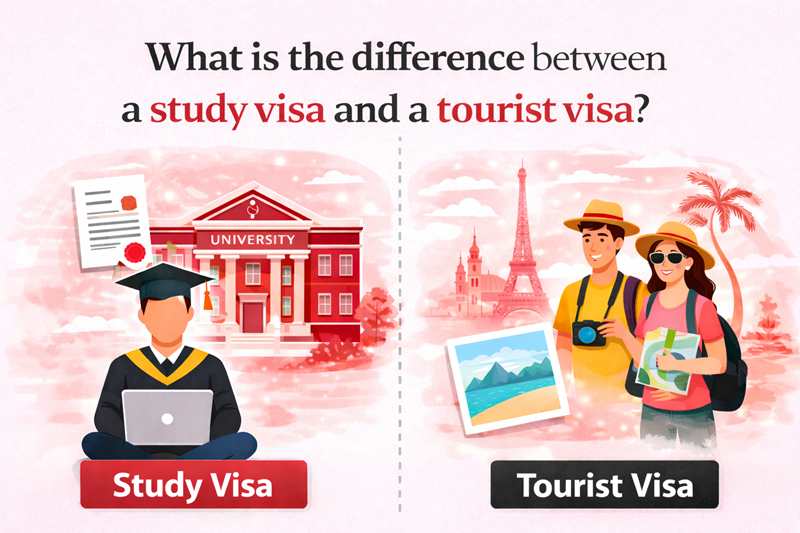
It is essential to understand the distinction between a tourist visa and a student visa when planning a trip abroad. One sort of visa enables you to pursue academic objectives, while the other type allows you to travel temporarily for pleasure or family trips. Selecting the appropriate visa influences your overall international experience in addition to guaranteeing legal compliance. We will outline the main distinctions, prerequisites, and proper application procedures for each visa type in this blog.
What do you understand by a Study and Tourist Visa?
Study Visa-
A study visa (sometimes called a student visa or study permit) is a long-term non‑immigrant visa issued to individuals admitted to educational programs abroad, diplomas, bachelor’s, master’s, doctoral degrees, language, or vocational courses. Its core purpose is to facilitate legal full-time study, often accompanied by permissible part-time work and post‑graduation opportunities.
Tourist Visa-
A tourist visa (or visitor visa, short‑term visa) is granted for leisure, tourism, family visits, or short-term training/business purposes. It's meant for short stays, typically ranging from a few weeks to several months. Holders may not engage in full-time study, paid employment, or long-term settlement abroad.
What are the eligibility criteria for a study and tourist visa?
Eligibility criteria for Study Visa-
To qualify for a study visa, applicants generally must meet the following criteria-
- Letter of acceptance- You have to possess an official admission letter (Confirmation of Enrollment) from a recognized educational institution in the destination country.
- Proof of financial support- This document shows evidence of sufficient funds to
- Pay tuition fees.
- Cover living expenses (accommodation, food, travel).
- Return airfare or proof of onward travel.
- Academic and language proficiency- It must meet the educational qualifications required by the institution. May need to submit scores from exams like-
- IELTS / TOEFL / PTE (for English proficiency)
- GRE / GMAT (for postgraduate courses)
- Valid passport- A valid passport (generally at least 6 months beyond intended stay).
- Medical examination- Some countries (e.g., Canada, Australia) require a medical exam to ensure good health.
- Police clearance certificate- Proof of good character or no criminal background may be required.
- Genuine temporary entrant (GTE) statement- For countries like Australia, you must prove that the intention to study is genuine and temporary.
- Visa application form and fee- Complete the visa application form accurately and pay the required visa processing fee.
- Statement of Purpose (SOP)- Many countries require a statement explaining why you want to study, your plans, and how the course fits into your goals.
Eligibility criteria for a Tourist Visa-
To qualify for a tourist visa, applicants typically must satisfy the following-
- Valid Passport- It must hold a valid passport with at least 6 months' validity beyond the travel date.
- Proof of travel purpose- It must provide details of the travel itinerary, such as
- Flight bookings (round trip)
- Hotel/accommodation bookings
- Travel plans or a tour package
- Proof of financial means- It shows adequate financial resources to cover:
- Trip expenses (food, transport, accommodation)
- Emergency funds (in some cases)
- Ties to home country- It demonstrates strong home country ties (to prove intent to return), such as
- Employment letter
- Family commitments
- Property ownership
- Health and character requirements- Depending on the country, they may require-
- Health insurance during travel.
- Police clearance for more extended visits.
- No intention to work or study- A Tourist visa does not allow paid work or formal study. Must declare that the visit is solely for tourism or visiting family/friends.
- Visa application form and fee- Must fill out the visa application form accurately and pay the visa fee.
What about the duration and extensions of study and tourist visas?
Study Visa-
- Granted for the whole duration of the program, often with a grace period to wrap up (e.g., F‑1 in the US, 485 in Australia, Graduate Route in the UK).
- Extensions are often possible if advancing to higher qualifications.
- Post-study work rights vary-
- UK: 2 years (UG/Masters), 3 years (PhD)
- Canada: PGWP up to 3 years; recent restrictions apply for private colleges
- Australia: Subclass 485 Temporary Graduate Visa extended “healthcare, engineering, IT” streams up to 4–6 years
- Germany: 24-month job-seeker visa, increased from 18 months
- Renewals depend on program status; some countries now forbid onshore switching (e.g., Australia prohibits switching from a visitor/temp graduate to a student visa onshore since July 2024).
Check: Top 8 universities for post-study work visa
Tourist Visa-
- Typically, valid for 30 days to 6 months per entry.
- Extensions are rare and allowed only in exceptional cases.
- Cannot be converted to a study or work visa while in the host country (most countries prohibit onboard switching).
- Overstays can lead to deportation, fines, or future visa denials.
What are the employment opportunities and other additional activities offered by a study and tourist visa?
Study Visa-
- Full-time study at the designated institution.
- Part-time work during term time:
- US- on-campus only, typically up to 20 hrs./week
- Canada- up to 20 hrs./week off-campus; full-time during breaks
- Australia- 48 hrs. per fortnight. Internships or practical training tied to an academic program.
- Post-study employment via relevant visas (e.g., OPT, PGWP, Graduate Route).
Tourist Visa-
- No paid employment is allowed anywhere.
- No full-time study, except very short courses (e.g., UK Visitor Visa allows day courses up to 30 days)
- Strict enforcement discourages job hunting or long-term training.
Financial costs and charges of study and tourist visa-
Study Visa Fees-
Costs include-
- Visa application/exam fees: e.g., US F‑1 approx USD 185 + SEVIS fees; recent hike from USD 160 to 185 for NIV visas.
- Health surcharges (e.g., UK IHS increased to £1,035).
- Documentation costs: language tests, medical exams, blocked accounts (e.g., Germany's €11,904).
- Visa fee rises: The UK and Australia have raised fees for Indian nationals, with a 13% increase as of April 2025.
Tourist Visa Fees-
- Generally lower than study visas but still subject to occasionally increasing rates (e.g., US B1/B2 increased to USD 185)
- It can fluctuate with policy shifts or bilateral agreements.
Intent and home country ties-
Study Visa-
- Must present a strong intent to study, often proven via:
- Genuine Student Validation (e.g., GTE in Australia, fast-track STEM in Canada, USA social‑media vetting resumed from June 18, 2025).
- Statement of Purpose (SOP) explaining course choice and future goals.
Tourist Visa-
- You must convince the consul that you have no immigrant intent.
- Submit evidence of-
- Employment or business ties at home
- Family commitments
- Property ownership
- Overcoming immigrant suspicion is vital under US law
Switching visas and onshore applications-
- Study → Tourist- Allowed in some countries by leaving and reapplying.
- Tourist → Study- Usually not allowed onshore; must apply offshore.
- E.g., Australia from July 2024 prevents switching onshore from tourist 600 to student 500.
- The UK/Japan require a passport during travel; processing may delay the visa grant.
- Visitor visa denials may negatively impact future student visa applications.
What about the policy changes and trends in 2024–2025?
United Kingdom-
- Dependent visas restricted to PhD/research students from Jan 2025.
- Financial thresholds increased (living costs); fast-track for STEM, AI programs.
- Fees hiked ~13% for Indians since April 2025.
United States-
- Interview waivers expanded for F‑1 with prior US travel; social‑media vetting for new F, M, J visas from June 18, 2025.
- SEVIS fee increased, OPT/STEM‑OPT under greater employer scrutiny.
- The F‑1 visa process requires exact passport details since 2023.
Canada-
- Cap at 364,000 student visas in 2024; PAL mandatory; GIC-proof doubled to CAD 20,635.
- PGWP ineligibility for students from private colleges under CLA.
Australia-
- Visitor/Temporary Graduate cannot switch to a student visa since July 1, 2024.
- IELTS min raised to 6.0; work hours cap of 48 hrs./fortnight reinstated; 485 visas extended for certain professions.
- Visa fees for Indian tourists/students have been bumped up since April 2025.
Germany
- Blocked account requirement bumped to €11,904; student visa processing accelerated to 4–6 weeks; post‑study job seeker stay extended to 24 months.
Schengen / EU
- ETIAS (European Travel Authorization) will be required from October 2025 for Indian travelers.
- Visa applications moving to digital, unified EU platform by 2026–28
Comparative Summary-
|
Aspect |
Study Visa |
Tourist Visa |
|
Duration |
Program length + post-study/grace period |
Short-term—weeks to months |
|
Purpose |
Academic study & training |
Tourism, visits, short courses |
|
Work rights |
Part-time during term, full-time in vacations; post-study work |
None |
|
Switching |
Can extend or switch within an academic path |
No conversion to a study visa onshore |
|
Ties proof needed |
Moderate; study intent prioritized |
Strong home ties are required |
|
Documentation |
Acceptance letter, funds, language, health, intent |
Funds, itinerary, return ticket, biometrics |
|
Cost |
Higher fees (visa + health + documentation) |
Lower fees; still subject to hikes |
|
Post-graduation |
Pathways to work, residency (varies by country) |
None |
|
Policy scrutiny |
Stronger, genuine intent assessed; frequent regulatory updates |
Moderate; focused on return intent & fraud prevention |
Key things to remember-
- Use a study visa when your primary purpose is education, particularly full-time programs, since it allows legal residency, part-time work, academic training, and potential post-study work/residency.
- A tourist visa is suitable only for short visits and minimal recreational or observational study. It offers no work, no long-term stay, no academic progression, and requires compliance with strict return obligations.
How to choose the proper visa- A checklist
Purpose of visit
- Define Your Intent Clearly – Decide whether you want to study, travel, or do both.
- Check Allowed Activities – A Study visa allows academics; a tourist visa is for leisure or short visits.
For a study visa – Quick checklist
- Academic requirement- It must have an admission letter from a recognized institution.
- Course duration- The Course should be longer than 3 months for most study visas.
- Proof of funds- You need to show bank statements to prove you can afford tuition and living expenses.
- Language proficiency- Submit English test scores (IELTS, TOEFL) if required by country or institution.
- Health and insurance- You must undergo medical checks and have health insurance in some countries.
- Post-study options- Choose if you want work rights or to stay back after study.
For tourist visa – Quick checklist
- Travel purpose- Your visit must be for tourism, sightseeing, or a family visit only.
- Short duration- Travel visa is valid for 15 to 180 days, depending on the country's rules.
- Proof of return- You need to show return flight bookings and ties to your home country.
- Travel itinerary- You must provide a detailed travel plan, hotel bookings, or an invitation letter.
- Financial proof- You have to show enough funds for the trip, including stay, food, and transportation.
No study or work
- Studying or working is not allowed on a tourist visa.
Documentation checklist
- Valid Passport with 6+ months validity
- Visa Application Form
- Recent Passport-size Photographs
- Visa Fee Payment Receipt
- Proof of Purpose (Admission Letter / Itinerary)
- Bank Statements / Proof of Funds
- Travel Insurance (for tourist visa, in some cases)
Recommendations
- Stay updated: policies evolve (e.g., Canada’s cap, UK fee increases, digitalization of Schengen visa).
- Seek official consulate guidance and authorized educational consultants.
- Assemble strong documentation: clear SOP, financial proof, and academic qualifications.
- Plan visa processing can take months; allow time for possible delays.
- Avoiding visa violations, overstays, unauthorized activity, and misrepresentations can jeopardize future travel.
Closing Thought
In summary, the main distinction between a tourist visa and a study visa is what they are intended for and what they allow. Long-term academic programs are eligible for study visas, which permit enrolment in educational institutions and occasionally part-time employment. A tourist visa, on the other hand, is only allowed for brief travel, pleasure, or family visits and forbids studying or working in any capacity. A tourist visa concentrates on trip intent and return guarantee, but a study visa frequently demands enrollment confirmation and proof of funds for living expenses and tuition. Selecting the appropriate visa guarantees both legal compliance and a seamless travel experience. After reading this amazing article, you must check the difference between a study permit and a study visa.
Frequently Asked Questions
Q.1 What is the primary purpose of a study visa?
Ans- A study visa allows international students to stay in a country for the purpose of pursuing full-time education at a recognized institution.
Q.2 What is the primary purpose of a tourist visa?
A tourist visa permits a person to enter a country for short-term visits, such as sightseeing, vacations, or visiting friends and family.
Q.3 Can you study on a tourist visa?
Ans-No, formal academic study is not allowed on a tourist visa; it is strictly for non-educational visits.
Q.4 Can you work while on a study visa?
Ans- In many countries, study visa holders are allowed to work part-time, usually up to 20 hours per week during sessions.
Q.5 Can you work on a tourist visa?
Ans- No, working on a tourist visa is illegal and may result in deportation or future visa denial.
Q.6 How long can you stay on a study visa?
Ans- You can stay for the entire duration of your course, which could range from several months to years, plus a grace period if applicable.
Q.7 How long can you stay on a tourist visa?
Ans- Tourist visas are typically short-term, allowing stays from 15 days to 6 months, depending on the country.
Q.8 Can you extend your tourist visa or convert it into a study visa?
Ans- In most countries, tourist visas are not extendable or convertible; you must return home and apply for a study visa separately.
Q.9 What documents are needed for a study visa?
Ans- Common documents include an admission letter, proof of funds, academic records, language test scores, and a valid passport.
Q.10 Is a visa interview required for both?
Ans- Yes, many countries require visa interviews for both types, but study visa interviews are generally more detailed and academic-focused.

Leave a Comment
Your email address will not be published.