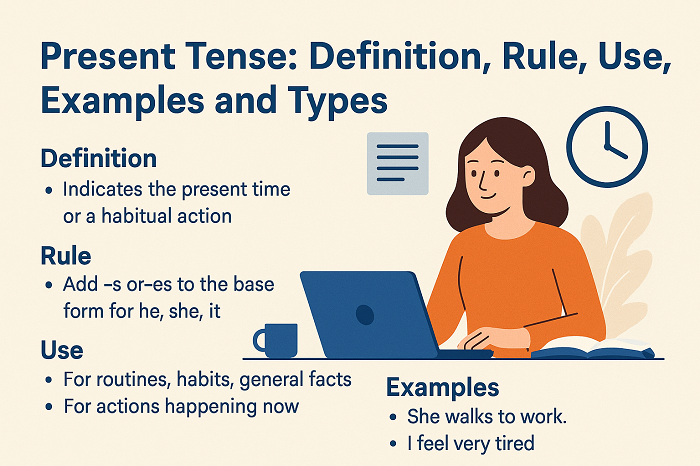
Understanding verb tenses is essential to mastering English grammar. Since it expresses current behaviors, routines, and universal truths, the present tense is the most often used of all the tenses. In this blog, we will explore the four main types of present tense with clear explanations and useful examples.
Definition:
The Simple Present Tense is used to describe habitual actions, general truths, repeated events, and fixed arrangements.
Examples:
Usage:
Definition:
The Present Continuous Tense describes actions happening right now or temporary actions in progress.
Examples:
Usage:
Definition:
This tense establishes a link between the present and previous deeds or occurrences. It highlights the result or impact of the past event on the present moment.
Examples:
Usage:
Definition:
The Present Perfect Continuous Tense is used to show that an action started in the past and is continuing or has just stopped, emphasizing the duration.
Examples:
Usage:
Comparison Table of present tense all forms-
|
Tense |
Structure |
Example |
Key Use |
|
Simple Present |
Subject + base verb / verb + s/es |
She sings well. |
Habit, fact, routine |
|
Present Continuous |
Subject + am/is/are + verb(-ing) |
They are studying. |
Ongoing, temporary, near future |
|
Present Perfect |
Subject + has/have + past participle |
I have eaten lunch. |
Result of a past action |
|
Present Perfect Continuous |
Subject + has/have been + verb(-ing) |
He has been sleeping for hours. |
Duration of action until now |
To communicate clearly and effectively in English, you need to know how to use the present tense properly. Whether you are describing daily routines, expressing ongoing actions, sharing experiences, or emphasizing duration, the present tense offers the flexibility to convey ideas with precision. By mastering the four key forms—Simple Present, Present Continuous, Present Perfect, and Present Perfect Continuous—you lay a strong foundation for both spoken and written English. Regular practice, real-life usage, and mindful observation of these tenses in action will greatly improve your fluency and confidence. Keep practicing, and soon the present tense will become a natural part of your language skills.
Ans- The Present Tense describes actions happening now, habits, general truths, or recent events affecting the present.
Ans- There are four types: Simple Present, Present Continuous, Present Perfect, and Present Perfect Continuous.
Ans- It is used for daily routines, facts, and general truths. Example: He drinks tea every morning.
Ans- Subject + am/is/are + verb-ing Example: She is reading a book.
Ans- Present Perfect focuses on the result, while Present Perfect Continuous emphasizes the duration of an activity.
Ans- Yes, particularly when it comes to anticipated future occurrences and the Present Continuous. For instance, Tomorrow, I'm going to meet her.
Ans- Non-action (stative) verbs like know, believe, love, hate are usually not used in the -ing form.
Ans- Mixing up verb forms, especially forgetting to add -s or -es for the third-person singular in Simple Present.
Ans- Use do/does not for Simple Present, am/is/are not for Present Continuous, and has/have not for perfect forms.
Ans- Because each form serves a unique purpose in expressing time, actions, and clarity in communication.
Author
Content Writer & International Education Specialist
Sakshi Taneja is a content writer specializing in international education, study abroad opportunities, university admissions, student visas, scholarships, and career guidance. She creates accurate, research-driven, and student-focused content to help aspiring international students make informed decisions about their global education journey.
No comments yet
Be the first to share your thoughts!
Please provide your contact information
Free Counselling

2/26/2026

11/3/2025

11/3/2025
10/27/2025

10/13/2025
Want some help figuring out what kind of prep service is right for you?
Help and Support

Leave a Comment
Your email address will not be published.