
Internship vs Part-Time Job: What’s Better While Studying Abroad?
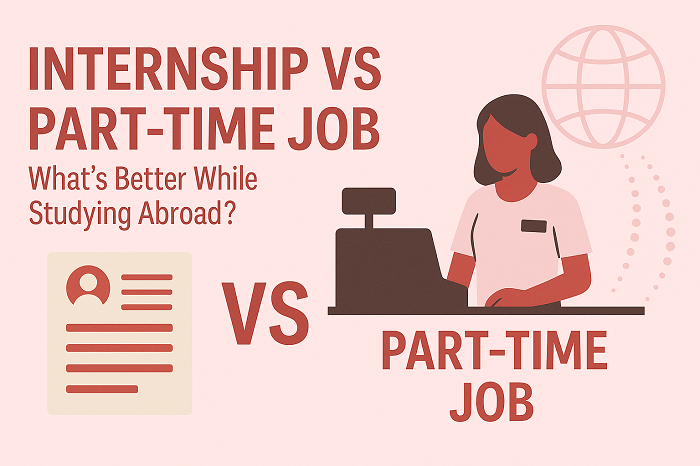
Studying overseas is a fantastic chance to advance professionally and personally, in addition to academically. For international students, the question often arises: Should you pursue an internship or a part-time job while studying abroad? Both options have unique advantages, and the best choice depends on your goals, time, and long-term aspirations.
In this blog, we explore the key differences, benefits, and challenges of internships and part-time jobs to help you make the most informed decision during your study abroad journey.
What is an internship?
An internship is a short-term, professional learning experience offered by companies or organizations to help students or recent graduates gain practical, hands-on experience in a specific field related to their studies or career goals.
It is designed to:
- Bridge the gap between academics and industry
- Provide exposure to real-world work environments
- Develop job-specific and soft skills
- Help build a professional network
Internships can be either full- or part-time, either rewarded or unrewarded, and typically run from a few days through several months. In order to improve their application materials and raise their probability of landing a permanent position after graduation, many students look for internships throughout their final year or during their summer break.
What is a part-time job?
A part-time job is one in which a person works fewer hours per week than a full-time employee; for students, this usually means 10 to 20 hours per week, depending on local labour regulations and visa constraints.
For international students studying abroad, part-time jobs often include roles such as:
- Retail Assistant
- Waiter/waitress
- Barista
- Library assistant
- Campus receptionist
Key features of a part-time job:
- Paid hourly (usually minimum wage or slightly above)
- Flexible schedules to fit around academic commitments
- Not always related to your field of study
- Helps students earn money to cover living expenses, build soft skills, and gain basic workplace experience
Key differences between internships and part-time jobs-
|
Feature |
Internship |
Part-Time Job |
|
Purpose |
Skill development & career exposure |
Earn income & manage expenses |
|
Relevance |
Field-specific (career-oriented) |
Not always related to studies |
|
Compensation |
May be paid or unpaid |
Always paid |
|
Duration |
Short-term (few weeks to months) |
Ongoing throughout the semester |
|
Learning |
Mentorship, structured learning |
Limited learning, work experience |
|
Networking |
High (industry contacts) |
Low to medium |
|
Resume Value |
Highly valuable for your career |
Shows work ethic & time management |
What are the benefits of doing an internship while studying abroad?
- Global work experience- Internships abroad expose you to international work environments, helping you understand cross-cultural communication and global industry standards—valuable assets in today’s global job market.
- Career-relevant skills- Internships are typically aligned with your field of study, allowing you to apply academic knowledge to real-world tasks and build industry-specific skills.
- Networking opportunities- You will connect with professionals, mentors, and peers in your industry, which will open doors to future job offers, references, or collaborations.
- Better job prospects- Employers value candidates with practical experience. Internships give you a competitive edge when applying for full-time roles after graduation.
- Stronger Resume/CV- Internship experience adds credibility to your resume, showing initiative, experience, and professional engagement early in your career.
- Clarify career goals working in a real professional setting; you’ll gain insights into whether a particular role or industry aligns with your interests and strengths.
- Improved communication skills- Working in an international team helps improve both verbal and written communication, especially in a second language like English.
- Time management- Balancing coursework and an internship helps you develop discipline and time management skills essential in any job.
- Cultural integration- You will get deeper exposure to the host country’s workplace culture, customs, and social norms—enhancing your overall study abroad experience.
- Potential for a job offer- Some internships lead to full-time job opportunities or graduate training programs if you perform well and fit the company’s needs.
What are the challenges of Internships?
- Limited Availability: Good internships can be competitive, especially in top industries like tech, finance, or media.
- Unpaid Work: Some internships, especially in non-profits or creative fields, may not offer a stipend.
- Time Management: Balancing an internship and academic responsibilities can be challenging.
- Visa Restrictions: Some countries require work permits or special permissions for internships, especially paid ones.
What are the benefits of a part-time job while studying abroad?
- Earn extra income from a part-time job to help you manage living expenses, including food, rent, transport, or leisure activities, reducing financial pressure on you and your family.
- Improved soft skills- You will develop essential life skills like communication, teamwork, and customer service, which are transferable across industries.
- Time flexibility- Part-time roles often offer flexible shifts, allowing you to maintain a healthy balance between work and study.
- Exposure to local culture- Working with locals gives you a chance to understand the local culture and improve your language skills, enriching your overall study abroad experience.
- Low entry barriers- Unlike internships that may need relevant skills or experience, part-time jobs are usually easier to secure, especially in retail or hospitality.
What are the challenges of part-time jobs?
- Limited Relevance to Career Goals: Most part-time jobs don’t align with your field of study, offering minimal career benefits.
- Lower Resume Value: Employers may not weigh unrelated work experience heavily during job screening.
- Physically Demanding: Jobs in retail, food service, or delivery can be tiring and affect your academic performance.
- Fixed Earnings: You earn a fixed hourly wage, with little opportunity for advancement or bonuses.
Which one should you opt internship or a part-time job?
Your choice depends on your goals, time availability, and visa conditions. Here’s a quick guide:
Choose an Internship If you:
- Want career-specific experience
- Are you in the later years of your degree
- Can manage your academic schedule efficiently
- Want to build industry connections
- Plan to apply for full-time roles post-graduation
Choose a Part-Time Job If you:
- Need a regular income to cover living expenses
- Are you in the early years of your course
- Want flexible hours and less mental load
- Don’t have access to internships yet
- Want to interact with the local community
Is it possible that you can do both?
Yes, but it needs proper planning and time management. For example, you could:
- Take a part-time job during semesters
- Do an internship during summer or winter breaks
- Opt for on-campus internships, which are sometimes more flexible
- Use online or remote internships if available
Make sure not to overload yourself. Always prioritize your studies, as that’s your primary reason for being abroad.
Understanding Visa & Work Regulations-
Every country has its student visa policies related to work-
- USA- F-1 visa allows up to 20 hours/week during the term; internships need CPT/OPT authorization.
- UK- The UK allows holders of Tier 4 visas to find employment up to 20 hours per week throughout the school year.
- Australia- Throughout academic times, anyone with a student visa is permitted to work 48 hours every two weeks.
- Canada- Students are permitted to work full-time over breaks and a maximum of twenty hours a week outside of campus.
Always check the latest visa conditions in your host country before committing to any work.
What are the strategies to balance work and study?
- Plan out your classes, study hours, and work shifts each week. Allocate fixed times for assignments, revision, rest, and social activities.
- Determine what's most important each week: assignments due, exams coming up, or work deadlines. Focus on urgent and high-impact tasks first.
- Stick to the number of work hours allowed on your student visa, which typically becomes 15–20 hours/week. Taking too many shifts can hurt your academic performance and health.
- Utilize small breaks between classes or during commute time to review notes, read, or work on minor tasks. These short sessions add up.
- Try to complete assignments early or study ahead of schedule before a busy work week. Avoid leaving things to the last minute.
- Tell your superiors the truth regarding your academic timetable. Many part-time jobs near universities are flexible and support students' needs.
- Don’t sacrifice sleep, exercise, or mental health for work. Increased attention and efficiency are the results of a mentally and physically fit person.
- Seek help from academic advisors, time management workshops, or counselling services if you feel overwhelmed.
- Stay in touch with classmates, roommates, or friends who can help with notes and reminders or even share part-time work experiences.
Conclusion Internship vs Part-Time Job -
Depending on your educational schedule as well as your preferences, you may choose to work Part-Time or undertake an internship while studying overseas. Internships are great for career building and gaining industry insight, while part-time jobs help with financial stability and life skills.
Ideally, a balanced approach that includes both experiences—at different stages of your academic journey—can give you the best of both worlds. Whatever you choose, make sure it enhances your overall study abroad experience and sets you up for long-term success.
FAQs on Internship vs Part-Time Job: What’s Better While Studying Abroad?
Q.1 What’s the main difference between an internship and a part-time job?
Ans- An internship provides career-related experience, while a part-time job mainly offers income and general work skills.
Q.2 Can you do both an internship and a part-time job while studying abroad?
Ans- Yes, but it depends on your visa rules and time management. Avoid overloading yourself.
Q.3 Are internships always unpaid?
Ans- No. In accordance with the sector and region, internships may be paid or free.
Q.4 Which is better for my career after graduation?
Ans- An internship is usually better for your career as it offers field-specific experience and industry contacts.
Q.5 Do part-time jobs help with resumes?
Ans- Yes, they show responsibility and time management, but may carry less weight in your specific field than internships.
Q.6 What type of jobs qualifies as part-time for international students?
Ans- Retail, food service, customer support, and administrative roles are common part-time jobs for students.
Q.7 Are internships more competitive than part-time jobs?
Ans- Yes, internships are often more competitive and require relevant skills or an academic background.
Q.8 Can you perform an internship internationally with your educational visa?
Ans- It depends on the country. Some require additional permits for internships, especially if they’re paid.
Q.9 When is the best time to apply for internships while studying abroad?
Ans- Start applying a semester in advance, especially for summer internships.
Q.10 What should you choose if you need money urgently while studying?
Ans- A part-time job is better for quickly earning a regular income.
Author
Sakshi Taneja
Content Writer & International Education Specialist
Sakshi Taneja is a content writer specializing in international education, study abroad opportunities, university admissions, student visas, scholarships, and career guidance. She creates accurate, research-driven, and student-focused content to help aspiring international students make informed decisions about their global education journey.
Comments (0)
No comments yet
Be the first to share your thoughts!
Contact Details
Please provide your contact information
Free Counselling
Similar Blogs

Top 10 Universities in Germany
9/21/2026

How to become a great Communicator?
2/26/2026

Preparing for TOEFL Speaking Scoring section: Key Skills and Practice Techniques
11/3/2025

Educational loan for study abroad: Everyone Should Know in 2026
11/3/2025
Form I-20 Explained: Start Your U.S. Study Journey with Confidence
10/27/2025
Have a question about GMAT?
Want some help figuring out what kind of prep service is right for you?
Help and Support
Leave a Comment
Your email address will not be published.