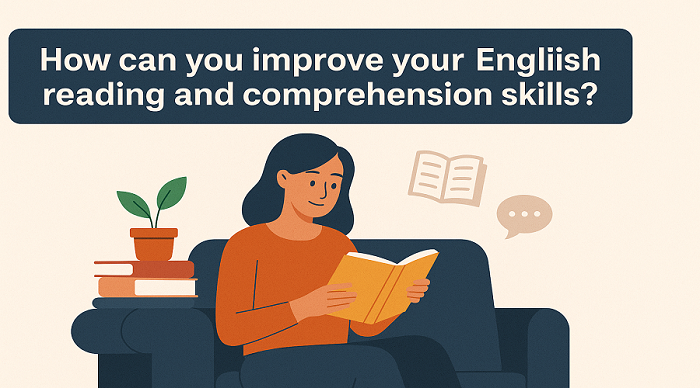
In today's globalized world, reading and comprehending English is crucial for professional development, academic achievement, and successful communication. Enhancing those abilities can improve your mental skills and expand your understanding of the subject, regardless of whether you are an expert, a student, or someone who wants to enjoy English literature.
The capacity to decipher texts or pieces of writing's implicit and explicit significance is known as reading comprehension. It adds importance by going above word identification and language knowledge. Students transform words into thoughts and concepts when they apply their understanding of literary skills. For adults and students, reading is one of the most crucial ways to acquire new knowledge. Additionally, comprehension of words can help students who struggle to develop a love of reading and engage more fully in class. Additionally, reading comprehension is helpful for readers of all ages outside of the classroom. It can
Text comprehension and vocabulary knowledge are the two primary pillars of reading comprehension. Combined, these two abilities help pupils make the most of a text.
The following are a few of the best reading comprehension techniques
A major obstacle to reading comprehension is a lack of prior knowledge. Ask pupils to list or describe what they already know about the solar system, for instance, if you are reading an astronomy text. Ask students to respond to brief questions or complete a KWL chart, then discuss the results to gain simple insights. Or read fiction and nonfiction books that discuss the same or related subjects.
For example, in a picture book with pigs as characters and a nonfiction book about pigs, instructors can use the nonfiction book's facts to help students distinguish between fact and fiction. To ensure that everyone is on the same page, make sure all pupils are familiar with the main concepts and words before you read the book. In terms of prior knowledge, this levels the playing field by assisting students in drawing conclusions and connecting the material to what they already know.
Summarizing a text after reading can assist pupils in identifying key ideas and retaining additional information. Use leading questions and a predetermined structure length, essential ideas, etc., to help pupils understand summarization. Employ the "I do, we do, you do" structure to demonstrate effective summarization strategies. As you demonstrate the technique, instruct students on how to
By teaching kids to do this intentionally, their brains are trained to begin summarizing independently, improving their comprehension of literature in general.
You can utilize various materials in your classroom to help students with multiple interests practice their reading comprehension skills. A brand-new journey called Prodigy English introduces children to a world full of wishes, adventures, and additional ways to enjoy reading.
Children are encouraged to respond to curriculum-aligned reading and language challenges on the game-based platform to obtain more energy. Once energized, players can create their hamlet, produce goods, earn cash, and gather resources from an ever-expanding globe.
Use visualization strategies and visual aids to assist pupils in forming an image of what they are reading. Begin by reading aloud to the class and asking them to attempt to visualize what is happening in their minds. Use writing prompts such as these afterwards-
Ask students to illustrate a scene, character, or narrative for even greater comprehension. To aid their memory of the story's main ideas, they can create a family tree of the characters or entertaining notes. You can also use picture books, word walls, and anchor charts to assist your kids in remembering essential ideas. They have a higher chance of remembering important details when they can picture the narrative or details they are reading.
Understanding a book requires a strong vocabulary, which is also essential for fluency and ease of reading. Students can develop the skills necessary to comprehend new words independently using vocabulary teaching techniques. Try the following strategies to assist students in learning and remembering new words-
You can also use read-aloud techniques to help pupils understand how to acquire new vocabulary. Ask them to compile a list of all the new words they are familiar with or wish to learn and demonstrate how to use context clues to determine meaning.
Enquire about the following to get students thinking critically about a text-
As they search for important details, these questions encourage students to consider a text's underlying significance and apply critical thinking techniques. They also allow students to create mental pictures to connect concepts to existing knowledge or ask questions for clarification when unclear about what the text conveys.
Asking pupils about various text facets encourages them to look at it differently and develop new interpretations. Ask challenging questions to get students to figure out the answers-
To help pupils better grasp individuals, make estimations, or comprehend the author's aim, pose questions to them.
Students are given four reading comprehension skills using reciprocal teaching, which also employs specific methods to engage students in text analysis. Utilizing the "I do, we do, you do" approach, adhere to the four reciprocal teaching building blocks-
Summarizing strategies teach students to identify and combine essential ideas, even though they may initially appear tiresome. They can help students of all skill levels and teach them to synthesize information as they read naturally.
Ask students to write a summary of a piece when they first come across it, then push them to edit it until it only contains the most essential details. To help them write, pose clarifying questions such as
Students make predictions when they utilize the evidence presented at the start of a book to make educated guesses about-
Ask pupils to write down their predictions before a reading begins. Discuss what they did well and what they did poorly after the reading. Why did they come up with their prediction? Did the author meet or surpass their expectations? Give pupils blank phrases to help them ponder or use a think-aloud to model predictions.
Students use their knowledge to guess what they do not know when they draw inferences. Rather than guessing what will happen next, they draw conclusions regarding information outside the tale, such as what happened before the story began, what genre the story is, or what occurs after it ends.
Like forecasting, read-aloud or guided questioning can be used to model inferences. Ask pupils to create a character backstory based on textual information or write a prequel to the story. Using inferences, students can connect the text and what they already know about the world. It can also help them become more creative.
Improving English reading and comprehension skills requires patience and dedication. Expanding your vocabulary, practising active reading, enhancing fluency, and developing critical thinking abilities can significantly boost your comprehension. Utilizing technology, joining reading communities, and setting measurable goals will further aid your progress. With consistent effort and curiosity, you’ll understand complex texts better and enjoy the learning process.
Ans- Regularly read diverse materials and engage actively with the text.
Ans- Use a dictionary, maintain a vocabulary journal, and practice with flashcards.
Ans- It helps you engage with the text, ask questions, and retain key information.
Ans- Practice reading aloud, use timed reading sessions, and revisit familiar texts.
Ans- It allows you to analyze the author's purpose, compare ideas, and make predictions.
Ans- Platforms like Grammarly, Coursera, and Khan Academy offer valuable exercises.
Ans- Use mind mapping, teach others, and review notes periodically.
Ans- Specific, Measurable, Achievable, Relevant, and Time-bound reading objectives.
Ans- Yes, it provides discussions and insights that enhance comprehension.
Ans- Consistent daily practice is key to steady progress.
Author
Content Writer & International Education Specialist
Sakshi Taneja is a content writer specializing in international education, study abroad opportunities, university admissions, student visas, scholarships, and career guidance. She creates accurate, research-driven, and student-focused content to help aspiring international students make informed decisions about their global education journey.
No comments yet
Be the first to share your thoughts!
Please provide your contact information
Free Counselling

9/21/2026
2/26/2026
11/3/2025

11/3/2025
10/27/2025
Want some help figuring out what kind of prep service is right for you?
Help and Support

Leave a Comment
Your email address will not be published.