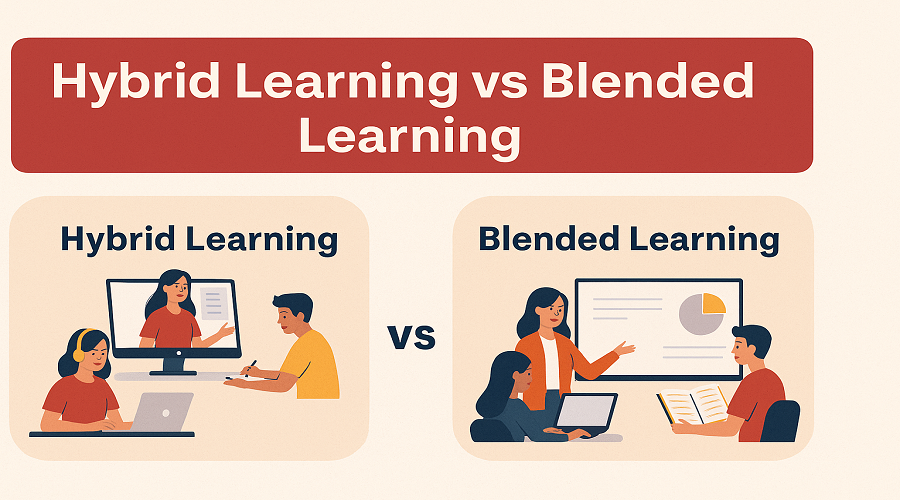
Two instructional models—hybrid Learning and Blended Learning—have gained prominence in the evolving education landscape. While these terms are often used interchangeably, they are distinct in their approach and implementation. This blog aims to clarify the differences, explore their benefits and challenges, and help educators and learners make informed decisions.
What is Hybrid Learning?
Hybrid learning is an educational model that combines in-person classroom instruction with online learning components. Its primary feature is the balance between physical and virtual environments. Typically, students alternate between attending classes on campus and engaging in online activities, such as video lectures, quizzes, and discussions.
Key Features of Hybrid Learning:
- Flexibility: Students can access course materials and complete assignments online, reducing the need for constant physical presence.
- Synchronous and Asynchronous Learning: Hybrid learning often involves live virtual sessions and pre-recorded content.
- Personalization: Educators can tailor learning experiences to meet the needs of individual students.
- Technology Integration: It is essential to use learning management systems (LMS), virtual classrooms, and digital collaboration tools.
What is Blended Learning?
Blended learning, on the other hand, is a teaching approach that integrates traditional face-to-face instruction with digital resources. However, the focus remains on enhancing the classroom experience rather than replacing it with online sessions.
Key Features of Blended Learning:
- Enhanced Classroom Experience: Online tools, such as multimedia presentations and interactive quizzes, supplement in-person lessons.
- Collaborative Learning Environment: Encourages group activities and peer interaction.
- Flexible Pacing: Students can review materials independently outside the classroom.
- Teacher-Led Instruction: Instructors play a central role in guiding and supporting students.
What are the differences between hybrid and blended learning?
- Hybrid Learning: Mix of online and physical settings.
- Blended Learning: Primarily classroom-based with online enhancements.
- Hybrid Learning: High, with alternating online and offline sessions.
- Blended Learning: Moderate, with supplemental online resources.
- Hybrid Learning: Greater control over learning pace and location.
- Blended Learning: Structured with teacher guidance.
- Hybrid Learning: Extensive use of virtual platforms and tools.
- Blended Learning: Limited to enhancing in-person instruction.
|
Aspect
|
Hybrid Learning
|
Blended Learning
|
|
Learning Environment
|
Mix of online and physical settings
|
Primarily classroom-based with online enhancements
|
|
Flexibility
|
High, with alternating online and offline sessions
|
Moderate, with supplemental online resources
|
|
Student Autonomy
|
Greater control over learning pace and location
|
Structured with teacher guidance
|
|
Technology Integration
|
Extensive use of virtual platforms and tools
|
Limited to enhancing in-person instruction
|
What are the benefits of hybrid learning and blended learning?
The advantages of hybrid and blended learning—such as more flexibility, individualized instruction, improved engagement, and cost-effectiveness—make them valuable resources for business training and educational institutions. Here is a closer look at the advantages-
- Flexibility and accessibility—Thanks to hybrid and blended learning models, a greater range of people can now attend education. These models let students access resources and participate in learning activities at their own pace and on their own time.
- Personalized learning—These strategies enable customized learning experiences that may boost retention and engagement by accommodating different learning styles and speeds.
- Increased engagement—Combining online and in-person learning activities can produce a more dynamic and captivating educational atmosphere.
- Various learning opportunities- Online sections, footage, online exercises, and in-person encounters are just a few of the learning tools and activities that hybrid and blended learning models provide to accommodate a range of learning styles.
- Better collaboration- Online platforms may help students work together, no matter where they are physically located, which promotes engagement and collaborative learning.
- Development of digital skills—Students acquire useful technology and digital literacy abilities, which are becoming increasingly crucial in today's jobs.
- Cost-effectiveness—Blended learning can lower training expenses by reducing the need for costly travel and lodging for teachers and students.
- Scalability- Blended and hybrid learning models are flexible enough to grow with more students, which makes them an affordable option for extensive training initiatives.
- Greater efficacy of corporate education—Blended learning can increase the efficacy of corporate training by giving staff members flexible and interesting learning options.
- Increased availability-Students who would be unable to take conventional instructor-led classes due to time, location, or other limitations may find that blended and hybrid educational options make educational opportunities more approachable.
- Improved teacher-student engagement- Blended and hybrid learning approaches can help students and teachers engage more frequently and meaningfully online and in person.
- Data-driven insights- Teachers and trainers can make data-driven decisions to enhance learning outcomes by using the valuable data on student performance and engagement that online learning platforms can offer.
What are the challenges of hybrid and blended learning?
Hybrid and blended learning difficulties include juggling online and in-person arrangements, guaranteeing equitable participation, preserving uniformity, producing captivating online content, handling deadlines, modifying content for blended learning, and resolving possible declines in student motivation and strained teacher-student relationships. Below is a more thorough explanation of the difficulties-
For Hybrid learning-
- Managing both online and in-person components—Hybrid learning requires logistical challenges and possibly technical problems.
- Ensuring equal participation- It is essential to guarantee that every student, whether enrolled in an online course or in-person, has an equal chance to participate and interact in the educational process.
- Time commitment and travel expenses- Students enrolled in hybrid learning programs may need to make in-person trips, which can be difficult for some, particularly those with little time or access to transportation.
- Modifying course formats- Teachers must modify their lesson plans and exercises to accommodate online and in-person learning environments, which can be difficult and time-consuming.
- Handling an overwhelming volume of information: Due to the merging of in-person and online education, students may find it challenging to manage their schoolwork and stay on schedule.
For Blended Learning-
- Preserving consistency—It can be difficult to ensure that the offline and online learning experiences are in line.
- Producing interesting online content- It takes a lot of work and experience to deliver excellent and captivating online resources that successfully enhance in-person training.
- Deadline management- Blended learning frequently combines online and in-person projects and tests, making it challenging to manage deadlines efficiently.
- Content adaptation for blended learning—Modifying or rewriting conventional course materials to accommodate the blended learning format could take a lot of time.
- Diminished motivation- Lower academic achievement and diminished involvement may result from some students' inability to maintain ambition when studying online.
- Weakened student-teacher connections- Blended learning's online component occasionally results in less in-person engagement, which can erode student-teacher connections.
- Technical issues- Since blended learning mostly depends on technology, technical problems can impede learning and irritate teachers and students.
- Cost of technology—Implementing blended learning may be prohibitively expensive for certain schools and institutions due to the sizable investment in technology required.
- Insufficient instruction- Educators and learners may require further instruction to utilize the technology and blended learning techniques efficiently.
- Resistance to technology or online learning—Successfully adopting blended learning may be difficult if some teachers and students are averse to using technology or learning online.
- Technology access- Due to unequal accessibility to technology and dependable internet connections, learning environments may be unfair.
Which model is right for you?
The choice between hybrid and blended learning depends on various factors, including the nature of the course, student demographics, and technological infrastructure. Hybrid learning is more suitable for institutions seeking to reach a geographically dispersed audience. However, blended learning is the ideal choice for enhancing traditional classroom instruction with digital tools.
Conclusion-
Hybrid and blended learning models have transformed the educational landscape, offering flexibility and improved engagement. Understanding their differences is crucial for educators, students, and institutions to make informed decisions and optimize learning outcomes. By leveraging the strengths of each model, educational institutions can create dynamic and compelling learning experiences for diverse student populations.
FAQs on Hybrid Learning vs Blended Learning
Q.1 What is the primary difference between hybrid and blended learning?
Ans- Hybrid learning balances online and in-person instruction, while blended learning enhances classroom experiences with digital tools.
Q.2 Which model offers more flexibility for students?
Ans- Hybrid learning offers greater flexibility due to its alternating online and offline sessions.
Q.3 Is blended learning more teacher-driven?
Ans- Blended learning relies heavily on teacher-led instruction with digital enhancements.
Q.4 Do both models require technology integration?
Ans- Yes, hybrid learning involves extensive virtual platform usage, whereas blended learning uses technology to support in-person instruction.
Q.5 Which model is better for remote learners?
Ans- Hybrid learning is more suitable for remote learners due to its online components.
Q.6 Can blended learning be used in higher education?
Ans- Absolutely. Blended learning is effective in enhancing traditional lectures with multimedia resources.
Q.7 What are the significant challenges of hybrid learning?
Ans- It requires reliable internet access, self-discipline, and time management.
Q.8 Is student engagement higher in blended learning?
Ans- Yes, as it fosters collaboration and interaction within the classroom.
Q.9 Do hybrid and blended learning models improve learning outcomes?
Ans- Both models can enhance retention and understanding when implemented effectively.
Q.10 Which model is better for working professionals?
Ans- Hybrid learning is more suitable for working professionals due to its flexible scheduling.





Leave a Comment
Your email address will not be published.