
Gerunds vs. Infinitives: Grammar Rules for Fluent Spoken English
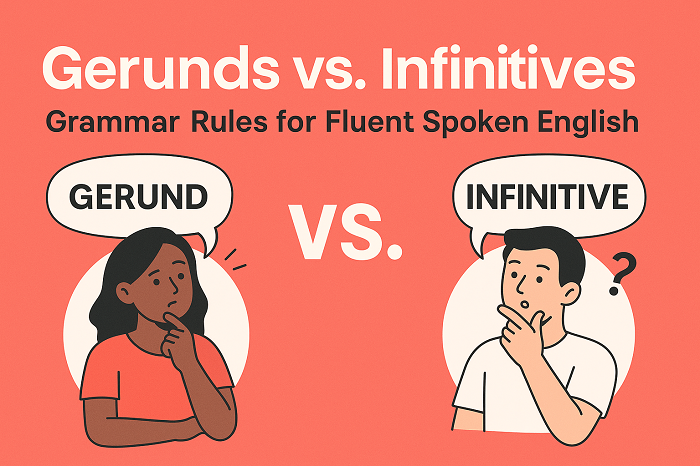
Fluent English doesn’t just mean speaking quickly—it means speaking naturally and correctly. One common area where English learners get stuck is choosing between gerunds and infinitives. Do you say “I enjoy to swim” or “I enjoy swimming”? What about “I want swimming” or “I want to swim”? Let’s break it down.
What are Gerunds and Infinitives?
Gerunds and infinitives are two forms of verbs that often function as nouns in a sentence. They are essential in English grammar, especially in spoken and written communication, and are used as subjects, objects, or complements in a sentence.
What is a Gerund?
- A gerund is the -ing form of a verb that functions as a noun.
Structure-
- Verb + ing → reading, writing, dancing, playing
Examples-
§ Swimming is good for health. (subject)
§ I enjoy reading novels. (object)
§ Her hobby is painting. (compliment)
- In conversation:
§ “I love jogging in the morning.”
§ (Here, jogging is a gerund acting as the object of “love.”)
What is an Infinitive?
- An infinitive is the base form of a verb usually preceded by "to". It also functions like a noun in many cases.
Structure-
- to + base verb → to read, to write, to dance, to play
- Examples-
§ I want to learn English. (object)
§ To travel the world is my dream. (subject)
§ Her goal is to become a doctor. (compliment)
- In conversation-
§ “He hopes to join the class tomorrow.”
§ (to join is the infinitive and the object of “hopes.”)
|
Form |
Structure |
Functions As |
Example |
|
Gerund |
Verb + ing |
Noun |
“Running is fun.” |
|
Infinitive |
to + base verb |
Noun/Adjective/Adverb |
“She wants to run.” |
When should you utilize Gerunds?
A gerund is the -ing form of a verb that functions as a noun in a sentence. You should use gerunds when the action (verb) becomes the subject or object of another action or statement. Here is a clear guide on when to use gerunds correctly:
- After certain verbs- A gerund, not an infinitive, always follows some verbs.
Common verbs that take gerunds-
§ Enjoy → I enjoy reading novels.
§ Avoid → He avoids talking too much.
§ Mind → Do you mind closing the window?
§ Suggest → She suggested taking a break.
§ Finish → They finished eating lunch.
§ Consider → I’m considering moving abroad.
§ Keep- Keep practising every day.
· Conversation Tip- Use gerunds with these verbs to sound natural.
§ Right- “I enjoy swimming.”
§ Wrong- “I enjoy to swim.”
- As the subject of a sentence- When an action is the subject of a sentence, we use the gerund form.
Examples-
§ Smoking is harmful to health.
§ Dancing brings me joy.
§ Learning English takes time and effort.
- After prepositions- A gerund always follows a preposition, even when it comes after a verb or an adjective.
- Examples-
§ She’s interested in learning Spanish.
§ They left without saying goodbye.
§ I’m good at drawing.
§ He apologized for being late.
- Note: Never use the infinitive form after a preposition.
§ Wrong- “I’m good at to draw.”
§ Right- “I’m good at drawing.”
- After phrasal verbs- Many phrasal verbs (verb + preposition/adverb) are followed by gerunds.
Examples-
§ He gave up smoking.
§ She looks forward to meeting you.
§ They ended up cancelling the trip.
- In fixed expressions- Some expressions or phrases naturally take a gerund.
Examples-
§ It’s no use crying over spilled milk.
§ I can’t help laughing at that joke.
§ There’s no point in arguing.
- Bonus: Passive meaning with Gerunds- Sometimes gerunds imply a passive sense.
Example-
§ The room needs cleaning.
§ (= The room needs to be cleaned.)
Summary table
|
Use Case |
Example |
|
After certain verbs |
I enjoy reading. |
|
As subject of sentence |
Swimming is fun. |
|
After prepositions |
She’s afraid of flying. |
|
After phrasal verbs |
He gave up drinking coffee. |
|
In fixed expressions |
It’s no use complaining. |
When should you utilize Infinitives?
An infinitive is the base form of a verb usually preceded by "to" (e.g., to eat, to run, to learn). Infinitives often function as nouns, adjectives, or adverbs in sentences. Understanding when to use infinitives correctly is key to forming fluent, grammatically correct sentences especially in spoken English.
- After certain verbs- Many verbs are followed by infinitives (not gerunds).
Common verbs followed by infinitives-
§ Want → I want to eat.
§ Hope → She hopes to travel soon.
§ Plan → They plan to move abroad.
§ Decide → He decided to join the course.
§ Agree → We agreed to help them.
§ Learn → I’m learning to drive.
§ Promise → He promised to call me.
· Conversation tip- Use infinitives to talk about intentions or future actions.
§ “I want to speak English fluently.”
- After certain adjectives- Use infinitives to explain reasons or results after adjectives.
For examples-
§ I’m happy to help.
§ She’s ready to go.
§ It isn’t easy to understand this topic.
§ He’s excited to meet you.
- To show purpose or intent- Infinitives often express why something is done.
- Examples-
§ I study to learn.
§ She works hard to succeed.
§ He came here to talk to you.
You can often replace “in order to” with an infinitive-
§ “He trained to win the race.”
- As the subject or complement of a sentence- Infinitives can act as the subject or complement (predicate noun).
For instance-
§ To travel is my dream. (subject)
§ His goal is to become a pilot. (compliment)
§ To read every day helps improve vocabulary. (subject)
- After question words (what, how, where, etc.)- Use infinitives after question words to express decisions or uncertainty.
Examples-
§ I don’t know what to say.
§ Can you tell me how to get there?
§ She taught me how to swim.
- After certain nouns or pronouns- Infinitives can follow certain nouns or pronouns to express what someone needs or wants to do.
For examples:
§ I have a book to read.
§ There’s nothing to do.
§ She’s the one to ask.
Summary table
|
Use Case |
Example |
|
After certain verbs |
I hope to learn. |
|
After adjectives |
It’s important to practice. |
|
To express purpose |
He studies to improve. |
|
As subject or complement |
To speak well takes effort. |
|
After question words |
I don’t know where to go. |
|
After nouns or pronouns |
She has work to do. |
Quick Comparison: Gerund vs. Infinitive
|
Expression |
Correct Usage |
Why |
|
I enjoy ___ |
I enjoy swimming |
“enjoy” is followed by a gerund |
|
I want ___ |
I want to swim |
“want” is followed by an infinitive |
Some of the exceptions related to the use of gerunds and Infinitives-
Tricky Verbs: Can Take Both (with Different Meanings)
Some verbs change meaning depending on whether you use a gerund or infinitive.
For example: Remember
- I remember meeting her last year. (I have a memory of it.)
- Remember to call your mom. (Don’t forget to do it.)
Such as: Stop
- He stopped smoking. (He quit the habit.)
- He stopped to smoke. (He paused another activity to smoke.)
How do you practice in real-life situations?
- Listen to native speakers (podcasts, shows) and note verb patterns.
- Speak in short sentences using gerunds and infinitives:
- “I plan to go.” / “I enjoy going.”
- Write down five daily activities using both:
- “I like cooking.” / “I hope to cook dinner tonight.”
Don’t memorize endless rules; focus on the verbs you use most in everyday conversations. Build familiarity through context, repetition, and listening.
Practice Exercise:
Fill in the blanks with the correct form (gerund or infinitive):
- I forgot __________ the door. (lock)
- She enjoys __________ to music. (listen)
- We decided __________ a taxi. (take)
- They avoided __________ about politics. (talk)
Answers: 1) to lock, 2) listening, 3) to take, 4) talking
Conclusion-
Mastering gerunds and infinitives is a small step that makes a big difference in sounding fluent. The more you listen and speak, the more natural these patterns will become. Choosing the correct form is not just about grammar it is about sounding confident and natural in conversation. Understanding which verbs require gerunds and which require infinitives will help you avoid common mistakes and make your spoken English more accurate.
FAQs on Gerunds vs. Infinitives: Grammar Rules for Fluent Spoken English
Q1: What is the main difference between a gerund and an infinitive?
Ans- A gerund is the -ing form of a verb (e.g., swimming), while an infinitive is to + base verb (e.g., to swim).
Q2: When should you use a gerund?
Ans- Use gerunds after verbs that express likes, dislikes, habits, or after prepositions (e.g., I enjoy reading).
Q3: When should you use an infinitive?
Ans- Use infinitives after verbs that express wants, plans, and decisions (e.g., I want to learn).
Q4: Can both gerunds and infinitives follow some verbs?
Ans- Some verbs can take both, but the meaning may change (e.g., stop smoking vs. stop smoking).
Q5: Are gerunds used after prepositions?
Ans-Yes, gerunds always follow prepositions (e.g., interested in learning).
Q6: Can an infinitive be the subject of a sentence?
Ans- Infinitives can be subjects (e.g., To travel is exciting).
Q7: How can you quickly remember which verbs take gerunds or infinitives?
Ans- Focus on common verb patterns, practice regularly, and listen to fluent speakers to build natural usage.
Author
Sakshi Taneja
Content Writer & International Education Specialist
Sakshi Taneja is a content writer specializing in international education, study abroad opportunities, university admissions, student visas, scholarships, and career guidance. She creates accurate, research-driven, and student-focused content to help aspiring international students make informed decisions about their global education journey.
Comments (0)
No comments yet
Be the first to share your thoughts!
Contact Details
Please provide your contact information
Free Counselling
Similar Blogs

Top 10 Universities in Germany
9/21/2026

How to become a great Communicator?
2/26/2026
Preparing for TOEFL Speaking Scoring section: Key Skills and Practice Techniques
11/3/2025

Educational loan for study abroad: Everyone Should Know in 2026
11/3/2025
Form I-20 Explained: Start Your U.S. Study Journey with Confidence
10/27/2025
Have a question about GMAT?
Want some help figuring out what kind of prep service is right for you?
Help and Support
Leave a Comment
Your email address will not be published.