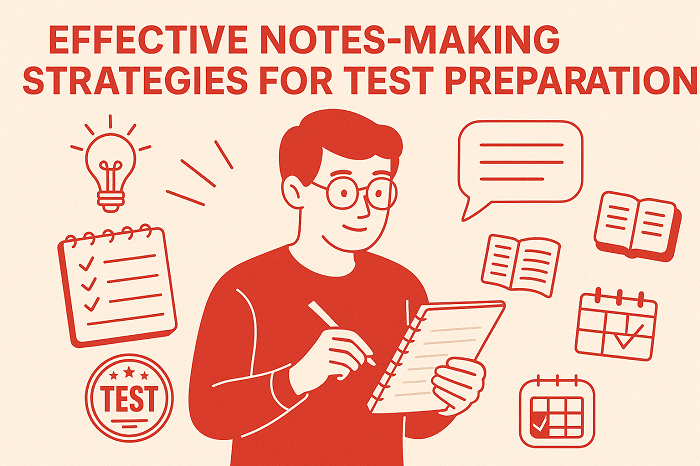
Effective note-making is an essential skill for students preparing for tests. It facilitates information organization, interpretation, and retention. Well-structured notes can simplify complex concepts and make revision more efficient. This blog explores various strategies for making notes that maximize learning outcomes and boost test performance.
The Cornell process is a little more concentrated and time-consuming. The Cornell Note-Taking System is a structured method that divides notes into three sections:
Important retention questions, the subject's primary keywords, and crucial answers to queries are among the keywords. Charts, tables, running notes, and class guidance should all be recorded in the notes section. The notes are more cohesive and logical when the summary section is included. Because it promotes active learning, the Cornell approach ought to be applied. It also manifests as a more structured and cognitively efficient approach to education.
This approach is questioned, though, because it barely makes room for the notes section following partitioning. Additionally, creating summaries takes a lot of work and consistent commitment. This method encourages reviewing and self-testing, making it ideal for test preparation.
A more connected idea replaces the mind-mapping technique. Complex subjects like history, psychology, sociology, and philosophy are typically taught using it. One fundamental thought must be the starting point for mind mapping, from which you must develop several smaller ideas, sub-ideas, and so forth. Understanding the general structure of the relevant chapter or lesson is beneficial.
For those who learn best visually and comprehend diagrams, this approach is excellent. Additionally, it provides chapter summaries in a structured manner. But details are easily missed, and they frequently have a great potential for distraction. This approach may cause users to become more preoccupied with the "maps" or diagrams they create rather than the knowledge itself and its applicability. A mind map is a visual representation of information that helps connect ideas effectively. To create a mind map:
Mind maps are particularly useful for subjects that involve interrelated concepts, such as science and history.
The most straightforward technique for taking notes is the outline method. It promotes framing your notes using pointers and sub-pointers. Begin by breaking your chapter down into four or five major points, then continue to add your notes as sub-pointers within those points. When there is a lot of content, this approach typically works. It facilitates referring to and comprehending the connections between points. It is essential to use the outlining method while writing on topics like sociology, psychology, and history. It is not without flaws, though. You may get more preoccupied with filling in the blanks than with comprehending ideas. Having access to computers usually makes this strategy more effective. Additionally, it may allow for careless note-taking and recording. The Outline Method organizes information hierarchically:
This method is effective for subjects like law, literature, and business studies that require structured notes.
The charting method relates ideas like the mental mapping method and encourages mental recall like the Cornell method. For those who learn best visually, the charting method is also excellent.
It entails compiling all the crucial information you need to comprehend an idea into a table or Venn diagram. When you're having trouble remembering stuff, it helps. This technique is excellent for active recall and for retaining details and facts that you might otherwise forget. It simplifies the writing process and makes it simple to draw parallels and comparisons between complex ideas. However, certain information cannot be categorized into charts, which makes the charting method inadequate. This technique is useful for comparing and contrasting information in subjects like mathematics and economics. Additionally, creating charts takes a lot of time and requires expertise and commitment. The Charting Method involves organizing information into tables-
|
Topic |
Definition |
Key Points |
Examples |
|
Physics |
Study of matter |
Laws of motion, energy |
Newton’s Laws |
In order to better understand the relationships between concepts, the Boxing method involves taking notes in little boxes around the page. It is typically employed to clarify the distinctions between two concepts and to relate them. It is used in conjunction with the outlining method to emphasize important elements. Using the boxing method keeps your notes concise and well-structured. It facilitates concept connections and works best with scheduled lectures and textbook notes. However, due to the ongoing requirement to create boxes and lectures in order to maintain a high level of organization and organization, this approach is frequently disapproved of.
The three pillars of the Flow Method are simplification, visualization, and connection. For disciplines with a lot of subtopics, like anatomy and philosophy, this approach works well.
With this approach, information is recorded using arrows, bubbles, squares, flowcharts, algorithms, and amusing doodling. Taking notes as quickly as possible necessitates using both your creative and processing faculties. The flow method is fantastic since it stimulates your creativity and increases brain activity. It is also user-friendly and promotes the simplification of complex ideas in your own words.
Using the Sentence Method, facts are recorded in entire sentences. This method is beneficial for fast-paced lectures where detailed note-taking is necessary.
This approach entails filling in the blanks on unrecorded concepts utilizing your professor's notes and slides. People who might be viewed as "lazy" or who don't care to take notes frequently employ this technique. It entails taking a xerox of the lecturer's slides and making a note of the ideas that aren't on the actual xerox.
Because the fundamental idea is already provided in the slides, this strategy is ideal for college students who want to save time and effort by merely expanding on the principles.
This approach, though, may promote indolence and passive learning. Additionally, it could cause students to become disinterested in the course topic and to stop attending lectures. Finally, this approach makes it easy to overlook minor nuances.
Mastering the art of note-making is a crucial step toward academic success. By employing structured methods such as the Cornell Method, Mind Mapping, or the Outline Method, students can organize their study materials effectively. Additionally, incorporating best practices like summarization, active recall, and the use of digital tools can further enhance retention and understanding. Effective notes serve as a roadmap for revision, allowing students to maximize their study sessions and approach exams with confidence. In a world where information overload is a challenge, structured note-making ensures that learning remains systematic and efficient. By refining their note-taking skills, students can transform their study habits and improve their overall test performance.
Ans- The best technique depends on your learning style. The Cornell Method, Mind Mapping, and the Outline Method are widely used.
Ans- Use bullet points, headings, numbering, and color coding to organize information clearly.
Ans- Handwritten notes improve memory retention, while digital notes are easier to organize and search. A hybrid approach is ideal.
Ans- Regularly review notes daily, weekly, and before exams—to reinforce learning.
Ans- Common mistakes include copying text verbatim, writing too much, and not reviewing notes frequently.
Ans- Use abbreviations, symbols, and key phrases to capture essential information efficiently.
Ans- Apps like Evernote, OneNote, Notion, and Google Keep help organize digital notes.
Ans- Use diagrams, color coding, highlighting, and mind maps to improve engagement.
Ans- Yes, structured notes enhance understanding, retention, and recall, leading to better exam performance.
Ans- Summarize key points, use flashcards, self-test, and review notes multiple times before exams.
Author
Content Writer & International Education Specialist
Sakshi Taneja is a content writer specializing in international education, study abroad opportunities, university admissions, student visas, scholarships, and career guidance. She creates accurate, research-driven, and student-focused content to help aspiring international students make informed decisions about their global education journey.
No comments yet
Be the first to share your thoughts!
Please provide your contact information
Free Counselling

9/21/2026

2/26/2026

11/3/2025

11/3/2025
10/27/2025
Want some help figuring out what kind of prep service is right for you?
Help and Support

Leave a Comment
Your email address will not be published.