
What is the difference between a visa and a passport?
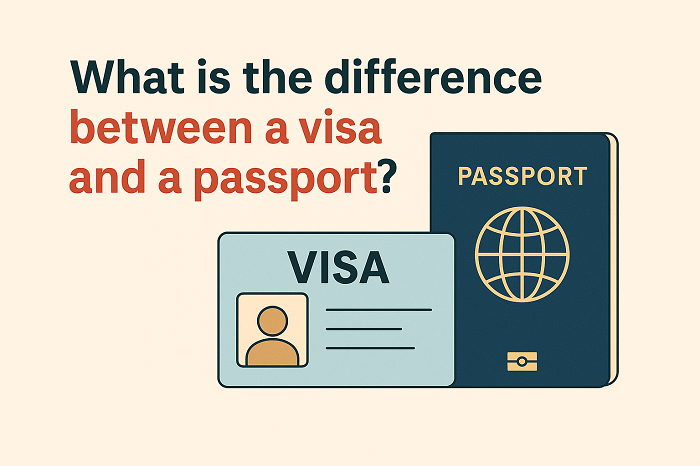
The phrases "passport" and "visa" are commonly used in foreign travel. Even though both are necessary travel papers, many individuals frequently mix them up, especially those traveling for the first time. It is essential to comprehend their unique functions, methods of acquisition, and roles within the international travel system. This article will describe the main distinctions between a passport and a visa, their kinds, application procedures, and the reasons both are necessary for traveling across international boundaries.
What is a Passport?
Definition:
A passport is an official government-issued document that certifies a person's identity and nationality. It allows the holder to travel internationally and requests foreign governments to permit entry and provide protection. A passport typically includes the bearer’s name, photograph, date of birth, signature, and nationality.
Types of Passports-
Countries issue various passports based on the traveler’s purpose and status. The most common types include:
1. Ordinary Passport (Regular Passport)-
- Issued to: General citizens for international travel.
- Color: Usually dark blue, green, or burgundy (varies by country).
- Purpose: Used for tourism, business, education, and personal travel.
2. Diplomatic Passport-
- Issued to: Diplomats, high-ranking government officials, and their families.
- Color: Often black or red.
- Purpose: Grants diplomatic privileges, immunities, and smoother processing through borders.
3. Official Passport (Service Passport)
- Issued to: Government employees traveling abroad on official duties.
- Color: Typically gray, white, or other distinct colors.
- Purpose: Used for official government work but without full diplomatic immunity.
4. Emergency Passport (Temporary Passport)
- Issued to: Citizens who lose their Passport while abroad or in emergencies.
- Purpose: Allows the traveler to return home or continue urgent travel.
5. Collective Passport
- Issued to: Groups such as school tours or sports teams.
- Purpose: Permits a group to travel together, usually for specific short-term trips.
6. Refugee Passport (Travel Document)
- Issued to Refugees and stateless individuals under the 1951 Refugee Convention.
- Purpose: Allows international travel for people without a national passport.
What are the key features of a Passport?
A modern passport has several security and identification elements, including:
- Personal information page- Includes photo, full name, date of birth, passport number, nationality, and signature.
- Machine-Readable Zone (MRZ)- Located at the bottom of the identity page for quick scanning at immigration checkpoints.
- Passport Number- Unique identification number linked to the holder’s record.
- Security Features- Includes holograms, micro-printing, watermarks, UV elements, and biometric chips to prevent forgery.
- Biometric Data (E-Passport)- Stores facial, fingerprint, or iris recognition data for enhanced security.
- Visa Pages- Blank pages for entry/exit stamps and visa endorsements.
What is the purpose of a Passport?
A passport serves several essential purposes:
- Proof of Identity and Nationality- Confirms your identity and legal citizenship.
- International Travel is required to cross international borders, board international flights, and enter foreign countries.
- Visa Applications- These are necessary for obtaining visas and permissions to enter certain countries.
- Consular Assistance- Facilitates support from your home country’s embassy or consulate while abroad in cases of emergencies.
- Immigration Control- Used to monitor entry, exit, and movement of people across countries.
- Record Keeping- Maintains an official record of international travel through stamps and visas.
What is a Visa?
A visa is an official authorization or endorsement placed in a passport that permits a person to enter, stay in, or leave a foreign country for a specified purpose and duration. It is typically issued by the embassy or consulate of the country the traveler wishes to visit. Unlike a passport (an identity document), a visa is permission to enter another country, subject to approval by immigration officers at the border.
Types of Visas-
Visas vary depending on the purpose, duration, and frequency of travel. The main types include-
1. Tourist Visa
- Purpose: Travel for leisure, sightseeing, and vacations.
- Duration: Short-term (usually a few weeks to a few months).
- Example: Schengen Tourist Visa.
2. Business Visa
- Purpose: Attending meetings, conferences, or business-related activities.
- Duration: Short to medium term.
- Example: U.S. B1 Business Visa.
3. Student Visa
- Purpose: To pursue education in a foreign country.
- Duration: Depends on the length of the academic program.
- Example: F1 Visa (USA), Tier 4 Visa (UK).
4. Work Visa (Employment Visa)
- Purpose: To take up employment in a foreign country.
- Duration: Depends on the employment contract.
- Examples are the H-1B Visa (USA) and the Skill Shortage Visa (New Zealand).
5. Transit Visa
- Purpose: Short stopover in a country en route to a final destination.
- Duration: Usually a few hours to a few days.
- Example: Schengen Transit Visa.
6. Spouse/Dependent Visa
- Purpose: Allows spouses, children, or dependents to accompany a primary visa holder.
- Example: Dependent Visa for family members of work or student visa holders.
7. Permanent Resident Visa (Immigrant Visa)
- Purpose: Allows long-term residence or settlement in another country.
- Examples are Green Card (USA) and PR Visa (Canada, Australia).
8. Refugee/Asylum Visa
- Purpose: Granted to individuals seeking protection from persecution or danger in their home country.
9. Working Holiday Visa
- Purpose: Allows young people to travel and work temporarily.
- Example: Australia Working Holiday Visa.
What are the key features of a Visa?
A visa typically contains several important elements:
- Visa type and purpose- Specifies whether it is for tourism, study, work, transit, or residency.
- Validity period- The time frame during which the Visa is valid, indicating when you can enter the country.
- Duration of stay- The maximum number of days, weeks, or months the visa holder can remain in the country per visit.
- Single-entry or multiple-entry-
- Single-entry: Allows entry into the country once.
- Multiple-entry: Allows entering and leaving multiple times within the validity period.
- Visa Number- A unique identification code is assigned to each Visa.
- Issuing Authority- The consulate, embassy, or immigration authority that granted the Visa.
- Conditions and Restrictions- This may limit where you can work, which institutions you can attend, or which regions you can visit.
- Biometric Requirements- Some modern visas require biometric data such as fingerprints or photographs.
What are the purposes of a Visa?
Visas serve several essential roles in international travel and immigration-
- Entry Authorization- Grants legal permission to enter a foreign country.
- Regulate Immigration- Helps countries control the flow of people across borders.
- Security Measure- Allows background checks on travelers for national security purposes.
- Categorize Travelers- Identifies the traveler's purpose (tourist, student, worker, etc.) to apply appropriate rules.
- Stay and Activity Control- Defines what a traveler can do in the country (study, work, visit, etc.) and how long.
- Record Keeping- Maintains international travel history and tracks overstays or visa violations.
Key differences between a Visa and a Passport
|
Feature |
Passport |
Visa |
|
Definition |
Government-issued identification and citizenship proof |
Entry permit for a specific country |
|
Purpose |
Identifies the traveler internationally |
Grants legal permission to enter/stay in another country |
|
Issuing Authority |
Home country government |
Destination country government |
|
Required For |
All international travel |
Specific countries depending on visa policy |
|
Format |
Booklet with personal details and security features |
Stamp, sticker, or electronic authorization |
|
Validity Period |
Typically, 5–10 years |
Ranges from a few days to several years, varies by visa type |
|
Types |
Ordinary, Diplomatic, Official, Temporary |
Tourist, Student, Work, Business, Transit, etc. |
|
Obligation |
Mandatory for international travel |
Required for entry into some countries |
How to obtain a Passport?
Obtaining a passport is a formal process that involves application, identity verification, and sometimes interviews or police verification. The steps may vary slightly by country, but the general process is similar worldwide.
Determine the type of Passport you need-
- Ordinary Passport: For general international travel.
- Diplomatic/Official Passport: For government officials (if applicable).
- Emergency Passport: For urgent situations.
Gather required documents-
Common documents needed to apply for a passport include:
- Proof of citizenship (e.g., birth certificate, national ID card).
- Proof of identity (e.g., driver’s license, voter ID, Aadhaar card in India).
- Recent passport-sized photographs.
- Address proof (utility bills, rental agreements, etc.).
- Previous Passport (if renewing).
- Application form (usually available online or at the passport office).
However, some countries may require additional documents, such as parental consent for minors or police clearance certificates.
Complete the Passport application form-
- Most countries now offer online application services.
- Carefully fill in personal details such as:
- Full name
- Date of birth
- Address
- Occupation
- Travel plans (if applicable)
Pay the application fee-
- Passport fees vary by type, processing speed, and validity (e.g., 5 or 10 years).
- Payments can be made online or at the passport office via cash, card, or bank draft.
Example-
- In India, passport fees typically range from ₹1,500 to ₹3,500 based on the type and urgency.
Book an appointment (If required)-
- Schedule an appointment at the nearest Passport Seva Kendra, passport agency, or regional passport office.
- Walk-in applications may be accepted in some countries, but appointments are usually recommended.
Attend the Passport interview or verification-
- Submit biometric data (fingerprints, photographs).
- Present original documents for verification.
- In some cases, an in-person interview may be conducted.
Police verification (If applicable)-
- In many countries like India, a police background check is required to verify the applicant’s address and identity.
- Police officers may visit your residence as part of this step.
Track application status-
- Use the tracking number provided after submission to monitor the progress of your application online.
Passport issuance and delivery-
- After successful verification, the Passport is processed and dispatched.
- Delivery is typically by post or can be collected in person.
- Processing time varies:
- Normal service: 2 to 6 weeks.
- Tatkal/expedited service: 1 to 7 days (available in some countries).
Verify Passport details-
- Upon receipt, check the Passport for errors such as:
- Spelling of name
- Date of birth
- Photograph
- Report any mistakes immediately to the passport office.
How to obtain a Visa?
A visa is crucial for international travel, work, study, or migration. The exact process can vary depending on the country you are visiting, your nationality, and the type of Visa you are applying for. However, most visa applications follow a similar general procedure.
Determine the type of Visa you need-
The first step is to identify the correct visa category based on your purpose of travel:
- Tourist Visa: For leisure and short-term visits.
- Business Visa: For business-related activities.
- Student Visa: For educational purposes.
- Work Visa: For employment.
- Transit Visa: For passing through a country.
- Permanent Residence or Immigration Visa: For long-term settlement.
Check visa requirements-
Each country has different visa requirements based on the following:
- Your nationality
- Purpose and length of stay
- Type of Visa
- Entry rules (some countries offer visa-free, visa-on-arrival, or e-visa options)
Gather required documents-
Typical visa application documents include:
- A valid passport (usually with at least 6 months validity beyond the intended stay)
- Completed visa application form
- Passport-sized photographs (as per specified size)
- Travel itinerary (flight tickets, hotel reservations)
- Proof of financial means (bank statements, sponsorship letter)
- Travel insurance (sometimes mandatory)
- Invitation letter (if applicable)
- Proof of enrollment (for student visas)
- Employment contract or offer letter (for work visas)
Complete the visa application form-
- Most embassies allow online visa applications.
- Some may still require paper forms.
- Provide accurate personal details and travel plans.
- Pay close attention to every question and follow the instructions carefully.
Pay the visa application fee-
- Visa fees vary depending on the visa type and destination.
- Payment methods may include online payment, cash, or bank drafts.
- Some countries offer priority/express visa processing at an additional cost.
Example-
- Schengen Visa: Approximately €80
- U.S. Tourist Visa (B2): Approximately $185
Book an appointment (If required)-
- Most embassies and visa application centers require a scheduled appointment for:
- Document submission
- Biometrics (fingerprints and photographs)
- Personal interview (if needed)
Attend the visa interview (If required)-
Some visa types require an in-person interview, especially for work, study, or long stays.
- Be honest and clear about your purpose of travel.
- Be prepared to answer questions about:
- Your financial situation
- Your travel plans
- Your ties to your home country (to prove you will return)
Submit biometrics (If required)-
- Many countries now require fingerprinting and digital photographs as part of the visa application process for security reasons.
Wait for visa processing-
- Processing times vary-
- Tourist Visas: A few days to a few weeks
- Work/Study Visas: Several weeks to months
- Permanent Visas: Can take several months to years
- You can often track your application status online.
Receive your Visa-
- If approved, the Visa will either:
- Be stamped or affixed to your Passport.
- Be issued electronically (e-Visa).
Follow visa conditions-
- Adhere to the Visa’s permitted duration of stay, entry limits (single-entry or multiple-entry), and activity restrictions.
- Violating visa conditions may result in penalties, deportation, or bans on future travel.
What is the role of visa-free travel?
Citizens of some nations can visit another nation without a visa in advance, thanks to visa-free traveling. It is usually based on bilateral or multilateral agreements between countries and significantly simplifies international travel for eligible passport holders.
Visa-free travel facilitates easier, faster, and more accessible international movement. Here’s a detailed look at its purpose and benefits-
- Promotes Tourism: Simplifies travel, attracting more international visitors and boosting local economies.
- Facilitates Business Travel: Enables quick, hassle-free trips for meetings and trade without lengthy visa processes.
- Strengthens Diplomatic Relations: Reflects mutual trust and cooperation between countries.
- Reduces Administrative Burden: Lowers paperwork and resource demands on immigration authorities.
- Encourages Cultural Exchange: Increases opportunities for people-to-people interaction and global understanding.
- Boosts Regional Integration: Supports free movement within the EU, ASEAN, and ECOWAS regions.
- Enables Emergency Travel: Allows faster access for urgent humanitarian or personal situations.
- Improves Travel Flexibility: Offers spontaneous and last-minute travel without planning for visas.
- Enhances Tourism Competitiveness: Makes destinations more attractive to travelers seeking easy entry.
- Supports Global Mobility: Promotes international connectivity and accessibility for frequent travelers.
Can someone travel with only their Passport?
The destination determines this-
- Visa-free nations, you need your Passport to enter these nations without a visa.
- Countries requiring a visa- You must have the necessary Visa and a current passport.
Example:
- An Indian citizen traveling to the UK needs a visa.
- An Indian citizen traveling to the Maldives (for up to 90 days) may not require a visa in advance.
What do you mean when you talk about electronic passports and visas?
- E-Visa- An electronic visa is applied online and often linked digitally to your Passport. Physical stamps are no longer necessary.
Example: Australia’s eVisitor visa.
- E-Passport- An e-passport includes an embedded electronic chip that holds the passport holder’s biometric information. It improves security and speeds up border clearance.
What are the common misconceptions about Visa and Passport?
- Passport and Visa are the same- Many think a passport alone grants entry, but a visa is often separately required.
- Visa guarantees entry- A visa permits travel to a border, but entry is granted at the discretion of immigration officers.
- All visas are the same- Visas differ by purpose (tourism, study, work), and each has specific rules and restrictions.
- Visa-free means no rules- Visa-free entry still has conditions like stay duration and activity limitations.
- Visa is always a sticker. Some visas are electronic (e-Visa) and are not physically attached to the Passport.
- One Passport is enough for all countries- Some countries still require a visa even if you have a passport.
- The visa process is always long- Some countries offer quick visa-on-arrival or e-visa options.
- Passport expiration affects visa validity- If your Passport expires, even a valid visa may become void, as most visas are linked to the passport number.
Practical Example: Student Scenario
Suppose you are an Indian student planning to study in Germany.
- Passport Requirement: Apply for and hold a valid Indian passport.
- Visa Requirement: Apply for a German student visa. Submit university admission letters, financial proofs, and other documents.
You cannot travel with just the admission letter and Passport; you need the appropriate student visa.
Conclusion-
In summary, a passport is your internationally recognized proof of identity and citizenship issued by your home country. At the same time, a visa is a permit granted by the country you wish to enter, allowing you to stay for a specific purpose and duration. Understanding the difference between these two documents is essential for anyone planning to travel abroad, whether for tourism, study, work, or migration. Your Passport opens the door to international travel, but the Visa often determines whether you can step inside another country’s borders. Always remember that you need a passport to travel abroad and may also need a visa, depending on your destination country. Both documents must be valid and properly applied to ensure a smooth travel experience. By staying informed and carefully following the Passport and visa application processes, you can confidently meet international travel requirements and enjoy a hassle-free journey.
FAQs on the Difference Between a Visa and a Passport
Q.1 What is the primary difference between a visa and a passport?
Ans- A visa is a license granted by the nation you intend to visit, enabling admission for a certain purpose and period. In contrast, a passport is an identification card provided by the country you are visiting for traveling abroad.
Q.2 Do you need a passport and a visa to travel abroad?
Ans- Yes, most international trips require a valid passport; depending on the destination, you may also need a visa.
Q.3 Is a visa sufficient for overseas travel?
Ans- In the absence of a passport, a visa is not valid.
Q.4 Is a passport enough to enter all countries?
Ans- No, while your Passport allows you to travel, many countries require you to obtain a visa before entry.
Q.5 Who issues a passport?
Ans- A passport is issued by your home country's government or authorized passport agency.
Q.6 Who issues a visa?
Ans- A visa is issued by the embassy, consulate, or immigration authority of the country you wish to visit.
Q.7 Does a visa guarantee entry into a country?
Ans- No, a visa permits travel to the border, but final entry is approved or denied by immigration officers upon arrival.
Q.8 Can a passport be used for multiple countries?
Ans- A passport is a global travel document, but each country may have different visa requirements.
Q.9 Is a visa always a physical stamp in the Passport?
Ans- Some visas are electronic (e-Visas) and are linked digitally to your passport number.
Q.10 Can a person hold multiple visas at the same time?
Ans- Yes, depending on the passport and destination rules, you can simultaneously hold valid visas for different countries.
Author
Sakshi Taneja
Content Writer & International Education Specialist
Sakshi Taneja is a content writer specializing in international education, study abroad opportunities, university admissions, student visas, scholarships, and career guidance. She creates accurate, research-driven, and student-focused content to help aspiring international students make informed decisions about their global education journey.
Comments (0)
No comments yet
Be the first to share your thoughts!
Contact Details
Please provide your contact information
Free Counselling
Similar Blogs

Top 10 Universities in Germany
9/21/2026

How to become a great Communicator?
2/26/2026

Preparing for TOEFL Speaking Scoring section: Key Skills and Practice Techniques
11/3/2025
Educational loan for study abroad: Everyone Should Know in 2026
11/3/2025
Form I-20 Explained: Start Your U.S. Study Journey with Confidence
10/27/2025
Have a question about GMAT?
Want some help figuring out what kind of prep service is right for you?
Help and Support
Leave a Comment
Your email address will not be published.