
Computer and Paper: Which format is better for IELTS Reading?
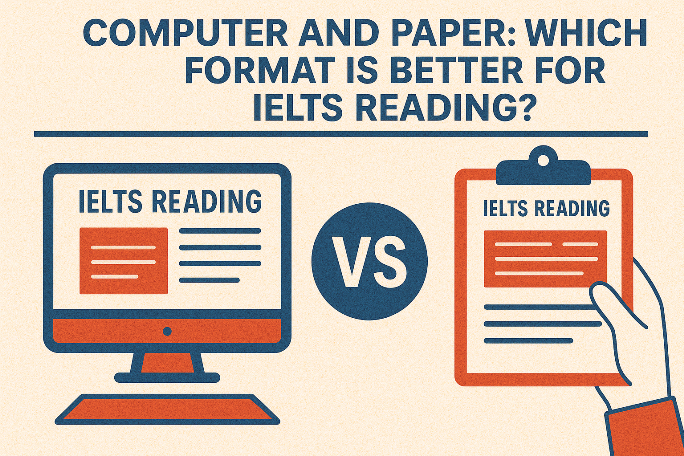
There are two ways that applicants can take the IELTS Reading test: on paper or on a computer. Every format has certain benefits and possible disadvantages that could affect how well you perform overall. This article helps you choose the best format for you by examining the main distinctions between the two choices.
IELTS on a Computer
Participants will use a computer to complete the Reading, Listening, and Writing portions of the computer-based IELTS Test. Examiners from IELTS administer the Speaking examination in person. Both the paper and computer-based versions of the test are finished on the same day. You can finish the Speaking portion up to a week before or after the other tests.
- More focus is possible in smaller spaces.
- It takes five to seven days to see results.
- You can see the word count on the screen.
- During the listening portion, each student receives a pair of headphones.
- When participants have five or ten minutes left for the writing and reading assessments, accordingly, the timer that is displayed on the monitor turns red.
- No issue with the quality of the handwriting.
- The screen displays the edit option.
- There is a navigation bar that monitors answers they have missed and displays progress at the bottom.
- Pupils can plan their time and move forward or backward as they choose.
- There is no need for them to continuously save or hit Enter because their responses will be securely stored.
- Students can change any response at any moment without any problems.
IELTS on Paper-
Students taking the paper-based IELTS test must complete the Reading, Listening, and Writing portions of the test. In this instance, speaking exams will be administered in person by qualified IELTS examiners.
- A lot of learners will value writing and drawing skills in the Writing area.
- Prior to putting the words on the response sheet, learners can swiftly circle, highlight, and practice them.
- The test is administered on paper; therefore, no fundamental knowledge of computers is needed.
- Students' performance will not be slowed down by having to enter their answers.
- At the conclusion of the listening portion, applicants will have an additional ten minutes to complete their responses to the response sheets.
IELTS on computer vs IELTS on paper: Highlights
|
|
IELTS on Computer |
IELTS on Paper |
|
Delivery format |
Complete the test parts using a computer and the Speaking test face-to-face with an IELTS examiner |
Complete the test parts on paper and the Speaking part face-to-face with an IELTS examiner |
|
Results |
Results will be available 2 days after taking your test |
Results will be available 13 days after taking your test |
|
Apply |
Apply for the test through the computer icon. |
Apply for the test through the paper icon. |
|
Test availability |
Testing up to 7 days a week and 3 times a day |
Testing up to 7 days a week and 3 times a day |
Core distinctions between IELTS on Computer and IELTS on Paper-
There are two options available for taking the IELTS exam: computer-based and paper-based. The structure and pace of each format vary, which may impact how you perceive the test.
· Order for Tests
The components are arranged differently on the paper-based IELTS. The writing portion comes first, followed by the reading portion and the listening portion. Your Spoken test may occasionally be planned immediately following these portions, but in some testing locations, it may be on a separate day. Conversely, the computer-based IELTS starts with the Listening portion, then moves on to Reading, and finally, Writing. The Speaking examination is administered before or following your computer exam on the same day.
· Duration of the Listening Test
There is also a significant variation in the listening test. If you have previously taken the paper-based test, you may recall that you listened to the tape and entered your responses in the question booklet. You have ten minutes to transfer your responses to an answer sheet following the listening portion. On the other hand, you enter your responses straight into the appropriate fields on the screen when taking the computer-based test. Although you have a few minutes to go over your responses throughout the parts, there is no more time at the completion for copying answers because you finished them as you proceeded.
|
Aspect |
IELTS on Computer |
IELTS on Paper |
|
Test Format |
The test is taken on a computer with headphones and a microphone. |
Test taken using a black ball pen and paper. |
|
Listening Test |
Multiple-choice questions are answered on the computer. |
Multiple-choice questions are answered on the answer sheet provided. |
|
Reading Test |
Texts and questions are displayed on the computer screen. |
Texts and questions are presented in a booklet. |
|
Writing Test |
Typed on the computer using a keypad. |
Handwritten on paper using a pen or Black ball pen. |
|
Speaking Test |
Conducted face-to-face with a certified examiner. |
Conducted face-to-face with a certified examiner. |
|
Result Delivery |
Results are available within 2 days |
Results delivered within 7 days. |
|
Score Reporting |
Scores are reported as whole or half bands. |
Scores are reported as whole or half bands. |
What is the best method for me to take the test?
It frequently boils down to personal preference whether to take the computer-based or paper-based IELTS exam. Because the computer version of IELTS is offered several times a day, it provides more schedule flexibility and speedier results, usually in 2 to 5 days. The ability to cut, copy, and paste text makes it easier to amend written comments. However, it calls for proficient typing abilities and could be annoying because of other test-takers typing sounds.
However, for those who prefer more conventional writing techniques, IELTS on paper offers a comfortable setting. When writing by hand instead of typing on a screen, many applicants find it simpler to focus. Additionally, the paper format gives you additional time to go over your responses following the listening portion. There isn't a simple solution to this issue, though, because everyone is unique. However, there are a few factors to take into account before deciding between the computer and paper versions of the IELTS.
· Knowledge of computers
IELTS on paper may be something to think about if you are used to writing by hand or if you are more comfortable reading larger materials on paper rather than a screen. If you have never typed your answers on a keyboard before, it could make you more anxious on exam day and lead to mistakes you could have avoided.
· Unclear handwriting
If you choose to take the IELTS on paper, you will need to ensure that your handwriting is readable and clear. The examiner's ability to figure out your handwriting is crucial. It will affect your band score if the examiner is unable to understand what you have written. Therefore, the computerized version of the IELTS may be a better option for you if your handwriting is hard to read.
· Concentration abilities
The majority of IELTS paper testing sessions are held in a large room with numerous other participants in the test. The computer version of the IELTS might be a better option if you find this distracting. There are limited applicants, and the IELTS computer version is administered in a smaller setting. The fact that you receive headphones for the test's listening portion is an additional benefit. To lessen the effect of extraneous noises, you could just wear these throughout the entire assessment.
Your tastes and level of familiarity with every form will eventually decide whether the computer-based or paper-based IELTS Reading test is preferable for you. Focusing on studying and rehearsing with the structure you feel easiest can help you perform at your best because both alternatives offer the same evaluation. To guarantee excellence on exam day, spend some time practicing in both forms, if at all possible, and select the one that best suits your skills.
Q.1 Can you pick between the computer-based and paper-based versions of the IELTS?
Ans- Yes, you might be able to select the format that works best for you based on the testing facility. You should confirm ahead of time, though, as not all centers provide both choices.
Q.2 Does the reading test include the same information in both formats?
Ans- Indeed, the IELTS Reading test's content is the same for both computer-based and paper-based modes. The media used to conduct the test is the only distinction.
Q.3 Is there a time benefit to the computer-based format?
Ans- The test lasts the same amount of time in both formats. On the other hand, some people feel that using a computer to navigate questions more effectively might save time, particularly when going over responses.
Q.4. How should you proceed if you are not accustomed to typing on a computer?
Ans- It would be best to take the test on paper if you have trouble typing. To assist you in getting comfortable with the computer-based form preceding the test, you can practice typing quickly and precisely.
Q.5 What is the most often used format?
Ans- Although the computer-based IELTS is becoming more and more popular in many testing facilities across the world, the paper-based format has historically been more prevalent. The availability of exam centers and individual preferences frequently determine which option is best.
Author
Sakshi Taneja
Content Writer & International Education Specialist
Sakshi Taneja is a content writer specializing in international education, study abroad opportunities, university admissions, student visas, scholarships, and career guidance. She creates accurate, research-driven, and student-focused content to help aspiring international students make informed decisions about their global education journey.
Comments (0)
No comments yet
Be the first to share your thoughts!
Contact Details
Please provide your contact information
Free Counselling
Similar Blogs

Top 10 Universities in Germany
9/21/2026

How to become a great Communicator?
2/26/2026

Preparing for TOEFL Speaking Scoring section: Key Skills and Practice Techniques
11/3/2025

Educational loan for study abroad: Everyone Should Know in 2026
11/3/2025
Form I-20 Explained: Start Your U.S. Study Journey with Confidence
10/27/2025
Have a question about GMAT?
Want some help figuring out what kind of prep service is right for you?
Help and Support
Leave a Comment
Your email address will not be published.